Michael Marder and Giovanbattista Tusa (eds.), Contemporanea: A Glossary for the Twenty-First Century – MIT Press, March 2024

Michael Marder and Giovanbattista Tusa (eds.), Contemporanea: A Glossary for the Twenty-First Century – MIT Press, March 2024

A groundbreaking, multidisciplinary collection that rethinks our present moment and anticipates the key concepts that will shape and direct the twenty-first century.

Contemporanea is a nascent lexicon for the twenty-first century edited by seasoned philosophers and authors Michael Marder and Giovanbattista Tusa. The collection showcases perspectives from a range of noteworthy thinkers in philosophy, ecology, and cultural studies, as well as artists, from across the globe, including Slavoj Zizek, Timothy Morton, Denise Ferreira Da Silva, and Vandana Shiva, who each describe what they anticipate will be the concepts shaping the trajectory of this century—everything from the world state to the nuclear taboo, automation to Teslaism, plant sexuality to arachnomancy, and ecotrauma to resonances, to name a few.

This century, as the editors explain, has to date grounded itself in the debris of the preceding century, whose revolutions and struggles failed to transform our time: post-colonialism, post-fascism, and post-liberalism have morphed into neocolonialism, neoliberalism, and neofascism, often combined in a previously unimaginable mix. And, just as the political developments at the beginning of the twenty-first century revived and reshuffled those of the preceding epoch, so too have philosophical trends sought to breathe fresh life into the stillborn -isms of the past—realism, vitalism, logicism, materialism, empiricism, criticism—adding the adjective “new” and sometimes “radical” before them. To articulate a different future, another language is needed. And, to develop another language, one needs to develop fresh concepts, including the concepts proposed in this collection.

Contributors
Mieke Bal, Claudia Baracchi, Amanda Boetzkes, Erik Bordeleau, Anita Chari, Emanuele Coccia, Valentina Desideri, Roberto Esposito, Filipe Ferreira, Denise Ferreira da Silva, Claire Fontaine, Graham Harman, Yogi Hale Hendlin, Ranjit Hoskote, Cymene Howe, Daniel Innerarity, Joela Jacobs, Ken Kawashima, Sabu Kohso, Bogna Konior, Brandon LaBelle, Anna Longo, Artemy Magun, Michael Marder, Michael Marder, Jason Bahbak Mohaghegh, Timothy Morton, Mycelium, Jean-Luc Nancy, Bahar Noorizadeh, Kelly Oliver, Uriel Orlow, Richard Polt, Marcia Sá Cavalcante Schuback, Tomás Saraceno, Vandana Shiva, Anton Tarasyuk, Anaïs Tondeur, Giovanbattista Tusa, Sjoerd van Tuinen, Santiago Zabala, Zahi Zalloua, Slavoj Žižek

Posted in Graham Harman, Jean-Luc Nancy, Roberto Esposito, Slavoj Zizek, Timothy Morton | Leave a comment

Elias J. Palti, Intellectual History and the Problem of Conceptual Change, Cambridge University Press, May 2024

Elias J. Palti, Intellectual History and the Problem of Conceptual Change, Cambridge University Press, May 2024

How does long-term intellectual change occur? Can we develop a theoretical framework for understanding past systems of knowledge? In this ambitious study, Elías José Palti seeks to reassess the main concepts in the field of intellectual history. Evaluating modes of thought from the seventeenth century to the present, this book aims to prevent an anachronistic understanding of the texts of the past. Palti rejects the idea of conceptual change as a coherent process deriving from one single source. Instead, he offers a convincing explanation of converging developments emanating from three different sources: namely, the Cambridge school, the German school of conceptual history, or Begriffsgeschichte, and French politico-conceptual history. Intellectual History and the Problem of Conceptual Change also closely examines the temporality of concepts, questioning how and why political languages mutate.

Posted in Uncategorized | 1 Comment

Dimitris Vardoulakis, The Ruse of Techne: Heidegger’s Magical Materialism – Fordham University Press, September 2024

Dimitris Vardoulakis, The Ruse of Techne: Heidegger’s Magical Materialism – Fordham University Press, September 2024

The Ruse of Techne offers a reappraisal of Heidegger’s entire work by focusing on the forms of activity he regards as separate from instrumentality. Non-instrumental activities like authenticity, poetry, and thinking—in short, the ineffectual—are critical for Heidegger as they offer the only path to the truth of being throughout his work.

By unearthing the source of the conception of non-instrumental action in Heidegger’s reading of Aristotle, Vardoulakis elaborates how it forms part of Heidegger’s response to an old problem, namely, how to account for difference after positing a single and unified being that is not amenable to change. He further demonstrates that an action without ends and effects leads to an ethics and politics rife with difficulties and contradictions that only become starker when compared to other responses to the same problem that we find in the philosophical tradition and which rely on instrumentality.

Heidegger’s conception of an action without ends or effect forgets the role of instrumentality in the tradition that posits a single, unified being. And yet, the ineffectual has had a profound influence in how continental philosophy determines the ethical and the political since World War II. The critique of the ineffectual in Heidegger is thus effectively a critique of the conception of praxis in continental philosophy. Vardoulakis proposes that it is urgent to undo the forgetting of instrumentality if we are to conceive of a democratic politics and an ethics fit to respond to the challenges of high capitalism.

Posted in Uncategorized | Leave a comment

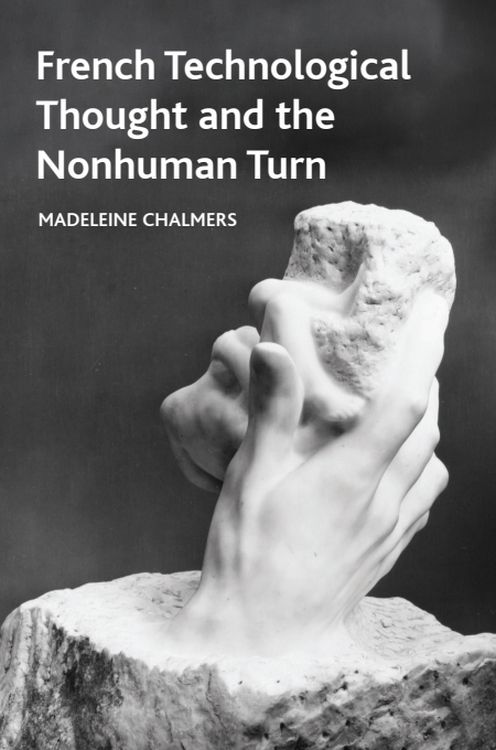
Madeleine Chalmers, French Technological Thought and the Nonhuman Turn – Edinburgh University Press, December 2024

Madeleine Chalmers, French Technological Thought and the Nonhuman Turn – Edinburgh University Press, December 2024

Update October 2025: New Books discussion with Gina Stamm.

Uncovers the nonhuman turn’s unexpected roots in the avant-gardes and mysticisms of nineteenth-century France

  • Builds a new genealogy which highlights the unacknowledged expression of Catholic mysticism and avant-garde French literature in the nonhuman turn
  • Brings into play both canonical and non-canonical authors, from Symbolism to Surrealism and beyond
  • Mines unexplored elements of major thinkers, including Gilbert Simondon and Gilles Deleuze
  • Tackles the porous boundaries between literature, philosophy, science, politics, and theology in French thought

French Technological Thought and the Nonhuman Turn traces a genealogy of thinking and writing about technology, which takes us from the French avant-gardes to the contemporary ‘nonhuman turn’ in Anglo-American theory via the Surrealists, Gilbert Simondon, and Gilles Deleuze. 

Tracking the unruly transition from Catholic vocabularies of grace, potentiality, and actuality to the modern and contemporary secular lexicon of agency, virtuality, and affect, this book explores technology as a source of subject matter and conceptual metaphors, but also probes how ideas and words are modes of technicity through which we shape and reshape the world. Fusing literature, philosophy, and theology, it offers readers new contexts – and questions – for the egalitarian ontological commitments of contemporary post- and nonhuman thinking.

Posted in Uncategorized | Leave a comment

Georges Bataille, Critical Essays Volume 2: 1949-51 – ed. Benjamin Noys and Alberto Toscano, trans. Chris Turner – Seagull, December 2024

Georges Bataille, Critical Essays Volume 2: 1949-51 – ed. Benjamin Noys and Alberto Toscano, trans. Chris Turner – Seagull, December 2024

An introduction for English-language readers to Georges Bataille’s postwar philosophical and critical writings.

In the aftermath of World War II, French thinker and writer Georges Bataille forged a singular path through the moral and political impasses of his age. In 1946, animated by “a need to live events in an increasingly conscious way,” and to reject any compartmentalization of intellectual life, Bataille founded the journal Critique. Continuing the publication of his postwar writings, this second book in a three-volume collection of Bataille’s work collects his essays and reviews from the years 1949 to 1951.

In this period of intellectual isolation and intense reflection, Bataille developed and refined his genealogy of morality through a sustained reflection on the fate of the sacred in the modern world. He offered a critique of the limits of existing morality, especially in its denial of excess, while sketching the lineaments of a new hyper-morality. Bataille’s wide-ranging reflections are true to the intellectual mission of Critique, which he founded as a space open to the broadest considerations of the present. As well as discussing significant figures like Samuel Beckett, André Gide, and René Char, Bataille also offers fascinating reflections on American politics, Nazism, existentialism, materialism, and play.

The connecting thread in these diverse essays remains Bataille’s concern with the extremes of human experience and the possibilities of transcending the limits of societies founded on utility and restraint. His writings remain a provocative incitement to rethink the boundaries we impose on expression and existence.

I’ll update my bibliography of Bataille’s work and translations when I have a copy, but it looks like it will translate the first half of Oeuvres complètes Vol XII.

Posted in Georges Bataille | Leave a comment

‘Homage to the Hommage à Jean Hyppolite’ – Philosophy, Politics and Critique Vol 1 No 3 theme section

Homage to the Hommage à Jean Hyppolite’ – Philosophy, Politics and Critique Vol 1 No 3 theme section

Introduction and three essays – all require subscription, unfortunately:

Joe Hughes, Introduction

Christopher O’Neill, Error, Truth and Anxiety against Death: Reading Georges Canguilhem’s ‘On Science and Counter-Science’

Lachlan Wells, François Dagognet on Jean Hyppolite and the ‘Epistemology of Information’

Alice Nilsson, Dialectics, Mathematics and the Cavaillès-Hyppolite Encounter

Posted in Georges Canguilhem, Jean Hyppolite | Leave a comment

Nick Couldry, The Space of the World: Can Human Solidarity Survive Social Media and What If It Can’t? – Polity, October 2024

Nick Couldry, The Space of the World: Can Human Solidarity Survive Social Media and What If It Can’t? – Polity, October 2024

update: thanks to dmf for a link to a Cultural Studies podcast discussion of the book

Over the past thirty years, humanity has made a huge mistake. We handed over to big tech decisions that have allowed them to build what has become our “space of the world” – the highly artificial space of social media platforms where much of our social life now unfolds. This has proved reckless and has huge social consequences.

The toxic effects on social life, young people’s mental health, and political solidarity are well known, but the key factor underlying all this has been missed: the fact that humanity allowed business to construct our space of the world at all and then exploit it for profit. In the process, we ignored two millennia of political thought about the conditions under which a healthy or even a non-violent politics is possible. We endangered the one resource that is in desperately short supply in the face of catastrophic climate change: solidarity. Is human solidarity possible in a world of continuous digital connection and commercially managed platforms, and what if it isn’t?

In the first book of his trilogy, Humanising the Future, Nick Couldry offers a radical new vision of how to design our digital spaces so that they build, rather than erode, both solidarity and community. This trenchant and vividly written book stresses that we cannot afford not to care for our space of the world. We need to rebuild it together.

Posted in Uncategorized | 1 Comment

CFP: Foucault Studies special issue – Critique beyond criticism: Crisis and potentials of critique in critical times

Posted in Uncategorized | Leave a comment

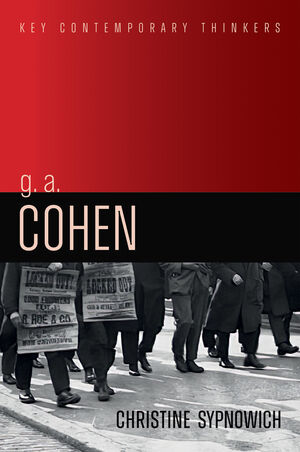
Christine Sypnowich, G. A. Cohen: Liberty, Justice and Equality – Polity, July 2024

Christine Sypnowich, G. A. Cohen: Liberty, Justice and Equality – Polity, July 2024

Part of the Key Contemporary Thinkers series

G. A. Cohen was one of the towering political philosophers of the late twentieth and early twenty-first centuries. His intellectual career was unusually wide-ranging, and he was celebrated internationally not only for his penetrating ideas about liberty, justice and equality, but also for his method, a highly original and influential combination of analytical philosophy and Marxism.

Christine Sypnowich guides readers through the rich body of Cohen’s work. By identifying five paradoxes in his thought, she explores the origins of his interest in analytical philosophy, his engagement with the ideas of right-wing libertarianism, his critique of John Rawls’s work, his late-career turn to conservatism, and the tension between his preoccupation with individual responsibility and the idea of a socialist ethos. Sypnowich acknowledges the strengths of Cohen’s positions as well as their tensions and flaws, and presents him as a thinker of startling insight.

This compelling introduction is a go-to resource for students and scholars of modern political philosophy.

Posted in Uncategorized | Leave a comment

Theory, Culture & Society special issue ‘Thinking with Latour’ – three papers open access

Theory, Culture & Society special issue ‘Thinking with Latour‘ – three papers open access.

Update: Thanks to dmf and others for the link to Steven Shapin’s piece at Journal of the History of Ideas blog

Posted in Bruno Latour, Theory, Culture and Society, Uncategorized | 1 Comment