Matthew Watson, False Prophets of Economics Imperialism: The Limits of Mathematical Market Models – Agenda, November 2024

Matthew Watson, False Prophets of Economics Imperialism: The Limits of Mathematical Market Models – Agenda, November 2024
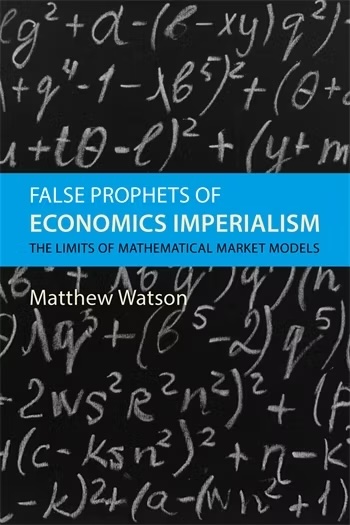
This book studies the methodological revolution that has resulted in economists’ mathematical market models being exported across the social sciences. The ensuing process of economics imperialism has struck fear into subject specialists worried that their disciplinary knowledge will subsequently count for less. Yet even though mathematical market models facilitate important abstract thought experiments, they are no substitute for carefully contextualised empirical investigations of real social phenomena. The two exist on completely different ontological planes, producing very different types of explanation.

In this deeply researched and wide-ranging intellectual history, Matthew Watson surveys the evolution of modern economics and its modelling methodology. With its origins in Jevons and Robbins and its culmination in Samuelson, Arrow and Debreu, he charts the escape from reality that has allowed economists’ hypothetical mathematical models to speak to increasingly self-referential mathematical truths. These are shown to perform badly as social truths, consequently imposing strict epistemic limits on economics imperialism.

The book is a formidable analysis of the epistemic limitations of modern-day economics and marks a significant counter to its methodology’s encroachment across the wider social sciences.
Posted in Uncategorized | Leave a comment

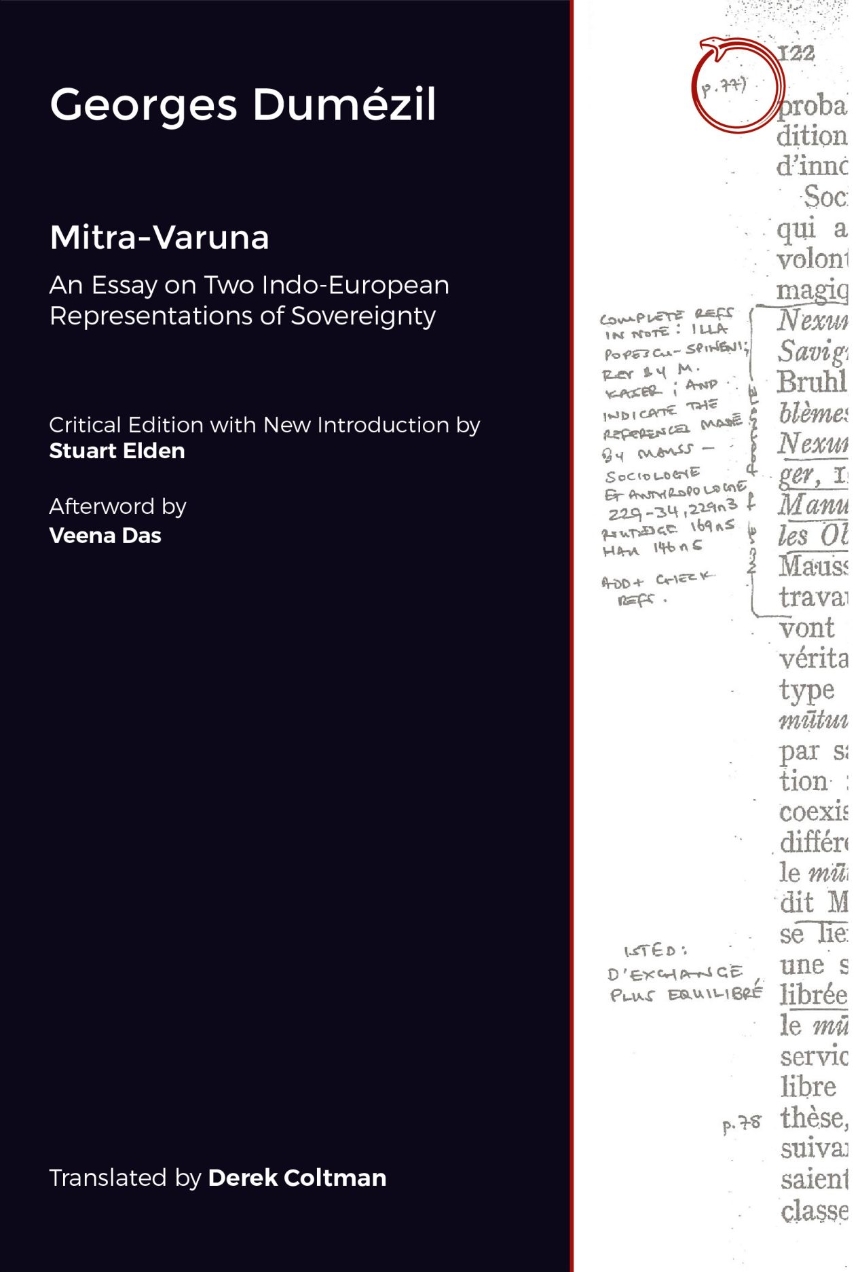
Georges Dumézil, Mitra-Varuna: An Essay on Two Indo-European Representations of Sovereignty, translated by Derek Coltman, edited by Stuart Elden, afterword by Veena Das – HAU books, December 2024

Georges Dumézil, Mitra-Varuna: An Essay on Two Indo-European Representations of Sovereignty, translated by Derek Coltman, edited by Stuart Elden, afterword by Veena Das – HAU books, December 2024

The book is now available for sale, in print or e-book via University of Chicago Press. HAU will make an open-access e-book available when they sell 200 copies. This is to recoup the costs of buying the rights to the translation (not to pay me as editor). If you’re in a position to buy the book or recommend to a library please do. The Introduction and Afterword are open access now.

The edition uses the existing translation by Derek Coltman, long out of print, and has a new critical apparatus and Introduction by me. There is a discussion of the editing work here. This is part of the work of my Mapping Indo-European thought in twentieth-century France research project, funded by the Leverhulme Trust.

A classic text that develops one prong of Dumézil’s tripartite hypothesis of Indo-European tribes: the sacred sovereign.
 
Georges Dumézil’s fascination with the myths and histories of India, Rome, Scandinavia, and the Celts yielded an idea that became his most influential scholarly legacy: the tripartite hypothesis, which divides Indo-European societal functions into three classes: the sacred sovereign, the warrior, and the producer. Mitra-Varuna, originally published in 1940, concentrates on the first function, that of sovereignty. Dumézil identifies two types of rulers, the first judicial and worldly, the second divine and supernatural. These figures, both priestly, are oppositional but complementary. The title nods to these roles, referring to the gods Mitra, a rational mediator, and Varuna, an awesome religious figure. 
 
Stuart Elden’s critical edition, based on the 1988 English translation by Derek Coltman, identifies variations between the first and second French editions and completes—and in places corrects—Dumézil’s references. The editor’s detailed introduction situates Mitra-Varuna within Dumézil’s career, outlines how his treatment of its themes developed over time, and relates the book to the political controversy around his ideas. Two new appendices contain passages that did not appear in the second French edition.

Posted in Georges Dumézil, Mapping Indo-European Thought in Twentieth Century France | 1 Comment

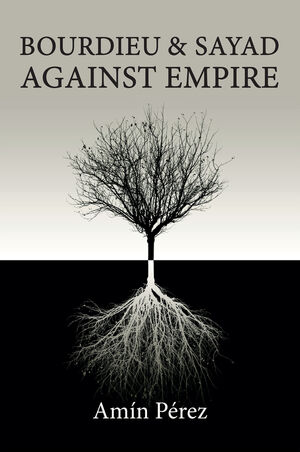
Amín Pérez, Bourdieu and Sayad Against Empire: Forging Sociology in Anticolonial Struggle – Polity Press, December 2023 and New Books Discussion

Amín Pérez, Bourdieu and Sayad Against Empire: Forging Sociology in Anticolonial Struggle – Polity Press, December 2023

New Books Discussion with Dave O’Brien – thanks to dmf for the link

Pierre Bourdieu and Abdelmalek Sayad met in their twenties in the midst of the Algerian war of independence. From their first meeting, a strong intellectual friendship was born between the French philosopher and the activist from the colony, nourished by the same desire to understand the world in order to change it.

The work of both men was driven by the necessity of putting knowledge to use, whether by unveiling the relations of domination that structured life in Algeria or by opening emancipatory perspectives for the Algerian people. Colonies were, of course, a customary site of ethnographic work, but Bourdieu and Sayad refused to sacrifice scientific rigor to political expediency, even as Algeria descended deeper into war. Indeed, the act of understanding as a political commitment to the transformation of society lay at the heart of their project.

Based on extensive interviews and deep archival work, Amín Pérez rediscovers the anticolonial origins of the pathbreaking social thought of these brilliant thinkers. Bourdieu and Sayad, he argues, forged another way of doing politics, laying the foundations of a revolutionary pedagogy, not just for anticolonial liberation but for true social emancipation.​

Posted in Pierre Bourdieu, Uncategorized | Leave a comment

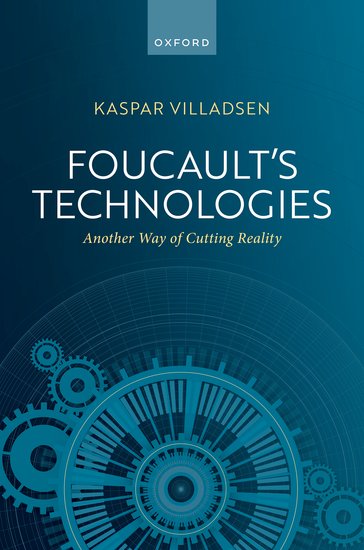
Kaspar Villadsen, Foucault’s Technologies – Oxford University Press, November 2024

Kaspar Villadsen, Foucault’s Technologies – Oxford University Press, November 2024

Shame about the prohibitive price…

Michel Foucault is rarely viewed as a philosopher of technology, yet academics and students routinely refer to his terms ‘technologies of power’, ‘governmental technologies’, and ‘technologies of the self’. This book is a response to the contradiction between the paucity of research into Foucault’s technological thought and the abundancy of technological vocabulary and metaphors in his own writings as well as in the commentary literature; it provides the most extensive examination of the role of technology in Foucault’s work so far. 

Villadsen argues that technology serves neither as an object of Foucault’s analysis nor as a convenient metaphor for making arguments, but as rather integral to his thinking and writing. As the book’s title, Foucault’s Technologies indicates, it explores not Foucault and modern technology understood as technical devices like television, smartphones, or industrial machines, but rather Foucault’s approach to the theme of technology and his use of technological terms. The book provides an extensive exploration of Foucault’s technological thought, arguing that he offers a distinct framework that confronts commonsensical understanding and other scientific approaches to technology. The reader will travel a route paved with discussions of how Foucault’s work intersects with that of other key thinkers, particularly Heidegger, Althusser, Nietzsche, and Deleuze. 

While presenting efforts in intellectual history, the book ultimately focusses on the analytical implications for ‘users’, showing how researchers can benefit from Foucault’s technological approach. As such, the book offers an analytical framework effective for the study of problems in present-day welfare states and the emergent world of data-capitalism.

Posted in Michel Foucault | 1 Comment

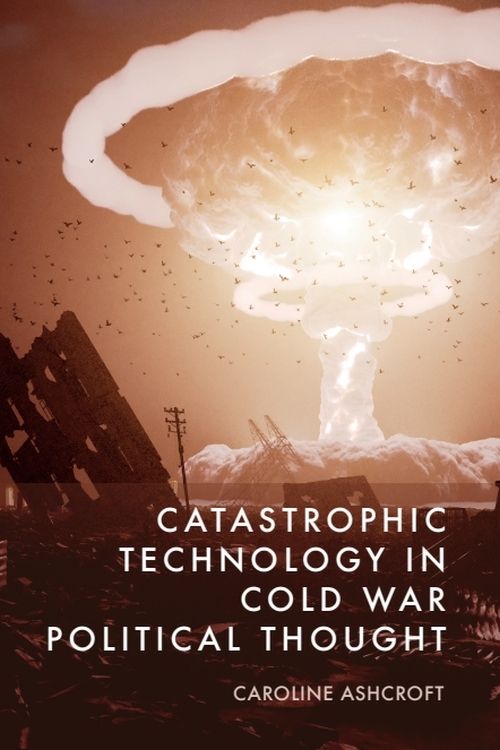
Caroline Ashcroft, Catastrophic Technology in Cold War Political Thought – Edinburgh University Press, November 2024

Caroline Ashcroft, Catastrophic Technology in Cold War Political Thought – Edinburgh University Press, November 2024

Explores a Cold War concept of technology as a catastrophic influence on modern politics

  • Explores the intellectual history of a ‘catastrophic’ concept of technology in the work of some of the twentieth century’s most important political thinkers
  • Reveals the centrality of this narrative in the work of what is otherwise generally considered to be an ideologically and philosophically diverse group of theorists
  • Contextualises this concept of technology in the Cold War period to reveal the fundamentally political character of the critique as a rejection of liberalism
  • Studies both ‘technology’ as an overarching concept as well as particular realisations of technology in these theorists’ work: technologies of war, production, media and biotechnology
  • Reveals the way in which this concept of technology produces a specific critique of the relationship between humans, world and nature in modernity, which brings the critics of technology into discourse with early environmentalism

In the mid-twentieth century, a certain idea of technology emerged in the work of many influential political theorists: a critical, catastrophic concept of technology, entangled with the apocalyptic fears fuelled by two all-consuming world wars and the looming nuclear threat. Drawing on the work of theorists such as Hannah Arendt, Jacques Ellul, Martin Heidegger and Herbert Marcuse, Catastrophic Technology in Cold War Political Thoughtexplores the critical idea of technology as both a response to a dramatically changing world, and a radical political critique of Cold War liberalism.

Posted in Uncategorized | 1 Comment

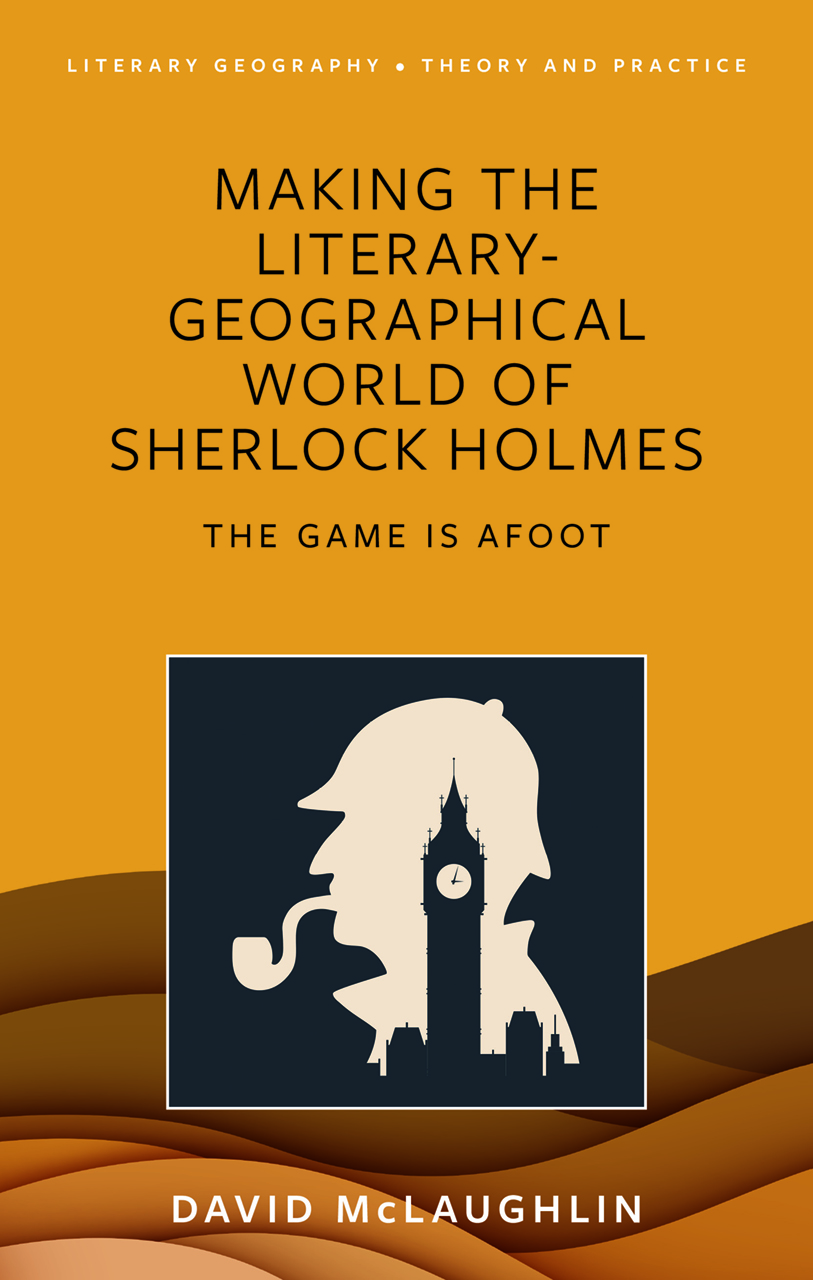
David McLaughlin, Making the literary-geographical word of Sherlock Holmes: The game is afoot – University of Wales Press, October 2024

David McLaughlin, Making the literary-geographical word of Sherlock Holmes: The game is afoot – University of Wales Press, October 2024

In the second half of the twentieth century, American readers of Arthur Conan Doyle’s Sherlock Holmes stories – known as Sherlockians – worked together to create a ‘world of Sherlock Holmes’ that crossed the boundary between reality and fiction. This book applies an innovative literary-geographical lens, informed both by geographical theories of spatiality as a process and literary scholarship readers’ active roles in making stories happen, to define the contours of a world in which the ontological boundary ordinarily assumed between the actual and the fictional bend, blur and break. Drawing extensively on the University of Minnesota’s Sherlock Holmes Collections, the world’s largest archive of Sherlockiana, this book aims to shine light on Sherlockian activities in the mid- to late-twentieth century. This is a relatively understudied but creatively rich period, in which the imaginative foundations of the fandom as we know it were laid. In these years, the world of Sherlock Holmes was collectively created by readers through a variety of textual and embodied practices: writing, mapping, playing and walking.

‘This engaging study explores some of the key ideas currently animating literary-geographical work. Taking Arthur Conan Doyle’s texts to be spatial events, McLaughlin carefully traces the collective, playful unfoldings of relations and meanings created by readers, leaving traces of the Sherlockian world scattered a long way from Baker Street.’

James Kneale, Associate Professor in Geography, University College of London

Posted in Uncategorized | Leave a comment

Thomas Piketty and Michael J. Sandel, Equality: What it Means and Why it Matters – Polity, January 2025

Thomas Piketty and Michael J. Sandel, Equality: What it Means and Why it Matters – Polity, January 2025

In this compelling dialogue, two of the world’s most influential thinkers reflect on the value of equality and debate what citizens and governments should do to narrow the gaps that separate us. Ranging across economics, philosophy, history, and current affairs, Thomas Piketty and Michael Sandel consider how far we have come in achieving greater equality. At the same time, they confront head-on the extreme divides that remain in wealth, income, power, and status nationally and globally.

What can be done at a time of deep political instability and environmental crisis? Piketty and Sandel agree on much: more inclusive investment in health and education, higher progressive taxation, curbing the political power of the rich and the overreach of markets. But how far and how fast can we push? Should we prioritize material or social change? What are the prospects for any change at all with nationalist forces resurgent? How should the left relate to values like patriotism and local solidarity where they collide with the challenges of mass migration and global climate change?

To see Piketty and Sandel grapple with these and other problems is to glimpse new possibilities for change and justice but also the stubborn truth that progress towards greater equality never comes quickly or without deep social conflict and political struggle.

Posted in Uncategorized | 1 Comment

Books received – Bradley, Konings, Nail, Adey, TCS

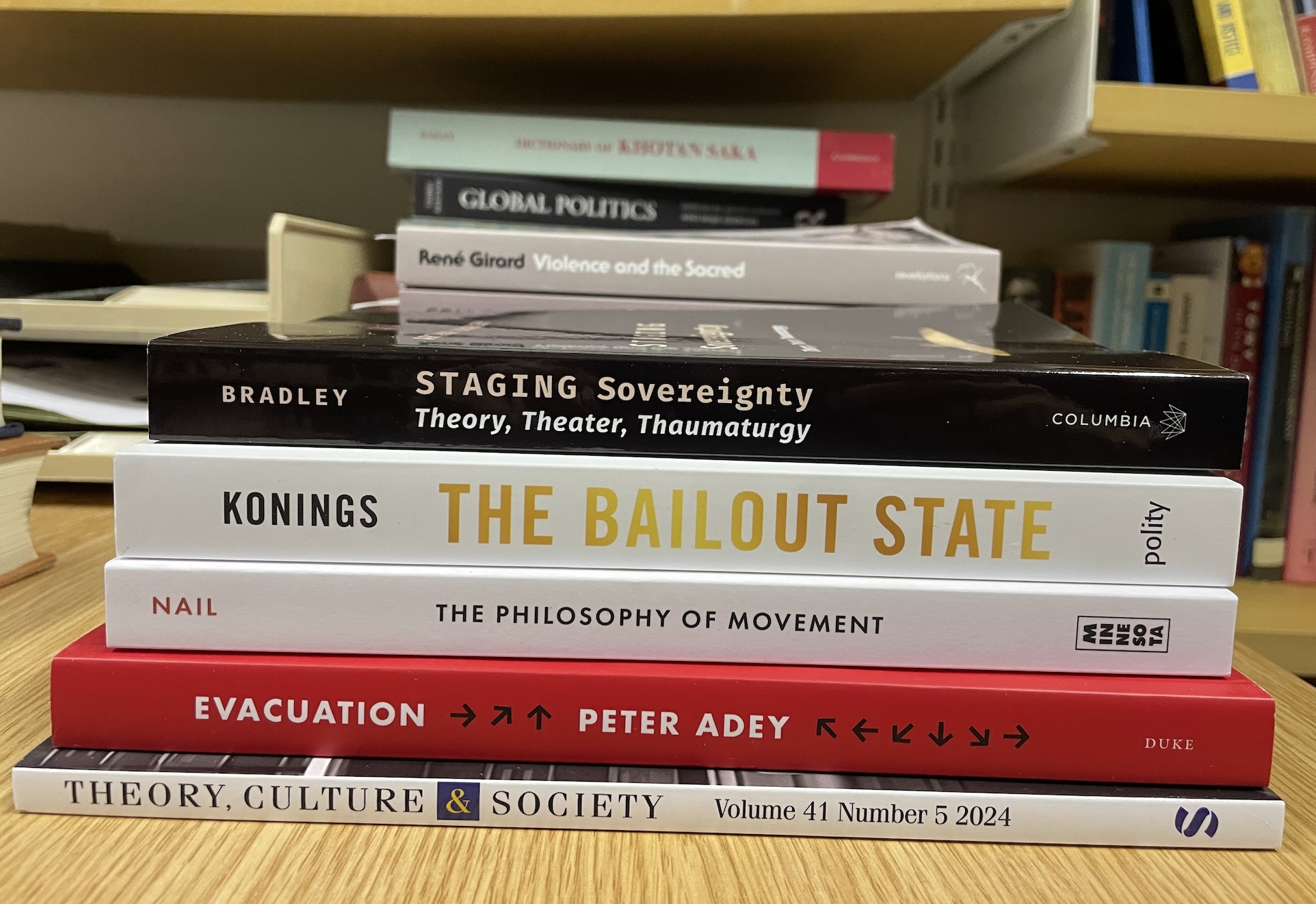
Some books previously mentioned here, sent by publishers – Arthur Bradley, Staging Sovereignty: Theory, Theater, Thaumaturgy; Martijn Konings, The Bailout State: Why Governments Rescue Banks, Not People; Thomas Nail, The Philosophy of Movement: An Introduction; Peter Adey, Evacuation: The Politics and Aesthetics of Movement in Emergency; and the theme issue of Theory, Culture & Society on ‘Thinking with Latour‘.

Posted in Bruno Latour, Theory, Culture and Society | 1 Comment

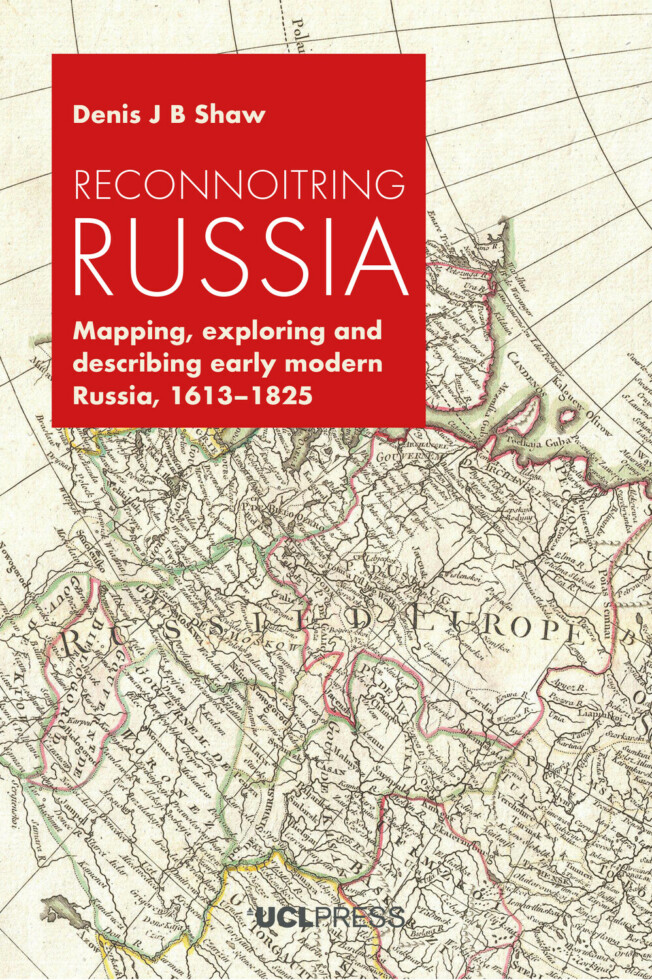
Denis J.B. Shaw, Reconnoitring Russia: Mapping, exploring and describing early modern Russia, 1613-1825 – UCL Press, October 2024 (print and open access)

Denis J.B. Shaw, Reconnoitring Russia: Mapping, exploring and describing early modern Russia, 1613-1825 – UCL Press, October 2024 (print and open access)

Like many European countries during the Great Age of Discovery and Exploration, Russia embarked on policies of state building, exploration and imperial expansion. At the beginning of the fourteenth century, the territory under Moscow’s control was about twenty thousand square kilometres. By 1800 Russia’s empire had expanded to some eighteen million square kilometres. Russia had thus become one of the world’s greatest empires.

By focusing on such geographical practices as exploring, observing, describing, mapping and similar activities, Reconnoitring Russia seeks to explain how Russia’s rulers and its educated public came to know and understand the territory of their expanding state and empire, especially as a result of the modernizing policies of such sovereigns as Peter the Great and Catherine the Great. It places the Russian experience into a comparative context, showing how that experience compares with those of other European countries over the same period. The book adopts a broad chronological framework, exploring the age between 1613 when the Romanov dynasty assumed power and 1825, the conclusion of Alexander I’s reign, or what is often termed the end of the ‘long eighteenth century’.

Posted in Uncategorized | Leave a comment

Rhodri Lewis, Shakespeare’s Tragic Art – Princeton University Press, October 2024

Rhodri Lewis, Shakespeare’s Tragic Art – Princeton University Press, October 2024

In Shakespeare’s Tragic Art, Rhodri Lewis offers a powerfully original reassessment of tragedy as Shakespeare wrote it—of what drew him toward tragic drama, what makes his tragedies distinctive, and why they matter.

After reconstructing tragic theory and practice as Shakespeare and his contemporaries knew them, Lewis considers in detail each of Shakespeare’s tragedies from Titus Andronicus to Coriolanus. He argues that these plays are a series of experiments whose greatness lies in their author’s nerve-straining determination to represent the experience of living in a world that eludes rational analysis. They explore not just our inability to know ourselves as we would like to, but the compensatory and generally unacknowledged fictions to which we bind ourselves in our hunger for meaning—from the political, philosophical, social, and religious to the racial, sexual, personal, and familial. Lewis’s Shakespeare not only creates tragedies that exceed those written before them. Through his art, he also affirms and invigorates the kinds of knowing that are available to intelligent animals like us.

A major reevaluation of Shakespeare’s tragedies, Shakespeare’s Tragic Art is essential reading for anyone interested in Shakespeare, tragedy, or the capacity of literature to help us navigate the perplexities of the human condition.

Posted in Uncategorized, William Shakespeare | Leave a comment