Arlette Farge worked with Foucault on Le Désordre des familles, lettres de cachet des Archives de la Bastille, Paris, Gallimard Julliard, 1982. See the Portail Michel Foucault for info and documents on this book
Rares sont les chercheurs auxquels il arrive de rencontrer des “fans” ; rares sont les auteurs de non-fiction dont on dévore les livres, tous les livres. Historienne du “peuple”, du “subalterne” et de tout ce que le XVIIIe siècle compte de dominés, Arlette Farge fait partie de ceux-là s’il en est. Depuis leur émergence des archives judiciaires jusqu’alors oubliées sous la poussière, sa plume et sa voix sont devenues familières aux habitués des librairies et aux auditeurs de France Culture. Poursuivant un parcours entamé par l’étude de la petite délinquance et de la vie fragile avant d’entreprendre plus récemment l’exploration des sons et des voix ouvrières de la capitale, Arlette Farge…
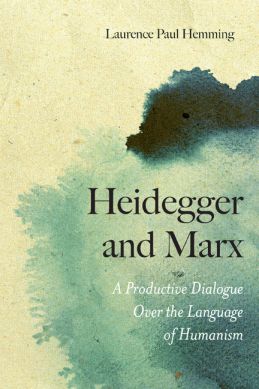
Laurence Paul Hemming, Heidegger and Marx: A Productive Dialogue over the Language of Humanism, forthcoming with Northwestern University Press in early 2013. I was one of the readers of the ms. and it’s a terrific study. Here’s the blurb – the 1966 study mentioned was by Kostas Axelos.
Martin Heidegger and Karl Marx remain two of the most influential thinkers in philosophy, in political science and other social sciences, and in the humanities. Yet there has never been a full-length study in English of the relationship between their ideas, and there has only been one study in German (from 1966). A Productive Dialogue fills this gap and contradicts the widely held assumption that Heidegger had no significant engagement with Marx. Hemming focuses on four related areas of inquiry—Heidegger’s reading of Marx; Marx’s relation to G. W. F. Hegel; Heidegger’s disastrous political involvement with National Socialism; and the significance of Hegel, Marx, Heidegger, and Friedrich Nietzsche for the politics of the twentieth and twenty-first centuries. A Productive Dialogue explores the understanding of political processes, systems, and behavior that animates both thinkers.
The manuscript for The Birth of Territory, the image files and all the permissions paperwork went to University of Chicago Press yesterday. Of course, there are still copy-editing queries, proofs, index, cover discussions, marketing questionnaires and so on to come, but it still feels an important moment.
But unfortunately I can’t just put my feet up for a few days. Instead, I have the following to do – some immediately, and some over the summer:
Secure the Volume: Vertical Geopolitics and the Depths of Power
This is the Political Geography lecture for the Royal Geographical Society conference in Edinburgh next week. While a complete draft of this talk exists, and was given as a lecture earlier this year at University of Kentucky, I don’t just want to give that same lecture again. The paper is destined for Political Geography, and the editors rightly want this fairly soon. I also owe it to the commentators on the lecture – Peter Adey and Gavin Bridge – so I’ve been trying to work on it in among the last revisions of the book. Not ideal, but I think it is getting into shape. I also need to write a few words of introduction for the Eyal Weizman, ‘Forensic Architecture‘ Society and Space lecture.
Bellies, Wounds, Infections, Animals, Territories: The Political Bodies ofCoriolanus
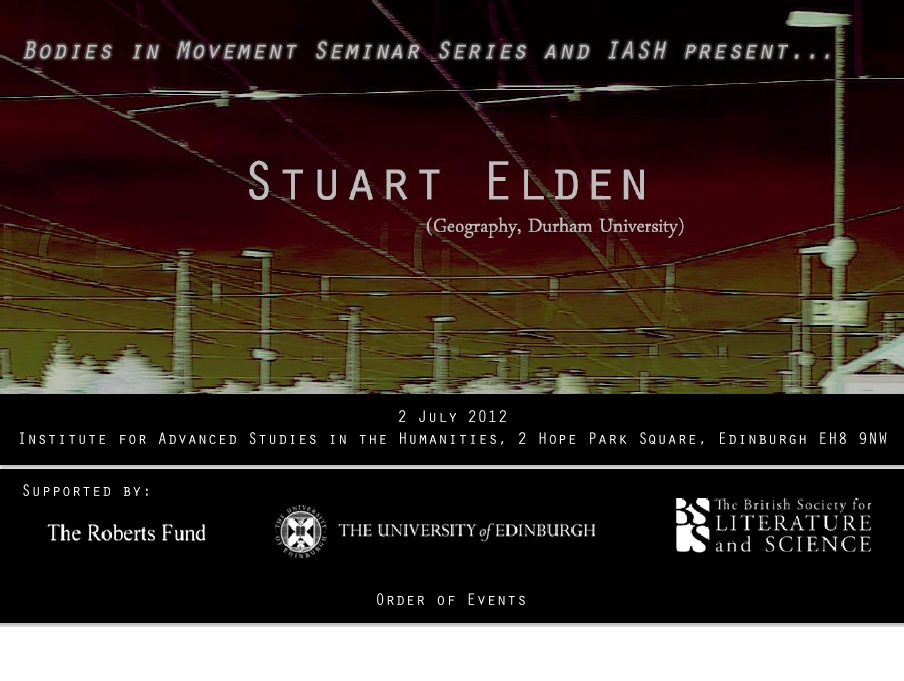
This is to be given as a seminar in Edinburgh the day before the RGS-IBG starts. Again I have a complete draft, but I really need to work on it before then, along with a powerpoint of the quotations. I may show some clips from the film too. My plan was to have this as one of the chapters of the planned Shakespearean Territories book. I’m giving a lecture on this project in early October, and plan to spend the summer largely working on this project as a whole.
Fossils: Age, World, Relation
I’d rather given up on this paper, thinking it could sit there as a draft chapter for the planned The Space of the World book at some point in the future, but the Lancaster workshop on Political Geology has made me think it might be worth working on this again with a view to submitting it to a journal now.
Another Leibniz
This paper was given a ‘revise and resubmit’ decision back in April by the journal I sent it to. I’ve not had time to go back to it and think about whether I can indeed do what this journal wants, or to withdraw it and think of another potential outlet. But I need to return to this soon either way. Here’s the very short version I gave at the AAG (audio and slides).
Kant, Natural Science
There is a session on the Reading Kant’s Geography book at the American Philosophical Association, Eastern Division meeting in December. I’ll be speaking at that along with Robert Bernasconi and Robert Louden. Eduardo Mendieta will hopefully chair. I was unsure what new to say. But the Natural Science volume, which includes a translation of the Physical Geography, is due out in August. I intend to write a review of that volume which will link to my APA paper. The rest of that paper will draw on my 2009 Journal of Historical Geographypiece and the Reading Kant’s Geography introduction.
Foucault, Du gouvernement des vivants
The eagerly awaited lecture course is due out in October. This is a key missing piece of the jigsaw for the book on Foucault I’ve been planning for many years. My talk on Leçons sur la volonté de savoir is also sitting waiting for me to work on it again, though that might just get left for the book. That book would be substantially complicated if indeed the Foucault archive does become opened up. But in the meantime, Du gouvernement des vivants will provide me with some useful new material.



 Foucault, Du gouvernement des vivants

