Revista Urban issue 3 and call for papers

The Spanish journal Revista Urban issue 3 is now out. It’s a theme issue on Conflicts of contemporary cities. It includes articles by Don Mitchell, Alain Bertho, Fabrizio Bottini & Maria Cristina Gibelli, Cristina Fernández & Fernando Roch, Julio Soria & Luis Valenzuela and Imanol Zubero.

The current call for papers is on Critical Landscapes. There is also a permanent call for papers on free topics.

While the journal requires subscription, I’ve been told you can contact the journal if you want to get hold of an individual piece.

[update: second link now fixed – sorry]

Posted in Publishing, Revista Urban | 2 Comments

Geographica Helvetica relaunch

The venerable Swiss geography journal Geographica Helvetica is being relaunched next year with a new editorial team – Francisco Klauser, Ola Söderström and Benedikt Korf. I’ve accepted an invitation to be part of the new editorial board. The plan is that the journal is available on paper and online in an open access format (using the Copernicus portal). It will be a multi-lingual journal – papers in French, German, English and Italian. There will be a conference on 19th October 2012 in Neuchâtel which will be a sort of informal launch (unfortunately I can’t attend due to teaching commitments). More details as they become available.

Posted in Geographica Helvetica, Publishing | Leave a comment

Posted in Uncategorized | Leave a comment

John Updike’s 6 Rules for Constructive Criticism

In The Atlantic. While these are intended for reviews of fiction, many apply to the review of academic books. They were written in the 1970s, so perhaps that explains his use of male pronouns alone. Here are the first three – the others, and the introduction, are longer:

1. Try to understand what the author wished to do, and do not blame him for not achieving what he did not attempt.

2. Give him enough direct quotation—at least one extended passage—of the book’s prose so the review’s reader can form his own impression, can get his own taste.

3. Confirm your description of the book with quotation from the book, if only phrase-long, rather than proceeding by fuzzy precis.

Posted in Books | Tagged | Leave a comment

This was added in comments to a previous post, but worth greater visibility.

Posted in Uncategorized | 1 Comment

Political Theology and Early Modernity

Interesting looking collection edited by Graham Hammill and Julia Reinhard Lupton, with a postface by Etienne Balibar.

Political theology is a distinctly modern problem, one that takes shape in some of the most important theoretical writings of the twentieth and twenty-first centuries. But its origins stem from the early modern period, in medieval iconographies of sacred kinship and the critique of traditional sovereignty mounted by Hobbes and Spinoza. In this book, Graham Hammill and Julia Reinhard Lupton assemble established and emerging scholars in early modern studies to examine the role played by sixteenth- and seventeenth-century literature and thought in modern conceptions of political theology.

Political Theology and Early Modernity explores texts by Shakespeare, Machiavelli, Milton, and others that have served as points of departure for such thinkers as Schmitt, Strauss, Benjamin, and Arendt. Written from a spectrum of positions ranging from renewed defenses of secularism to attempts to reconceive the religious character of collective life and literary experience, these essays probe moments of productive conflict, disavowal, and entanglement in politics and religion as they pass between early modern and modern scenes of thought. This stimulating collection is the first to answer not only how Renaissance and baroque literature help explain the persistence of political theology in modernity and postmodernity, but also how the reemergence of political theology as an intellectual and political problem deepens our understanding of the early modern period.
Posted in Baruch Spinoza, Books, Carl Schmitt, Etienne Balibar, Niccolò Machiavelli, Thomas Hobbes, Walter Benjamin, William Shakespeare | Leave a comment

Pirate Radical Philosophy?

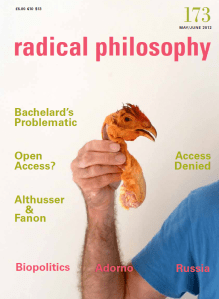
The latest issue of Radical Philosophy has an interesting piece entitled ‘Pirate Radical Philosophy’, which is free to download. It raises questions about open access, piracy, copyright and the digital humanities. It is followed by a brief statement from the editorial collective:

Access to Radical Philosophy: principles and policy

As an independent journal of the Left, collectively self-published in A4 magazine form, and non-profit-making, Radical Philosophy has always aimed to maximize access while generating sufficient revenue to fund production. Currently, we do this by keeping the cover and individual subscription prices as low as possible, giving individual subscribers free access to our forty-year archive in electronic form on the web, and making more than 50 per cent of the archive available open access. We charge university libraries for full web access, in order to make up the deficit on sales to individuals. Downloads of individual articles that are unavailable to those without university or individual subscriptions cost £3 each – about 20 per cent of commercial rates.

But why isn’t Radical Philosophy freely available in its entirety to all on the web? Because we would not then be able to produce it as a hard copy magazine, since we would not generate sufficient income from institutional subscriptions. Much of what is intellectually and culturally distinctive about Radical Philosophy,we believe, is connected to its format and low-priced availability in bookshops and to individual subscribers. However, we are also exploring the possibilities of new formats.

We are interested to hear readers’ views on these issues and to debate them in the journal. Email short pieces to mark.neocleous@brunel.ac.uk or write to us at admin@radicalphilosophy.com.

RP

Posted in Publishing | Leave a comment

Political Geology: Stratigraphies of Power

I’ll be speaking at a conference on Political Geology: Stratigraphies of Power on 21 June at Lancaster University  – I’ll be giving an abbreviated version of the ‘Fossils’ paper I gave in Canberra and Macau last year. Thanks to Kathryn Yusoff for inviting me. In part this is a continuation of the conversation with Elizabeth Grosz at the AAG – audio available at the Society and Space open site.

With what language can we describe the politics of the Earth? ‘Geopolitics’ should be the name of that language; yet the geopolitical lexicon is strangely lacking in any reference to the Earth System, to its structures and resistances, its deep time and its sudden upheavals. In recent decades, social and political theory has undertaken a number of biological turns, giving rise for example to political ecology, ecological economics and theories of biopolitics. But, despite Deleuze and Guattari’s exploration of ‘geophilosophy’, and Elizabeth Grosz’s recent discussion of ‘geopower’, there has been no comparable geological turn: no concerted inquiry into the ways that the geophysical, as much as the biological, conditions what politics is and can be.

However, debates around the advent of the Anthropocene epoch seem to mark a growing recognition of humankind as a geological force. At the same time, unregenerate seismic, volcanic and other geomorphological forces attest to the limits of the human, and point to our eventual mineral fate – but also can be seen as powers that propel and incite human agency, not least in the form of fossilised hydrocarbons.

This workshop will explore the possibilities for a political vocabulary that can articulate the geophysical dimensions of politics and the political dimensions of the geophysical. We will touch on domains and structures such as tectonic plates and rock, fossils and soil, air and water, life and bodies, and on phenomena such as erosion, (de)stratification, flow and viscosity, in order to think the politics of an Earth that is constantly in becoming and in formation.

Speakers will include: Nigel Clark (Open University), Deborah Dixon (Aberystwyth University), Stuart Elden (Durham University), Myra Hird (Queen’s University, Canada), Arun Saldanha (University of Minnesota), Bronislaw Szerszynski (Lancaster University) and Kathryn Yusoff (Lancaster University).

Posted in Conferences, Elizabeth Grosz, Felix Guattari, Fossils, Gilles Deleuze, The Space of the World | 4 Comments

Mark Purcell on Lefebvre, State, Space, World

There is a very generous review of Lefebvre’s State, Space, World collection by Mark Purcell in the new issue of Social and Cultural Geography (requires subscription). [Update: Mark has posted the whole thing here]

Let me say this plainly: this is an excellent book. There are two main reasons for this excellence. The first is the enduring quality and originality of Lefebvre’s work, and the second is the evident abilities of the editors, Neil Brenner and Stuart Elden. Both are important factors, but let me begin with the editors. A significant element of the editors’ contribution is the translation of the works, for which they were joined by Gerald Moore…

In addition to the excellent translation, the editors’ introduction is extremely substantive, well written, and makes an excellent guide to the theoretical contents of the book. Their scholarship is meticulous; this is clearly not a book that was rushed in any way. It is patiently crafted and is the work of serious scholars who care very deeply about the material they are working with.

Much of the review is, naturally, taken up with Lefebvre’s ideas, notably the notion of autogestion, which he ties, entirely appropriately, to the much better idea of the right to the city.

Very much related to this political agenda is the concept of autogestion. The term is extraordinarily important for Lefebvre, though it has been subjected to relatively little attention in geography scholarship. It forms the basis of his understanding of politics and his hope for the future. It also draws him toward an anarchist position, which is articulated with the Marxist–Leninist position on the state and capitalism, into an exciting and complex political vision. Lefebvre imagines people reappropriating control over the conditions of their own existence so that they create a world in which no one is governed by outside authority, a world in which power is no longer alienated from people to institutions like the state or the corporation, but remains with the people themselves…

Lefebvre is very clear here: he is offering a vision for radical democracy. It is easy to imagine how we can connect that larger political vision with Lefebvre’s writings on cities to imagine urban inhabitants reappropriating control over the production of urban space, a vision which helps us to more fully specify, and understand far more radically, the concept of the right to the city.

Overall then, I would say this book is not only required reading for anyone interested in Lefebvre but also it should be the starting point for those who want to engage his work on the state, politics, Marxism, and autogestion. Especially if it is paired with The Urban Revolution, I think this book is a powerful weapon in the struggle against the neoliberal city, and a source of great strength as we build another world.

Posted in Henri Lefebvre, My Publications, Neil Brenner, Politics | Leave a comment

Deborah Cowen website

My friend and co-editor of Society and Space, Deborah Cowen, has a nicely designed website about her work.

My work is concerned with the politics of space and questions of citizenship. I am captivated by the ways groups claim space, organize and design space, interpret space, fight over space, govern space, and share space, particularly in cities. In all of my work I am interested in how territory is fashioned and how the political is remade through conflict. I investigate these broad themes through three research trajectories – militaries, logistics, cities.

Posted in Politics, Society and Space, Territory | Leave a comment