Outside Territory

This is the talk I’ll be giving at the ‘Extraterritoriality’ conference of the Exterritory project – Paris, May 2nd.

This talk seeks to explore what it means to be outside territory. It does so in three registers. First, it discusses what is meant, and has been meant, by ‘territory’ and therefore to outline forms of political space which are not territory, and are outside it conceptually. In doing so, it sketches some aspects of a much longer account of the history of the concept of territory in Western political thought. Contrary to many accounts, territory is not that central or even general a category of geography; not all problems should be seen through a territorial lens; and while it is certainly of fundamental importance in the modern period, territory historically is not the key concept of political theory and its relation to place. Rather we should recognise the emergence of a concept out of a complicated and multi-layer set of chronologies, fragments and aporias. Second, following this, if territory has a history, and emerged at a particular conjuncture, then it follows that before this there were political-spatial orderings that were not territory. The talk therefore provides some examples of configurations of the relation between power and place that were not territorial, that is what is outside territory historically. Last, it looks at what it means to be outside territory politically. The final theme is exemplified not through contemporary examples but through readings of the question of banishment in the plays of William Shakespeare, in particular Richard II, The Tempest and Coriolanus.


Posted in Conferences, Territory, William Shakespeare | 2 Comments

Is your packaging really necessary?

Posted in Books, Jacques Rancière | 1 Comment

The analytic/continental divide (again)

Gary Gutting has recently written a piece about the analytic/continental divide for The New York Times. Eric Schliesser has written a long response here; Graham Harman responds here; Plastic Bodies here.

Posted in Uncategorized | Leave a comment

CRIPS annual lecture at Warwick

I’ll be giving the Critical International and Political Studies annual lecture at the University of Warwick in October 2012. It will be 10 years since I left the Politics and International Studies department at Warwick, and though I’ve been back for a few things since they were not PAIS events. The provisional title is ‘Shakespearean Territories’.

Posted in Conferences, William Shakespeare | 1 Comment

By Sovereignty of Nature: Ralph Fiennes’s Coriolanus

My piece on Coriolanus has now been published at Berfrois.

[update: Julia Reinhard Lupton links to this from her valuable Thinking with Shakespeare blog – and in doing so describes me as a ‘progressive geographer’… I like it, and perhaps that’s my answer the next time I’m asked ‘are you a geographer?’, as I was in Cambridge.]

Posted in William Shakespeare | Leave a comment

Cambridge discussion audio

The audio recording of the discussion on 16 February 2012 with Adam Ramadan is now available. Many thanks to Adam for asking the questions and John Mason and the Cambridge University Geographical Society for inviting me and organising the event. Apart from a minor bit of sound editing (i.e. the bit where the microphone was knocked which I cut out), this is unedited, and includes the questions from the floor. The discussion covers theory, territory, writing, this blog, Society and Space, contemporary politics, Foucault, translating Lefebvre, Shakespeare, fossils, etc.

Posted in Conferences, Henri Lefebvre, Michel Foucault, My Publications, Neil Brenner, Politics, Publishing, Society and Space, Territory, Terror and Territory, The Birth of Territory, The Space of the World, Universities | Leave a comment

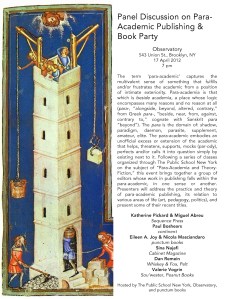
Para-Academic Publishing

Interesting event in New York in April (via The Whim)

Posted in Publishing | Leave a comment

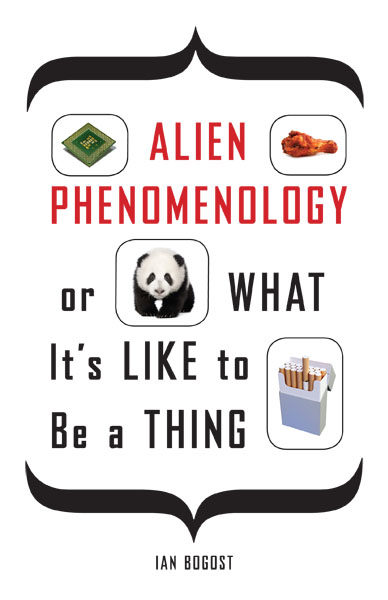
Ian Bogost – Alien Phenomenology

Ian Bogost has news of his very shortly forthcoming book Alien Phenomenology, with  University of Minnesota Press.

A bold new metaphysics that explores how all things—from atoms to green chiles, cotton to computers—interact with, perceive, and experience one another

In this book, Ian Bogost develops an object-oriented ontology that puts things at the center of being—a philosophy in which humans are elements but not the sole or even primary elements of philosophical interest. Bogost encourages professional thinkers to become makers as well, engineers who construct things as much as they think and write about them.

Nigel Thrift provides the back cover endorsement:

This book needs to be read by many different audiences since it is not only fascinating but also of considerable significance. As the task of thinking through things as actors in their own right according to Ian Bogost’s maxim ‘all things exist, yet they do not exist equally’ becomes a real intellectual project so the implications of this stance start to multiply. In turn, they begin to produce the outlines of a landscape in which things aren’t just are. Rather, they form an active cartography which is always and everywhere–an alien ontography

Posted in Ian Bogost, Nigel Thrift | Leave a comment

Gerard Toal on political affect

Interesting post from Gerard Toal (Gearóid Ó Tuathail) on political affect, which links to a piece he wrote for Antipode in 2004, and where he promises to develop an affective geopolitics.

Most contemporary geographers will be aware that the discipline has been grappling with a movement called ‘non-representational theory’ for the last few years, codified by, among other things, Nigel Thrift’s book of that same name (like many, I think the name is not helpful in suggesting an oppositional: ‘more than representational’ is certainly better). This movement within Geography is part of a larger ‘affect turn’ in contemporary social science, though it is still fringe in the more positivistic enthralled disciplines like Political Science, and, of course, Economics… (continues)

Posted in Nigel Thrift, Politics | Leave a comment

Unpublished Foucault interview

Foucault News links to a previously unpublished interview with Foucault from 1977. Some interesting discussion of history, genealogy and archaeology; the question of strategy; politics, state, classes and state apparatuses; power, sexuality and the body… The beginning of the Présentation follows:

Cet entretien a eu lieu dans les premiers jours du mois de juillet 1977. Animateurs de la rubrique culturelle du journal quotidien Rouge, nous avions le désir de rendre compte d’un livre de Michel Foucault paru en 1976, La Volonté de savoir, premier volume de son Histoire de la sexualité, et plus encore de pouvoir questionner son auteur sur son rapport au marxisme et au gauchisme. Michel Foucault avait paru un temps très lié à la fraction maoïste de l’extrême gauche et n’avait en tout cas jamais eu de contacts directs avec les trotskystes de la Ligue communiste révolutionnaire, lesquels avaient plutôt tendance à le renvoyer hors du champ légitime de la pensée révolutionnaire. Or il était pour nous, surtout depuis Surveiller et punir, un « éveilleur » qui avait toute sa place dans un quotidien comme Rouge, conviction qui n’était pas partagée par les responsables du journal…

Posted in Michel Foucault | 5 Comments