University of Sydney and research ‘project management’

I posted the first link I was sent about the situation at the University of Sydney yesterday, in the long message about email. It is worth a look – a statement by a large number of faculty members about the plan for people who have not produced four research outputs (books, chapters, articles etc.) in three years to be moved to teaching-only contracts or sacked. Henry Barnes provides some context here, suggesting many of the problems are self-inflicted. The University’s policy is here (appendix one).

In the comments to these articles Alex Burns dissents from the standard critical view. To his mind, the expectation is not that high, and people who fail to hit these targets are simply not organising their work effectively. His response is to point out a number of project management advice books that people should be reading in order to know how “to outmaneuver such decision rules and the administrative, finance and management staff who formulate them”. But he is pointing these out for the running of research projects and article writing.

I’ve mentioned some of the organisational things I do on this blog in the past, but I hope it’s clear that these are for the other parts of my job – organisation of email; how to edit a big journal; how to deal with other tasks. I try to be as efficient as possible in those things, in order to protect or free up time to work on research. Research – reading, thinking, writing – is the oasis in the managerial desert, it’s the one thing I don’t quantify, measure, overly bureaucratise etc. Others might, but you can resist that, not by beating them at their own game, but by continuing to have a love of the material, an inspiration in the search, and a willingness to be surprised or to change tack. I try to act the same way in the classroom – while the bureaucracy of teaching drives me crazy, I hope that my enthusiasm for the material comes across when in the presence of students. If we turn these parts of our job into an extension of the rest, then we might as well pack up and become civil servants or finance managers.
Posted in Politics, Publishing, teaching, Universities | 4 Comments

Keith Thomas on the state of British universities

Distinguished historian Keith Thomas writes in the London Review of Books.

Secondly, we must press for changes to the REF, formerly the RAE. In my experience, this operation, though initially a stimulus, has in the longer run had appalling effects. It has generated a vast amount of premature publication and an even larger amount of unnecessary publication by those who have nothing new to say at that particular moment, but are forced to lay eggs, however addled. In the social sciences, it has discouraged the writing of books, as opposed to specialist articles, and by making peer review the ultimate arbiter it has very probably enshrined orthodoxies and acted as a curb on intellectual risk-taking and innovation.

Posted in Politics, Publishing, Universities | 2 Comments

Sloterdijk Now available

Available at the Polity site, but Amazon UK has it for the discounted price of £11.99. Amazon.com doesn’t have it yet as the US release date is a little later. Google Books has quite a bit as a preview.

If you consider that Spheres I: Bubbles is now available; and that another collection of essays was released just a few days ago – In Medias Res: Peter Sloterdijk’s Spherological Poetics of Being, this is an important moment in the English-language engagement with his work.

Posted in Books, My Publications, Peter Sloterdijk | 1 Comment

A day in email

Mary Beard has recently dedicated her column ‘A Don’s Life’ to a day in email, and I thought I’d do the same. After yesterday’s message ‘Evernote, Email, Organisation’ it seemed fitting. I was pretty shocked at the number that arrived in the strike day – when very few British academics sent messages. Given I usually process emails several times a day I’d not kept a tally of how many actually arrived in a single day. I should say right away that all the mailing lists I am on go to another email account. I try to avoid using my Durham email address when asked for my email by companies etc. and when I do end up on lists I tend to unsubscribe if at all possible.

So, these are the messages that arrived in one twenty-four hour period.

Durham

  1. A message from the person I asked about an administrative issue saying that they don’t know the answer but they will ask a person who might. And then a follow-up from the second person that says that they don’t know and explaining why no-one will know. At least not now, but possibly in January, and maybe not then because it is dependent on something else which might not be known for some time. In sum, I now know that we don’t know; which at least is better than not knowing myself nor knowing who it was that might know. Nobody knows. And we don’t know when we will know. Kafka and Donald Rumsfeld take note.
  2. a message about the dates of the May examination period and the need to keep them clear of other commitments (especially travel)
  3. yet another reminder for a seminar in the department. How many do we need for a single seminar?
  4. a message about a research workshop in the department I’d like to go to but can’t. But I already knew about it, and knew I couldn’t go.
  5. A meeting of the University’s Middle East & West Africa and Central & South Asia regional interest group. That’s quite a region. I’ve never shown any interest in this group: I think this must be because I’ve written on theMiddle East.
  6. another reminder about an Ecology seminar. Why do I get these messages?
  7. a message asking for feedback about the MA in Medieval and Renaissance Studies
  8. Three messages from colleagues who don’t seem to realise that ‘reply all’ goes to a lot of people who don’t need to know their response to a general question.
  9. a student message about a missing file in the Durham Online page for a module; now fixed
  10. a message about potential AHRC studentships in the department
  11. a message about general PhD funding issues, timescales and procedures; and a follow-up to that asking us to list potential topics
  12. another message about ESRC doctoral training
  13. an idiot’s guide to updating web list of publications (I didn’t need this)
  14. two messages from colleagues about the marking for one of the modules I convene
  15. a query about my annual review; and then a follow-up to that with the review itself; then a follow-up to that.
  16. The Vice Chancellor’s fortnightly bulletin of University news
  17. Two messages giving information on two research fellowship schemes at Durham (here and here)
  18. two indiscriminate uses of general email lists
  19. a message to disregard a message doing the rounds that contains a virus

Society and Space

  1. two new submissions to Society and Space. One is wildly inappropriate, from someone who appears never to have opened the journal.
  2. A message from an author saying that while we rejected their paper, they are grateful for the reports and the prompt turnaround.
  3. A message from an author whose paper was not sent to review acknowledging this.
  4. News that someone else is following the Society and Space blog
  5. Four emails from co-editors about a possible Society and Space lecture
  6. Eleven messages about problems with the new manuscript submission software we are trialling.
  7. Four messages from co-editors about the editorial I drafted for issue 1 next year
  8. Two messages with reports back on papers for editorial decision, though one of my colleagues is coordinating editor for these, so just for info
  9. an author asking for confirmation their paper was going to be reviewed, and a follow-up from the journal managing editor; leading to four messages about it being over length. Yes, inclusive means it includes everything.
  10. an author apologising for a late resubmission of a paper; and then that paper late in the evening
  11. ten messages from co-editors on new papers
  12. two messages from the review editors on suggested reviewers
  13. four other messages I was copied into for information

Other Work related

  1. a message from a graduate student elsewhere about his work
  2. three emails checking, confirming and then sending the e-ticket for my trip to Kentucky in March
  3. confirmation of details of a conference at Yale in April
  4. a response to a review I’ve just done for a journal asking for other reviewer suggestions
  5. two messages from Australian friends on the dire situation at the University of Sydney
  6. Rob Sullivan sending me the text of his ‘Ode to Geography’
  7. A personalised message from the publisher saying that Jenny Edkins’s new book Missing: Persons and Politics is now out. Jenny is one of the most interesting people working in IR and this should be really good.
  8. a message from the Open University advertising the next Doreen Massey lecture in March
  9. a message about the 2012 Heidegger Circle conference
  10. a message about an interesting French book on Foucault, from Colin Gordon. I posted about this yesterday.
  11. then a followup from Colin about The Foucault Effect II project
  12. a message about a potential book chapter for a collection on the Occupy movement
  13. a message from the Open Political Science journal inviting submissions. Another venture from Bentham Open publishing. This is a scam, basically. The journals are ‘free’ to read (if anyone actually tries, I suppose), but they charge authors top whack to publish. I’ve declined countless invitations to be editor or a board member or contributor for such journals. I try to unsubscribe from these messages but they keep coming.
  14. a Google Scholar citation alert

Personal

  1. A message from Amazon about an order
  2. Two emails about the house we are buying and insurance policy changes
  3. A message from one of my sisters about Christmas plans
  4. A ‘Linked In’ invitation. I don’t want these and keep trying to unsubscribe and block them. This invite is for a taxi service I booked online a year ago in Seattle!
  5. four comments/trackbacks on blog posts for approval

That’s 51 topics, with multiple emails for several of them. Over 100 in total – and that doesn’t include obvious spam, mailing lists or advertising crap which goes elsewhere. Many were deleted, some were filed, and a few replied to or otherwise dealt with. A couple were marked as unread and put into an ‘Action’ folder to be dealt with later. There is nothing left in the inbox itself, which is clear to receive the next twenty-four hours worth of stuff.

It was a somewhat unusual day – only one message from a student. Deadlines were last week so that makes sense. It was a fairly average day on the journal, though one of the issues is consuming a lot of time. It is sorely tempting to send a whole host of these people the email charter. Did writing this post take some time? Yes, of course, but the audit of just how much stuff I receive and deal with in a single day was pretty revealing for me. I regularly get to the end of a day like this and think that I have achieved nothing.

Posted in Uncategorized | 3 Comments

Michel Foucault et le christianisme

This book by Philippe Chevalier looks really important. Thanks to Colin Gordon for the link.

Posted in Michel Foucault | 1 Comment

Kentucky-Harvard-Yale

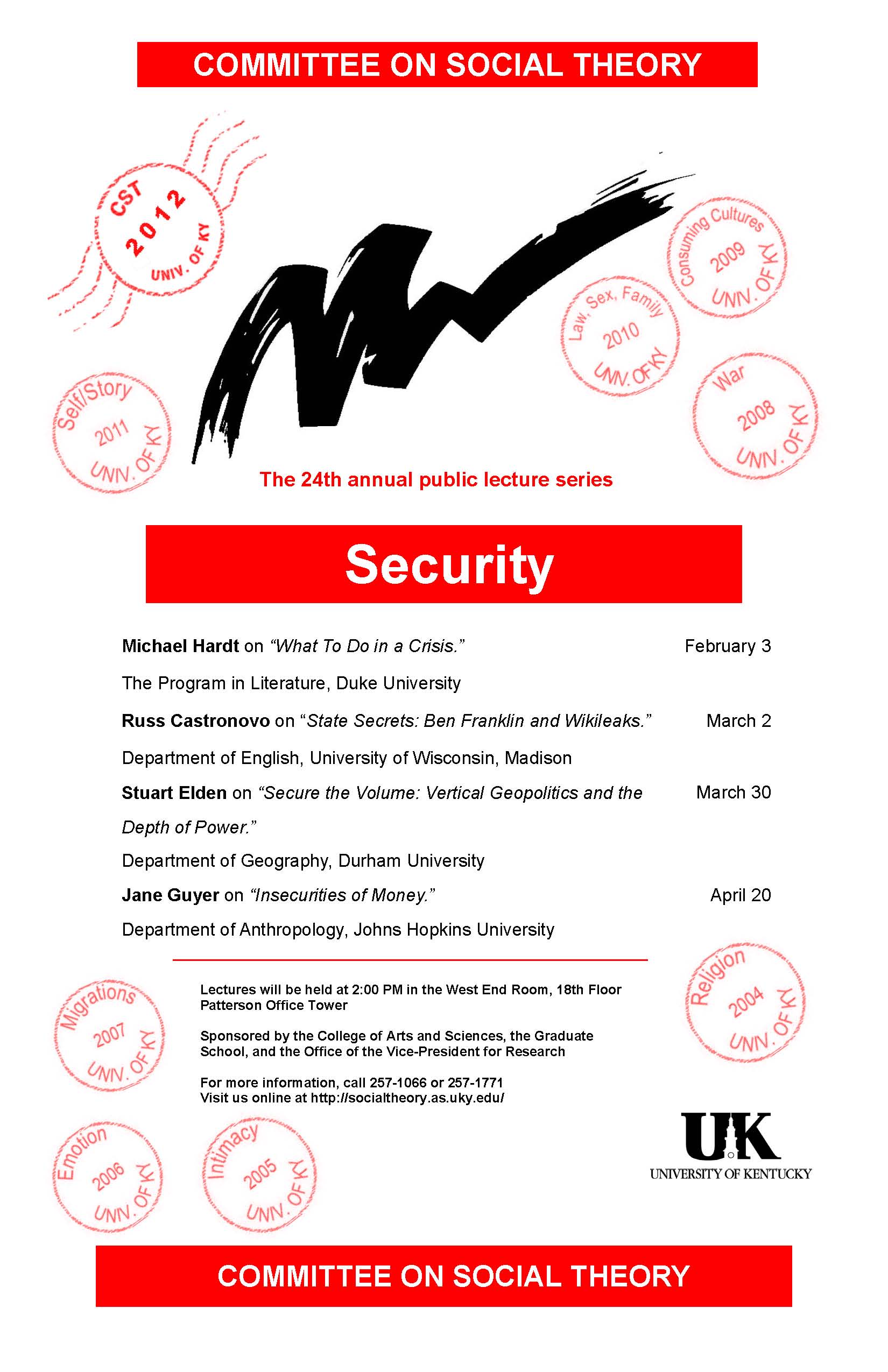
This has been a bit of a logistical challenge. I’m speaking in Kentucky to the Committee on Social Theory on March 30th. They’ve just sent me this nice poster advertising the series. I was also asked to speak at Yale University at a workshop on Borders and Walls in early April. So it seemed fairly straight-forward to combine these, until they moved the Yale workshop dates until later in the month. The time between was a bit long to kick around with no purpose, but too short for me to want to fly back to the UK and back again. Plus it’s Easter, so it’s not a cheap or easy time to fly. I asked Yale to give me the equivalent of a translatlantic flight towards expenses in between – same cost for them; less cost for the planet and my health. As they have agreed I’m flying from Lexington to Boston, will hang out with Neil Brenner for a few days and maybe give a talk at the Graduate School of Design at Harvard, and then get the train down to New Haven. If I have time I might stop off in Providence, which I’ve never been to before, and which Graham Harman made sound appealing on his trip last year.

I’ve also made a few other changes to future speaking dates and titles. The Exterritory conference now looks like to be held in May. That’s a much nicer time to visit Paris than January, and gives me more time to write the paper. This has had a knock-on effect in terms of the titles of some later talks – since the paper for that conference won’t be written when planned I’ll give a pre-existing talk at King’s and Leeds.

Posted in Conferences, Neil Brenner, The Space of the World, Travel | Leave a comment

Evernote, email, organisation

I only heard about Evernote recently (via this which I stumbled upon via WordPress), and have been using it for a few weeks. It’s great, and has made a big difference to how I keep notes and lists. It takes almost no time to set up, and saves a huge amount of time. You can find it here. It’s free (there is a quota for data, but I’m not even close). The advantage is that you simply install it once on all devices – I have it on my home pc, work computer/laptop, iPad and Blackberry phone. And then anything you do in Evernote on any of these is synchronised with all. I always have at least one of these with me in any work situation.

So my ‘to do’ list is no longer on paper, my Society and Space working notes are now on here instead of in a notebook, my lists of things to read, check out of libraries, books that I’ve ordered, etc. The advantages are huge: instead of bookmarking a webpage that is something I want to go back to later, I send it to Evernote (the program links to many others); emails you might keep unread for later reference can be copied and saved here. I’ve started keeping notes on future projects/chapters of the next book in this and just throw references into these as I come across them. I used to do this in Word files, but unless I had these all saved in something like dropbox, I couldn’t always access them when on another device. There are loads of other things I’ve not tried yet – you can scan documents into it, or take photos of things which are sent to it, for example.

One other thing: read the Email charter. I confess I fall foul of some of these. It is a diagnosis of a problem: “The average time taken to respond to an email is greater, in aggregate, than the time it took to create”. My only criticism of the Email charter is that is puts the entire onus on the sender of emails.  

This story of one person’s email chaos is deeply worrying, but there are some obvious solutions in the comments (folders, delete, and filters). Anyone keeping nearly 1,500 emails in an inbox is in trouble. They are definitely not alone. Yes, it takes time to set up filters, but it will save you time many times over. And other people’s time. Because if you’re disorganised with email, you create work. One of those messages might be important and you will miss stuff if you have that many emails waiting to be dealt with.

The email charter is good. But it puts all the onus on the sender to send less. That’s important. But it’s not enough. There also needs to be more of a commitment to get a grip on email chaos and not to allow things like this to build up.

Posted in Uncategorized | 2 Comments

David Harvey at Occupy Philly

Posted in David Harvey, Politics, Uncategorized | Leave a comment

William E Connolly on the Return of the Big Lie

at The Contemporary Condition

Posted in Politics, William E Connolly | Leave a comment

Posters from the Occupy movement

Many more here.

Posted in Politics | 1 Comment