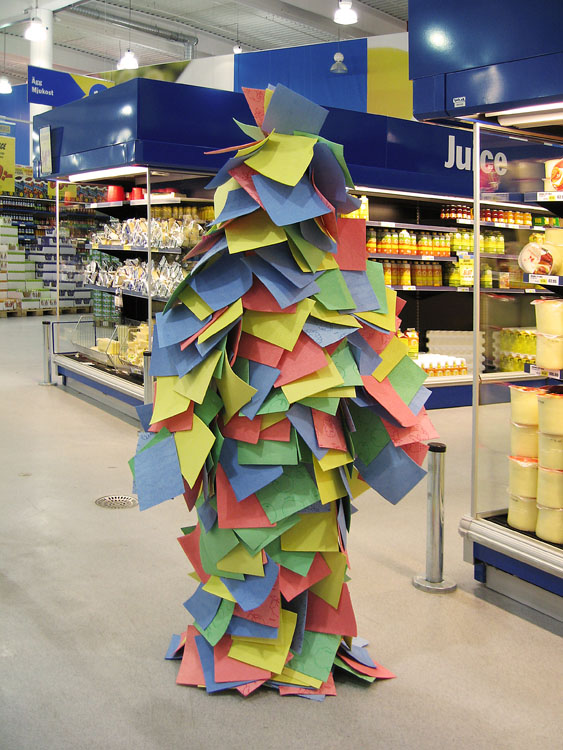
Urban Camouflage

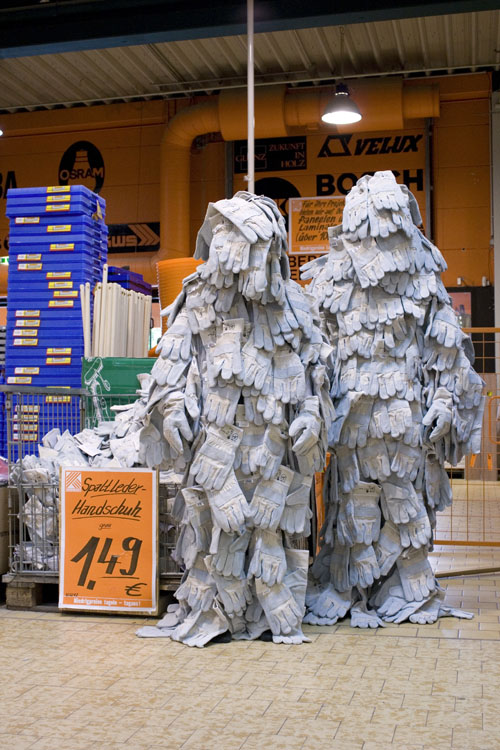
In Sloterdijk’s book Der Welt über die Straße helfen (with Sven Völker, München: Wilhelm Fink Verlag, 2010) there are some interesting images. Some are from the Urban Camouflage project of Sabina Keric and Yvonne Bayer. These are the first two images Sloterdijk and Völker included, but there are plenty more at the site (bottles, boxes, Ikea bags, frozen veg).

This work is interesting, but not quite in the same league as the astonishing work of the Beijing artist Liu Bolin. The Guardian did a photo feature on him last year (from which the images below come); see also these pictures.

Posted in Peter Sloterdijk | Leave a comment

Journals and rejections

This is pretty good – the Journal of Universal Rejection: “You name it, we take it, and reject it”.

Not to be confused with journals that only publish rejected work, such as Rejecta Mathematica…

Posted in Publishing | Leave a comment

Roundup – PhDs, Connolly, Banning Books, Congratulations

Over at Ecology without Nature, Timothy Morton has begun a new series of advice posts, this time on ‘How to Plan a PhD’. Will be interesting to see this one develop.

Adrian Ivakhiv reports his first thoughts on William Connolly’s new book A World of Becoming (Duke UP, 2011) here. Still not available in the UK as far as I can tell.

As if he didn’t have enough trouble, Silvio Berlusconi and his colleagues are picking a fight by trying to get books banned from Venice libraries. They include those by Wu Ming. Verso has a report here; Wu Ming themselves further details here. 

And finally, pleased to congratulate my sometime-collaborator, Jeremy Crampton, who is moving to the geography department at the University of Kentucky. He has the news here, in among details of travel and all his new toys.

Posted in Jeremy Crampton, Publishing, Timothy Morton, Universities, William E Connolly, Wu Ming | Leave a comment

Turkel report on IDF Gaza boat raid

The Turkel report into the attack on the aid ship to Gaza has concluded that Israel acted within international law, and that the soldiers acted in self-defence. As a reminder, nine activists died and several more were injured. Some IDF soldiers were also injured. The summary is here; the international observers’ endorsement here. (The observers were former Northern Ireland first minister David Trimble and a retired Canadian Brigadier-General.) Paragraph 41 of the summary is telling

It should be emphasized that the Commission’s ability to construct a complete picture of the incidents in which force was employed by IDF soldiers is limited for a number of reasons, including the nature of the event, the lack of testimonies by the flotilla participants, and the fact that the scenes in which the events took place were not kept “sterile.” Such an analysis is particularly complex when it is conducted retroactively, under the fluorescent lights of the office and after the fog of war has dissipated.

Nonetheless the summary judges (para 43)

After examining all the material it can be determined that the IDF soldiers acted professionally and in a measured manner in the face of extensive and unanticipated violence. This professionalism was evident, among other factors, in their continuing to switch back and forth between less-lethal and lethal weapons in order to address the nature of the violence directed at them.

And concludes:

The conclusion of the Commission is that – despite the fact that
several incidents have not been fully clarified – overall the actions undertaken were lawful and in conformity with international law (para 48)…

The naval blockade imposed on the Gaza Strip – in view of the security circumstances and Israel’s efforts to comply with its humanitarian obligations – was legal pursuant to the rules of international law.

The actions carried out by Israel on May 31, 2010, to enforce the naval blockade had the regrettable consequences of the loss of human life and physical injuries. Nonetheless, and despite the limited number of uses of force for which we could not reach a conclusion, the actions taken were found to be legal pursuant to the rules of international law (para 49).

For those who can stomach it, the full report is here. This is part 1; the forthcoming second part is on the intelligence gathering in advance.  The Guardian reports on the inquiry here; the BBC reports here that the Turkish government have rejected the report. They won’t be the only ones. Israel refused an international investigation, and appointed Trimble and Watkin to try to counter criticism that it would not be objective.

The report itself, after the conclusions which are put in the summary and quoted above, says “Now all has been heard, here is the conclusion of the matter”. Both parts of that sentence seem unlikely.

Posted in Politics | 1 Comment

Speculative Medievalisms podcasts

The audio from the conference in London recently is now available here. (See also my brief report and question.)

Posted in Conferences, Medieval Studies | Leave a comment

Sloterdijk on Heidegger’s drawing

Sloterdijk tells the story of how his Sphären project was inspired by Heidegger’s ‘artwork’.

I was also fascinated by a chalkboard drawing Martin Heidegger made around 1960, in a seminar in Switzerland, in order to help psychiatrists better understand his ontological theses. As far as I know, this is the only time that Heidegger made use of visual means to illustrate logical facts; he otherwise rejected such antiphilosophical aids. In the drawing, one can see five arrows, each of which is rushing toward a single semicircular horizon—a magnificently abstract symbolization of the term Dasein as the state of being cast in the direction of an always-receding world horizon (unfortunately, it’s not known how the psychiatrists reacted to it). But I still recall how my antenna began to buzz back then, and during the following years a veritable archaeology of spatial thought emerged from this impulse.

“Against Gravity: Bettina Funcke talks with Peter Sloterdijk”, Book Forum, 2005.

This was the Zollikoner Seminare with Medard Boss, and the diagram is shown on p. 3 of the German edition.

Posted in Martin Heidegger, Peter Sloterdijk | Leave a comment

Review of State, Space, World

There’s a review of the Lefebvre collection Neil Brenner and I edited (and translated with Gerald Moore) in the new issue of Urban Studies. From the conclusion

Lefebvre has shown that we have “passed from the production of things in space to the production of space itself” and his conception of generalised ‘autogestion’ in the expanded realm of reproduction under late capitalist conditions points the way to a radical social practice of space. What remains to be seen is whether Lefebvre’s readers can also become critical social actors.

 The full review is subscription only here.

Posted in Henri Lefebvre, Neil Brenner | Leave a comment

Sloterdijk video

This may be of interest to some people – Sloterdijk speaking at The Tate, London, in 2005. Unlike most of the videos on the web, this one is in English.

There is a long introduction by Eric Alliez – Sloterdijk starts speaking at around 16 minutes in. The text later appeared in Radical Philosophy 137 as “War on Latency: On some Relations between Surrealism and Terror”, and in revised form in the translation of Luftbeben (Terror from the Air). It’s worth it just for the story of Dali in the diving suit.

Posted in Peter Sloterdijk | Leave a comment

Further talks

Matthew Sparke and I will be in conversation at National University of Singapore on 17th February, around the themes of territory, geopolitics and geoeconomics. This is my stopover on my way to Australia. I fly back through Hong Kong and have a few days there in May.

It looks like I’ll be giving a talk to the geography department at University of Arizona, Tucson, just after the Berkeley talk, in mid September.

Posted in Conferences, Travel | Leave a comment

The spatial politics of occupation

Interesting piece here on the student occupations (via Alex at Experimental Geographies).

Posted in Politics, Universities | Leave a comment