Reading List

One of the things about being away is the mountain of post to deal with on my return.

These are the books received while away… some were bought, some were gifts, some were payment for reviews

Peter E. Gordon, Continental Divide: Heidegger, Cassirer, Davos

Andrew Mitchell, Heidegger Among the Sculptors: Body, Space, and the Art of Dwelling

Martin Heidegger, Being and Time – the Dennis Schmidt revision of the Stambaugh translation

Dominique Janicaud, Powers of Rational – after Peter Gratton recommended it at the RPA (had to get this second hand)

Mehdi Belhaj Kacem, L’esprit du nihilisme: Une ontologique de l’Histoire

Daniel Heller-Roazen – The Enemy of All: Piracy and the Law of Nations

Franco Farinelli, De la raison cartographique – thanks Pasquale!

Claudine Cohen, The Fate of the Mammoth

Benjamin Hoys, The Persistence of the Negative – recompense for a report on a book series for Edinburgh UP

Nevins, Operation Gatekeeper and Beyond; Elliott, Contemporary Social Theory; Staeheli & Mitchell, The People’s Property; Graham (ed.), Disrupted Cities ; Woods, Rural – all recompense for review work. The last is in an interesting series and has some good titles. I particularly enjoyed John Wylie’s Landscape.

It’s pretty clear to me, looking at this list, that mentally I’m already moving onto the next project…

Posted in Martin Heidegger, Mehdi Belhaj Kacem, Publishing, Stephen Graham | Leave a comment

Alain Badiou, Five Lessons on Wagner

Alain Badiou – new translation of his book Five Lessons on Wagner is out with Verso. Also has an afterward by Slavoj Žižek.

Posted in Alain Badiou, Slavoj Zizek | Leave a comment

Free Wu Ming

You can download Verso’s translation of Wu Ming’s most recent book, Manituana, free here.

Posted in Wu Ming | 2 Comments

Leaving Seattle with a better draft

Time to leave Seattle. It’s been a good, but busy, six weeks. I had great side trips to Vancouver (twice), Victoria, Eugene, and Columbus. University of Washington has a great geography department and it’s been good to get to know people here – as well as some well-known faculty they have some particularly impressive graduate students.

I came with a draft of the book’s chapters; I leave with a better draft of each chapter. I’ve just put all the chapters into a single word file, along with the Rousseau ‘frame’ I’ve been using to begin and end recent lectures. That’s a bit less than I think will be in the real introduction, which I expect will be a version of the ‘Land, Terrain, Territory’ piece, and I have a stack of notes for the coda. So there is still quite a lot I need to do. But it would now just about work as a book from start to finish, which is an important stage. I’ve trimmed about 10,000 words out in this draft, but single spaced at 12 point it’s still 464 pages.

While I could keep reading things for this book for ever, and still have a bunch of things I’d like to look at, I’m now down to only six references that are incomplete in what I have: one each to Boethius, Hostiensis, Baldus and Bartolus and two to Innocent IV.

Back to London tomorrow, and then driving to York, if weather permits…

Posted in The Birth of Territory, Travel, Universities | Leave a comment

UCLA conference streaming

Today’s conference at UCLA (details here) is being streamed live on the Ecology without Nature site. Starts in just over an hour – 10.30 local time.

Posted in Conferences | Leave a comment

The Birth of Territory – Chapter Updates

These are the links to the chapter updates I’ve been posting as I’ve worked through this redraft. Reading the posts through would give a pretty good idea of what’s in the book, as well as some of the issues I faced in writing and particularly in revising the chapters.

Chapter One

Chapter Two

Chapter Three

Chapter Four  

Chapter Five

Chapter Six

Chapter Seven

Chapter Eight

Chapter Nine

Posted in The Birth of Territory | 1 Comment

Chapter Nine

Chapter Nine is now done. This is the last chapter of the book, which means I’ve now worked through all the chapters in the revision I’ve done while in Seattle. I leave tomorrow. I’ve posted quite a bit about this chapter before (i.e. here, here and here), since I wrote it between May and October this year, when I was already doing this blog.

Basically the chapter is on the seventeenth century. It begins with a section I call ‘The Consolidation of the Reformation’ which looks at Hooker, Althusius, Zasius, Stephani, Knichen, Bacon, and ‘Walter Ralegh’ (actually the focus is a text probably not by him). There is then a section on the relation between the scientific revolution and politics – Descartes, a brief backtrack to Copernicus, Galileo, and Cusa, a little on Hobbes, some on Spinoza, Boulainviller, Newton and Leibniz. There is then a fuller discussion of Hobbes, Filmer and Locke, plus a bit on Neville and Harrington. I’ve ended up dropping the discussion of George Lawson down to a single footnote, and removed most of the discussion of Hobbes’s reading of Cardinal Bellarmine. Throughout I try to historically and geographically situate these writers and the debates.  The final section is principally on struggles within the Empire, looking at Reinking, von Chemnitz, the Westphalia treaties, Pufendorf, and Leibniz again.

Most of the relatively minor work on this revision was cutting some of the lengthy quotes from these writers down to try to tighten up the argument. The notes were in good shape: I was keen not to leave things in this chapter undone before I left London.

Posted in Andreas Knichen, Bogislaw Philipp von Chemnitz, George Lawson, Gottfried Leibniz, Henri de Boulainviller, Isaac Newton, James Harrington, Johannes Althusius, John Locke, Matthias Stephani, Nicholas of Cusa, René Descartes, Robert Filmer, Samuel Pufendorf, The Birth of Territory, Theodor Reinking, Thomas Hobbes, Udalricus Zasius, Walter Ralegh | 1 Comment

Leibniz, fossils, unicorns and the mammoth

While working on Chapter Nine, I wrote a review of Leibniz’s Protogaea for Society and Space. It’s a fascinating book, in a very good bi-lingual edition, with some striking illustrations. Particularly interesting for the discussion of fossils, which is something I’m going to be looking at for my next book. It’s very interesting to see how Leibniz used empirical evidence as the basis for his theories about the earth. There are some errors, of course, including the attempt at reconstructing the skeleton of a unicorn, but it’s a striking piece of work for the late 17th century. Leibniz talks of the ‘new science of natural geography’, and it’s not over inflated – he really does have a lot to say to discussions in geography and history, alongside his better known work on mathematics and metaphysics. There are all sorts of interesting linkages to his work on the mines in the Harz mountains and his massive history of the Brunswick family for the Dukes of Hanover.

One of the translators, Claudine Cohen, had an excellent book of her own translated and published by Chicago a few years ago. Entitled The Fate of the Mammoth, chapter three is on “Leibniz’s Unicorn”. She notes that the book is not really about the mammoth, but rather about a whole range of issues in the history of science and objects, for which the mammoth is the way in. It’s a great book, again very nicely produced. I’m sure I’ll return to this next year too.

Posted in Fossils, Gottfried Leibniz, Society and Space, The Space of the World | 2 Comments

Bi-lingual German philosophy texts

Thanks to Enowning for alerting me to this site – bilingual pdfs of some major works of German thought, including Kant, Hegel, Nietzsche, Freud, and Heidegger. An enormous amount of work here. If you want to check if it is Ursprung, Herkunft or Entstehung; Geschichte or Historie; Dasein or Da-sein this would be a helpful place to look…

Posted in Friedrich Nietzsche, Georg Wilhelm Friedrich Hegel, Immanuel Kant, Martin Heidegger | Leave a comment

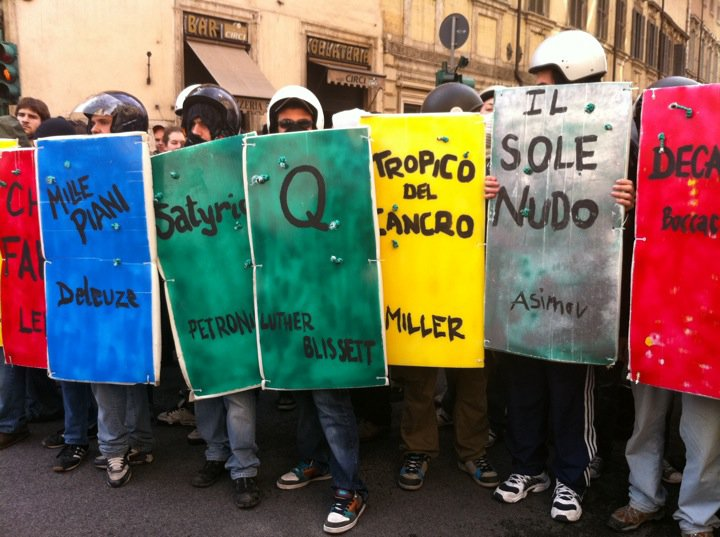
Literary protests – image from Wu Ming

Wu Ming kindly sent me a link to a better picture of the literary themed protests.

Posted in Politics, Universities, Wu Ming | 1 Comment