Marco Bresciani, Learning from the Enemy: An intellectual History of Antifascism in Interwar Europe – Verso, June 2024

Marco Bresciani, Learning from the Enemy: An Intellectual History of Antifascism in Interwar Europe – Verso, June 2024

The first comprehensive history of Italian revolutionary group Giustizia e Libertà

When democracy is under threat from authoritarianism, models of resistance must come to the fore. Giustizia e Libertà, founded by the Italian thinker and activist Carlo Rosselli in 1929, is one intriguing historical example. Operating both in exile and as part of a clandestine network at home, the organization fought against fascism and Nazism, while criticizing Stalinism. To defeat the enemy, the group aimed to go beyond the Marxist notion of class and to assert fresh concepts of nationhood and Europe. The book traces the group’s trajectories and debates and follows its legacy to the present.

Posted in Uncategorized | Leave a comment

Corey Ross, Liquid Empire: Water and Power in the Colonial World – Princeton University Press, July 2024

Corey Ross, Liquid Empire: Water and Power in the Colonial World – Princeton University Press, July 2024

In the nineteenth and twentieth centuries, a handful of powerful European states controlled more than a third of the land surface of the planet. These sprawling empires encompassed not only rainforests, deserts, and savannahs but also some of the world’s most magnificent rivers, lakes, marshes, and seas. Liquid Empire tells the story of how the waters of the colonial world shaped the history of imperialism, and how this imperial past still haunts us today.

Spanning the major European empires of the period, Corey Ross describes how new ideas, technologies, and institutions transformed human engagements with water and how the natural world was reshaped in the process. Water was a realm of imperial power whose control and distribution were closely bound up with colonial hierarchies and inequalities—but this vital natural resource could never be fully tamed. Ross vividly portrays the efforts of officials, engineers, fisherfolk, and farmers to exploit water, and highlights its crucial role in the making and unmaking of the colonial order.

Revealing how the legacies of empire have persisted long after colonialism ebbed away, Liquid Empire provides needed historical perspective on the crises engulfing the world’s waters, particularly in the Global South, where billions of people are faced with mounting water shortages, rising flood risks, and the relentless depletion of sea life.

Posted in Uncategorized | 1 Comment

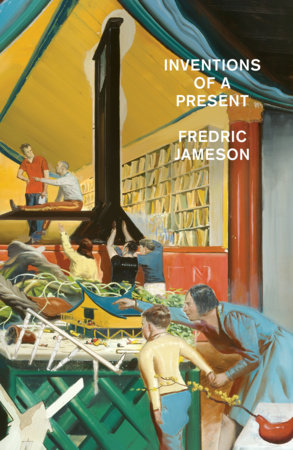
Fredric Jameson, Inventions of a Present – Verso, May 2024

Fredric Jameson, Inventions of A Present: The Novel in its Crisis of Globalisation, Verso, May 2024 – now published

The giant of literary theory analyses the novel: Conrad, James, Atwood, Oe, Mailer, Grass, Grossman, Garcia Marquez, Gibson, Knausgaard and more

A novel is an act, an intervention, which, most often, the naïve reader takes as a representation. The novel intervenes to modify or correct our conventional notions of a situation, and, in the best and most intense cases, to propose a wholly new idea of what constitutes an event or of the very experience of living.

The most interesting contemporary novels are those which try – and sometimes succeed – in awakening our sense of a collectivity behind individual experience; opening up a relationship between the isolated subjectivity and class or community. But even if this happens (rarely!), one must go on to find traces of collective praxis hidden away within the mere awakening of a feeling of multitude.

And, since it is in the sense of the nation and nationality that collectivity is most often expressed, it is urgent to disengage the possibilities of genuine action within these nationalisms.

This sweeping collection of essays ranges from the elusive politicality of North American literature to the sometimes frozen narrative experiences of the eastern countries and the old Soviet Union; from East Germany to Japan, Latin America and the Nordic countries. Like any such voyage, it is an arbitrary movement across the world of historical situations which, however, seeks to dramatize their common kinship in late capitalism itself.

Posted in Fredric Jameson | Leave a comment

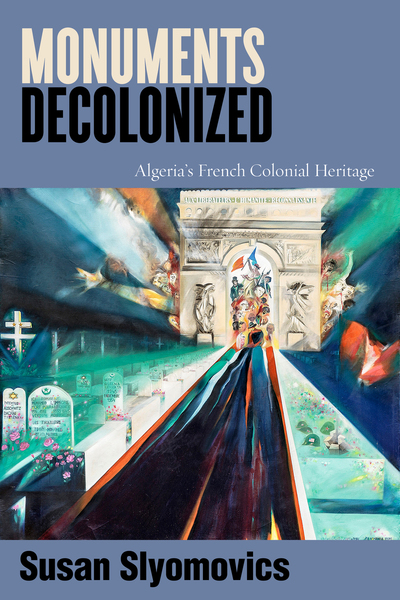
Susan Slyomovics, Monuments Decolonized: Algeria’s French Colonial Heritage – Stanford University Press, July 2024

Susan Slyomovics, Monuments Decolonized: Algeria’s French Colonial Heritage – Stanford University Press, July 2024

Introduction open access at the Stanford UP site; 20% discount code currently at www.sup.org with SLYOMOVICS20 (July 2024)

“Statuomania” overtook Algeria beginning in the nineteenth century as the French affinity for monuments placed thousands of war memorials across the French colony. But following Algeria’s hard-fought independence in 1962, these monuments took on different meaning and some were “repatriated” to France, legally or clandestinely. Today, in both Algeria and France, people are moving and removing, vandalizing and preserving this contested, yet shared monumental heritage.

Susan Slyomovics follows the afterlives of French-built war memorials in Algeria and those taken to France. Drawing on extensive fieldwork in both countries and interviews with French and Algerian heritage actors and artists, she analyzes the colonial nostalgia, dissonant heritage, and ongoing decolonization and iconoclasm of these works of art. Monuments emerge here as objects with a soul, offering visual records of the colonized Algerian native, the European settler colonizer, and the contemporary efforts to engage with a dark colonial past. Richly illustrated with more than 100 color images, Monuments Decolonized offers a fresh aesthetic take on the increasingly global move to fell monuments that celebrate settler colonial histories.

Posted in Uncategorized | Leave a comment

Martijn Konings, The Bailout State: Why Governments Rescue Banks, Not People – Polity, October 2024

Martijn Konings, The Bailout State: Why Governments Rescue Banks, Not People – Polity, October 2024

How did we end up in a world where social programs are routinely cut in the name of market discipline and fiscal austerity, yet large banks get bailed out whenever they get into trouble?

In The Bailout State, Martijn Konings exposes the inner workings of this sprawling infrastructure of government guarantees. Backstopping financial markets and securing banks’ balance sheets, this contemporary Leviathan manages the inflationary pressures that its generosity produces by tightening the financial screws on the rest of the population.

To a large extent, the bailout state was built by progressives seeking to buttress the institutions of the early postwar period. The resulting tide of capital gains fostered an asset-centered politics that experienced its heyday in the nineties. But ever since the financial crisis of 2007-08, promises of inclusive economic growth have looked increasingly thin. A colossus locked in place, the bailout state disburses its benefits to a rapidly shrinking group of property owners.  Against the backdrop of a ferocious post-pandemic turn to anti-inflationary policy, the only remaining way to exit the logic of the bailout, Konings argues, is to challenge the monetary drivers at the heart of capitalist society.

Posted in Uncategorized | Leave a comment

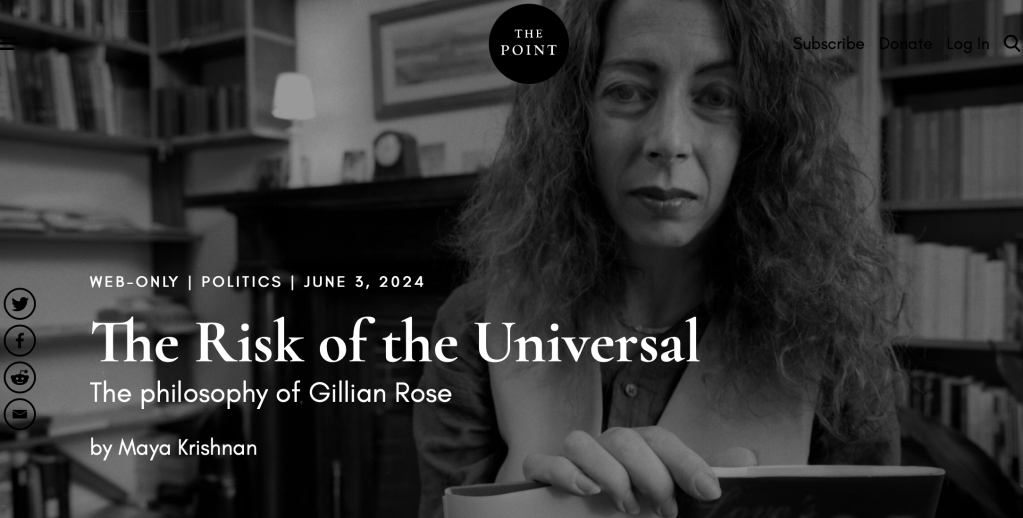
Maya Krishnan on the legacy of Gillian Rose

Maya Krishnan, The Risk of the Universal: The Philosophy of Gillian Rose

Posted in Gillian Rose | 1 Comment

Working with archives – a collection of links

A few links about working with archives. I’ve started a page on this site with these links. At the moment it is just the links below, but intended to be a work-in-progress page and I’ll add other things that look useful. Suggestions welcome.

These are all by others, but if there is interest I might write up a few thoughts of my own, particularly about using them for the history of ideas.

The National Archives, How to use archives

Mary Morrisey, Royal Historical Society, Working in Archives

Laura Schmdt, Using Archives: A Guide to Effective Research

Royal Geographical Society, Getting started with archival research

Royal Geographical Society, Top ten tips for researching in archives

Will Pooley, Doing Archival Research

Kate Stewart – series at Medium

Alessandro Silvestri, Making History through Archives (review of Stéphane Péquignot et Yann Potin (dir.), Les conflits d’archives : France, Espagne, Méditerranée, Presses universitaires de Rennes)

Happy to have other suggestions and will update this page with things I think are useful.

Posted in Uncategorized | 2 Comments

Jameson at 90: A Verso Blog Series – updated

Jameson at 90: A Verso Blog Series

Fredric Jameson turns 90 years old this month. To celebrate this milestone, we’re publishing a series of short essays focused on the major books in Jameson’s oeuvre.

Several new entries added recently.

Unintimidated languages – Daniel Hartley

On prophetic form and the whole tangled, dripping mass of the dialectic – Christopher Breu

Intense Curiosity – Matthew Beaumont

On Fredric Jameson’s Fables of Aggression – Ian Buchanan

History is what hurts – Maria Elisa Cevasco

Deep Listening – Phillip E. Wegner

Synchronic History – Kristin Ross

Negative Dialectics – C.D. Blanton

Historicizing the Present – Robert T. Tally

Inevitable Negations – Clint Burnham

Orienting towards the social totality – Alberto Toscano

Utopia Hurts – Christian P. Haines

On Brecht and Method – Olivier Neveux

Losing Historicity – Kirk Boyle

The becoming cultural of the economic, and vice versa – Xudong Zhang

Imagining Utopia – Gerry Canavan

Rereading “On Rereading Doktor Faustus” – Nicholas Brown

Jameson’s complex chord – Sianne Ngai

The Rebus in Fredric Jameson’s The Hegel Variations – Andrew Cole

Marxist interpretation as a vocation – Anna Kornbluh

Posted in Uncategorized | Leave a comment

A minor note on UK prime ministers and general elections

There have been twelve UK prime ministers in my lifetime – Heath, Wilson, Callaghan, Thatcher, Major, Blair, Brown, Cameron, May, Johnson, Truss, Sunak. Only five became prime minister because of a general election (Heath, Wilson, Thatcher, Blair, Cameron). Only four lost power because of an election (Heath, Callaghan, Major, Brown). So only one of those both became prime minister because of an election, and lost it because of one (Heath). (Wilson’s first term was before I was born.) All the others either gained power through an internal party process or lost it that way, sometimes both.

Because Heath was elected before I was born, I’ve never seen a PM both elected to that office and voted out of it. There is no profound point here, and certainly not a party political one, other than noting how rare it is that general elections make and end a Prime Minister’s term in office.

(Even Heath clung on to power for a few days after the February 1974 election, resigning when he failed to get an agreement with the Liberal Party to remain PM. Going further back, Wilson’s first term and Attlee are prime ministers both elected and defeated at a general election.)

Posted in Uncategorized | Leave a comment

Andy Merrifield, “A Life Full Circle: Gramsci in Sardinia”

Andy Merrifield, “A Life Full Circle: Gramsci in Sardinia

Posted in Uncategorized | Leave a comment