Jean-Paul Sartre’s Modern Times, older second-hand books by Alexandre Koyré and Antoine Meillet, the new edition of Key Thinkers on Space and Place, and Foucault, l’indiscipliné – Sciences Humaines, Les Essentiels hors-série 16, April-May 2024.
I am one of the new people included in this edition of Key Thinkers on Space and Place – a great honour to be in this important text. Many thanks to the editors for including me, and Rachael Squire and Kimberley Peters for writing a generous and thoughtful discussion of my work – mainly the parts on territory, volume and terrain.
“Tribes” appear worldwide today as vestiges of a pre-modern past at odds with the workings of modern states. Acts of resistance and rebellion by groups designated as “tribal” have fascinated as well as perplexed administrators and scholars in South Asia and beyond. Tribal resistance and rebellion are held to be tragic yet heroic political acts by “subaltern” groups confronting omnipotent states. By contrast, this book draws on fifteen years of archival and ethnographic research to argue that statemaking is intertwined inextricably with the politics of tribal resistance in the margins of modern India.
Uday Chandra demonstrates how the modern Indian state and its tribal or adivasi subjects have made and remade each other throughout the colonial and postcolonial eras, historical processes of modern statemaking shaping and being shaped by myriad forms of resistance by tribal subjects. Accordingly, tribal resistance, whether peaceful or violent, is better understood vis-à-vis negotiations with the modern state, rather than its negation, over the past two centuries. How certain people and places came to be seen as “tribal” in modern India is, therefore, tied intimately to how “tribal” subjects remade their customs and community in the course of negotiations with colonial and postcolonial states. Ultimately, the empirical material unearthed in this book requires rethinking and rewriting the political history of modern India from its “tribal” margins.
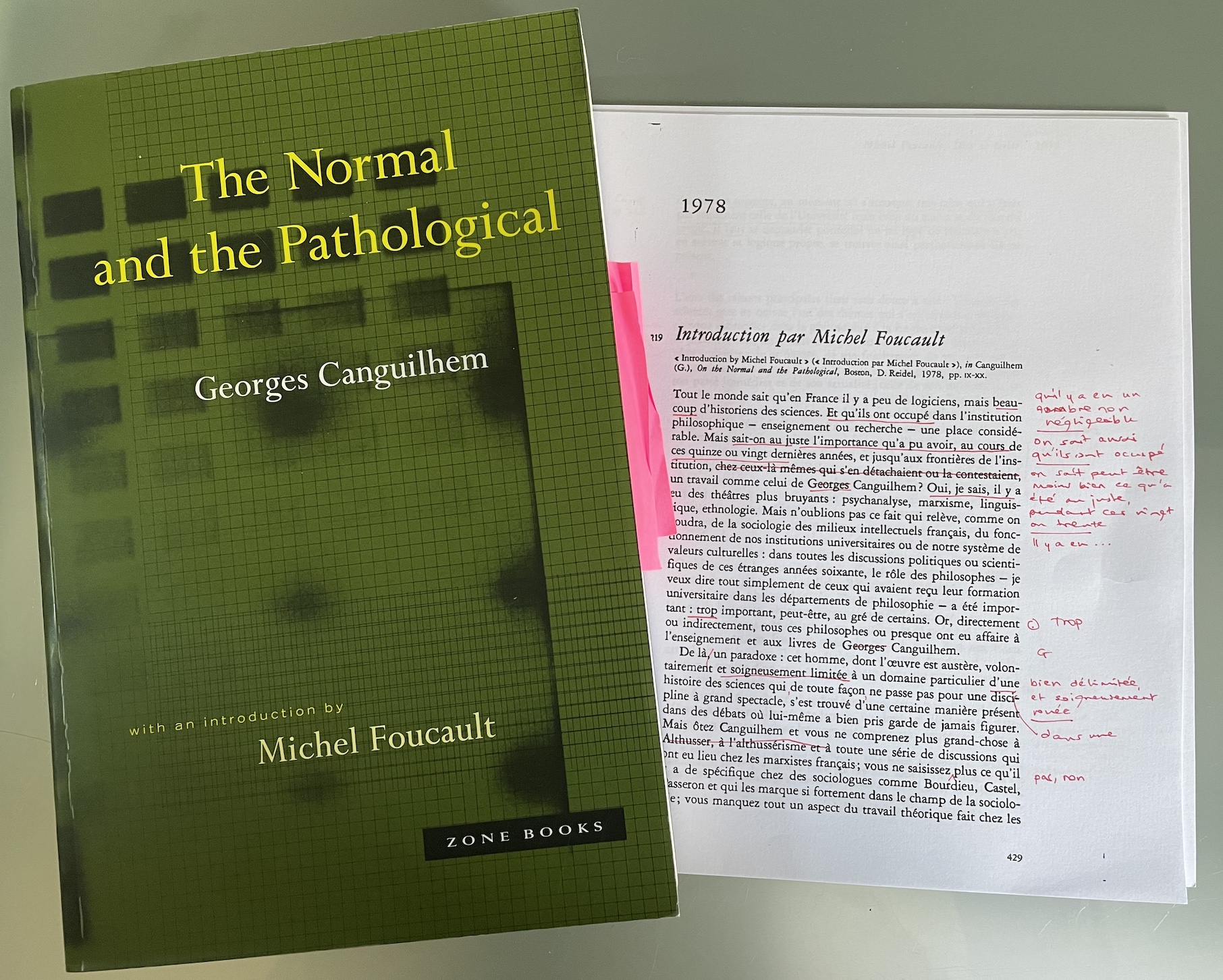
The Zone books re-edition of Canguilhem’s The Normal and the Pathological, along with a marked up copy of the French text of Foucault’s Introduction.
In 1978, Foucault contributed an introduction to the English translation of Georges Canguilhem’s The Normal and the Pathological. The French version is included in Dits et écrits as text 219. (No translator is indicated, which suggests the editors had access to the original French text.) Right at the end of his life, Foucault revised the text for a theme issue of Revue de métaphysique et de morale, published after his death and reprinted as Dits et écrits text 364. An online version of the latter is here. The second text was translated in Essential Works as “Life: Experience and Science”, Vol 2, 465-78.
In an editorial note Dits et écrits says “Épuisé, il ne put que modifier la préface… Il remit ce texte fin avril 1984; ce fut donc le dernier auquel il donna son imprimatur [Exhausted, he could only modify the preface… He submitted this text at the end of April 1984; it was therefore the last he approved for publication]”.
As far as I know, nobody has compared the two texts to see the modifications Foucault made. The full analysis is here.
Many changes are minor, but some are more interesting. Minor changes to punctuation, Georges replaced by G., etc. are not noted, but I hope all the other changes are. Corrections and additions are of course welcome.
There are lots of other resources on this site relating to Foucault – bibliographies, audio and video files, some other textual comparisons, some short translations, etc. They are listed here. There are resources relating to other thinkers and topics listed here.
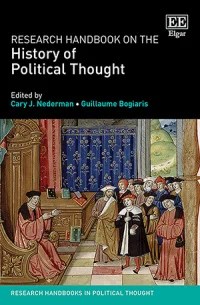
This insightful Handbook reviews the key frameworks guiding political scientists and historians of political thought. Comprehensive in scope, it covers historical methodology, traditions, epochs, and classic authors and texts, spanning from ancient Greece until the nineteenth century.
Elucidating the evolution and current state of the field, the Handbook emphasizes the value of studying the history of political ideas to gain a critical perspective on our own embedded cultural predispositions. Authors analyze various intellectual schools, such as Stoicism, Christianity, Islam, Liberalism, Republicanism, and Libertarianism, and discuss hermeneutical strategies to reading historical texts, including approaches from the Cambridge School and the Straussians. Providing a broad overview of Western political ideas, an international range of contributors also demonstrate cognizance of global theoretical movements and their significance for historical inquiry. They reexamine the standard canon of political thinkers in light of topics such as gender, colonization, and race, exploring the ideas of, amongst others, Plato, Aristotle, Cicero, Machiavelli, Hobbes, Locke, Wollstonecraft, and Marx.
Accessible to undergraduate and postgraduate students as well as established scholars, this Handbook is a crucial resource for academics in political science, philosophy, intellectual history, and economics, as well as scholars who study economic thought, law and politics. It will also appeal to scholars seeking a clear understanding of the key concepts that continue to influence contemporary theory and research across the social sciences.
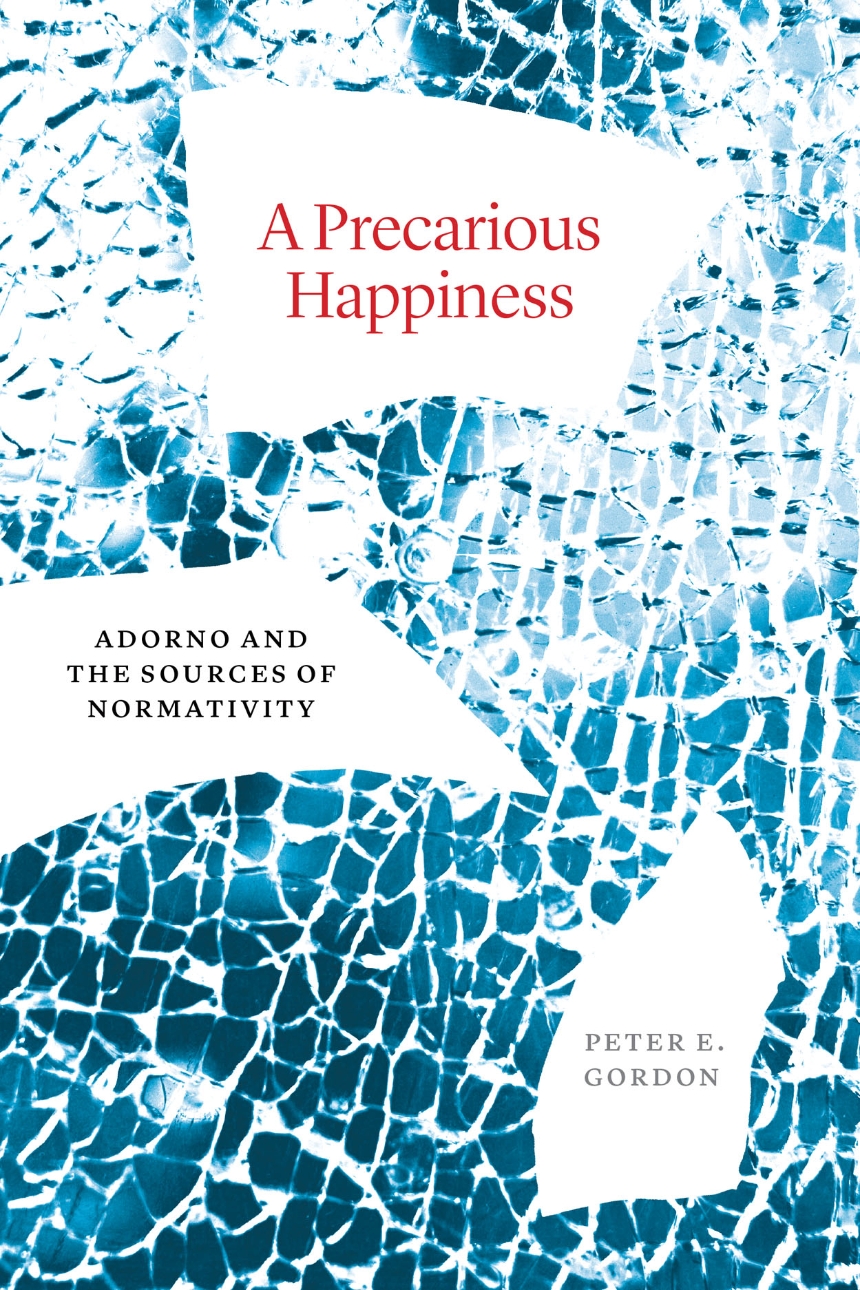
A strikingly original account of Theodor Adorno’s work as a critique animated by happiness.
“Gordon’s confidently gripping and persistently subtle interpretation brings a new tone to the debate about Adorno’s negativism.”—Jürgen Habermas
Theodor Adorno is often portrayed as a totalizing negativist, a scowling contrarian who looked upon modern society with despair. Peter E. Gordon thinks we have this wrong: if Adorno is uncompromising in his critique, it is because he sees in modernity an unfulfilled possibility of human flourishing. In a damaged world, Gordon argues, all happiness is likewise damaged but not wholly absent. Through a comprehensive rereading of Adorno’s work, A Precarious Happiness recovers Adorno’s commitment to traces of happiness—fragments of the good amid the bad. Ultimately, Gordon argues that social criticism, while exposing falsehoods, must also cast a vision for an unrealized better world.
The three texts published here were written in the mid-1970s….
Here I explain how these came about.
Back in 1974, I was teaching on a Modern Politics and History degree at Manchester. This involved modern historians from the History Department and members of POLSIS, the politics department. There was some concern that the academics from the two departments did not communicate with each other but taught their respective courses quite separately.
It was suggested that one way to address this problem would be to organise joint seminars on subjects of shared concern. The running was made by Terry Ranger of the History department. His initiative, which turned out to be a one-off achievement, took the form of organising three seminars discussing two recently published books by Perry Anderson: Passages from Antiquity to Feudalism and Lineages of the Absolute State. In each seminar, Mike Evans of POLSIS considered questions of Marxist theory and method involved in the particular historical problems under consideration. He was then followed by an historian. In the second seminar, Ian Kershaw (best known now as an historian of the Third Reich, especially his biography of Hitler, but, at the time, a lecturer in medieval economic history) criticised Anderson’s arguments about the feudal mode of production and the transition from feudalism to capitalism. So, the first two seminars were devoted to the slimmer, first volume. I was the historian tasked subjecting the whole of the Lineages book to critique in the third seminar. What is more, Ranger invited Anderson to attend that seminar. (Mischievously, Ranger did not introduce us to each other before the seminar began and challenged me to recognise Anderson – whom I had never met before – from how he listened to my critique! It was obvious who he was within about 30 seconds.) We had a very good discussion.
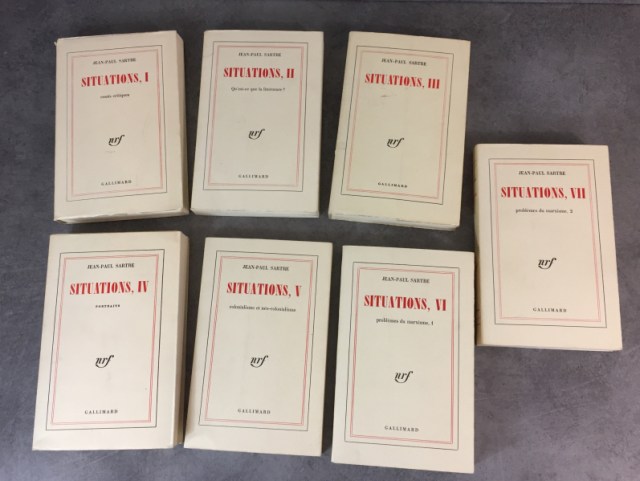
I previously grumbled about how hard it was to navigate Jean-Paul Sartre’s Situations. I went looking for an essay in the French, only to find it was in one volume of the original edition and a different volume of the revised edition. I then found this wasn’t an isolated example, but that the second edition broke with Sartre’s own organisation and went with a more chronological one, including many essays he hadn’t. There are good reasons for that, but calling it Situations again seems needlessly confusing. Chroniques might have been clearer.
Finding an essay in English translation can also be a challenge. There are multiple, overlapping but not entirely comprehensive collections of his essays in English. Some essays have been translated more than once; others it seems not at all.
This page is an attempt to make sense of the first few volumes of the first edition, with links to the useful French Wikipedia articles and Gallimard pages which give details of material in the second editions, and a list of the places where essays are available in English. I’ve not yet included the Seagull thematic volumes, which include many of these pieces. And I’m sure I’ve missed some of the pieces which appeared in journals or other collections. Corrections and additions welcome. As with the other resource pages on this site, this is intended to be a work in progress.
A photograph of seven volumes of the first edition, taken from an auction site.
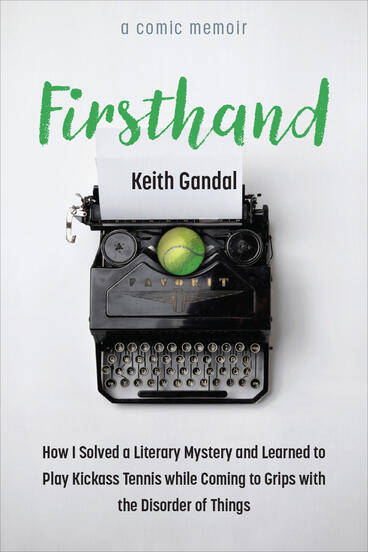
Firsthand is an exploration—both suspenseful and comic—of the creative process in research writing. The book takes the reader through the ins and outs of a specific research journey, from combing through libraries and archives to the intellectual challenges involved with processing information that contradicts established ideas. More fundamentally, it addresses the somewhat mysterious portion of the intellectual process: the creative and serendipitous aspects involved in arriving at a fruitful research question in the first place.
Keith Gandal combines this scholarly detective story with a comic personal narrative about how a midlife crisis accidentally sent him on a journey to write a research monograph that many in his profession—including at times himself—were dubious about. While researching how Hemingway, Fitzgerald, and Faulkner faced their forgotten crises of masculinity, Gandal discovers that his own crisis is instrumental to his creative process. Incorporating stories from Gandal’s comic romp through the hyper-competitive world of middle-aged men’s tennis, adopting pitbulls, and discussing Michel Foucault, Firsthand gives readers an inside look at how to acquire accurate knowledge—about the world, about history, and about oneself.
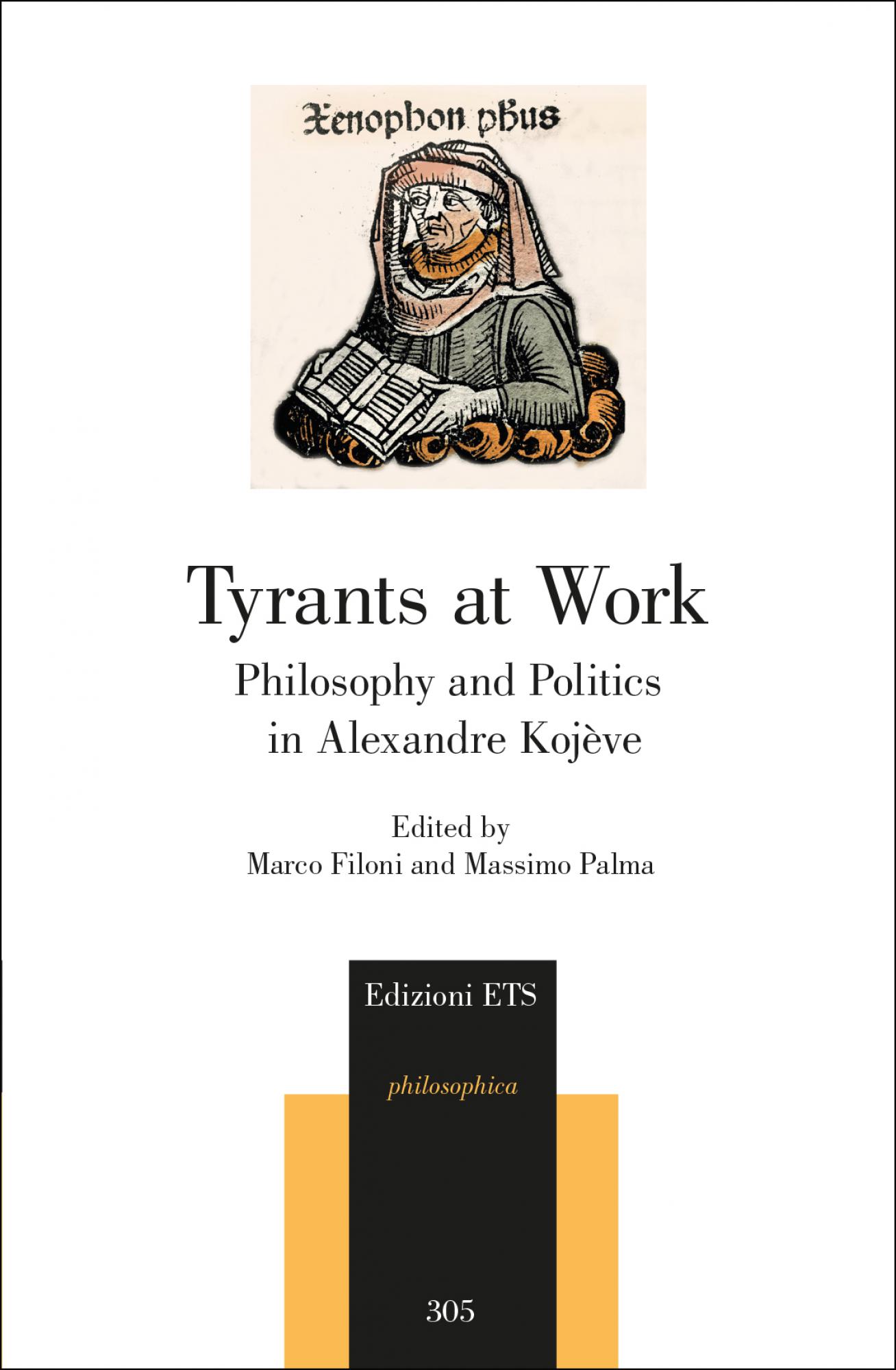
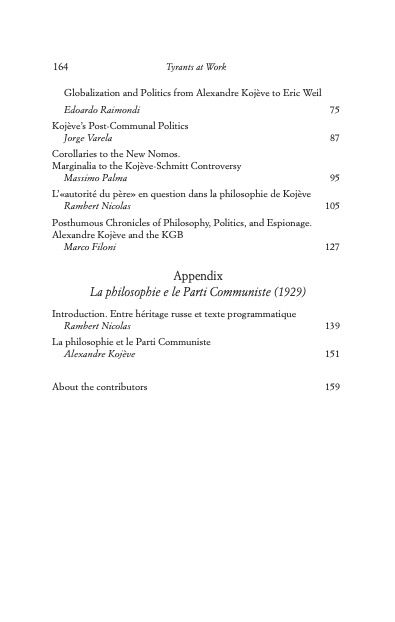
This volume wants to restore the depth and contradictions – both theoretical and biographical, political and speculative – of Alexandre Kojève. An author who wrote a lot, but published very little – leaving thousands of pages destined for oblivion or research. And research, after so much Kojèvian mythology, has recently opened up. Many have begun to delve into archives, translate unpublished works, and seek new sources. The contributions in this book start from this need: to study the entire corpus of Kojève, combining hermeneutical and philological approaches, reconstructing the biographical path with an investigation of intellectual alliances and hostilities.
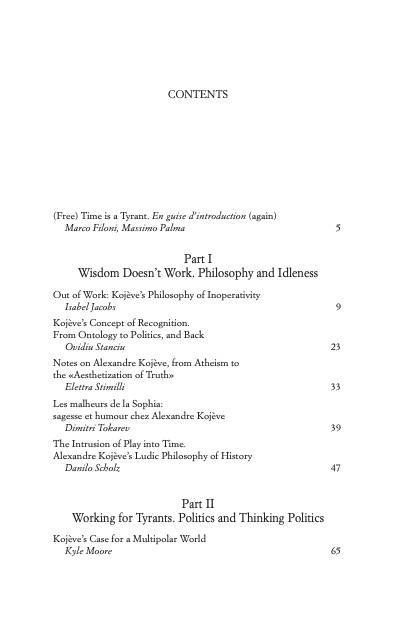
The table of contents is in the images below – clicking on each will bring up a larger image.
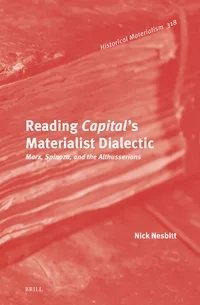
While the explicit Althusserian engagement with Marx’s Capital remained largely limited to Reading Capital, after 1968, Nick Nesbitt argues, this theoretical intervention remained insistent, adopting the form of a general theory of materialist dialectic. The book thus analyzes the Althusserianist theory of a materialist dialectic across diverse sites including Althusser’s unpublished archive, Macherey’s exposition of Spinoza’s Ethics, and Badiou’s Logics of Worlds, while simultaneously bringing this fully-developed theory of materialist dialectic to bear anew on the reading of Capital itself, to show that Spinoza’s influence on Marx is far greater–and that of Hegel increasingly diminishing–than has been previously thought.