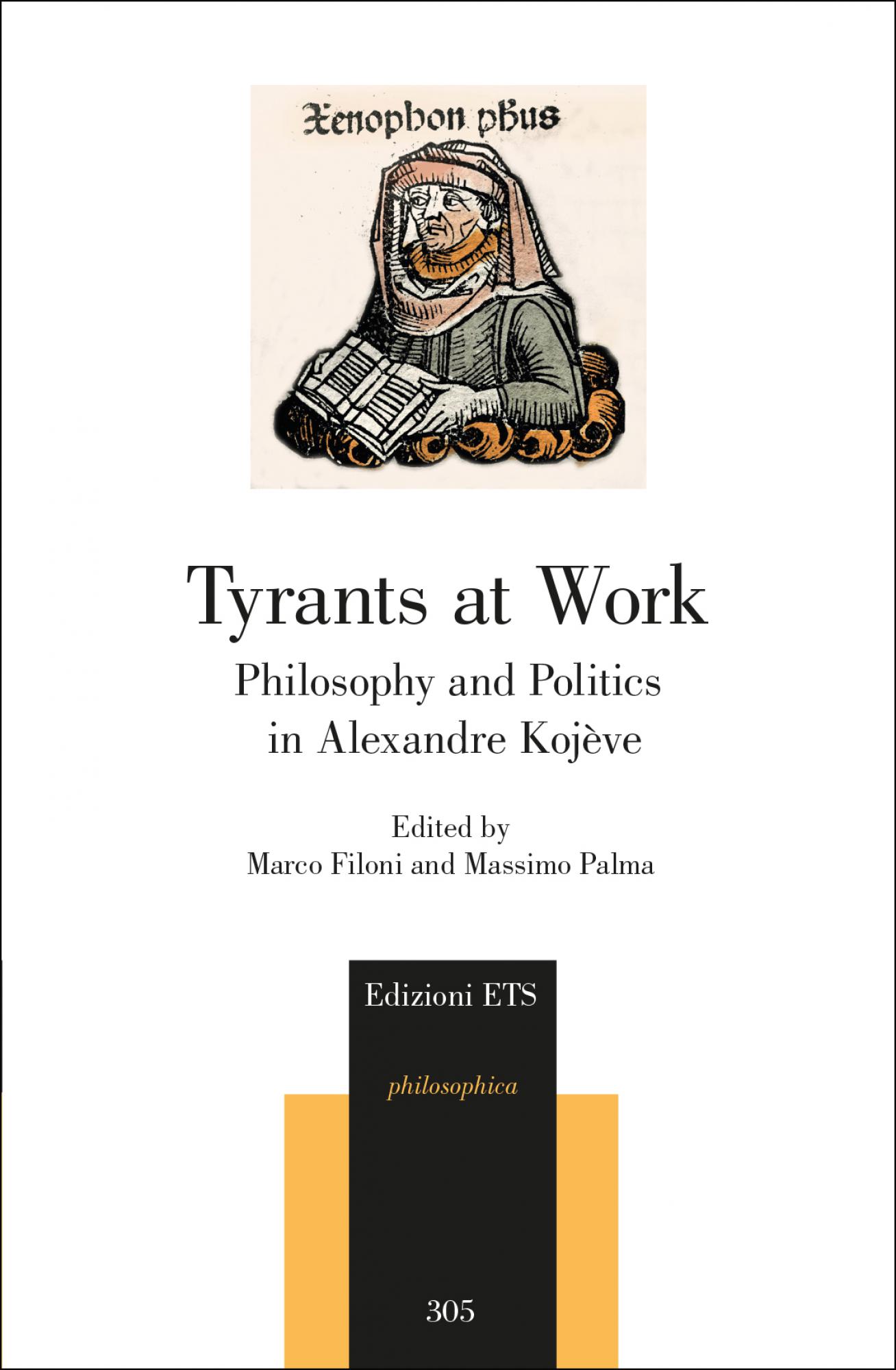
This volume wants to restore the depth and contradictions – both theoretical and biographical, political and speculative – of Alexandre Kojève. An author who wrote a lot, but published very little – leaving thousands of pages destined for oblivion or research. And research, after so much Kojèvian mythology, has recently opened up. Many have begun to delve into archives, translate unpublished works, and seek new sources. The contributions in this book start from this need: to study the entire corpus of Kojève, combining hermeneutical and philological approaches, reconstructing the biographical path with an investigation of intellectual alliances and hostilities.
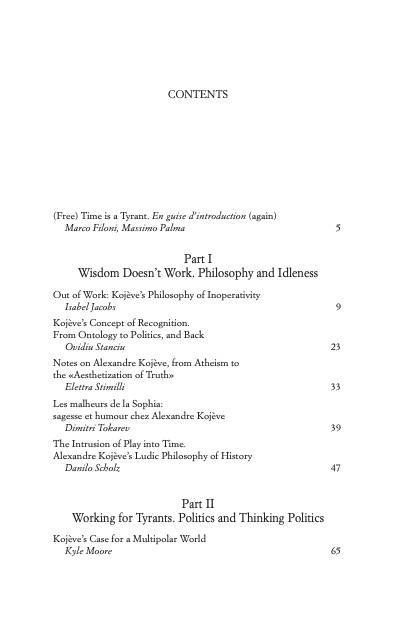
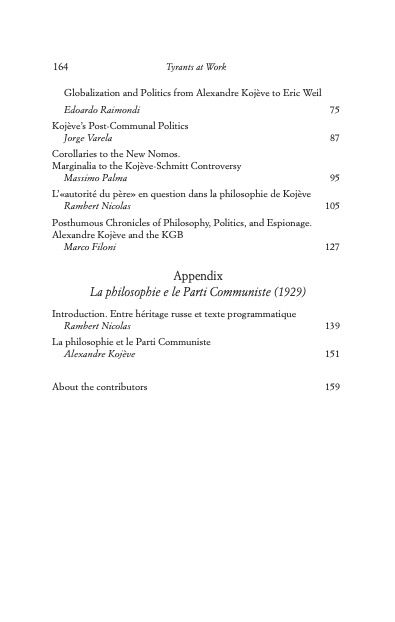
The table of contents is in the images below – clicking on each will bring up a larger image.
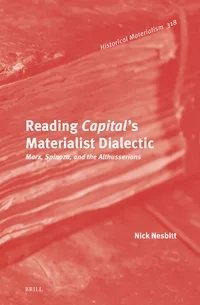
While the explicit Althusserian engagement with Marx’s Capital remained largely limited to Reading Capital, after 1968, Nick Nesbitt argues, this theoretical intervention remained insistent, adopting the form of a general theory of materialist dialectic. The book thus analyzes the Althusserianist theory of a materialist dialectic across diverse sites including Althusser’s unpublished archive, Macherey’s exposition of Spinoza’s Ethics, and Badiou’s Logics of Worlds, while simultaneously bringing this fully-developed theory of materialist dialectic to bear anew on the reading of Capital itself, to show that Spinoza’s influence on Marx is far greater–and that of Hegel increasingly diminishing–than has been previously thought.
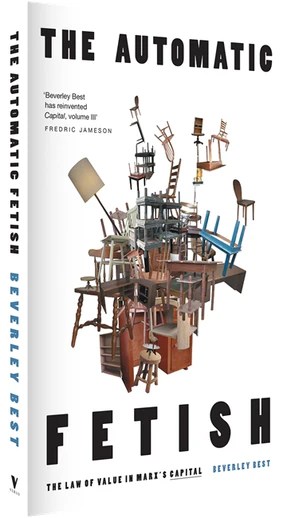
Why the neglected third volume of Capital holds the key to Marx’s theory of value
The Automatic Fetish traces Marx’s analysis of capital, step by step, through the material compiled posthumously as the third volume of Capital. Identifying the critique of value as the central through line of the entire work, Beverley Best elaborates a theory of movement through which the capital machine generates social forms of appearance as the inversion of its inner operating mechanisms. Neither a return to basics nor a new-fangled reconstruction, The Automatic Fetish eschews novelty to show once again that Marx rewards careful study.
– ‘If I had to choose one book that would make the case for the relevance of Marx’s critique of political economy to the humanities, this might very well be it’ Colleen Lye, co-editor of After Marx – ‘The contribution of The Automatic Fetish is hard to exaggerate’ Nicholas Brown, author of Autonomy – ‘Will make a significant contribution to the wider field of materialist theory’ Joshua Clover, author of Riot. Strike. Riot – ‘In Best’s hands, Capital becomes not only fascinating but useful, down to its last detail. Written with clarity, focus, and urgency, Best has “unreconstructed” Marx for our times’ Richard Dienst, author of The Bonds of Debt – ‘A groundbreaking book’ Werner Bonefeld, author of A Critical Theory of Economic Compulsion – ‘That rare work of theory whose practical implications just sing out loud … Surely among the most useful books on Capital III ever written’ Christopher Nealon, author of The Matter of Capital – ‘Brilliant, eloquent, and precise. Best has given us one of the most profound re-readings of Capital to have appeared in a generation and an essential source’ Neil Larsen, author of Determinations
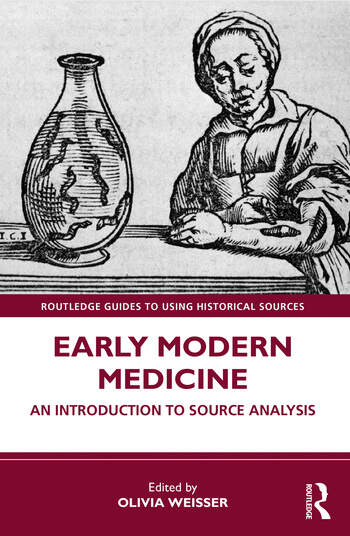
This collection offers readers a guide to analyzing historical texts and objects using a diverse selection of sources in early modern medicine. It provides an array of interpretive strategies while also highlighting new trends in the field.
Each chapter serves as a study of a different type of source, including the benefits and limitations of that source and what it can reveal about the history of medicine. Contributors provide practical strategies for locating and interpreting sources, putting texts and objects into conversation, and explaining potential contradictions. A wide variety of sources, including account books, legal records, and personal letters, provide new opportunities for understanding early modern medicine and developing skills in historical analysis. Together, the chapters highlight emerging methodologies and debates, while covering a range of themes in the field, from reproductive health to hospital care to household medicine.
With wide geographical breadth, this book is a valuable resource for students and researchers looking to understand how to better engage with primary sources, as well as readers interested in early modern history and the history of medicine.
I just looked for an essay in one of Jean-Paul Sartre’s Situations. What a chaotic mess the different editions and translations are. The English text with the title Situations (1965) is a partial translation of volume IV. Qu’est-ce que la littérature? [What is Literature?] is in volume II of the first edition, and volume III of the later more chronological one, and available as a separate text in French and English. The English collection Literary and Philosophical Essays picks essays from volumes I and III. The reprint edition of Situations I as Critiques littéraires is of the first edition, not the updated one; the English Critical Essays is a complete translation of the first edition, but not the second edition which came out the same year as the translation. Situations philosophiques reprints texts from different volumes. Situations V has the subtitle Colonialisme et néo-colonialisme, and is translated as Colonialism and Neocolonialism, but I don’t think the English is of the updated version. The first edition of Situations III is translated as The Aftermath of War, but there is also a volume with the same press called Post-War Reflections, which has just the first two parts. There are also a bunch of thematic volumes with Seagull that translate many of these essays – but follow neither Sartre’s initial organisation nor the more chronological second edition. I’m sure there are more confusions.
[update 21 June 2024: a more systematic outline of contents and translations is here.]
The French wikipedia pages are useful – start with Situations I and follow the Chronologie for the other nine volumes. This says what is in the first and later edition of each volume, But has any ever tried to do a bibliography of where the essays are translated? My quick sense is that some essays are available in more than one translation, and certainly in more than one English collection, but that there are other essays which haven’t been translated. I was only, initially, looking for one piece, but it’s opened up what seems to be a really chaotic situation…
Update: Modern Times has some of the essays – some available elsewhere, others not. Portraits is a complete translation of the first edition of SituationsIV. Thanks to Patrick ffrench for the information on the first. The essay I was looking for, “Qu’est-ce qu’un collaborateur?” is in Situations III in the first edition and II in the second.
Update 17 and 18 June: my quick take on what should have been done is this. By all means produce a chronological reordering of material, including other essays, but do it systematically and don’t call it the same thing as the earlier French edition – Chroniques, for example. Or add supplemental essays to the existing arrangement. And with the translations, either do all new translations on a systematic basis, which seems to be what Seagull were doing initially, or translate the essays which are not already in English in thematic volumes. Chris Turner has done a huge amount of work with this, but the thematic volumes with Seagull look like they include a lot of previously translated material.
I know from the Foucault shorter essays how difficult it is – Essential Works reprinted a lot of previously available material, but without completely making any previous collection redundant, along with much new material. But its selection of material from Dits et écrits has made it difficult to propose a more systematic version – so many of the ‘best’ essays are already available, often in multiple collections. It has taken Richard Lynch’s bibliographical labours, now being updated by Daniele Lorenzini, to make sense of the English translations.
But from my initial look at the Sartre essays, it seems the case is even more complicated, as there are two French editions. I should also say I’m not against translations which select essays – that was done with a couple of Lefebvre collections I co-edited, for example. There are good reasons for this – not all the essays in a French collection are of the same interest for an Anglophone audience, choices might need to be made for cost, etc. But with Lefebvre we’ve tried to avoid reprinting essays which are already translated, usually only if they were incomplete initially or in hard-to-find places.
Very good to see this book scheduled. (update May 2025: it is now scheduled for August 2025. I’ve added the cover.)
‘Richard Wilson’s meticulously researched, powerfully argued and brilliantly written account of Shakespeare’s 20th-century fascist followers is not just an important but a genuinely essential book.’ Robert Shaughnessy, Guildford School of Acting, UK In this illuminating book, Richard Wilson demonstrates how in the 20th century Shakespeare and his plays were subjected to a sustained institutionalized misreading, which served the purposes of proto-, present and future fascism. It exposes how Shakespeare was misappropriated by the far right to represent Britain’s supposedly glorious history, and the ways in which they utilized him and the cultural capital of his work. Wilson argues that in Britain the plays were invoked as a way to anglicize fascism, as its leaders campaigned ‘to recover theatre for the national cause’ by ‘looking back fondly to Elizabethan England’. His extensive and rigorous research also gestures beyond Britain, taking in case studies from North America, Germany and France.
Some of the names this book unearths will surprise: many of the right-wing political views or leanings of the prominent figures discussed have been brushed under the carpet, left unexplored or ignored. Across its ten chapters, this book provides in-depth case studies of a wide variety of figures, from A. K. Chesterton, who was both editor of the British Union of Fascists’ newspaper Blackshirt and former manager of press and publicity at the Shakespeare Memorial Theatre, to celebrated Shakespeareans such as G. Wilson Knight, through to writers, artists and theatre practitioners including W. B. Yeats, T. S. Eliot, Edward Gordon Craig and Philip Larkin, among many others. At a time when democracy is under threat, populism is on the rise and far right views are increasingly prominent in our political landscape, Richard Wilson’s book makes an especially vital and timely contribution to Shakespeare scholarship.
A British Academy conference exploring horizons and methods of a critical theory for the 21st century
Venue: Stewart House 2/3, Senate House London
Dates: 12 and 13 July, 2024 from 10:00 am to 6:00 pm BST
Taking as its premise the notion that critical languages move multi-directionally between a plurality of centres rather than disseminate from a single, metropolitan axis of power, this conference considers the emergences, conflicts, suppressions, adaptations and mutations of concepts that take place at a distance from the loci traditionally associated with critical theory—metropolitan Europe, North America. The speakers explore, inter alia, cases of conceptual cross-pollinations across worlds and histories beyond the “Global North”; and the influence, facilitated by variously colonial and imperial conditions of linguistic and philosophical translation, of concepts from the “Global South” on the development of critical theory. Broadly construing critical theory to include not only Frankfurt School Critical Theory but also feminist and gender theory, eco-criticism, psychoanalysis, and postcolonial and decolonial theory among others, the conference will have a dual aim: (i) to frame critical theory as a productively unstable entity that retains intelligible markers of its origins in sociopolitical and epistemological “crises”; and (ii) “map” the historical and contemporary diversity of critical keywords, their translations, and the tools they provide us for articulating the emancipatory potentials of vocabularies be they indigenous, hybrid, or global.
Free and open to the public, though registration is required. To register, please visit here:
** N.B. Due to the UCU boycott of Goldsmiths and in solidarity with the staff who are currently at risk of redundancy due to the restructure planned by Goldsmiths’ management, this conference has been moved from campus to an alternative location and dissociated from Goldsmiths. We thank you for your understanding and support.
(For updates and more information, including abstracts, please visit here)
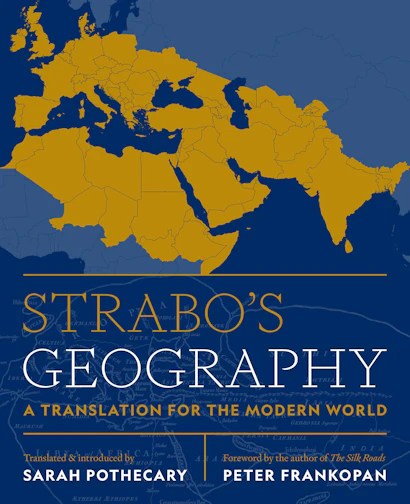
Strabo’s Geography is an encyclopedic description of the ancient world as it appeared to a contemporary observer in the early Roman empire. Information about taming elephants, collecting saffron, producing asphalt, and practicing yoga is found alongside accounts of prostitution, volcanic activity, religious festivals, and obscure eastern dynasties—all set against the shifting backdrop of political power in the first century CE. Traveling around the Mediterranean, Strabo gathered knowledge of places and people, supplementing his firsthand experiences with an immense amount of reading to create a sweeping chronicle that attempts to answer the implicit questions “Who are we?” and “Where do we come from?” Sarah Pothecary’s new translation of Strabo’s complete Geography makes this important work more accessible, relevant, and enjoyable than ever before.
Conveying the informal, lively, and almost journalistic style of Strabo’s Greek, this translation connects the ancient and modern worlds by providing modern names and maps for places mentioned in the text, a generous page layout, and marginal notes, allowing readers to appreciate Strabo’s work directly and immediately. The result mimics what Strabo was doing two thousand years ago—relating the rapidly changing present of his original readers to their own ancient past.
A remarkably modern translation of a revealing window on the ancient world, this is essential reading for anyone interested in how we look at both antiquity and the world today.
Theatres of Value explores the idea that buying and selling are performative acts and offers a paradigm for deeper study of these acts—”the dramaturgy of value.” Modeling this multifaceted approach, the book explores six case studies to show how and why Shakespeare had value for nineteenth-century New Yorkers. In considering William Brown’s African Theater, P. T. Barnum’s American Museum and Lecture Hall, Fanny Kemble’s American reading career, the Booth family brand, the memorial statue of Shakespeare in Central Park, and an 1888 benefit performance of Hamlet to theatrical impresario Lester Wallack, Theatres of Value traces a history of audience engagement with Shakespearean cultural capital and the myriad ways this engagement was leveraged by theatrical businesspeople.
Jacques Rancière on Eric Hazan at Sidecar – Grand Éditeur
There is an infinitely reductive way of commemorating Eric Hazan, simply by saluting him as a courageous publisher and defender of the radical left, an unyielding supporter of the rights of the Palestinians and a man who, against the grain of his times, so believed in revolution that he devoted a book to the first measures to be taken on the morning after.
He was certainly all these things, but we first need to register the essential point: in an age when the word ‘publishing’ conjures up empires of businessmen for whom everything is a commodity, even the most nauseating ideas, he was first and foremost a great publisher. This was not simply a matter of competence. It was much more a question of personality. And Eric was an exceptional personality: possessed of a mind curious about everything, a scientist by training and neurosurgeon in a previous life, but also a connoisseur of the arts and lover of literature; a city-dweller, sensitive to the living history of every stone in the street; an open and welcoming man with a radiant smile and eloquent handshake, eager to communicate his passions, to share his discoveries and convince others – without preaching – of what he considered to be the exigences of justice.
…
This article was originally published in French in Libération.