
I’ve mentioned this before, but the Henri Lefebvre who wrote Les unités perdues (2004, 2011), translated by David L. Sweet as The Missing Pieces (2014), is not the Henri Lefebvre who wrote The Production of Space and The Critique of Everyday Life, among many other works.
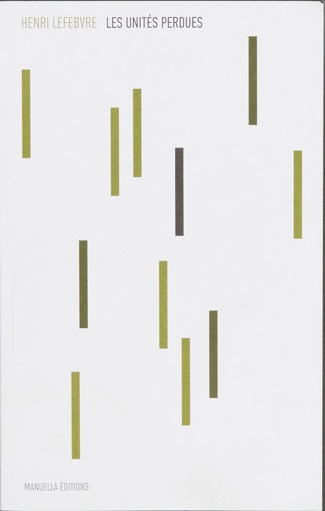
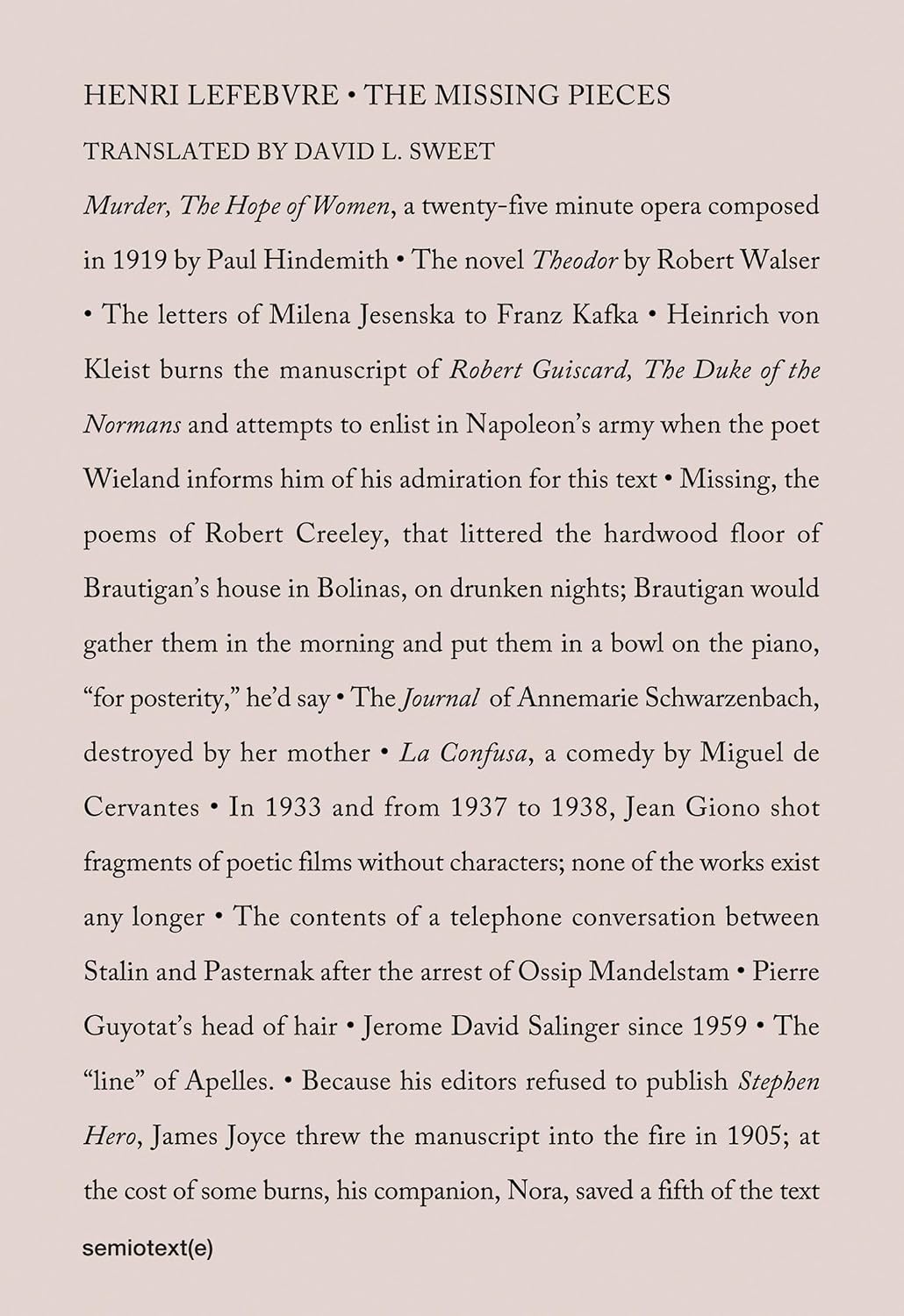
For one thing, the more famous one was long dead when The Missing Pieces was published. The book’s final remarks are dated to 2004 (p. 85). Its author also did interviews about it at the time of publication – i.e. here.
Henri Lefebvre is a common name – Lefebvre is close to the French equivalent of Smith, and you would not assume that everyone named Henry Smith was the same person.
But I’ve seen a couple of places where people have thought that this Henri Lefebvre is that Henri Lefebvre. The author of The Missing Pieces is a poet and publisher born in 1959, as the book’s “About the Author” indicates. The book is an interesting and stylistically innovative text on abandoned, lost, destroyed, forgotten and unfinished works. Previously a short excerpt was available on the Berfrois website, but that’s – perhaps fittingly – vanished along with the rest of its archive including the pieces I wrote for them.
Here’s the publisher description for the English edition, the first paragraph of which (or the cover above) gives an indication of the book’s style:
• A boarder for two years following a national funeral, Mirabeau is removed from the Pantheon and transferred to the cemetery of Clamart when his pornographic novels are discovered • A photograph taken by Hessling on Christmas night, 1943, of a young woman nailed alive to the village gate of Novimgorod; Hessling asks his friend Wolfgang Borchert to develop the film, look at the photograph, and destroy it • The Beautiful Gardener, a picture by Max Ernst, burned by the Nazis
—from The Missing PiecesThe Missing Pieces is an incantatory text, a catalog of what has been lost over time and what in some cases never existed. Through a lengthy chain of brief, laconic citations, Henri Lefebvre evokes the history of what is no more and what never was: the artworks, films, screenplays, negatives, poems, symphonies, buildings, letters, concepts, and lives that cannot be seen, heard, read, inhabited, or known about. It is a literary vanitas of sorts, but one that confers an almost mythical quality on the enigmatic creations it recounts–rather than reminding us of the death that inhabits everything humans create.
Lefebvre’s list includes Marcel Duchamp’s (accidentally destroyed) film of Man Ray shaving off the Baroness Elsa von Freytag-Loringhoven’s pubic hair; the page written by Balzac on his deathbed (lost); Spinoza’s Treatise on the Rainbow (thrown into a fire); the final seven meters of Kerouac’s original typescript for On the Road (eaten by a dog); the chalk drawings of Francis Picabia (erased before an audience); and the one moment in André Malraux’s life in which he exclaimed “I believe, for a minute, I was thinking nothing.” The Missing Pieces offers a treasure trove of cultural and artistic detail and will entertain even those readers not enamored of the void.
The Publisher’s Weekly tries to warn people off making the confusion, while praising the work: “Each sentence or phrase in this haunting project from French poet and publisher Lefebvre (not to be confused with the Marxist philosopher) describes something lost, erased, destroyed, or otherwise unfinished within the life of an artist”. A review by Daniel Barbiero does the same thing. But one review on Amazon complains of their disappointment that it was not by the more famous person – and rather unfairly only gives it three stars as a result.
This is my fault for not reading the “About the author,” but I was disappointed that this is not the Henri Lefebvre of “Right to the City” or “The Production of Space.” If your name is Henri Lefebvre and you didn’t write those two books, you should probably mention that somewhere in the description, something like “The contemporary poet Henri Lefebvre.”
But here’s the amusing bit. In The Missing Pieces, Henri Lefebvre (2) makes a passing reference to Henri Lefebvre (1). It’s not about his fabled missing study of rural sociology, which his biographer Rémi Hess recounts was stolen from a car parked near the Panthéon (pp. 169-70), and which Adam David Morton and I discuss briefly in our introduction to On the Rural (pp. xii-xiv). Rather, it’s about the acrimonious falling out between Lefebvre and the Situationists, which was probably to do with women and accusations of plagiarism: “We no longer know why Henri Lefebvre fell out with Guy Debord” (p. 34). It’s almost as if he’s inviting the confusion.
References
Daniel Barbiero, “The Missing Pieces by Henri Lefebvre”, February 2025, https://www.arteidolia.com/lost-found-the-missing-pieces/
Damien Guggenheim, “The Missing Pieces: An Interview with Henri Lefebvre”, trans Ian Monk, 2023, https://jeudepaume.org/en/palm/les-unites-perdues/
Rémi Hess, Henri Lefebvre et l’aventure du siècle, Paris: A.M. Métailié, 1988.
Henri Lefebvre, On the Rural: Economy, Sociology, Geography, eds. Stuart Elden and Adam David Morton, trans. Robert Bononno and others, Minneapolis: University of Minnesota Press, 2022.
Henri Lefebvre, Les unités perdues, Paris: Manuella, 2011; The Missing Pieces, trans. David L. Sweet, South Pasadena: Semiotext(e), 2014.
This is the 89th post of a weekly series, posted every Sunday throughout 2025, and continuing into a second year. The posts are short essays with indications of further reading and sources. The pieces are not as formal as something I’d try to publish more conventionally, but are hopefully worthwhile as short sketches of histories and ideas. They are usually tangential to my main writing focus, a home for spare parts, asides, dead-ends and possible futures. I hope there is some interest in them. They are provisional and suggestions are welcome. A few, usually shorter, pieces in a similar style have been posted mid-week.
The full chronological list of ‘Sunday histories’ is here, with a thematic ordering here.
Discover more from Progressive Geographies
Subscribe to get the latest posts sent to your email.


Pingback: No, not that Henri Lefebvre – The Missing Pieces | Rashid's Blog: A Place for Inquisitive Souls
Pingback: The other Henri Lefebvre – excerpt from The Missing Pieces in Berfrois | Progressive Geographies
Pingback: No, not that Henri Lefebvre – The Missing Pieces | Rashid's Blog: A Place for Inquisitive Souls