
Back in 2024 I complained about how hard it was to navigate Jean-Paul Sartre’s Situations. I went looking for the French version of “What is a Collaborator?”, only to find it was in volume III of the original edition and volume II of the revised edition. Qu’est-ce que la littérature? [What is Literature?] is in volume II of the first edition, and volume III of the second. I then found these were not isolated examples, but that the second edition broke with Sartre’s own organisation and went with a more chronological one, including many essays he had not included in the original edition.
Sartre published ten volumes of Situations, thematically organised though with some volumes more so than others. The more comprehensive and chronological arrangement of the second edition has merit, not least in collecting some other pieces, but I said that calling it Situations again seemed needlessly confusing. Chroniques might have been clearer to mark the differences. The second edition was initially edited by Arlette Elkaim-Sartre, and nine volumes have appeared to date. Almost none of the second edition volumes are close to the first edition volumes in their content.
In 2024, I made a list of the contents of the first five volumes of the first edition, along with their English translations. The English translations are themselves confusing. The English book Situations is a partial translation of Volume IV, while Literary and Philosophical Essays picks essays from volumes I and III. Seagull have done important work in translating Volumes I, III and IV of the first edition complete as Critical Essays, The Aftermath of War and Portraits, but they are not explicitly labelled as translations of the series. The essays translated in those three volumes are also reprinted in Seagull’s series of thematic volumes. Colonialism and Neocolonalism is a translation of volume V of the first edition. The US edition of What is Literature? has essays not in the UK version.
As far as I know, there are no plans to translate the second, more complete, and chronological edition of Situations. In the list of the volumes I provided links to the Gallimard pages of the second edition and the useful Wikipedia pages which list the revised contents.
I’ve now updated the listing on this site to include two other volumes of the first edition, along with the translations I know about. Parts of Situations VI, VII, VIII and IX are translated, and the whole of Situations X. I’m sure I’ve missed some of the pieces which appeared in journals or other collections.
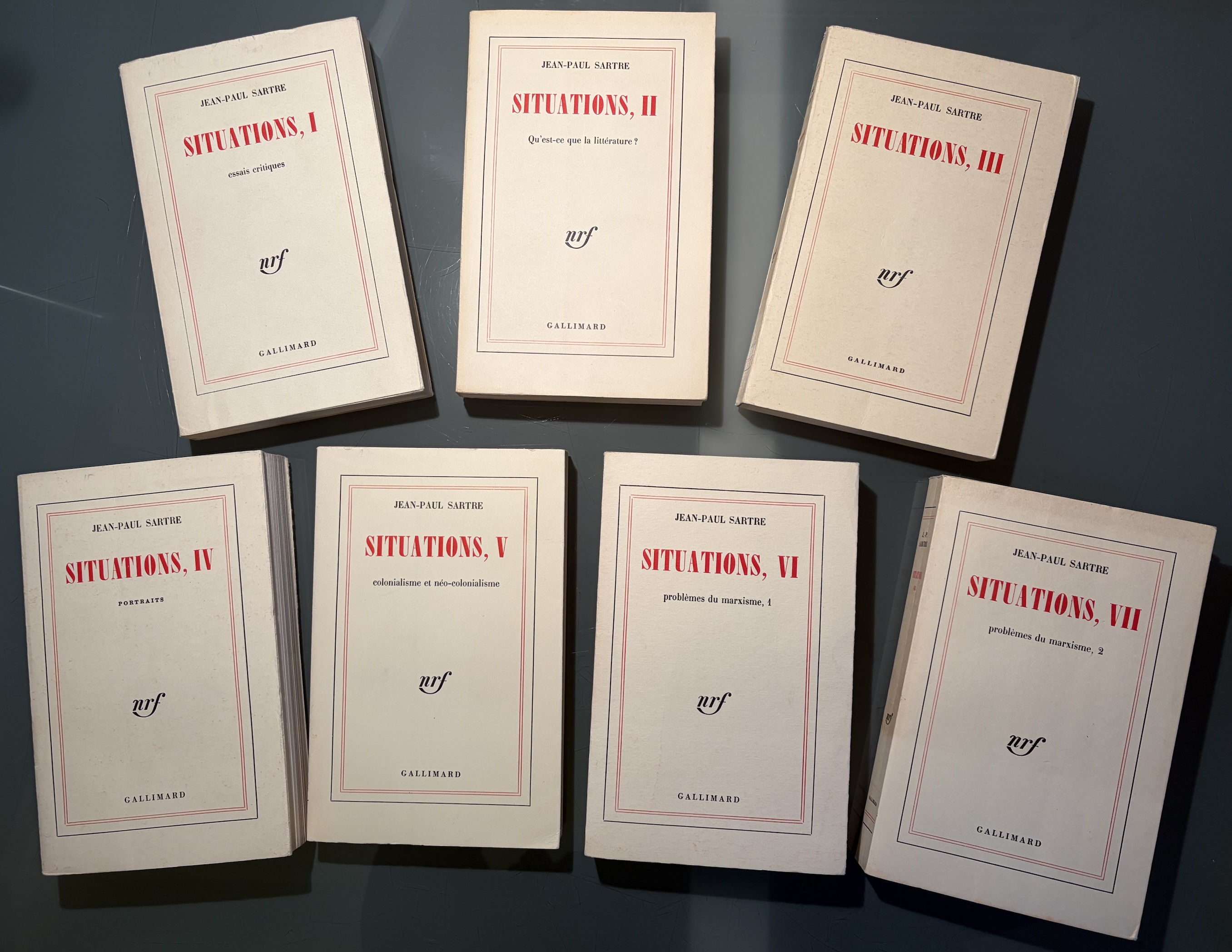
One example from Situations VI and VII (first edition) and Situations IV and V (second edition) will indicate the change from a thematic arrangement by Sartre to a more chronological one, and the unsystematic English translations.
Sartre published three long essays under the title “Les communistes et la paix” in Les Temps Modernes in issues 81, 84-85 and 101 – the first two in 1952 and the third in 1954. They are generally seen as the beginning of his communist phase, or at least his closeness to the French Communist Party. The three parts are on “The Demonstration of May 28, 1952”, “The Strike of June 4, 1952” and “The Causes”. They appeared together in Situations VI: Problèmes du marxisme 1 in 1964. The first piece in Situations VII: Problèmes du marxisme, 2 in 1965 was “Réponse à Claude Lefort”, which also appeared in Les Temps Modernes in issue 89 in 1953.
All these four texts were translated into English, confusingly twice, a year apart: The Communists and Peace, trans. Martha H. Fletcher with John R. Kleinschmidt, New York: George Braziller, Inc. 1968; The Communists and Peace, trans. Irene Clephane, London: Hamish Hamilton, 1969. This was a period when US and UK rights were sometimes sold separately, and while sometimes different presses used the same translation, in this case they commissioned different ones. (The English translation of Situations X is a good example of the former – the US and UK editions have different titles, but use the same translation.) It’s a shame that duplication of effort and expense happened with The Communists and the Peace when other essays were not translated. Both English books are out of print; the Clephane translation is available on archive.org
Sartre’s “Réponse” engages with Claude Lefort, “Sartre et le marxisme”, Les Temps Modernes 89, 1953, which was itself an engagement with the first two parts of “Les Communistes et la paix”. Lefort replied to Sartre’s response in a letter published as “De la réponse à la question”, Les Temps Modernes 104, 1954, to which Sartre added a brief note:
Sur les problèmes précis que j’avais étudiés dans ma réponse à Lefort, cette lettre n’apporte rien de nouveau. Quant aux autres questions qu’elle pose, et aux inquiétudes qu’elle exprime, la suite des Communistes et la paix y répond d’elle-même (p. 184).
On the specific problems that I had examined in my answer to Lefort, this letter contributes nothing new. As for the other questions that it raises, and the concerns that it expresses, the next installment of ‘The Communists and Peace’ will serve as a response (translated in Alexandre Feron, “Sartre vs. Lefort: The Meaning of Proletarian Experience”, Journal of the CIPH 96, 2019, 65-79, 78 n. 4).
To reconstruct the original chronology, it is necessary to read the texts out of the sequence in which they are presented in Situations VI and VII, and the two English translations of The Communists and the Peace. You would need to read “Les Communistes et la paix”, part I, part II, “Sartre et le marxisme”, “Réponse à Claude Lefort”, “De la réponse à la question”, Sartre’s brief note above, and then “Les Communistes et la paix”, part III. If you were being historically careful, you should probably check the original issues of Les Temps Modernes to see if those texts are the same as the versions in Situations. Lefort’s two contributions are reprinted in the first edition of his Éléments d’une critique de la bureaucratie in 1971, but not the 1979 Tel edition.
In the second edition of Situations, the first two parts of “Les Communistes et la paix” and “Réponse à Claude Lefort” appear in Situations IV. The third part is in Situations V. This arrangement therefore organises Sartre’s pieces chronologically, but of course only includes his parts of the exchange. Feron’s article is a valuable guide to this debate, and the related split between Sartre and Maurice Merleau-Ponty.
If you have a spare £4000 you could buy a fragment of Sartre’s manuscript!
I’ll add Situations VIII, IX and X to this list soon: Jean-Paul Sartre’s Situations – contents and a guide to the English translations
References
Alexandre Feron, “Sartre vs. Lefort: The Meaning of Proletarian Experience”, Journal of the CIPH 96, 2019, 65-79.
Claude Lefort, “Sartre et le marxisme”, Les Temps Modernes 89, 1953, 1540-70.
Claude Lefort, “De la réponse à la question”, Les Temps Modernes 104, 1954, 157-84.
Claude Lefort, Éléments d’une critique de la bureaucratie, Genève: Droz, 1971; reprint without the two pieces on Sartre, Paris: Gallimard/Tel, 1979.
Jean-Paul Sartre, Situations VI: Problèmes du marxisme, 1, Paris: Gallimard, 1964.
Jean-Paul Sartre, Situations VII: Problèmes du marxisme, 2, Paris: Gallimard, 1965.
Jean-Paul Sartre, The Communists and Peace, trans. Martha H. Fletcher with John R. Kleinschmidt, New York: George Braziller, Inc. 1968.
Jean-Paul Sartre, The Communists and Peace, trans. Irene Clephane, London: Hamish Hamilton, 1969.
Jean-Paul Sartre, Situations IV: Avril 1950-Avril 1953, ed. Arlette Elkaïm-Sartre, Paris: Gallimard, 2015.
Jean-Paul Sartre, Situations V: Mars 1954-Avril 1958, ed. Arlette Elkaïm-Sartre, Paris: Gallimard, 2018.
This is the 93rd post of a weekly series, posted every Sunday throughout 2025, and so far through 2026. The posts are short essays with indications of further reading and sources. The pieces are not as formal as something I’d try to publish more conventionally, but are hopefully worthwhile as short sketches of histories and ideas. They are usually tangential to my main writing focus, a home for spare parts, asides, dead-ends and possible futures. I hope there is some interest in them. They are provisional and suggestions are welcome. A few, usually shorter, pieces in a similar style have been posted mid-week.
I discuss what I am doing in this series in “Writing the ‘Sunday histories’ – an experiment in sharing short pieces on a blog”, my contribution to the Northern Ireland Legal Quarterly “Reflections on Writing” Series – all pieces are open access.
The full chronological list of ‘Sunday histories’ is here, with a thematic ordering here.
Discover more from Progressive Geographies
Subscribe to get the latest posts sent to your email.


