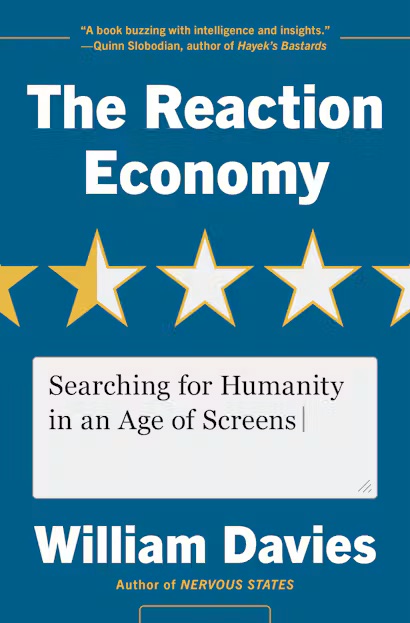
Today’s world is driven by reactions. We are constantly prompted to like or comment on digital content—and bombarded with requests to rate everything from customer service to doctors. Reactions have become both an object of fascination—as seen in “reaction videos”—and a highly valued metric. What happens when the worth of every action is determined by how people react to it? Can we still act with purpose—or are we trapped in a loop of stimulus and response? In this groundbreaking book, William Davies argues that we are living not in an “attention economy” but rather in what he calls a “reaction economy”—a world where the kind of witnessing implied by “attention” has been displaced by the harvesting of reactions, and humans have become less distinguishable from nonhumans. Exploring the fascinating idea and history of reactions, The Reaction Economy asks what happens to our lives, culture and politics when everyone is constantly reacting to everyone else.
The Reaction Economy traces the concept of reaction through the natural sciences, psychology, avant-garde experiments and the cybernetic notion of “feedback mechanisms.” It shows that the relationship between two kinds of reaction—automatic and rapid responses and slower reactions rooted in sustained feelings of injustice or vengeance—cuts to the heart of our world today, including the explosion of reactionary politics.
Identifying and illuminating a central aspect of contemporary life, The Reaction Economy also explores how we might escape this system by rediscovering a capacity for action, spontaneity and imagination, beyond the compulsion to react.
A Protestant Air focuses on the Protestant connection linking three intellectual giants of twentieth-century French thought: André Gide, Jean-Paul Sartre, and Roland Barthes. All three came from a Protestant background and thus shared a common marginality in a nation culturally marked by Catholicism, one that profoundly shaped their personalities, thinking, and literary careers. When André Gide received the Nobel Prize in 1947, he declared that if he had represented anything as a writer, it was the “spirit of protestation.”
Clémentine Fauré-Bellaïche explores the filiation that this spirit weaves between Gide, Sartre, and Barthes. She shows how their Protestant difference, confronted with France’s Catholicity, informed their posture as writers, their conceptualization of literature, and their elaboration of the figure of the French intellectual as a counter-authority, with a distinctive positioning vis-à-vis the individual and the institution. In so doing, A Protestant Air examines the religious underpinnings of twentieth-century letters and politics, their interaction with the secularization of French society, and, more broadly, the historical and philosophical relationship between the Protestant ethos and modernity itself.
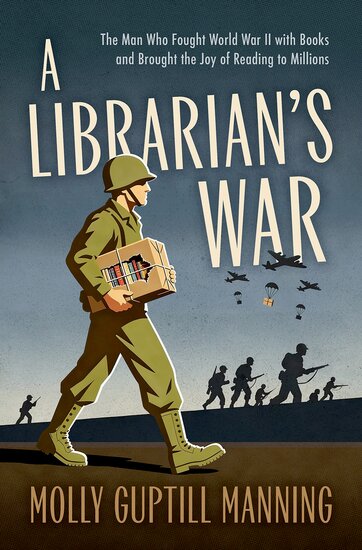
The untold story of Ray Trautman, the Greatest Generation’s librarian, who made reading central to the Allied fight in World War II and transformed the role of books in American life.
Though unknown to most readers, no one made a greater contribution to reading habits in America than Ray Trautman. Growing up in the rural Midwest, Trautman looked to reading as a way of exploring the world—as both escape and enlightenment—and yet, as with many Americans, discovered that with no community library and limited funds finding books was a challenge. This sparked in him a lifelong passion to build libraries and ensure free access to books for all. After working his way through college, Trautman became an independent bookseller, and then joined the Civilian Conservation Corps during the Depression, building libraries and teaching people how to read. In late 1940, after earning a degree in library studies from Columbia, he landed the job of a lifetime: Chief Librarian of the Army. Many military leaders believed books were an unnecessary distraction for troops, but Trautman relentlessly championed books, believing, like others, that they were key to the fight against totalitarianism and ultimately built the largest and most far-reaching library system in the world. He devised the “Armed Services Editions,” wallet-sized paperbacks and printed miniature magazines for soldiers. He also created the most popular comic book in the Army, Overseas Comics. Along the way, Trautman fought book bans and book-resistant generals (including Douglas MacArthur), was nearly killed in the Battle of the Bulge while on a special assignment for Dwight Eisenhower and joined forces with librarians and publishers to spread access to reading. Trautman was credited with distributing nearly a half billion books, magazines, and comic books to troops.
When the war ended in 1945, Trautman brought the fight for books home: advocating for rural libraries, building libraries in prisons, campaigning for more books for the visually impaired, and working to develop materials for adults with low reading proficiency so they could improve their literacy skills.
A Librarian’s War introduces readers to a man who dedicated his life to instilling a passion for reading and unhindered access to books. Molly Guptill Manning’s book puts Trautman where he deserves to be: at the center of the story.
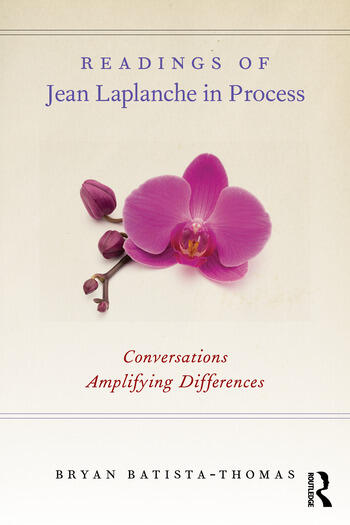
This book is a series of interviews with nine Laplanche scholars who expand our understanding of his work and highlight its contemporary importance and applications in psychoanalytic theory and practice.
Much of Jean Laplanche’s work remains untranslated into English, but his ideas are increasingly influential in the Anglophone psychoanalytic world, especially the United States. His groundbreaking work on gender and sexuality leads the way in terms of psychoanalytic understanding of the current social and cultural developments in these areas. This work shows the ways in which his concepts migrate and transform into a global perspective through the lenses of epistemology, clinical practice, theory, culture, and linguistics. With contributions from current members of the Scientific Council of the Laplanche Foundation and prominent Laplanche scholars, this book aims to stand alongside Laplanche’s theoretical work as an example of the complexity of the relationship between theory and clinical practice.
Enriched with clinical vignettes of child and adult analysands, this book gives psychoanalysts and psychotherapists an excellent introduction to the key tenets of Laplanche’s work and its application to classic and current clinical issues.
The collection of poems including those written in POW camps
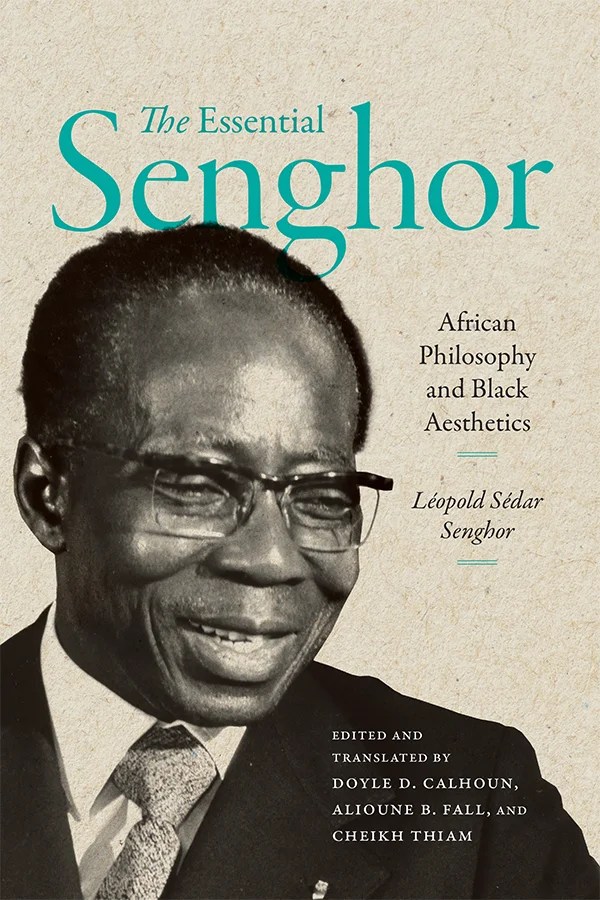
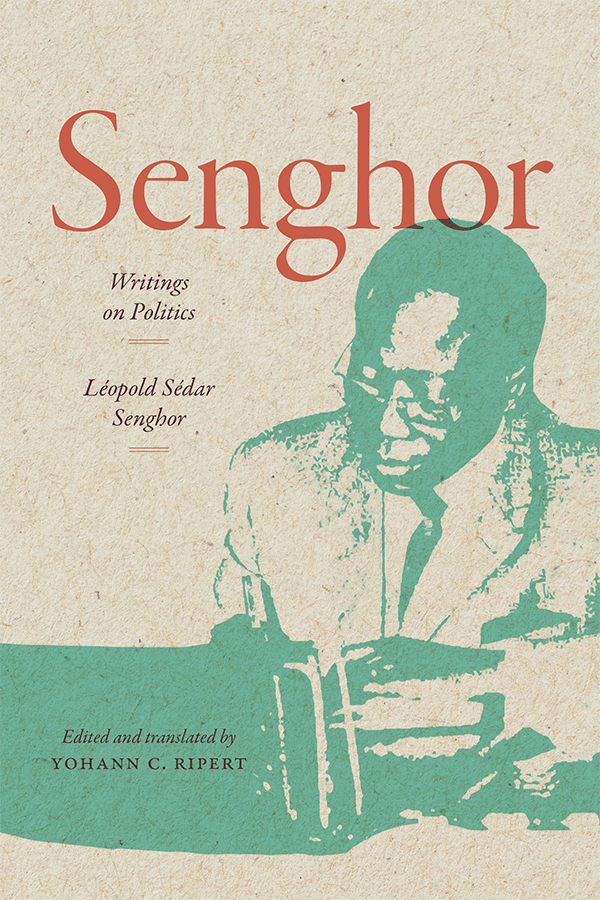
Léopold Sédar Senghor (1906-2001) is known as a poet, one of theoreticians of négritude and the first President of Senegal. Senghor’s 1948 edited collection Anthologie de la nouvelle poésie nègre et Malgache de langue française[Anthology of new black and Malagasy poetry in French] had a preface by Jean-Paul Sartre, which was reprinted in Situations III and has been translated at least three times as “Black Orpheus”. In English, that text is probably better known than the collection it introduced. Much of Senghor’s own poetry is available in English. Recently, two collections of essays have recently been published by Duke University Press – Writings on PoliticsandThe Essential Senghor: African Philosophy and Black Aesthetics.
Before becoming Senegalese president, Senghor taught linguistics and African literature. He served in the French army in World War II, part of the Tirailleurs Sénégalais riflemen unit recruited from French West Africa. This time in his life is of course discussed in biographies, and there is also a discussion of Senghor’s experience in Clarence Lusane’s book Hitler’s Black Victims:
On 20 June 1940, Senghor was taken prisoner while defending the bridge at La Charité-sur-Loire. He would eventually spend time in seven different camps including Poiters at Frontstalag 230, Charité-sur-Loire, Romilly-sur-Seine, Troyes, and Amiens, among others. In many instances, the camps that held the African POWs were more like labor camps with prisoners tasked to a wide range of duties. Some African prisoners found themselves working on farms as hired prison labor, while others were domestic and personal servants for German officers (Hitler’s Black Victims, p. 159; see Spleth, Léopold Sédar Senghor, p. 11-12).
There are reports that the Germans originally planned to execute Senghor and his fellow captives, but that they were persuaded by a French officer this would be dishonourable (Hymans, Léopold Sédar Senghor, p. 109). Apparently, Senghor and the others called out “Vive la France! Vive l’Afrique noire!” (Senghor, La poésie de l’action, p. 83). He was thereby identifying the twin affiliations of metropolitan and colonial homelands (Vaillant, Black, French, and African, pp. 166-67). Many colonial soldiers were executed, a story which is told in detail in Raffael Scheck, Hitler’s African Victims. Some however were captured, and many of these prisoners were put to work. As well as Scheck’s work, Armelle Mabon, Prisonniers de guerre «indigènes» and Sarah Ann Frank, Hostages of Empire: Colonial Prisoners of War in Vichy France are good on this, a theme which is somewhat neglected in the literature on POWs more generally. The Frontstalags were generally reserved for colonial prisoners, though some metropolitan French soldiers were held in them too – including Émile Benveniste, who later escaped and went into exile in Switzerland, a story I tell in detail elsewhere. Although some were originally in camps in Germany, the colonial prisoners were later transferred to camps back in France.
(The terminology of ‘colonial’ was not necessarily used at the time, since France did not consider its North African territories as colonies, but as part of France. ‘Indigenous’ was sometimes used, or ‘North African and colonial’.)
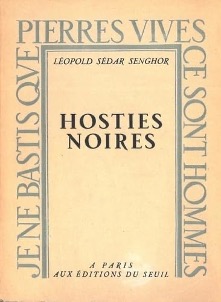
Lusane indicates that the period in the camp was “a crucial transitional period… a cultural reawakening” for Senghor, incarcerated together with other Africans. Despite his academic training in France, and pre-war position as a lycée teacher, he was a second-class private, like Benveniste, and was therefore held alongside recruits straight from France’s colonies. He gained a new understanding which came through both in his own poetry, and in his understanding of négritude (Lusane, Hitler’s Black Victims, pp. 159-60). The second part of Senghor’s 1948 collection Hosties Noires is entitled “Camp 1940”, including poems he wrote in the camps. One poem is dated to “Camp d’Amiens, Septembre 1940”, four others to Front-Stalag 230, others to Paris after his return. The first part of Hosties Noires, “Ethiopie”, includes two poems to the Tirailleurs Sénégalais.
Senghor learned German in the camp, which allowed him to read philosophy and literature, including Goethe, in the original. His attitude to France’s neighbour, sometime enemy, and its intellectual life is described in detail in János Riesz and Aija Bjornson, “Senghor and the Germans”. He was seen by the camp commandant reading Plato in Greek, which helped to get him allocated to administrative work (Senghor, La poésie de l’action, p. 84). While in the camp he was diagnosed with “some unknown ‘colonial disease’”, probably spuriously as a meaning of deceiving the Germans, and released in February 1942 (Lusane, Hitler’s Black Victims, p. 161; see Spleth, Léopold Sédar Senghor, p. 12; Vaillant, Black, French, and African, p. 177). He went back to teaching, and after the liberation held a chair at the École Nationale de la France d’Outre-Mer [National School of Overseas France].
Hosties Noires is an ambiguous title, the first word meaning hosts or victims, coming from the Latin hostia and closest in sense to the sacrificial host in religion (see Vaillant, Black, French, and African, pp. 171-72). The poems of this collection are all included in his Œuvre poétique, and translated by Melvin Dixon in the bilingual The Collected Poetry.(The Collected Poetry also includes the French texts, a reprint of Œuvre poétique, but unhelpfully as an appendix, rather than on facing pages to the translations.) Dixon translates this collection as “Black Hosts”. A few of Senghor’s poems from this time are in French and English translation here. Senghor says that there no word of hatred towards the Germans in these poems – he always made a distinction between Nazis and the German people (La poésie de l’action, pp. 84-85).
The biographies of Senghor naturally discuss these periods of his life, and I wasn’t sure there was much new to discover. But then I found that Raffael Scheck has written about Senghor’s time in the camp. I mention his book on Hitler’s African Victims above, but he is also the author of French Colonial Soldiers in German Captivity during World War II, and some related chapters summarising the account, including “French African Soldiers in German POW Camps, 1940–1945”.
Scheck is particularly important because he identified Senghor as the author of an anonymous report about the experience of captivity. The report is in the Archives nationales and is entitled “Compte-rendu de captivité établi par un prisonnier indigène récemment libéré [Captivity report written by a recently released prisoner]”, dated to 7 July 1942. The author was a released prisoner from Senegal who was a “professeur agrégé dans un lycée de Paris”. Senghor was the only person at the time who was all those things (see Benoït Hopquin’s report in Le Monde).
There is much less literature on the Frontstalags than other prisoner of war camps, in part because many of those incarcerated did not record their experiences, either because they were not literate in European languages, because they were labouring and had less time in the camps to keep diaries or write letters, or because records were not kept. The report is therefore not just significant because it is by Senghor, but also as a key source for what is known of the Frontstalag in which he was imprisoned (see Scheck, “Frontstammlager (Frontstalag) 230”). In Hostages of Empire, Sarah Ann Frank, has also made use of Senghor’s work on this camp (i.e. pp. 14, 82-83), noting that she had found this anonymous report early in her research but until Scheck’s identification had not realised its author or rarity (p. 273 n. 19).
Senghor therefore might feature in my own future research, which plans to explore the story of French academics who were POWs. I’ve written a bit more about that planned project here, and about two other people I expect to discuss, Étienne Wolff and Fernand Braudel in other posts in this series.
Jacques L. Hymans, Léopold Sédar Senghor: An Intellectual Biography, Edinburgh: Edinburgh University Press, 1971.
Clarence Lusane, Hitler’s Black Victims:The Historical Experiences of Afro-Germans, European Blacks, Africans, and African Americans in the Nazi Era, New York: Routledge, 2003.
Armelle Mabon, Prisonniers de guerre «indigènes»: Visages oubliés de la France occupée, Paris: La Découverte, 2010.
Jean-Paul Sartre, “Black Orpheus”, trans. John MacCombie, The Massachusetts Review, 6 (1), 1964-65, 13-52; reprinted in “What is Literature?” and Other Essays, Cambridge, MA: Harvard University Press, 1988, 289-330.
Jean-Paul Sartre, “Black Orpheus”, trans. Chris Turner, The Aftermath of War, Seagull, 2008, 259-329.
Raffael Scheck, Hitler’s African Victims: The German Army Massacres of Black French Soldiers in 1940, Cambridge: Cambridge University Press, 2006.
Raffael Scheck, French Colonial Soldiers in German Captivity during World War II, Cambridge: Cambridge University Press, 2014.
Raffael Scheck, “Léopold Sédar Senghor prisonnier de guerre allemand: Une nouvelle approche fondée sur un texte inédit”, French Politics, Culture & Society 32 (2), 2014, 76-98.
Raffael Scheck, “French African Soldiers in German POW Camps, 1940–1945”, in Judith A. Byfield, Carolyn A. Brown, Timothy Parsons and Ahmad Alawad Sikainga eds. African and World War II, Cambridge: Cambridge University Press, 2015, 420-38.
Raffael Scheck, “Frontstammlager (Frontstalag) 230” in Geoffrey P. Megargee, Rüdiger Overmans and Wolgang Vogt eds. The United States Holocaust Memorial Museum Encyclopedia of Camps and Ghettos Volume IV: Camps and Other Detention Facilities under the German Armed Forces, Bloomington: United States Holocaust Memorial Museum/Indiana University Press, 2022, 198-201.
Léopold Sédar Senghor ed. Anthologie de la nouvelle poésie nègre et Malgache de langue française, Paris: Presses Universitaires de France, 2nd edition, 1969 [1948].
Janet G. Vaillant, Black, French, and African: A Life of Léopold Sédar Senghor, Cambridge: Harvard University Press, 1990.
This is the 95th post of a weekly series, posted every Sunday throughout 2025, and so far through 2026. The posts are short essays with indications of further reading and sources. The pieces are not as formal and developed as something I’d try to publish more conventionally, but are hopefully worthwhile as short sketches of histories and ideas. They are usually tangential to my main writing focus, a home for spare parts, asides, dead-ends and possible futures. I hope there is some interest in them. They are provisional and suggestions are welcome. A few, usually shorter, pieces in a similar style have been posted mid-week.
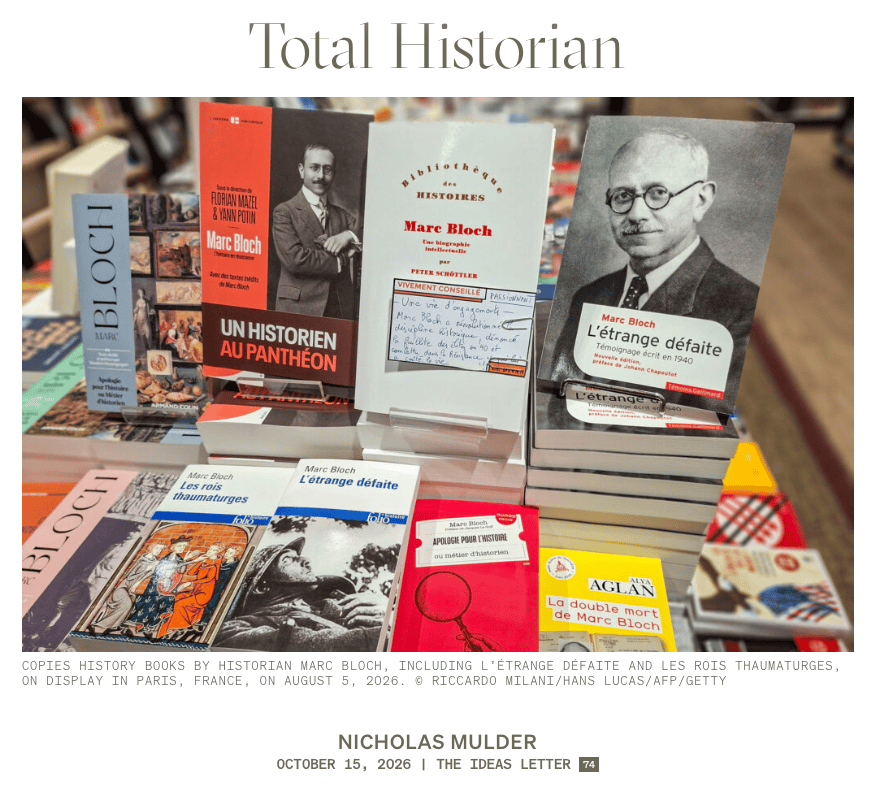
As the piece indicates, Bloch’s entry into the Pantheon has seen several reissues or new publications, some of which are pictured above, and most of which I’ve previously mentioned here, including
The podcast is free to access; the links below require subscription. Thanks to dmf for the link.
Perry Anderson once wrote that in Fredric Jameson’s account of postmodernism, ‘the vocation of Western Marxism has reached its most complete consummation.’ Praising the ‘spacious rhythms’ of his ‘complex, yet supple syntax’ and ‘sudden bursts of metaphoric intensity’, Anderson also called Jameson a ‘great writer’. As Toril Moi wrote recently in the LRB, he was a great reader, too. Moi, who was recruited by Jameson to Duke University in the mid-1980s and remained his colleague there until his death in 2024, joins Thomas Jones on this episode to look back at Jameson’s earlier work, from Sartre: The Origins of a Style (1961) to The Political Unconscious (1981), and to retrace the intellectual path he took to arrive at that milestone.
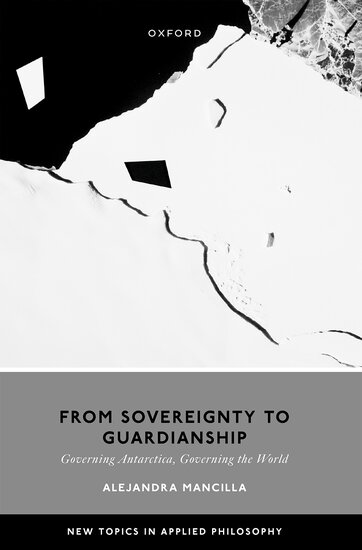
Antarctica is the coldest, windiest, driest, and highest continent in the world, so it is no wonder that it has been painted as exceptional in geographic and climatic terms. But not only that: Antarctica is also seen as exceptional politically. Since the Antarctic Treaty came into force in 1961, it has been under the Joint Guardianship of a group of states that have kept peace and privileged science as the main activity on the continent, with a focus on the protection rather than the exploitation of nature.
For natural scientists, Antarctica is seen as the largest open-air laboratory in the world. In From Sovereignty to Guardianship, Alejandra Mancilla proposes that Antarctica should also be seen as a laboratory for territorial governance, providing inspiration in places where both the regime ofPermanent Sovereignty over Natural Resources of individual states and the international regime of Common Heritage of Mankind have proven insufficient and inadequate. At the same time, she shows that Antarctic governance has important limits that can be surmounted to be made less state-centric and less anthropocentric, embracing the fact that protecting Antarctica requires acting beyond Antarctica, and vice versa. Given the global environmental challenges that we face, and the growing challenges to international law and cooperation, this book argues that environmental governance around the world can—and should—benefit from the creative and often unexpectedly fruitful political imagination of Antarctica.
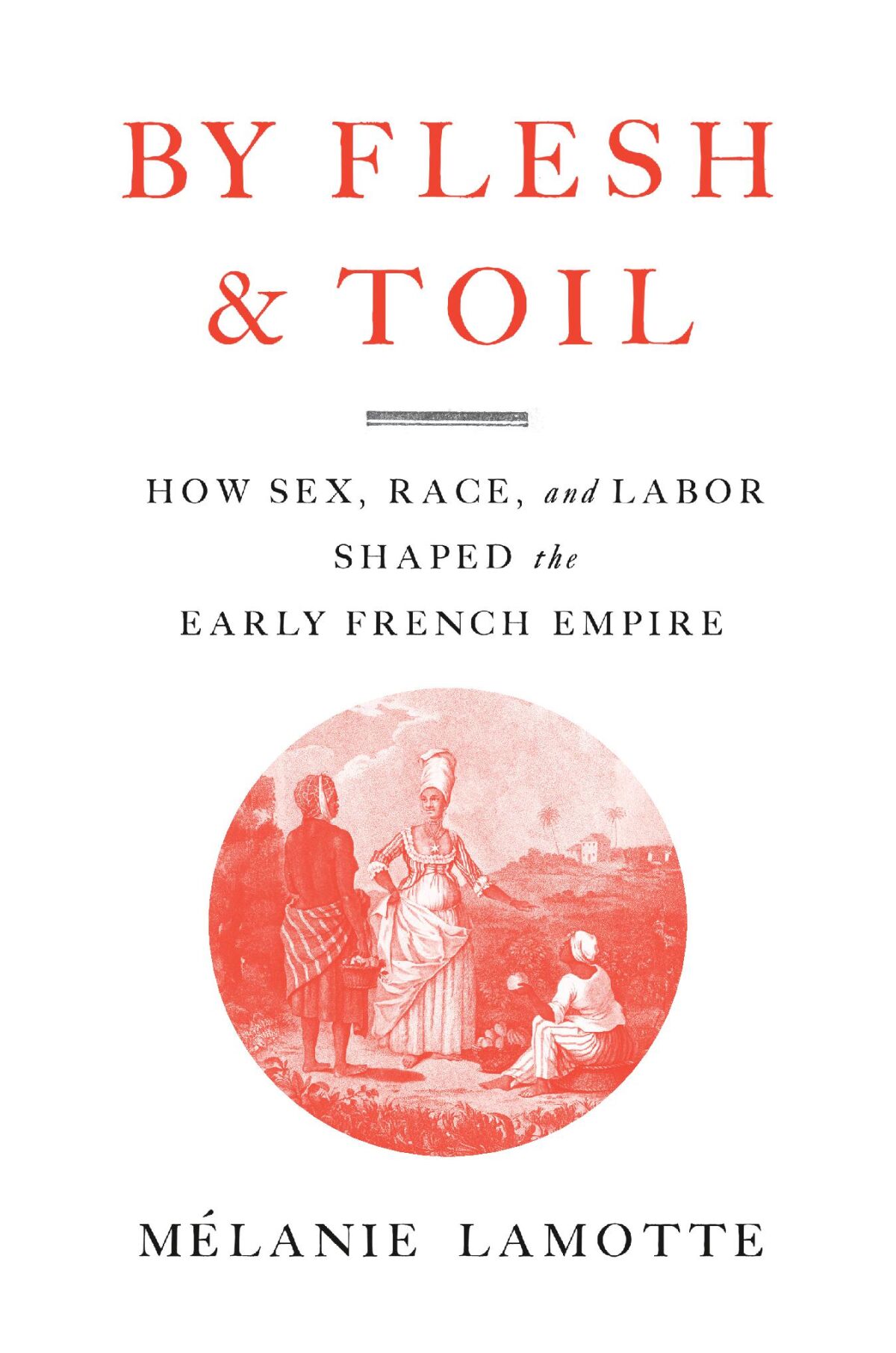
From the beginning of the seventeenth century, French colonies and trading posts sprawled across the Atlantic and Indian Oceans. In the first pan-imperial history of the early French Empire in the English language, Mélanie Lamotte shows how an increasingly cohesive legal culture came to govern the lives of enslaved and free people of African, Malagasy, South Asian, and Native American descent. She also illuminates the important role played by these populations in the development of the empire, from Louisiana to Guadeloupe, Senegambia, Madagascar, Isle Bourbon, and India.
The early French Empire has often been portrayed as a fragmented conglomerate of isolated colonies or regions. Yet Lamotte shows that racial policies issued by the metropole, as well as by officials in the Atlantic and Indian Oceans, significantly influenced one another. Rather than focusing on the actions of administrators, however, Lamotte also reveals the extensive influence of people on the ground—especially those of non-European descent. Through their sexuality and their labor, along with their socio-economic and political endeavors, they played a critical role in building the empire and setting its limits. As they sought justice for themselves, strove to protect their kin, and aimed to improve their social conditions, these individuals also pushed against the advancement of white dominion in unexpected ways.
Archivally rich and rigorously documented, By Flesh and Toil illuminates the transoceanic connections that united the French colonial world—and recasts people of African, Malagasy, South Asian, and Native American descent as key actors in the story of empire-building.