
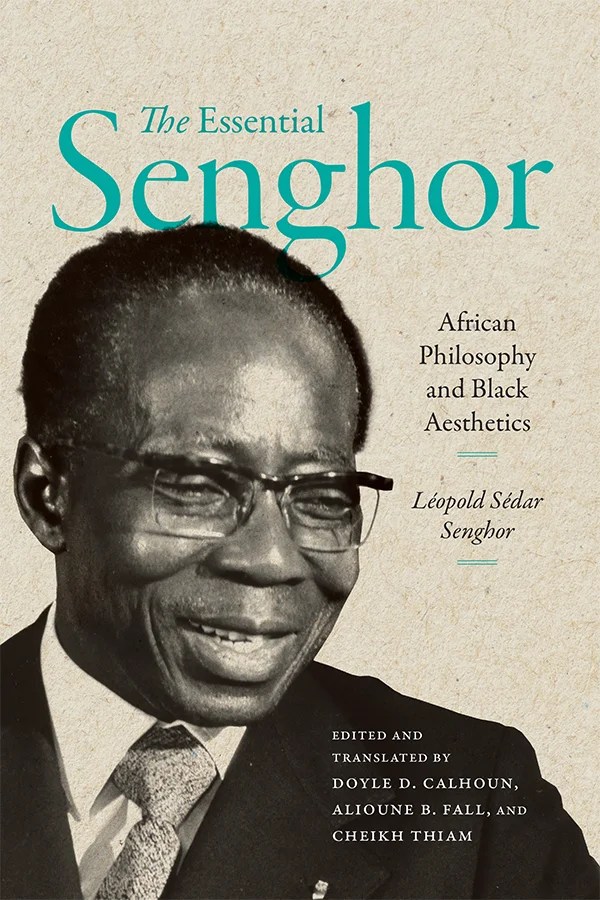
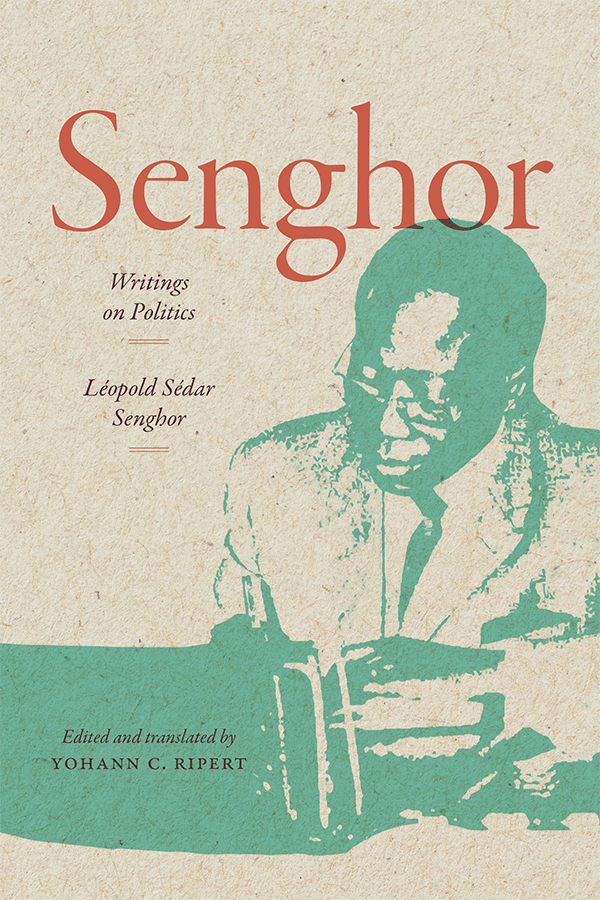
Léopold Sédar Senghor (1906-2001) is known as a poet, one of theoreticians of négritude and the first President of Senegal. Senghor’s 1948 edited collection Anthologie de la nouvelle poésie nègre et Malgache de langue française[Anthology of new black and Malagasy poetry in French] had a preface by Jean-Paul Sartre, which was reprinted in Situations III and has been translated at least three times as “Black Orpheus”. In English, that text is probably better known than the collection it introduced. Much of Senghor’s own poetry is available in English. Recently, two collections of essays have recently been published by Duke University Press – Writings on Politics and The Essential Senghor: African Philosophy and Black Aesthetics.
Before becoming Senegalese president, Senghor taught linguistics and African literature. He served in the French army in World War II, part of the Tirailleurs Sénégalais riflemen unit recruited from French West Africa. This time in his life is of course discussed in biographies, and there is also a discussion of Senghor’s experience in Clarence Lusane’s book Hitler’s Black Victims:
On 20 June 1940, Senghor was taken prisoner while defending the bridge at La Charité-sur-Loire. He would eventually spend time in seven different camps including Poiters at Frontstalag 230, Charité-sur-Loire, Romilly-sur-Seine, Troyes, and Amiens, among others. In many instances, the camps that held the African POWs were more like labor camps with prisoners tasked to a wide range of duties. Some African prisoners found themselves working on farms as hired prison labor, while others were domestic and personal servants for German officers (Hitler’s Black Victims, p. 159; see Spleth, Léopold Sédar Senghor, p. 11-12).
There are reports that the Germans originally planned to execute Senghor and his fellow captives, but that they were persuaded by a French officer this would be dishonourable (Hymans, Léopold Sédar Senghor, p. 109). Apparently, Senghor and the others called out “Vive la France! Vive l’Afrique noire!” (Senghor, La poésie de l’action, p. 83). He was thereby identifying the twin affiliations of metropolitan and colonial homelands (Vaillant, Black, French, and African, pp. 166-67). Many colonial soldiers were executed, a story which is told in detail in Raffael Scheck, Hitler’s African Victims. Some however were captured, and many of these prisoners were put to work. As well as Scheck’s work, Armelle Mabon, Prisonniers de guerre «indigènes» and Sarah Ann Frank, Hostages of Empire: Colonial Prisoners of War in Vichy France are good on this, a theme which is somewhat neglected in the literature on POWs more generally. The Frontstalags were generally reserved for colonial prisoners, though some metropolitan French soldiers were held in them too – including Émile Benveniste, who later escaped and went into exile in Switzerland, a story I tell in detail elsewhere. Although some were originally in camps in Germany, the colonial prisoners were later transferred to camps back in France.
(The terminology of ‘colonial’ was not necessarily used at the time, since France did not consider its North African territories as colonies, but as part of France. ‘Indigenous’ was sometimes used, or ‘North African and colonial’.)
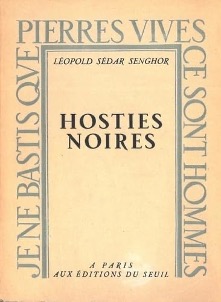
Lusane indicates that the period in the camp was “a crucial transitional period… a cultural reawakening” for Senghor, incarcerated together with other Africans. Despite his academic training in France, and pre-war position as a lycée teacher, he was a second-class private, like Benveniste, and was therefore held alongside recruits straight from France’s colonies. He gained a new understanding which came through both in his own poetry, and in his understanding of négritude (Lusane, Hitler’s Black Victims, pp. 159-60). The second part of Senghor’s 1948 collection Hosties Noires is entitled “Camp 1940”, including poems he wrote in the camps. One poem is dated to “Camp d’Amiens, Septembre 1940”, four others to Front-Stalag 230, others to Paris after his return. The first part of Hosties Noires, “Ethiopie”, includes two poems to the Tirailleurs Sénégalais.
Senghor learned German in the camp, which allowed him to read philosophy and literature, including Goethe, in the original. His attitude to France’s neighbour, sometime enemy, and its intellectual life is described in detail in János Riesz and Aija Bjornson, “Senghor and the Germans”. He was seen by the camp commandant reading Plato in Greek, which helped to get him allocated to administrative work (Senghor, La poésie de l’action, p. 84). While in the camp he was diagnosed with “some unknown ‘colonial disease’”, probably spuriously as a meaning of deceiving the Germans, and released in February 1942 (Lusane, Hitler’s Black Victims, p. 161; see Spleth, Léopold Sédar Senghor, p. 12; Vaillant, Black, French, and African, p. 177). He went back to teaching, and after the liberation held a chair at the École Nationale de la France d’Outre-Mer [National School of Overseas France].
Hosties Noires is an ambiguous title, the first word meaning hosts or victims, coming from the Latin hostia and closest in sense to the sacrificial host in religion (see Vaillant, Black, French, and African, pp. 171-72). The poems of this collection are all included in his Œuvre poétique, and translated by Melvin Dixon in the bilingual The Collected Poetry.(The Collected Poetry also includes the French texts, a reprint of Œuvre poétique, but unhelpfully as an appendix, rather than on facing pages to the translations.) Dixon translates this collection as “Black Hosts”. A few of Senghor’s poems from this time are in French and English translation here. Senghor says that there no word of hatred towards the Germans in these poems – he always made a distinction between Nazis and the German people (La poésie de l’action, pp. 84-85).
The biographies of Senghor naturally discuss these periods of his life, and I wasn’t sure there was much new to discover. But then I found that Raffael Scheck has written about Senghor’s time in the camp. I mention his book on Hitler’s African Victims above, but he is also the author of French Colonial Soldiers in German Captivity during World War II, and some related chapters summarising the account, including “French African Soldiers in German POW Camps, 1940–1945”.
Scheck is particularly important because he identified Senghor as the author of an anonymous report about the experience of captivity. The report is in the Archives nationales and is entitled “Compte-rendu de captivité établi par un prisonnier indigène récemment libéré [Captivity report written by a recently released prisoner]”, dated to 7 July 1942. The author was a released prisoner from Senegal who was a “professeur agrégé dans un lycée de Paris”. Senghor was the only person at the time who was all those things (see Benoït Hopquin’s report in Le Monde).
Scheck published the report in Jeune Afrique in 2011. He wrote about what it means for our understanding of Senghor in French Colonial Soldiers in German Captivity and particularly in his article “Léopold Sédar Senghor prisonnier de guerre allemand: Une nouvelle approche fondée sur un texte inédit” in 2014.
There is much less literature on the Frontstalags than other prisoner of war camps, in part because many of those incarcerated did not record their experiences, either because they were not literate in European languages, because they were labouring and had less time in the camps to keep diaries or write letters, or because records were not kept. The report is therefore not just significant because it is by Senghor, but also as a key source for what is known of the Frontstalag in which he was imprisoned (see Scheck, “Frontstammlager (Frontstalag) 230”). In Hostages of Empire, Sarah Ann Frank, has also made use of Senghor’s work on this camp (i.e. pp. 14, 82-83), noting that she had found this anonymous report early in her research but until Scheck’s identification had not realised its author or rarity (p. 273 n. 19).
Senghor therefore might feature in my own future research, which plans to explore the story of French academics who were POWs. I’ve written a bit more about that planned project here, and about two other people I expect to discuss, Étienne Wolff and Fernand Braudel in other posts in this series.
References
Xavier Courouble, “A Concealed Reality: Léopold Sédar Senghor’s years in captivity”, Unbound: Smithsonian Libraries and Archives, 24 February 2017.
Sarah Ann Frank, Hostages of Empire: Colonial Prisoners of War in Vichy France, Lincoln: University of Nebraska Press, 2021.
Benoït Hopquin, “Un document inédit de Léopold Sédar Senghor”, Le Monde, 16 June 2011.
Jacques L. Hymans, Léopold Sédar Senghor: An Intellectual Biography, Edinburgh: Edinburgh University Press, 1971.
Clarence Lusane, Hitler’s Black Victims: The Historical Experiences of Afro-Germans, European Blacks, Africans, and African Americans in the Nazi Era, New York: Routledge, 2003.
Armelle Mabon, Prisonniers de guerre «indigènes»: Visages oubliés de la France occupée, Paris: La Découverte, 2010.
Hannah McCann, “Still Unheard? The Voices of African POWs Imprisoned in Wartime France”, Historians for History, 7 March 2023.
János Riesz and Aija Bjornson, “Senghor and the Germans”, Research in African Literatures 33 (4), 2002, 25-37.
Jean-Paul Sartre, “Orphée Noir”, Situations III, Paris: Gallimard, 1949, 229-86.
Jean-Paul Sartre, “Black Orpheus”, trans. S.W. Allen, Présence Africaine 10/11, 1951, 219-47.
Jean-Paul Sartre, “Black Orpheus”, trans. John MacCombie, The Massachusetts Review, 6 (1), 1964-65, 13-52; reprinted in “What is Literature?” and Other Essays, Cambridge, MA: Harvard University Press, 1988, 289-330.
Jean-Paul Sartre, “Black Orpheus”, trans. Chris Turner, The Aftermath of War, Seagull, 2008, 259-329.
Raffael Scheck, Hitler’s African Victims: The German Army Massacres of Black French Soldiers in 1940, Cambridge: Cambridge University Press, 2006.
Raffael Scheck, French Colonial Soldiers in German Captivity during World War II, Cambridge: Cambridge University Press, 2014.
Raffael Scheck, “Léopold Sédar Senghor prisonnier de guerre allemand: Une nouvelle approche fondée sur un texte inédit”, French Politics, Culture & Society 32 (2), 2014, 76-98.
Raffael Scheck, “French African Soldiers in German POW Camps, 1940–1945”, in Judith A. Byfield, Carolyn A. Brown, Timothy Parsons and Ahmad Alawad Sikainga eds. African and World War II, Cambridge: Cambridge University Press, 2015, 420-38.
Raffael Scheck, “Frontstammlager (Frontstalag) 230” in Geoffrey P. Megargee, Rüdiger Overmans and Wolgang Vogt eds. The United States Holocaust Memorial Museum Encyclopedia of Camps and Ghettos Volume IV: Camps and Other Detention Facilities under the German Armed Forces, Bloomington: United States Holocaust Memorial Museum/Indiana University Press, 2022, 198-201.
Léopold Sédar Senghor ed. Anthologie de la nouvelle poésie nègre et Malgache de langue française, Paris: Presses Universitaires de France, 2nd edition, 1969 [1948].
Léopold Sédar Senghor, Hosties noires, Paris: Seuil, 1948.
Léopold Sédar Senghor, La poésie de l’action: Conversations avec Mohamed Aziza, Paris: Stock, 1980.
Léopold Sédar Senghor, Œuvre poétique, Paris: Seuil, 1990.
Léopold Sédar Senghor, The Collected Poetry, trans. Melvin Dixon, Charlottesville: CARAF/University Press of Virginia, 1991.
Léopold Sédar Senghor, “Senghor: Le manuscrit inconnu”, Jeune Afrique, 24 July 2011, 22-31.
Léopold Sédar Senghor, Writings on Politics, ed. Yohann C. Ripert, Duke University Press, 2025.
Léopold Sédar Senghor, The Essential Senghor: African Philosophy and Black Aesthetics – eds. Doyle C. Calhoun, Alioune B. Fall and Sheikh Thiam, Duke University Press, 2026.
Janice Spleth, Léopold Sédar Senghor, Boston: Twayne, 1985.
Janet G. Vaillant, Black, French, and African: A Life of Léopold Sédar Senghor, Cambridge: Harvard University Press, 1990.
This is the 95th post of a weekly series, posted every Sunday throughout 2025, and so far through 2026. The posts are short essays with indications of further reading and sources. The pieces are not as formal and developed as something I’d try to publish more conventionally, but are hopefully worthwhile as short sketches of histories and ideas. They are usually tangential to my main writing focus, a home for spare parts, asides, dead-ends and possible futures. I hope there is some interest in them. They are provisional and suggestions are welcome. A few, usually shorter, pieces in a similar style have been posted mid-week.
I discuss what I am doing in this series in “Writing the ‘Sunday histories’ – an experiment in sharing short pieces on a blog”, my contribution to the Northern Ireland Legal Quarterly “Reflections on Writing” Series – all pieces are open access.
The full chronological list of ‘Sunday histories’ is here, with a thematic ordering here.
Discover more from Progressive Geographies
Subscribe to get the latest posts sent to your email.


