Call for Abstracts: Warwick Graduate Conference in Political and Legal Theory – 10 February 2024 

Call for Abstracts: Warwick Graduate Conference in Political and Legal Theory  

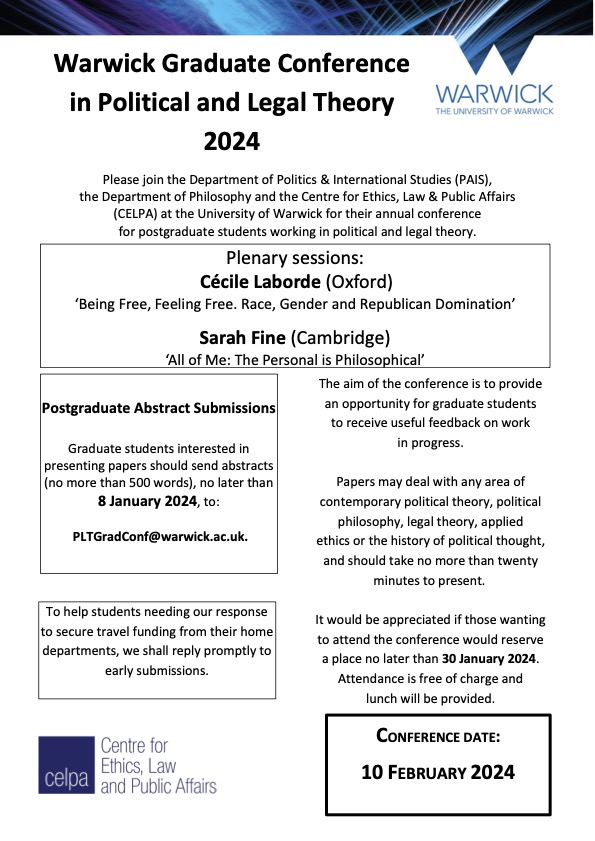
Please join the Department of Politics and International Studies (PAIS), the Department of Philosophy and the Centre for Ethics, Law and Public Affairs (CELPA) at the University of Warwick for their annual conference for postgraduate students working in political and legal theory.

Conference Date: 10 February 2024 

Location: The University of Warwick 

Plenary sessions:  

Cécile Laborde (Oxford): ‘Being Free, Feeling Free. Race, Gender and Republican Domination’.

Sarah Fine (Cambridge): ‘All of Me: The Personal is Philosophical’.

The aim of the conference is to provide an opportunity for graduate students to receive useful feedback on work in progress. Papers may deal with any area of contemporary political theory, political philosophy, legal theory, applied ethics, or the history of political thought, and should take no more than twenty minutes to present.

Graduate students interested in presenting papers should send abstracts (no more than 500 words) to PLTGradConf@warwick.ac.uk by no later than 8 January 2024.

To help students needing our response to secure travel funding from their home departments, we shall reply promptly to early submissions with our decisions.

Those wanting to attend the conference should register by no later than 30 January 2024 via email. Attendance is free of charge. Lunch and refreshments will be provided.

For any enquiries, please feel free to contact the conference organisers using the email address: PLTGradConf@warwick.ac.uk.
Posted in Uncategorized | 1 Comment

Books received – Antoniol, Foucault, Benveniste, Woodard

Valentina Antoniol, Foucault et la guerre: À partir de Schmitt, contre Schmitt; Michel Foucault, The Japan Lectures, edited by John Rajchman; and second-hand copies of Benveniste’s Problems in General Linguistics, Autour d’Émile Benveniste and Roger Woodard (ed.), The Ancient Languages of Mesopotamia, Egypt and Aksum. Valentina kindly sent me a copy of her book, and The Japan Lectures was sent by Routledge. The expanded edition of Benveniste’s Problems is still listed as forthcoming from Hau books, but it has been long delayed.

Posted in Carl Schmitt, Emile Benveniste, Michel Foucault | Leave a comment

British Library new temporary site – but a concerning (realistic?) assessment of time to get back up and running

The British Library has a new temporary site up, with much more information available since I last checked. But in their FAQ they are anticipating ‘several months’ to assess and repair, and indicate similar organisations have taken over 12 months to get back up and running: www.bl.uk/cyber-incident

Edited above – the site says ‘over 12 months’, rather than ’12 months’. This expectation management is fair enough, but ‘over 12 months’ and ‘several months’ are obviously very vague. It’s over 12 months since the Battle of Waterloo, so this really doesn’t say anything. We are probably at a stage where PhDs, post-docs, research projects etc. which are dependent on BL collections are going to need reassessment and institutional support.

Posted in Uncategorized | Leave a comment

Tobias Keiling and Ian Alexander Moore, Spoiling the Party? Heidegger’s Lectures on Trakl at Spa Bühlerhöhe – b2o (boundary 2 online)

Tobias Keiling and Ian Alexander Moore, Spoiling the Party? Heidegger’s Lectures on Trakl at Spa Bühlerhöhe – b2o (boundary 2 online)

It all began with plans for a birthday party. Gerhard Stroomann, chief physician and charismatic leader of the posh spa resort and sanitarium Bühlerhöhe (imagine Thomas Mann’s character Hofrat Behrens, transplanted to a postwar “magic mountain” in the Black Forest) would be turning sixty-five in 1952, and he wanted to celebrate it with a weekend of events devoted to his beloved poet Georg Trakl. Even more, he wanted to hear the philosopher Martin Heidegger speak about the poet. Heidegger had already given a few lectures at the spa while he was still prohibited from teaching at the university, including one on language under the guise of a commentary on Trakl’s poem “A Winter Evening.” Although irritated by the overeager, elite milieu of the luxury retreat—“it was,” as one eyewitness reported about the event, “very highbrow, […] teeming with counts and princesses, a bit snobbish”—Heidegger accepted Stroomann’s invitation.

Posted in Uncategorized | Leave a comment

Julia Kristeva, Dostoyevsky in the Face of Death or Language Haunted by Sex, trans. Armine Kotin Mortimer, Columbia University Press, December 2023

Julia Kristeva, Dostoyevsky in the Face of Death or Language Haunted by Sex, trans. Armine Kotin Mortimer, Columbia University Press, December 2023

Julia Kristeva has been both attracted and repelled by Dostoyevsky since her youth. In this extraordinary book, by turns poetic and intensely personal, she brings her unique critical sensibility to bear on the tormented and visionary Russian author.

Kristeva ranges widely across Dostoyevsky’s novels and his journalism, plunging deep into the great works—and many of the smaller ones—to investigate her fascination with the Russian author. What emerges is a luminous vision of the writer’s achievements, seen in a wholly new way through Kristeva’s distinctive perspective on language. With her keen psychoanalytical eye, she offers brilliant insights into the passionate heroines of the great novels. Focusing on Dostoyevsky’s polyphonic writing, Kristeva also demonstrates the importance of Orthodox Christianity throughout his body of work, analyzing the complex ways his carnivalesque theology informs his fiction and commentary.

An original and profound interpretation of one of the nineteenth century’s greatest writers, this book’s insights are also relevant to the twentieth and twenty-first centuries—up to our unsettled present, to which Kristeva’s humane reading of the suffering Russian author brings understanding and even solace.

Posted in Julia Kristeva, Uncategorized | 2 Comments

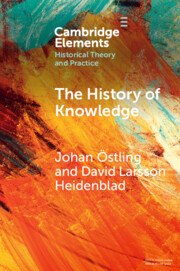
Johan Östling and David Larsson Heidenblad, The History of Knowledge – trans. Lena Olsson, Cambridge University Press, January 2024 (print and open access)

Johan Östling and David Larsson Heidenblad, The History of Knowledge – trans. Lena Olsson, Cambridge University Press, January 2024 (print and open access)

Despite the date, the e-book is available now.

This Element provides a pedagogical overview of the history of knowledge, including its main currents, distinguishing ideas, and key concepts. However, it is not primarily a state-of-the-art overview but rather an argumentative contribution that seeks to push the field in a certain direction – towards studying knowledge in society and knowledge in people’s lives. Hence, the history of knowledge envisioned by the authors is not a rebranding of the history of science and intellectual history, but rather a reinvigoration of social and cultural history. This implies that many different forms of knowledge should be objects of study. By drawing on ongoing research from all across the world dealing with different time periods and problems, the authors demonstrate that the history of knowledge can enrich our understanding of past societies. This title is also available as Open Access on Cambridge Core.

Posted in Uncategorized | 1 Comment

Richard Lynch and Daniele Lorenzini, Bibliography of Foucault’s shorter works in English translation – newly updated (2023)

Richard Lynch’s very useful Bibliography of Foucault’s shorter works in English translation has been newly updated by Daniele Lorenzini.

This is a continual work in progress, and updates and corrections should be sent to Daniele for inclusion in future versions (details in above link). Many thanks to Daniele for taking on this work, and Richard for creating this invaluable resource and updating it for 25 years.

Posted in Michel Foucault, Uncategorized | Leave a comment

CFP: Foucault: Art, Histories, and Visuality in the 21st Century OCAD (Ontario College of Art and Design) University, Toronto/Tkaronto, Canada, May 29-30, 2024

Foucault: Art, Histories, and Visuality in the 21st Century OCAD (Ontario College of Art and Design) University, Toronto/Tkaronto, Canada, May 29-30, 2024

The French philosopher Michel Foucault’s (1926–84) work has had a major effect on scholars of art and visuality since Les Mots et les choses (1966) appeared in English in 1970 as The Order of Things. His radical ideas galvanized artists and art writers into many different directions: to insert ruptures and incoherence into history; to reimagine the subject, subjectivity, and identity; to politicize the realms of vision, visuality, and visibility; to formulate critical approaches to technology and media; and to scrutinize the inner workings of art institutions, including museums, schools, and archives. The versatility of Foucault’s thought greatly contributed to major shifts across disciplines, including the interventions of the “new art history” in the 1970s, multiculturalism and identity politics in the 1980s, visual and cultural studies in the 1990s, the questions of contemporaneity and globalization in this century. Owing to the posthumous publications of his lectures and the papers deposited at archives internationally, Foucault’s oeuvre continues to shape current discussions on methodological, political, and ethical assumptions regarding visualities and art histories forty years after his death.

Proposals can be sent to foucault2024@gmail.com by Jan 22, 2024

Full details here.

Posted in Uncategorized | Leave a comment

Earthly volumes, voluminous materialities: Working with apprehension – special issue of Territory, Politics, Governance, edited by Mia Bennett and Klaus Dodds (part open access)

Earthly volumes, voluminous materialities: Working with apprehension – special issue of Territory, Politics, Governance, edited by Mia Bennett and Klaus Dodds (part open access)

Earthly volumes, voluminous materialities: working with apprehension
Mia M. Bennett & Klaus Dodds
Pages: 1-11 | DOI: 10.1080/21622671.2023.2242394


Data centres on the Moon and other tales: a volumetric and elemental analysis of the coloniality of digital infrastructures | Open Access
Yung Au
Pages: 12-30 | DOI: 10.1080/21622671.2022.2153160


Governing and securing the territorial volumes of burial: transformations in the political economy and domestic geopolitics of death | Open Access
Cameron Byron
Pages: 31-49 | DOI: 10.1080/21622671.2022.2123032


The geopolitics of whaling and Japanese colonialism in Korea
Hanbyeol Jang & Kimberley Anh Thomas
Pages: 50-71 | DOI: 10.1080/21622671.2022.2138524


Beyond the BRI: the volumetric presence of China in Nepal
Galen Murton
Pages: 72-92 | DOI: 10.1080/21622671.2023.2186475


Securitise the volume: epistemic territorialisation and the geopolitics of China’s Arctic research | Open Access
Trym Eiterjord
Pages: 93-111 | DOI: 10.1080/21622671.2023.2179535


Selling seasteading: rhetoric, accumulation, and appropriation of space in French Polynesia
Elizabeth Bennett
Pages: 112-131 | DOI: 10.1080/21622671.2023.2212017


Making Mars resonate: the role of analogue sites in territorializing China’s outer space imaginaries
Paloma Puente-Lozano & Alexia Herring-Bazo
Pages: 132-152 | DOI: 10.1080/21622671.2023.2173284


The deep interface of the effectuated voluminous territories: gates, smooth and striated spaces, and the royal science in the Air Silk Road | Open Access
Chao Yao & June Wang
Pages: 153-169 | DOI: 10.1080/21622671.2022.2150286

Posted in terrain, Territory, Uncategorized | Leave a comment

Carolyn Dever, How to Lose a Library at Public Books – the best thing I’ve read on the ongoing and very serious British Library problems

Carolyn Dever, How to Lose a Library at Public Books – the best thing I’ve read on the ongoing and very serious British Library problems (via @nescio13 on X/Twitter)

What’s business as usual at the Victoria and Albert Museum is far from the case fewer than four miles away, at the United Kingdom’s national public repository, the British Library. At the British Library, hopeful would-be readers of the library’s prodigious catalogue of unique, rare, and contemporary materials are out of luck.

On Halloween, 2023, the British Library suffered a massive cyberattack, which rendered its web presence nonexistent, its collections access disabled, and even its wifi fried. Moreover, the cyberattack also swept the personal data of the British Library’s humans—its users, but, far more extensively, its staff—into the hands of an outside party. During the final week of November, images of the stolen data were presented for auction on the dark web, for sale to whoever’s willing to pay 20 bitcoin, or about £600,000. By making the library’s digital infrastructure into a commodity (in an open, albeit dark, market), a “ransomware gang” calling itself Rhysida hopes to pressure the British Library to pay up first.

Update 16 Dec 11am: after weeks of limited information, the British Library blog has been updated with a much more detailed statement from the chief executive. A phased return of some more services is due in the New Year.

Update 19 Dec: some good questions at The Edithorial

Update 22 Dec: there is a piece in The New Yorker

Posted in Uncategorized | 1 Comment