My favourite academic books of 2023

At the end of each year I’ve posted a list of academic books I liked. The criteria was that they were published in that year, and that I read and liked them. This means that good books which came out this year but which I didn’t read immediately don’t feature, and I will of course miss many. In the middle of the year, when I was unwell, I went for a while without reading anything work-related.

Some of those featured are books I reviewed or endorsed, and others are by friends and colleagues. Certain publishers, especially those I review for, feature disproportionately. It’s of course biased by my interests and prejudices. So while there are doubtless many other good books from each of these years, I can at least say that these are all worth reading.

Here are the lists from 201320142015201620172018201920202021 and 2022.

My favourite academic books of 2023 are:

  1. Kostas Axelos, The Game of the World, trans. Justin Clemens and Hellmut Munz  (Edinburgh) – which I endorsed
  2. Georges Bataille, The Limit of the Useful, trans. and ed. Cory Austin Knudson and Tomas Elliott (MIT) and Critical Essays Volume I: 1944-1948, ed. Alberto Toscano and Benjamin Noys, trans. Chris Turner (Seagull)
  3. Nikolina Bobic and Farzaneh Haghighi (eds.), The Routledge Handbook of Architecture, Urban Space and Politics, Volume I: Violence, Spectacle and Data (Routledge)
  4. Andrea Mubi Brighenti, Elias Canetti and Social Theory (Bloomsbury)
  5. Italo Calvino, The Written World and the Unwritten World: Collected Non-Fictiontrans. Ann Goldstein (Penguin)
  6. Noel Castree, Greig Charnock, Brett Christophers, David Harvey: A Critical Introduction to his Thought (Routledge)
  7. Irene Cheng, The Shape of Utopia: The Architecture of Radical Reform in Nineteenth-Century America (Minnesota)
  8. Karen Culcasi, Displacing Territory: Syrian and Palestinian Refugees in Jordan (Chicago) – which I endorsed
  9. Danny Dorling, Shattered Nation: Inequality ad the Geography of a Failing State (Verso)
  10. Michel Foucault, Le Discours philosophique, edited by Daniele Lorenzini and Orazio Irrera (Gallimard/Seuil/EHESS) and the translations of Madness, Language, Literature (Chicago)  and The Japan Lectures (Routledge)
  11. Bernard Dionysius Geoghegan, Code: From Information Theory to French Theory (Duke)
  12. David Harvey, A Companion to Marx’s Grundrisse (Verso)
  13. Julian Jackson, France on Trial: The Case of Marshal Pétain (Harvard/Allen Lane)
  14. Ian Klinke, Life, Earth, Colony: Friedrich Ratzel’s Necropolitical Geography (Michigan)
  15. Natalie Koch, Arid Empire: The Entangled Fates of Arizona and Arabia (Verso)
  16. Shiloh Krupar, Health Colonialism: Urban Wastelands and Hospital Frontiers (Minnesota Forerunners)
  17. Daniele Lorenzini, The Force of Truth: Critique, Genealogy, and Truth-Telling in Michel Foucault (Chicago)
  18. Jared D. Margulies, The Cactus Hunters: Desire and Extinction in the Illicit Succulent Trade (Minnesota)
  19. Ian Merkel, Terms of Exchange: Brazilian Intellectuals and the French Social Sciences (Chicago)
  20. Sara Safransky, The City after Property: Abandonment and Repair in Postindustrial Detroit (Duke)
  21. Tim Simpson, Betting on Macau: Casino Capitalism and China’s Consumer Revolution (Minnesota)
  22. Martina Tazzioli, Border Abolitionism: Migrants’ Containment and the Genealogies of Struggle and Rescue (Manchester)
  23. Jing Tsu, Kingdom of Characters: A Tale of Language, Obsession and Genius in Modern China (Penguin)
  24. James Tyner, Academic Writing for Geographers: A Handbook (De Gruyter)
  25. Karine Varley, Vichy’s Double Bind: French Collaboration between Hitler and Mussolini during the Second World War  (Cambridge)
  26. Joseph Vogl, Capital and Ressentiment: A Short Theory of the Present, translated by Neil Solomon (Polity)
  27. Françoise Waquet, Latin: Or, the Empire of a Sign, trans. John Howe (Verso reissue)
  28. Richard Wolin, Heidegger in Ruins: Between Philosophy and Ideology (Yale)
  29. Jeffrey Whyte, The Birth of Psychological Warfare: Propaganda, Espionage, and Military Violence from WWII to the Vietnam War (Oxford/British Academy; open access) – which I endorsed
  30. Rosemary Lévy Zumwalt, Franz Boas: Shaping Anthropology and Fostering Social Justice – University of Nebraska Press (sequel to Franz Boas, The Emergence of the Anthropologist, 2019)

I’ve just started Ash Amin, After Nativism: Belonging in an Age of Intolerance (Polity). Valentina Antoniol, Foucault et la guerre: À partir de Schmitt, contre Schmitt (Mimésis) arrived late in the year and I hope to have time for it soon.

Posted in Boundaries, Claude Lévi-Strauss, David Harvey, Georges Bataille, Karl Marx, Kostas Axelos, Martin Heidegger, Michel Foucault, Territory, Uncategorized, urban/urbanisation | 7 Comments

The music of my 2023

The music I enjoyed most from 2023, either bought in physical form, often through Burning Shed, or digitally through bandcamp:

  1. Akku Quintet, Kinema
  2. Anchor and Burden, Kosmonautik Pilgrimage
  3. Big Big Train, Ingenious Devices
  4. Blaer, Pure
  5. Delrei, Desolation and Radiation
  6. D’Virgilio, Morse & Jennings, Sophomore
  7. Colin Edwin and Robert Jürjendal, The Weight of a Shadow
  8. The Fierce and the Dead, News from the Invisible World
  9. Peter Gabriel, i/o
  10. Haken, Fauna
  11. Hely, Plode
  12. Katatonia, Sky Void of Stars
  13. Jeremias Keller, Alloy
  14. Neal Morse, The Dreamer – Joseph Part One
  15. The Neal Morse Band, An Evening of Innocence and Danger: Live in Hamburg
  16. PAKT [Percy Jones, Alex Skolnick, Kenny Grohowski, Tim Motzer], Live in Piermont
  17. Reichenhall, Muschelkalk
  18. Markus Reuter & Stefano Castagna, Sea of Hopeless Angels
  19. North Atlantic Oscillation, United Wire
  20. Sanscreed Kanon, Sanscreed Kanon
  21. Shibui, Quint
  22. Sonar with David Torn and J. Peter Schwalm, Three Movements
  23. Stephan Thelen and Fabio Anile, Music for Piano and Strings
  24. Steven Wilson, The Harmony Codex
  25. Temic, Terror Management Theory

For previous years: 2022, 202120202019201820172016201520142013 and 2012.

I didn’t get to see much music live, and missed a few due to illness, but particularly enjoyed Big Big Train, Haken, The Aristocrats, Peter Gabriel, Extreme and Nik Bärtsch’s Ronin.

Posted in Uncategorized | 3 Comments

Foucault Studies 35, special issue on Covid – Biopolitical Tensions after Pandemic Times

Foucault Studies 35, special issue on Covid – Biopolitical Tensions after Pandemic Times

Posted in Michel Foucault | Leave a comment

Peter Sloterdijk, Out of the World – Stanford University Press, May 2024

Peter Sloterdijk, Out of the World – Stanford University Press, May 2024

In this essential early work, the preeminent European philosopher Peter Sloterdijk offers a cross-cultural and transdisciplinary meditation on humanity’s tendency to refuse the world.

Developing the first seeds of his anthropotechnics, Sloterdijk develops a theory of consciousness as a medium, tuned and retuned over the course of technological and social history. His subject here is the “world-alien” in man that was formerly institutionalized in religions, but is increasingly dealt with in modern times through practices of psychotherapy. Originally written in 1993, this almost clairvoyant work examines how humans seek escape from the world in cross-cultural and historical context, up to the mania and world-escapism of our cybernetic network culture. Chapters delve into the artificial habitats and forms of intoxication we develop, from early Christian desert monks to pharmaco-theology through psychedelics. In classic form, Sloterdijk recalibrates and reinvents concepts from the ancient Greeks to Heidegger to develop an astonishingly contemporary philosophical anthropology.

Posted in Peter Sloterdijk | Leave a comment

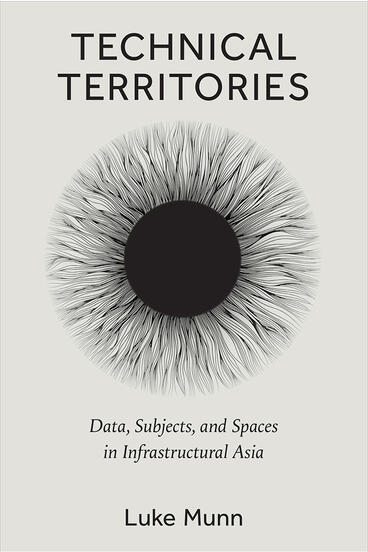
Luke Munn, Technical Territories: Data, Subjects, and Spaces in Infrastructural Asia – University of Michigan Press, 2023

Luke Munn, Technical Territories: Data, Subjects, and Spaces in Infrastructural Asia – University of Michigan Press, 2023

Territory is shifting. No longer defined by the dotted line of the border or the national footprint of soil, today’s territories are enacted through data infrastructures. From subsea cables to server halls, these infrastructures underpin new forms of governance, shaping subjects and their everyday lives. Technical Territories moves from masked protestors in Hong Kong to asylum-seekers in Christmas Island and sand miners in Singapore, exploring how these territories are both political and visceral, altering the experience of their inhabitants.
Infrastructures have now become geopolitical, strategic investments that advance national visions, extend influence, and trigger trade wars. Yet at the same time, these technologies also challenge sovereignty as a bounded container, enacting a more distributed and decoupled form of governance. Such “technical territories” construct new zones where subjects are assembled, rights are undermined, labor is coordinated, and capital is extracted. The stable line of the border is replaced by more fluid configurations of power. Luke Munn stages an interdisciplinary intervention over six chapters, drawing upon a wide range of literature from technical documents and activist accounts, and bringing insights from media studies, migration studies, political theory, and cultural and social studies to bear on these new sociotechnical conditions.

There is a review by Anshul Rai Sharma at the LSE Review of Books.

Posted in Territory | 2 Comments

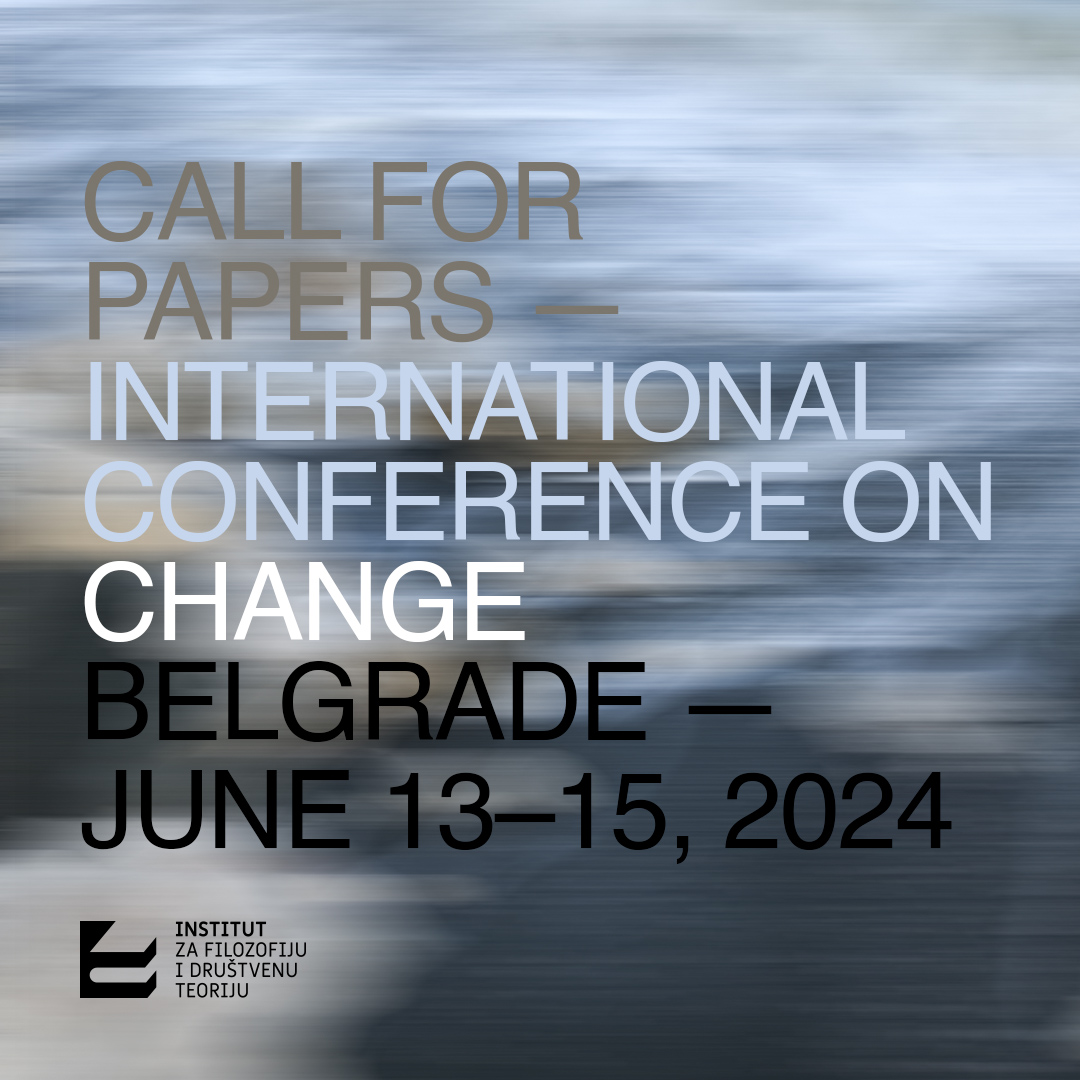
CFP: International Conference on Change, Belgrade, 13-15 June 2024

CFP: International Conference on Change, Belgrade, 13-15 June 2024

With the confirmed participation of Étienne Balibar, Axel Honneth, and Jonathan Wolff.

Change is one of those fundamental notions in social sciences and humanities that appears intuitively intelligible until one tries to provide a clear definition of the term. What constitutes change? To what extent is change the ‘other’ of being? When is change possible and is it always desirable? Do people crave certainty and stability or is “love of change a weakness and imperfection of our nature,” as John Ruskin famously said? Is change possible, or was the epigram right: Plus ça change, plus c’est la même chose?

One significant aspect of change is its inherent complexity. While the causes of change may sometimes be easy to identify, the actual trajectory and outcomes are most often not unilinear and are difficult to foresee. Social systems are so intricately interconnected that a seemingly minor alteration of rules can trigger a cascading series of effects that reverberate through the entire fabric of society. Navigating change requires a nuanced understanding of the interplay between the initial factors and the ripple effects they may generate.

One way of approaching the theme of change within social systems is through the optic of systemic contradictions, but the most fruitful discussions arise when we contemplate change as the product of human agency. Political movements, revolutions and technological innovations are marked by reflexive decision-making of individual and collective actors directed towards changing societal norms, often experienced as unjust or dysfunctional. The driver of change is social engagement, the articulation of a shared understanding of what the most pressing societal problems are and how to overcome them. Not all forms of engagement are progressive in the usual sense – some aim to institutionalize authoritarian norms or restore traditionalist and conservative ones. On the other hand, not all calls for restoring “old” norms must mean conservative change – witness contemporary leftists struggling to restore discarded elements of the post-war welfare state.

The study of change demands a serious (re)consideration of, among others, the following issues:

  1. What is the fundamental nature of change? This question seeks to explore the ontological status of change and whether it is an inherent and universal aspect of reality.
  2. What are the underlying causes and catalysts of engaging in and for social change?
  3. How can we effectively mobilize and engage diverse communities in supporting and driving social change? What constitutes the cognitive and emotional common ground that enables us to articulate a project of (social) change?
  4. What potential challenges and obstacles might arise during the process of realizing social change? What types of social domination – suppression of systemic contradictions and social engagement – exist today and how does one challenge them?
  5. What constitutes a conservative vision of social change, as opposed to a progressive one? Are these terms helpful or are they obfuscating reality? How about other binaries, such as reformist/revolutionary, radical/moderate and procedural/substantive change?
  6. Our present order is sometimes seen as resting upon an ideology of constant change which protects the fundamental structures from real change. Can one engage in changing the “tyranny of change” in a manner that doesn’t call for restoring old norms?

We welcome papers that address these and related questions. We invite both theoretical and empirical papers, employing a comparative or case study perspective, coming from all disciplines of the social sciences and humanities.

Please send proposals (up to 300 words; submissions for presentations of up to 15 minutes) to conference@ifdt.bg.ac.rs by Jan 31 2024. Applicants will be notified of their submission status by Feb 29 2024.

Abstracts should be sent in a Word document. The document should include the presentation title, abstract, and the applicant’s full name, institutional affiliation, and contact information.

The conference will be held in Belgrade, Serbia on June 13-15, 2024. For additional information, please contact conference@ifdt.bg.ac.rs

Posted in Axel Honneth, Etienne Balibar | Leave a comment

Dave Beer recalls his reading of 2023, with a nice mention of my Foucault work

Dave Beer recalls his reading of 2023, with a nice mention of my Foucault work.

Posted in Foucault's Last Decade, Foucault: The Birth of Power, Michel Foucault, The Archaeology of Foucault, The Early Foucault | Leave a comment

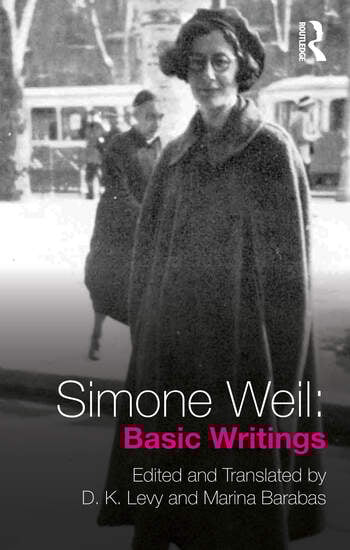
Simone Weil, Basic Writings, eds. D.K. Levy and Marina Barabas, Routledge, December 2023

Simone Weil, Basic Writings, eds. D.K. Levy and Marina Barabas, Routledge, December 2023

Simone Weil is one of the most profound and thought-provoking thinkers of the 20th century. A teacher, factory and farm labourer, a political activist at home and abroad, a loving friend, daughter and sister—all these manifest a life devoted to the good in its many forms. Her writings explore the good open to us and the various routes to it, spanning philosophy, politics, science and spirituality. While she saw her vocation primarily as a philosopher—examining questions concerning human faculties, action and thought, the limits of language and our need of mediation, suffering and beauty for contact with reality—her startlingly original thought is often obscured by her having been too readily categorized as a Christian mystic.

Simone Weil: Basic Writings is an expertly edited anthology of Weil’s most important writings, presenting her philosophy as it relates to the architecture of human nature, politics, work, necessity, beauty, goodness and God. Working from the definitive French edition of Weil’s complete writings, D. K. Levy and Marina Barabas have translated the essays anew or for the first time, adding important notes and references absent from existing English language editions of Weil’s work.

Following an extensive introduction that gives an overview of Weil’s life and thought, each part opens with a short preface situating the selected essays within Weil’s oeuvre.

Simone Weil: Basic Writings provides an excellent entry point to Weil’s philosophy, as well as a reference for students and scholars of Weil’s thought in philosophy and related disciplines.

Posted in Uncategorized | Leave a comment

Friedrich Nietzsche, Unpublished Fragments from the Period of Dawn (Winter 1879/80–Spring 1881) – trans. J.M. Baker, Jr. and Christian Hertel, Stanford University Press, December 2023

Friedrich Nietzsche, Unpublished Fragments from the Period of Dawn (Winter 1879/80–Spring 1881) – trans. J.M. Baker, Jr. and Christiane Hertel, Stanford University Press, December 2023

This volume provides the first English translation of Nietzsche’s unpublished notes from late 1879 to early 1881, the period in which he authored Dawn, the second book in the trilogy that began with Human, All Too Human and concluded with The Joyful Science.

In these fragments, we see Nietzsche developing the conceptual triad of morals, customs, and ethics, which undergirds his critique of morality as the reification into law or dogma of conceptions of good and evil. Here, Nietzsche assesses Christianity’s role in the determination of moral values as the highest values and of redemption as the representation of humanity’s highest aspirations. These notes show the resulting tension between Nietzsche’s contrasting thoughts on modernity, which he critiques as an unrecognized aftereffect of the Christian worldview, but also views as the springboard to “the dawn” of a transformed humanity and culture. The fragments further allow readers insight into Nietzsche’s continuous internal debate with exemplary figures in his own life and culture—Napoleon, Schopenhauer, and Wagner—who represented challenges to hitherto existing morals and culture—challenges that remained exemplary for Nietzsche precisely in their failure. 

Presented in Nietzsche’s aphoristic style, Dawn is a book that must be read between the lines, and these fragments are an essential aid to students and scholars seeking to probe this work and its partners.

Posted in Friedrich Nietzsche, Uncategorized | Leave a comment

Fascism Vol 12 No 2 Special Issue: (Re)Living Greece and Rome: Performances of Classical Antiquity under Fascism, edited by Eleftheria Ioannidou, Giovanna Di Martino and Sara Troiani

Fascism Vol 12 No 2 Special Issue: (Re)Living Greece and Rome: Performances of Classical Antiquity under Fascism, edited by Eleftheria Ioannidou, Giovanna Di Martino and Sara Troiani

The papers are currently available open access.

Posted in Uncategorized | Leave a comment