Richard Wolin, Heidegger in Ruins: Between Philosophy and Ideology – Yale University Press, January 2023

Richard Wolin, Heidegger in Ruins: Between Philosophy and Ideology – Yale University Press, January 2023
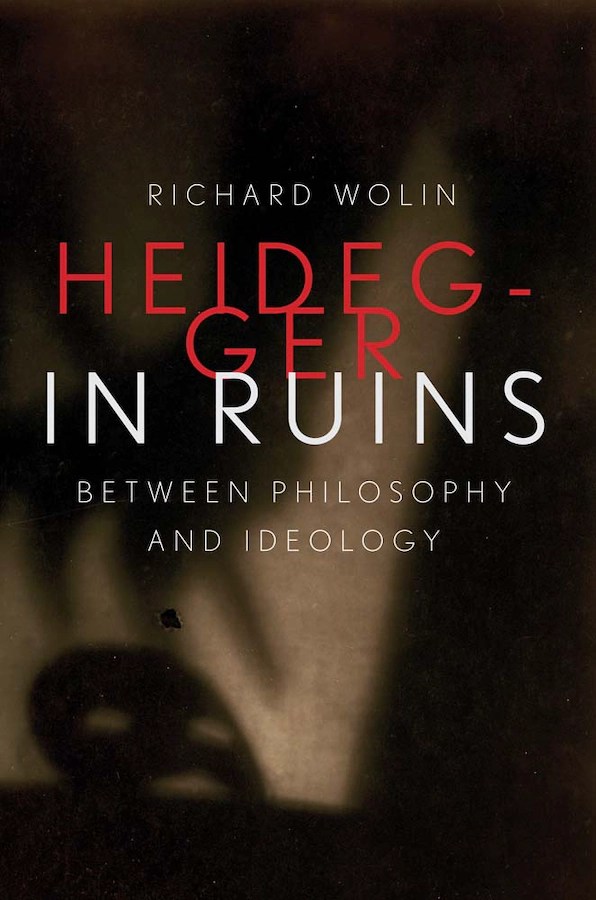
What does it mean when a radical understanding of National Socialism is inextricably embedded in the work of the twentieth century’s most important philosopher?
 
Martin Heidegger’s sympathies for the conservative revolution and National Socialism have long been well known. As the rector of the University of Freiburg in the early 1930s, he worked hard to reshape the university in accordance with National Socialist policies. He also engaged in an all-out struggle to become the movement’s philosophical preceptor, “to lead the leader.” Yet for years, Heidegger’s defenders have tried to separate his political beliefs from his philosophical doctrines. They argued, in effect, that he was good at philosophy but bad at politics. But with the 2014 publication of Heidegger’s Black Notebooks, it has become clear that he embraced a far more radical vision of the conservative revolution than previously suspected. His dissatisfaction with National Socialism, it turns out, was mainly that it did not go far enough. The notebooks show that far from being separated from Nazism, Heidegger’s philosophy was suffused with it. In this book Richard Wolin explores what the notebooks mean for our understanding of arguably the most important philosopher of the twentieth century, and of his ideas—and why his legacy remains radically compromised.

New Books podcast

New Statesman piece by Lyndsey Stonebridge – Who is Afraid of Martin Heidegger?

Update: also a piece in The Conversation

Update 2: an excerpt from the book is at the LARB
Posted in Martin Heidegger | Leave a comment

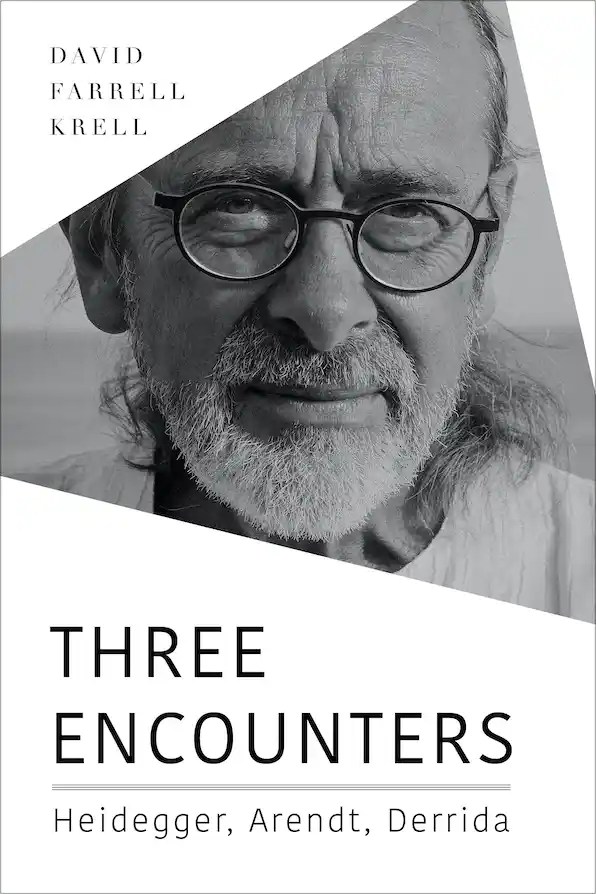
David Farrell Krell, Three Encounters: Heidegger, Arendt, Derrida – Indiana University Press, June 2023

David Farrell Krell, Three Encounters: Heidegger, Arendt, Derrida – Indiana University Press, June 2023

In 1974, thirty-year-old philosopher and translator David Farrell Krell began corresponding and meeting with Martin Heidegger and Hannah Arendt. Years later, he would meet Jacques Derrida and, through many letters and visits, come to know him well. Drawing on unpublished correspondence and Krell’s warmly told personal recollections, Three Encounters presents an intimate and highly insightful look at the lives and ideas of three noted philosophers at the peak of their careers. 

Three Encounters offers a chance for readers to encounter these three great philosophers and their ideas, not merely through the lens of their biographies, but as “people” we come to know through their personal correspondence and Krell’s recollections. Three Encounters demonstrates the intertwining of thought and lived experience.

“In the tradition of Continental Philosophy, Heidegger, Arendt, and Derrida loom large, and Krell is perhaps unique in having had personal relationships with all three. The reader comes away from this book with vivid pictures of these philosophers. We learn not only about aspects of their professional lives, but also about them as people at the times Krell knew them. A delight to read.”~Samir Haddad, Fordham University 

“The text brims with philosophical ideas from the three thinkers—as well as from Nietzsche, whose presence shadows much of the narrative—and these ideas are presented clearly and discussed in ways that are invariably illuminating. The prose flows beautifully, with frequent sparkles of wit and erudite humour. The interweaving of ideas and themes with engaging anecdotes is judicious and nuanced. I found the entire account enthralling.”~Graham Parkes, University of Vienna

Posted in David Farrell Krell, Hannah Arendt, Jacques Derrida, Martin Heidegger | Leave a comment

David Harvey discussion “La géographie du capital” and dialogue with Jean-Luc Mélenchon (videos)

David Harvey discussion – although the questions are in French, Harvey speaks in English, followed by an interpreter.

Cette conférence est le premier événement d’une série de deux organisés par le département de géographie de l’Institut La Boétie, dans le cadre de ses chaires, à l’occasion de la venue exceptionnelle de David Harvey en France.

David Harvey est un géographe britannique. Il est le fondateur de la géographie critique et à l’origine de la première lecture spatiale de la théorie marxiste. Aujourd’hui, géographe le plus cité du monde, il est une référence pour plusieurs générations d’intellectuels à travers le monde entier.

Dans cette conférence dédiée à la géographie du capital, David Harvey présentera les principaux éléments qu’il développe depuis plus de quarante ans sur la production de l’espace par le capitalisme. Cet exposé pourra le conduire à revenir sur différents processus urbains, sur les relations entre centre et périphéries, ou encore sur l’impérialisme.

David Harvey and Jean-Luc Mélenchon dialogue (here the interpreter is simultaneous, so speaks over Harvey).

Cette conférence est la seconde organisée par le département de géographie de l’Institut La Boétie, dans le cadre de ses chaires, à l’occasion de la venue exceptionnelle de David Harvey en France.

David Harvey est un géographe britannique. Il est le fondateur de la géographie critique et à l’origine de la première lecture spatiale de la théorie marxiste. Aujourd’hui, géographe le plus cité du monde, il est une référence pour plusieurs générations d’intellectuels à travers le monde entier.

Après avoir présenté dans une première conférence le 8 avril 2023 sa théorie sur la géographie du capital, il dialoguera avec Jean-Luc Mélenchon, co-président de l’Institut La Boétie et ancien candidat à l’élection présidentielle.

Dans cet échange exceptionnel et inédit, se mêleront pensée critique théorique et de l’action politique transformatrice. Les deux évoqueront ensemble de nombreux sujets comme leurs conceptions de la ville, la crise du néolibéralisme, la place de l’État, l’état de la gauche et des mouvements sociaux en Europe et dans le monde…

Posted in David Harvey | 1 Comment

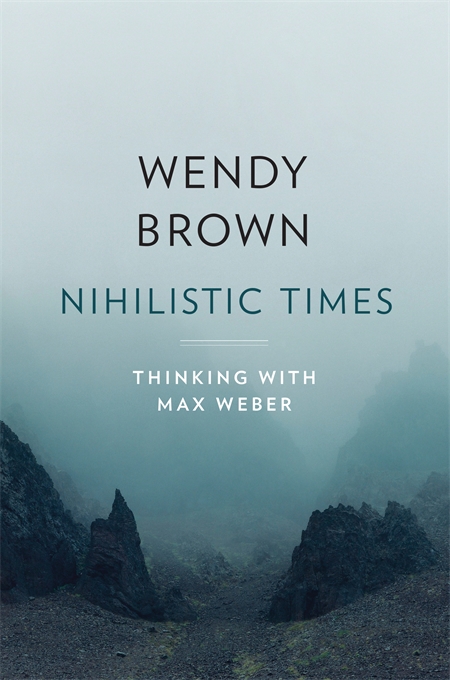
Wendy Brown, Nihilistic Times: Thinking with Max Weber – Harvard University Press, April 2023

Wendy Brown, Nihilistic Times: Thinking with Max Weber – Harvard University Press, April 2023

One of America’s leading political theorists analyzes the nihilism degrading—and confounding—political and academic life today. Through readings of Max Weber’s Vocation Lectures, she proposes ways to counter nihilism’s devaluations of both knowledge and political responsibility.

How has politics become a playpen for vain demagogues? Why has the university become an ideological war zone? What has happened to Truth? Wendy Brown places nihilism at the center of these predicaments. Emerging from European modernity’s replacement of God and tradition with science and reason, nihilism removes the foundation on which values, including that of truth itself, stand. It hyperpoliticizes knowledge and reduces the political sphere to displays of narcissism and irresponsible power plays. It renders the profound trivial, the future unimportant, and corruption banal.

To consider remedies for this condition, Brown turns to Weber’s famous Vocation Lectures, delivered at the end of World War I. There, Weber himself decries the effects of nihilism on both scholarly and political life. He also spells out requirements for re-securing truth in the academy and integrity in politics. Famously opposing the two spheres to each other, he sought to restrict academic life to the pursuit of facts and reserve for the political realm the pursuit and legislation of values.

Without accepting Weber’s arch oppositions, Brown acknowledges the distinctions they aim to mark as she charts reparative strategies for our own times. She calls for retrieving knowledge from hyperpoliticization without expunging values from research or teaching, and reflects on ways to embed responsibility in radical political action. Above all, she challenges the left to make good on its commitment to critical thinking by submitting all values to scrutiny in the classroom and to make good on its ambition for political transformation by twinning a radical democratic vision with charismatic leadership.

Posted in Wendy Brown | Leave a comment

Shiloh Krupar, Health Colonialism: Urban Wastelands and Hospital Frontiers – University of Minnesota Press/Forerunners, March 2023

Shiloh Krupar, Health Colonialism: Urban Wastelands and Hospital Frontiers – University of Minnesota Press/Forerunners, March 2023

Health Colonialism considers how U.S. urban development policies contribute to the uneven and unjust distribution of health care in this country. Here, Shiloh Krupar investigates the racially inequitable effects of elite U.S. hospitals on their surrounding neighborhoods and their role in consolidating frontiers of land primed for redevelopment. 

Naming this frontier “medical brownfields,” Krupar shows how hospitals leverage their domestic real estate empires to underwrite international prospecting for patients and overseas services and specialty clinics. Her pointed analysis reveals that decolonizing health care efforts must scrutinize the land practices of nonprofit medical institutions and the liberal foundations of medical apartheid perpetuated by globalizing American health care.

Posted in Uncategorized | Leave a comment

Frédéric Keck, How French Moderns Think: The Lévy-Bruhl Family, From “Primitive Mentality” to Contemporary Pandemics – HAU books, December 2023

Frédéric Keck, How French Moderns Think: The Lévy-Bruhl Family, From “Primitive Mentality” to Contemporary Pandemics – HAU books, December 2023

This book traces the contributions of the Lévy-Bruhl family to social and political thought and expertise in 20th-century France, shaping the anticipation of economic and health crises.

How French Moderns Think tells the story of the French sociological tradition through four generations of the Lévy-Bruhl family: Lucien, who founded the Institute of Ethnology at the University of Paris; his son Henri, who founded the Institute of Roman Law; his grandson Raymond, who took part in the creation of the National Institute of Statistics and Economic Studies; and his great-grandson Daniel, a vaccine specialist at the Institute of Public Health. This family history casts a new light on the philosophical debates about “primitive mentality” and the “savage mind.” By drawing on the expert knowledge inherent in this family genealogy, the articulation between the logical and the “pre-logical” is not a cognitive question but rather a problem of anticipating unpredictable events. By relating Lévy-Bruhl’s engagements from the Dreyfus Affair to the Minister of Armaments during the First World War, Keck narrates the confrontation of the socialist ideal of justice and truth with the French colonial experience and its transformations in global technologies preparing for pandemics.

Posted in Uncategorized | Leave a comment

Italo Calvino on writing

Italo Calvino, The Written World and the Unwritten World: Collected Non-Fictiontrans. Ann Goldstein (Penguin) – two nice passages about writing, taken from the title essay.

I have to say that most of the books I’ve written and those I have it in mind to write originate in the idea that writing such a book seemed impossible to me. When I’m convinced that a certain type of book is completely beyond the capacities of my temperament and my technical skills, I sit down at my desk and start writing it (p. 129).

In a certain sense, I believe that we always write about something we don’t know: we write to make it possible for the unwritten world to express itself through us. At the moment my attention shifts from the regular order of the written lines and follows the mobile complexity that no sentence can contain or use up, I feel close to understanding that from the other side of the words, from the silent side, something is trying to emerge, to signify through language, like tapping on a prison wall (p. 130).

Posted in Italo Calvino, Uncategorized, Writing | Leave a comment

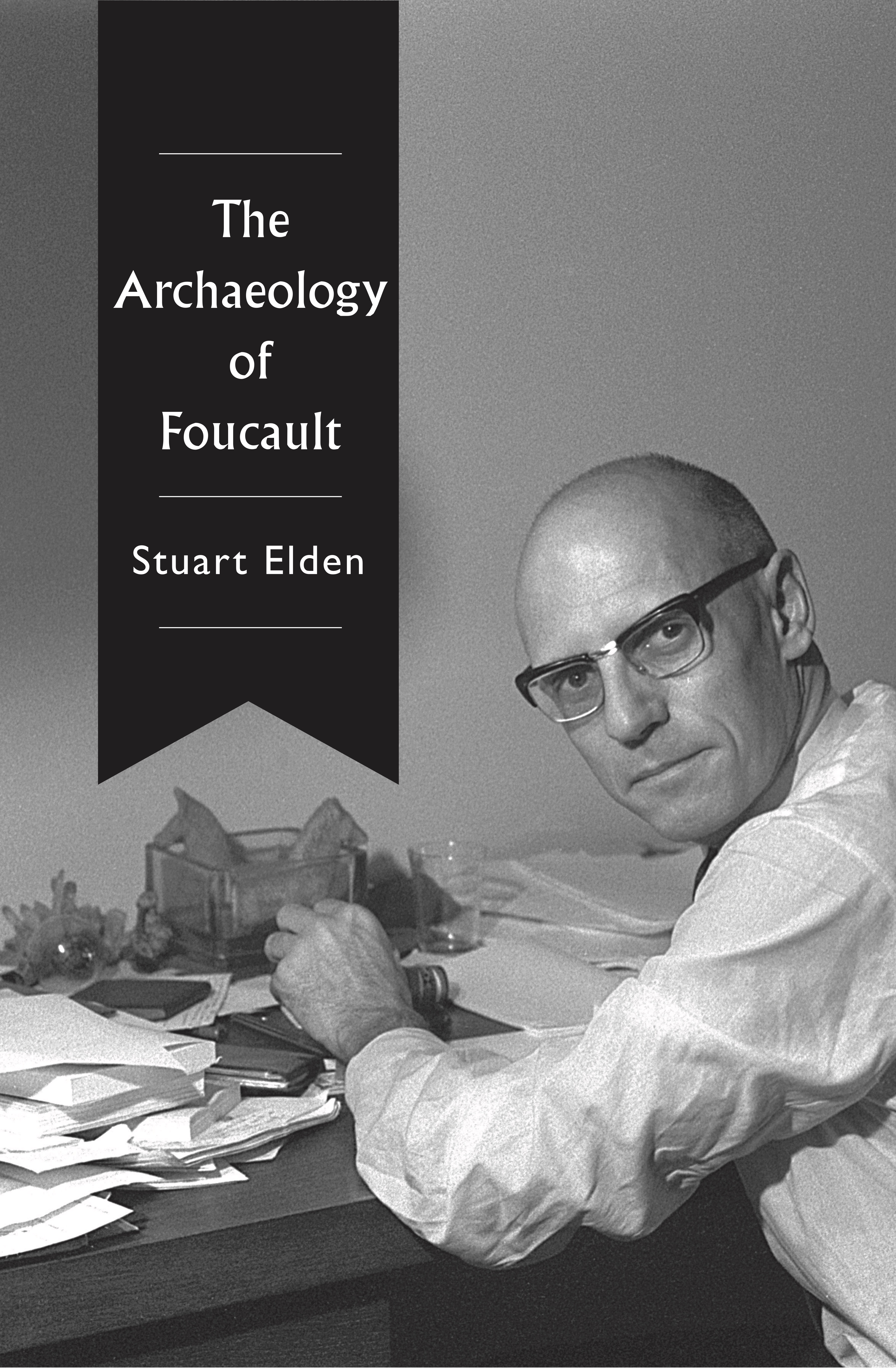
The Archaeology of Foucault (Polity, 2023) – New Books Network discussion with Dave O’Brien

I discuss my recent book The Archaeology of Foucault (Polity, 2023) on the New Books Network with Dave O’Brien (audio)

Dave has now generously discussed all the books in this series:

Foucault’s Last Decade, 21 September 2016

Foucault: The Birth of Power, 6 November 2017

The Early Foucault, 11 February 2022

we also discussed Shakespearean Territories, 18 December 2020

Many thanks Dave!

More information on all the Foucault books, discussions, reviews and research updates here.

The Polity books page is here.

Posted in Foucault's Last Decade, Foucault: The Birth of Power, Michel Foucault, The Archaeology of Foucault, The Early Foucault, Uncategorized | 2 Comments

Benjamin Tallis, Identities, Borderscapes, Orders: (In)Security, (Im)Mobility and Crisis in the EU and Ukraine – Springer, February 2023

Benjamin Tallis, Identities, Borderscapes, Orders: (In)Security, (Im)Mobility and Crisis in the EU and Ukraine – Springer, February 2023

This book provides a pre-history of Russia’s war on Ukraine and Europe’s relations to it, illuminating the deep roots of the EU’s neighbourhood crisis as well as the migration crises the Union created in the last decade. To do so, the book employs a new and innovative framework that allows for a comprehensive, yet nuanced analysis of borders and a more cogent interpretation of their socio-political consequences.

Drawing on interdisciplinary scholarship the book analytically examines the key common elements of borderscapes and links them in related arrays to allow for nuanced evaluation of both their particular and cumulative effects, as well as interpretation of their overall consequences, particularly for issues of identities and orders. The book offers a significant conceptual and theoretical advance, providing a transferable conceptualization of borderscapes to guide research, analysis, and interpretation. Drawing on the author’s experience in policy, practice and academia, it also makes a methodological contribution by pushing the boundaries of reflexivity in interpretive International Relations (IR) research. 

Analyzing three main sites in Central and Eastern Europe (CEE), the book challenges conventional critical wisdom on EU bordering in the Schengen zone, at its external frontiers, and in its Eastern neighborhood. In so doing, it sheds new light on the politics of post-communist transitions as well as the contemporary politics of CEE. It also shows how EU bordering and its relations to identities and orders created great benefits for many Europeans, but also hindered the lives of many others and became self-defeating. This book is a must-read for scholars, students, and policy-makers, interested in a better understanding of Critical Border Studies (CBS) in particular, and International Relations in general. It will also appeal to anyone interested in CEE or wishing to get a deeper understanding of Russia’s war and the fight for Europe’s future.

Posted in Uncategorized | Leave a comment

Engin Isin, The conditions of planetary citizenship – online lecture, 13 April 2023

Engin Isin, The conditions of planetary citizenship – online lecture, 13 April 2023, 4pm BST

registration required via Eventbrite

This lecture outlines the conditions that are creating planetary citizenship movements in the 21st century. The planetary citizens are activists, cosmopolitical, agonistic, solidaristic, and disobedient. The planetary citizens are mobile, multiple, and transversal. They act against injustice and for justice by performing abolishment, disobedience, refusal, and resistance. We will discuss how the gatekeepers have taken notice and developed various strategies of incorporation, pacification, and immobilization of planetary citizenship movements.

About the speaker: https://www.qmul.ac.uk/politics/staff/profiles/isinengin.html

Responding to the widespread cynicism, disengagement and alienation citizens across the globe express towards official political cultures, this series investigates the idea of ‘the critical citizen’. What constitutes a critical citizen? And can a critical citizenry be (re-) activated as an antidote to contemporary political crises?

More information on the Language, Literature and Politics Research Group can be found here

Posted in Engin Isin | 1 Comment