I’ve updated the ‘forthcoming‘ page on this site – removing a few pieces that have now been published, and adding details of a couple of new ones in production or available online first. This page doesn’t include things under review or being drafted. Preprints are listed where available.
Some of my earlier articles and chapters are available at Warwick’s publication service WRAP; many more are available on ResearchGate.
I also try to provide links to as many as I can on this site – first listing those that are open access, and then some others. Generally I’m happy to share things if I have a pdf, if you contact me.
The two lists are roughly chronological, rather than thematic. If you’re interested in how these different pieces might fit into an overall chronology, especially in relation to my books, then maybe this page on Main Periods of Research will be of interest.
Machiavelli’s repeated use of the adverb nondimanco (“nevertheless”) indicated he thought that there was an exception to every rule. This may seem to confirm the traditional image of Machiavelli as a cynical, “machiavellian” thinker. But Carlo Ginzburg’s close analysis of Machiavelli the reader throws a different light on Machiavelli the writer. The same hermeneutic strategy inspires Ginzburg’s essays on the Provinciales, Pascal’s ferocious attack against Jesuitical casuistry, or case-based ethical reasoning.
Carlo Ginzburg is an Italian historian and pioneer of micro-history. He is best known for The Cheese and the Worms: The Cosmos of a Sixteenth Century Miller, which examined the beliefs of an Italian heretic, Menocchio, from Montereale Valcellina. His many other books include The Night Battles: Witchcraft and Agrarian Cults in the Sixteenth and Seventeenth Centuries and Ecstasies: Deciphering the Witches’ Sabbath.
Pierre Force is Professor of French and History and Emmanuelle Saada is Professor of French and History at Columbia University. Raphaëlle Burns is Assistant Professor at UCLA.
This event is co-sponsored by the Columbia Maison Française, The Italian Academy for Advanced Studies, and the Department of History.
Since the last update on this project, the main task has been beginning to work through Dumézil’s books and articles in broadly chronological order, filling in some gaps in my earlier reading, and trying to write a bit about each. So far, I’ve been concentrating on the period pre-1938, as Dumézil regularly cites 1938 as a breakthrough moment with the formulation of his trifunctional hypothesis. I think that his work pre-1938 will be the subject of one chapter, so instead of moving around in focus, I’ve tried to stick broadly to that for a while. In this period he writes both studies of Indo-European mythology and develops an interest in Caucasian languages and folktales. The latter developed during the six years he spent in Turkey at the start of his career. Both themes would continue throughout his career, often in parallel – as can be seen from his publications; with his often teaching one of his classes on mythology, the other on the Caucasus; or heading to Turkey in the summer after his Collège de France courses had finished to do fieldwork.
As part of this work I’ve sketched out what might be a table of contents of the planned book, which on this plan initially alternates between chapters on Benveniste and Dumézil before their stories become more intertwined. There would be a few other chapters, probably one on Mircea Eliade’s time in Paris, one on various students of Benveniste and Dumézil, including Julia Kristeva’s early work, as well as broader legacies. I have a possible idea for a prelude on a much later period, before returning to the start of the twentieth century and then broadly proceeding chronologically. At this early stage this plan is very provisional, but it’s helped to structure some of the notes I’ve taken, and forced me to focus on things in a more disciplined way. Of course, I might tear this up and start again, but sometimes making a choice and running with it is helpful. As I’ve said before, I resave each file at the start of the day with the date in the filename, so I can easily go back to earlier versions if I decide something doesn’t work.
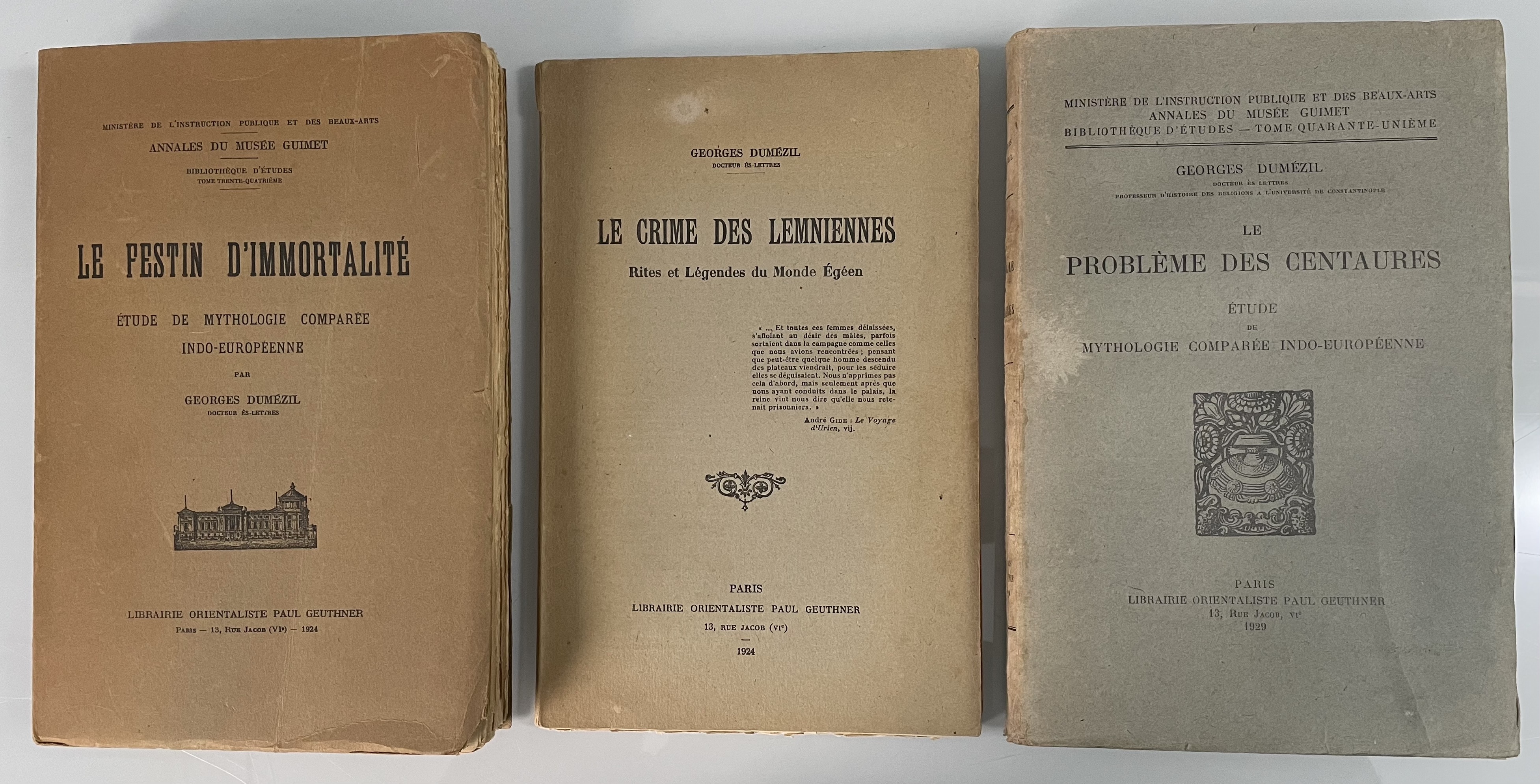
Dumézil’s first three books – Le Festin d’immortalité, Le Crime des Lemniennes and Le Problème des centaures
Although I planned to have Dumézil pre-1938 as the entire focus, I have also done a bit of work on Georges Bataille, Roger Caillois and the Collège de Sociologie, which went back over a bit of the research I did for The Early Foucault, and as background for the event on the Collège de Sociologie and Shakespeare I co-organised last year with Richard Wilson. Caillois was one of Dumézil’s students, who became a life-long friend. As far as I can tell, Dumézil never attended Collège de Sociologie events, but Dumézil reports that Bataille did come to some of his lectures. Bataille certainly read some of his work, and they had further links through Caillois.
I also wrote a little on Maurice Blanchot’s reviews of some of Dumézil’s books during the war, published in Chroniques littéraires. I’m grateful to Alin Constantine for alerting me to these, and sharing some copies. Reading Christophe Bident’s biography of Blanchot was interesting, and opened up a lot of new lines of inquiry. The reviews were 1941-44, but Bident’s biography gave some detail on some of Blanchot’s earlier journalism, which was an unpleasant window into the past. While Blanchot republished some pieces in his own early collections, including Faux Pas and La Part du feu, many more were not.These pieces have been collected in a series of volumes. Political issues are becoming even more significant for this project than I’d originally thought.
Some of this work on related thinkers will be useful not just for the discussions of Dumézil, but also for the potential chapter on Eliade’s time in Paris. Eliade’s journals and autobiography are valuable sources here, and following up on some of his early publications in French has been interesting. With his books there are some challenges in working out what was written when and what was reworked – complicated by some texts being written in Romanian but first appearing in French translation; some written directly in French; and then later, some in English with French or Romanian versions. He reused or reworked a lot of material. Some English translations of his work are based on the French versions, and some directly from Romanian. But there are a lot of interesting connections – his few initial contacts in Paris, including Dumézil, introduced him to a lot of other people. And there was a lot of informal support – invitations to speak, writing commissions, and so on.
For example, Eliade wrote a couple of times for the Diogène journal Caillois edited, and several times for Critique in the late 1940s and early 1950s. Eliade talks a bit about meeting Bataille in his journals and autobiography. Bataille owned several of his books, some dedicated by Eliade. The recent sale of a substantial part of Bataille’s library is I think a tragedy, because the books have been scattered and will be impossible ever to reconstitute. But it did provide the opportunity of a comprehensive inventory of at least this part of his collection.
Bataille also asked Eliade to write a book on tantrism for Éditions de Minuit, but this was never produced. Eliade’s excuse for not writing it is at least novel: he told Bataille he was waiting for some texts to be translated from Tibetan before he could begin. So there are some interesting connections to explore a bit further: Eliade isn’t mentioned in Michel Surya’s biography of Bataille, or Christophe Bident’s of Blanchot, so it will take a bit more digging around. Florin Turcanu’s biography of Mircea Eliade is quite useful, though having read all of Eliade’s published diaries and autobiographies, I found that it didn’t reveal that much more, at least on this period. Mac Linscott Ricketts’s epic study of Eliade’s “Romanian Roots” – almost 1500 pages – only covers the first 38 years of his life, stopping just as he moves to Paris. I still need to spend time with that. Cristina Bejan’s book Intellectuals and Fascism in Interwar Romania is also useful – a book I’ve mentioned before and to which I need to return. But my focus is on the Paris years.
I’ve also mentioned Emmanuelle Loyer’s biography of Claude Lévi-Strauss (French/English) before. This has been useful in indicating some things to explore further. I don’t anticipate Lévi-Strauss being treated in anything like the same detail as Dumézil and Benveniste, or even Eliade, but he will, I think, be important to the story I want to tell. He was a colleague of both Dumézil and Benveniste, and his institutional connections were important in lots of ways. Loyer’s research has been useful here, as has Bernard Dionysius Geoghegan’s recent book Code: From Information Theory to French Theory. At some point I hope to do at least some work with Lévi-Strauss’s papers at the Bibliothèque Nationale.
Claude Bernard statue at the Collège de France on 24 March 2023, after the anti-Macron pension protests
I had another trip to Paris in mid-March, when I continued working through boxes of the Dumézil archive at the Collège de France. Some of these were administrative, with a lot of interesting information about his auditors at both the Collège de France and the EPHE. But I’ve also started working through the folders relating to his books. He wrote or edited about sixty books, so there is a lot of material – rough drafts, fair copies, sometimes corrected proofs and related material. He must have been a nightmare to work with – appalling handwriting, lots of foreign languages in his texts, many in different alphabets with complicated layout issues and diacritics, and a tendency to keep fiddling with things. The proofs are often a mess, and it’s clear he often used others to do his corrections for him. These materials have already given me a further insight into how he worked, and reveal that he could write more neatly if he tried.
One key disappointment is there is a big gap in the publication records from the late 30s to the mid 1950s – a real shame for me, given how important this period is to what I’m doing. I already knew there wasn’t a manuscript for Mitra-Varuna, but also none for the Jupiter Mars Quirinus series, or the ones on Roman myths that Foucault often discussed.
I also made use of the Bibliothèque nationale to track down a lot of references that are not easy to find in the UK, and made one trip to the Archives Nationales, looking at some correspondence. I’m still at the stage with this work that everything I look at gives me another ten things to follow-up, so the harder I work the more I have to do, but it’s interesting and hopefully is going to produce something worthwhile.
Previous updates on this project can be found here, along with links to some research resources and forthcoming publications, including the reedition of Dumézil’s Mitra-Varuna. There is a lot more about the Foucault work here. The final volume, The Archaeology of Foucault, is now out worldwide.
Climate scientists point to permafrost as a “ticking time bomb” for the planet and, from the Arctic, apocalyptic narratives proliferate on the devastating effects permafrost thaw poses to human survival. In Earth, Ice, Bone, Blood, Charlotte Wrigley considers how permafrost—and its disappearance—redefines extinction to be a lack of continuity, both material and social, and something that affects not only life on earth but nonlife, too.
Earth, Ice, Bone, Blood approaches the topic of thawing permafrost and the wild new economies and mitigation strategies forming in the far north through a study of the Sakha Republic, Russia’s largest region, and its capital city Yakutsk, which is the coldest city in the world and built on permafrost. Wrigley examines people who are creating commerce out of thawing permafrost, including scientists wishing to recreate the prehistoric “Mammoth steppe” ecosystem by eventually rewilding resurrected woolly mammoths, Indigenous people who forage the tundra for exposed mammoth bodies to sell their tusks, and government officials hoping to keep their city standing as the ground collapses under it. Warming begets thawing begets economic activity—and as a result, permafrost becomes discontinuous, both as land and as a social category, in ways that have implications for the entire planet.
Discontinuity, Wrigley shows, eventually evolves into extinction. Offering a new way of defining extinction through the concept of “discontinuity,” Earth, Ice, Bone, Blood presents a meditative and story-focused engagement with permafrost, emphasizing how much more it is than just frozen ground.
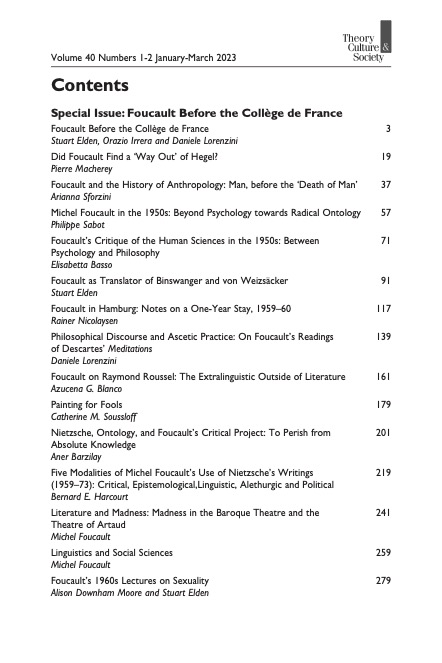
‘Foucault before the Collège de France’ – theme issue of Theory, Culture & Society, coming soon, edited by Stuart Elden, Orazio Irrera and Daniele Lorenzini
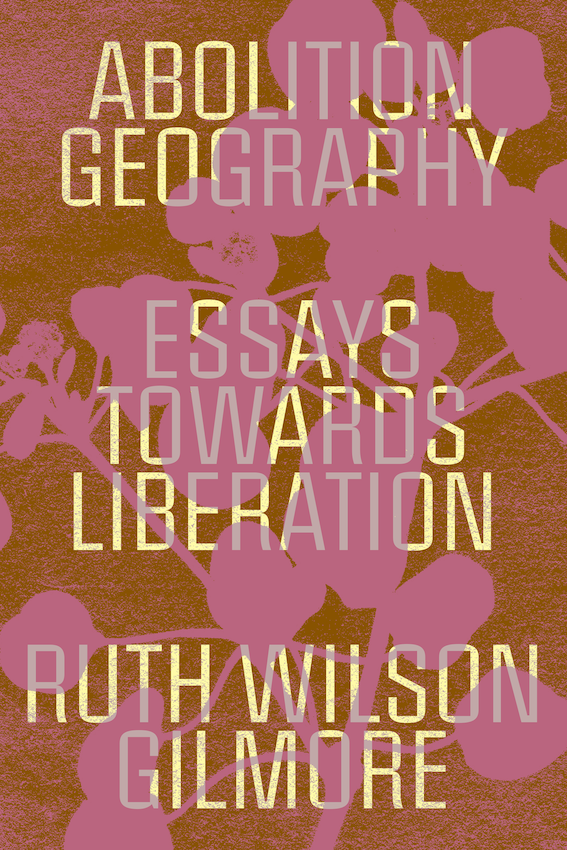
First collection of writings from one of the foremost contemporary critical thinkers on racism, geography and incarceration.
Gathering together Ruth Wilson Gilmore’s work from over three decades, Abolition Geographypresents her singular contribution to the politics of abolition as theorist, researcher, and organizer, offering scholars and activists ways of seeing and doing to help navigate our turbulent present.
Abolition Geography moves us away from explanations of mass incarceration and racist violence focused on uninterrupted histories of prejudice or the dull compulsion of neoliberal economics. Instead, Gilmore offers a geographical grasp of how contemporary racial capitalism operates through an “anti-state state” that answers crises with the organized abandonment of people and environments deemed surplus to requirement. Gilmore escapes one-dimensional conceptions of what liberation demands, who demands liberation, or what indeed is to be abolished. Drawing on the lessons of grassroots organizing and internationalist imaginaries, Abolition Geography undoes the identification of abolition with mere decarceration, and reminds us that freedom is not a mere principle but a place.
Edited with an introduction by Brenna Bhandar and Alberto Toscano.
The theoretical underpinnings of public international law have taken the sovereign status of the nation-state for granted since the beginning of the modern era. After centuries of evolution in legal and political thought, the state’s definition as a bounded territorial unit has been strictly codified. The legal development of the nation-state was an ideological project informed by extra-legal considerations. Additionally, the ever-narrowing scope of the juridical idea of sovereignty functioned as a boundary mechanism instrumental in colonising Africa and other regions. While international law claims universal liberalism today, the current system based on sovereign nation-states represents not social inclusion but fierce and dangerous exclusion.
The central thesis of this book is that the development of legal sovereignty was, rather than part of the modernist progress narrative, a historically contingent evolutionary regression. While other social systems such as economics and science became globalised, politics and law counterintuitively became more territorialised. It is argued that the nation-state today is not only anachronistic but is dangerously ill-equipped for facing international problems such as the climate crisis or global pandemics. Finally, it also leaves African states and many other formerly-colonised territories at a particular disadvantage by regulating their political practices into a predefined mould.
This book straddles two worlds and attempts to bring them together: that of Lefebvre’s Marxism on the one hand, and that of real estate development on the other. Lefebvre has now become a household name amongst many contemporary Marxists, especially those with an interest in urban planning and certain quarters of the architectural profession, however his work is far less well known by real estate professionals, whether investors, developers, brokers or indeed policymakers.
Marxism and Real Estate: Taking Lefebvre Seriously has both a large scope and a very bold aim – to use an explication and analysis of the work of Henri Lefebvre not only to present a critique of development, but on the contrary to draw these two worlds together. It therefore aims first, to present the arguments of this increasingly well-known French Marxist philosopher, sociologist, and pioneer of urban studies. Second, to situate contemporary real estate development in the light of Lefebvre’s work. And third, to analyse the potential application of Lefebvre’s work to each of the major components of contemporary real estate, to use Lefebvre’s work in order to recommend practical action for developers, working alongside planners and architects, to influence the future of global real estate.
As well as its direction at developers themselves, this book should be of interest to economists, real estate researchers and professionals, planners, urban studies scholars and, of course, to those interested in the application of Lefebvre’s work to real estate.
In 1923 Walter Benjamin published The Task of the Translator, a seminal essay in which he considers what is obscured and what is elucidated through the process of literary translation.
The translators of his short stories approached the task beautifully, and their talents and insights mustn’t go uncelebrated!
“In translating Walter Benjamin’s stories, it was important to capture rhythms, cadences, the lilt of a storyteller in the market square passing on lessons for life or unfathomable mysteries that will become the talk of the town” — Esther Leslie on the task of the translator.
“If the original text defies definitive interpretation, the translator’s task has to be one principally of deferral – the transferal of the task to the reader. To bring an incomprehensible text into the realm of comprehensibility is to kill it.” — Sam Dolbear on the anxiety of the translator.
“Benjamin introduces a distinction between “what is meant” by a text and its distinctive “way of meaning it”, a relation of disjunction between what and how.” — Sebastian Truskolaski on the labours of translation.
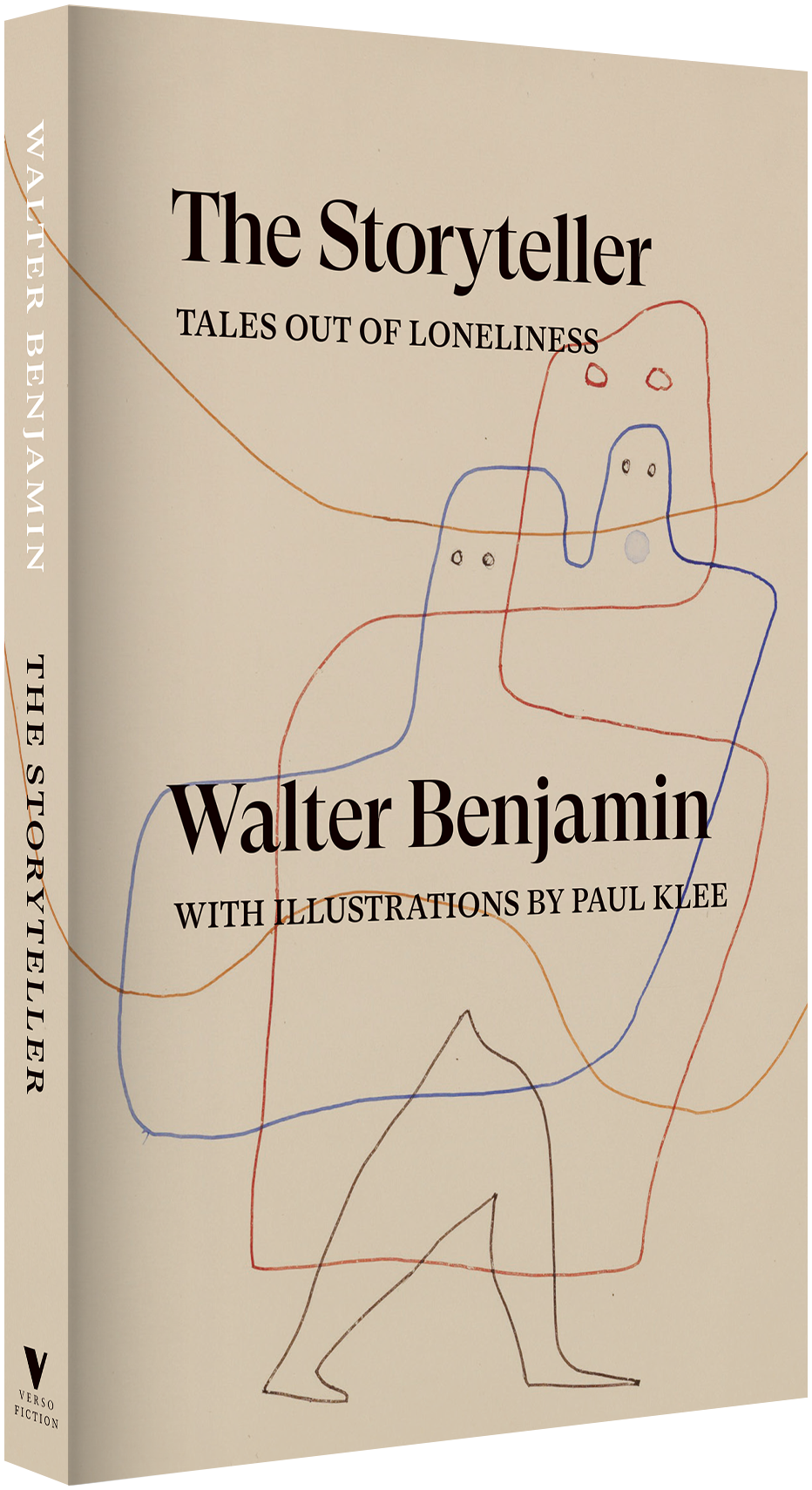
Walter Benjamin’s book The Storytellerhas just been reissued by Verso
Interesting to see a new series of Maurice Merleau-Ponty texts in progress, Inédits. I’ve seen two volumes so far, and I can’t find information on further volumes planned. At 42 euros each volume this might become expensive:
Cet ouvrage constitue une transcription commentée de conférences, cours et notes de Maurice Merleau-Ponty, datant de la période 1946-1949. Ces manuscrits totalement inédits s’inscrivent dans le prolongement de la «Phénoménologie de la perception» de 1945, gravitent autour d’«Humanisme et terreur», et anticipent certaines analyses des premiers cours au Collège de France. Ils possèdent une grande spécificité par rapport au corpus déjà publié, et offrent comme une sorte de vivier de la pensée du philosophe, lequel est demeuré englouti pendant plus de 70 ans. Tous ces essais témoignent de la richesse et de la vitalité de la pensée de Merleau-Ponty en ces années d’après-guerre, en dialogue avec de nombreux courants de pensée de son époque. Une édition scientifique exhaustive incluant des variantes ainsi que le traçage systématique des références aux auteurs et aux notions évoqués par Merleau-Ponty.
Ce premier volume contient: Conférences en Europe sur l’existentialisme français: «Conférences en Belgique et au retour» (mars 1946) «Conférences en Scandinavie» (mars 1947) Notes de cours et de lecture : «Liberté – En particulier chez Leibniz» (1946-1947) «Esthétique de Hegel» (1947 ?)
Avec ce deuxième volume Mimésis poursuit son édition des inédits de Merleau-Ponty. Cet ouvrage constitue une transcription commentée de conférences, cours et notes de Maurice Merleau-Ponty, datant de la période 1946-1949. Ces manuscrits totalement inédits s’inscrivent dans le prolongement de la «Phénoménologie de la perception» de 1945, gravitent autour d’«Humanisme et terreur», et anticipent certaines analyses des premiers cours au Collège de France. Ils possèdent une grande spécificité par rapport au corpus déjà publié, et offrent comme une sorte de vivier de la pensée du philosophe, lequel est demeuré englouti pendant plus de 70 ans. Tous ces essais témoignent de la richesse et de la vitalité de la pensée de Merleau-Ponty en ces années d’après-guerre, en dialogue avec de nombreux les courants de pensée de son époque. Une édition scientifique exhaustive incluant des variantes ainsi que le traçage systématique des références aux auteurs et aux notions évoqués par Merleau-Ponty.
Ce second volume contient: Notes de cours et de lecture : «Les Problèmes de la Philosophie de l’histoire»(1947-1948) Conférences en Amérique : «Conférences à Mexico» (février-mars 1949) «Conférences à New York» (mars 1949) «Autres conférences sur l’existentialisme» (1949-1950 ?)