All hail the new masters of Capitalism: How asset managers acquired the world
Banks have taken a backseat since the global financial crisis over a decade ago. Today, our new financial masters are asset managers, like Blackstone and BlackRock. And they don’t just own financial assets.
The roads we drive on; the pipes that supply our drinking water; the farmland that provides our food; energy systems for electricity and heat; hospitals, schools, and even the homes in which many of us live—all now swell asset managers’ bulging investment portfolios.
As the owners of more and more of the basic building blocks of everyday life, asset managers shape the lives of each and every one of us in profound and disturbing ways. In this eye-opening follow-up to Rentier Capitalism, Brett Christophers peels back the veil on “asset manager society.”
Asset managers, he shows, are unlike traditional owners of housing and other essential infrastructure. Buying and selling these life-supporting assets at a dizzying pace, the crux of their business model is not long-term investment and careful custodianship but making quick profits for themselves and the investors that back them.
In asset manager society, the natural and built environments that sustain us become one more vehicle for siphoning money from the many to the few.
Verso currently have a sale – 40% off books; 60% off e-books (physical books usually come with a bundled e-book too)
Since the last update on this project I’ve not done quite what I intended. I had thought I’d begin working systematically through Georges Dumézil’s works in a chronological way, filling in much detail and some gaps in my previous reading. Instead I went down a couple of detours which have been interesting and productive, but are almost at the two different ends of the project – one right at the beginning, and another towards its end.
One of these things I want to discuss in the project is how Dumézil and Émile Benveniste were important for a younger generation. I’ve already done quite a lot on the relation between Dumézil and Foucault for my books on Foucault, and for some separate papers. More recently, my focus has been on Roland Barthes, following up on some clues in the excellent biographies by Tiphaine Samoyault (French/English) and Marie Gil. Barthes’s references to Dumézil are minor, but he is explicit about the importance of Benveniste to his work. There are lots of references, both in texts he published in his lifetime – including, among others, reviews of both volumes of Problèmesde linguistique générale and an obituary. There are also some references in his courses, both at the Collège de France and the École pratique des hautes études. This expanded quite a way beyond what I originally anticipated. I asked some bibliographic questions about Barthes, and received some really useful replies. I added all the information into this post. I’m particularly interested in his courses, mainly at the Collège de France, but also at the École pratique des hautes études.
I’ve also begun a bit of work on the relation between Dumézil, Benveniste and Lévi-Strauss. This is a much bigger challenge, and I think will be more important to the story I want to tell. The correspondence between Benveniste and Lévi-Strauss has been published, as well as his more extensive correspondence with Roman Jakobson, but not the Dumézil-Lévi-Strauss letters. Emmanuelle Loyer quotes some of the latter in her biography of Lévi-Strauss (French/English), but I will try to look at the full collection in the archives at some point. There are a lot of things to follow up here.
There is also work to be done at some stage on the way wider Indo-European work was important for some French classicists, including Jean-Pierre Vernant, Pierre Vidal-Naquet, Clémence Ramnoux, and possibly others including Marcel Detienne and Nicole Loraux. For that I think I need to get a much better sense of Dumézil’s work on Greece, which is be largely at the start and end of his career, and especially his work on Rome, which runs as one of its major themes throughout.
Paul Pelliot examining manuscripts in the Dunhuang ‘library cave’, 1908 (public domain)
The influence on these thinkers is a late part of the story I want to tell. But the other part of the story which I’ve been reading and writing about is towards its beginning. This is the Mission Paul Pelliot from 1906-1909. This was an expedition to central Asia and Western China, led by Pelliot, which brought back a lot of artefacts and manuscripts – bought under such dubious circumstances they were effectively looted. The Musée Guimet has a lot of this material, and the manuscripts, many of which came from a remarkable find in Dunhuang, are mainly at the Bibliothèque nationale. There are lots of publications which came from the material returned to Paris, some of which involve a very young Benveniste. I started reading a little on this to provide some background, but ended up spending more time on it than I anticipated. It’s been interesting, and has taken me to a different reading room at the British Library, Asian and African Studies, one of the very few there I had not used before.
There are a couple of popular books which talk about Pelliot, including Peter Hopkirk’s classic Foreign Devils on the Silk Road and more recently Eric Enno Tamm, The Horse that Leaps through Clouds, so I’ve been reading those too, as well as accounts of the almost parallel expedition of Aurel Stein. The material Stein brought back is across London – including the Victoria and Albert Museum, the British Library and the British Museum. And there is a lot elsewhere, so material from key sites, including Dunhuang, is scattered across the world. There are obviously connections to some of the more high-profile debates about cultural repatriation like the Benin Bronzes and the Parthenon Marbles. But Dunhuang seems to be a case where there is a lot more international collaboration, and there is an incredible online resource, The International Dunhuang Project, gathering links, reproductions and information.
In the last update I talked about the records of Dumézil’s teaching, and especially his courses at the École Pratique des Hautes Études. I followed the references in Hervé Coutau-Bégarie’s bibliography, which are largely complete, but found a few other sources of information, including the pre-announced titles. The records on Gallica are very good, and saved a lot of time, but there are a couple of pages missing from that digitisation, one of which I still can’t find. But I now have an almost complete listing, which will be useful as I work through the manuscripts.
I will be back in Paris for much of January, and I’m beginning to think about what I will do there. But I will be taking some days off now. Thanks for reading Progressive Geographies in 2022, and I’ll be back with the academic books I enjoyed most this year around the New Year.
Previous updates on this project can be found here, along with links to some research resources and forthcoming publications, including the reedition of Dumézil’s Mitra-Varuna. There is a lot more about the Foucault work here. The final volume, The Archaeology of Foucault, is now out!
Marx’s Critique of the Gotha Program is a revelation. It offers the fullest elaboration of his vision for a communist future, free from the shackles of capital but also the state. Neglected by the statist versions of socialism, whether social democratic or Stalinist that left a wreckage of coercion and disillusionment in their wake, this new annotated translation of Marx’s Critique makes clear for the first time the full emancipatory scope of his notion of life after capitalism. An erudite new introduction by Peter Hudis plumbs the depth of Marx’s argument, elucidating how his vision of communism, and the transition to it, was thoroughly democratic. This definitive edition also includes an afterword by Peter Linebaugh and other supplementary materials. At a time when the rule of capital is being questioned and challenged, this volume presents Marx at his most liberatory, offering an essential contribution to a philosophically grounded alternative to capitalism, rather than piecemeal reforms.
Avant que d’être psychanalyste, Lacan a été psychiatre. On n’aurait pas republié ses premiers écrits s’ils n’invitaient à une lecture après coup. Que nous apprennent-ils de la formation du futur analyste ?
Sa clinique est enracinée dans l’unicité du cas. Celui-ci n’est jamais choisi que pour sa « singularité ». Il faut qu’il présente un « caractère original », une « atypicité ». On pourrait y reconnaître une orientation vers le « un par un » qu’impose la pratique analytique.
La singularité du cas se retrouve au niveau du détail clinique, serré avec un souci de précision poussé à l’extrême de la minutie. Lacan fera état plus tard de son goût pour « la fidélité à l’enveloppe formelle du symptôme ».
Trois autres traits font traces de l’avenir. C’est l’usage du mot de structure pour désigner l’organisation d’une entité formant un tout, et détachée de la notion de développement. C’est l’importance accordée à l’analyse des écrits des malades. Et de là, la connexion établie du symptôme à la création littéraire.
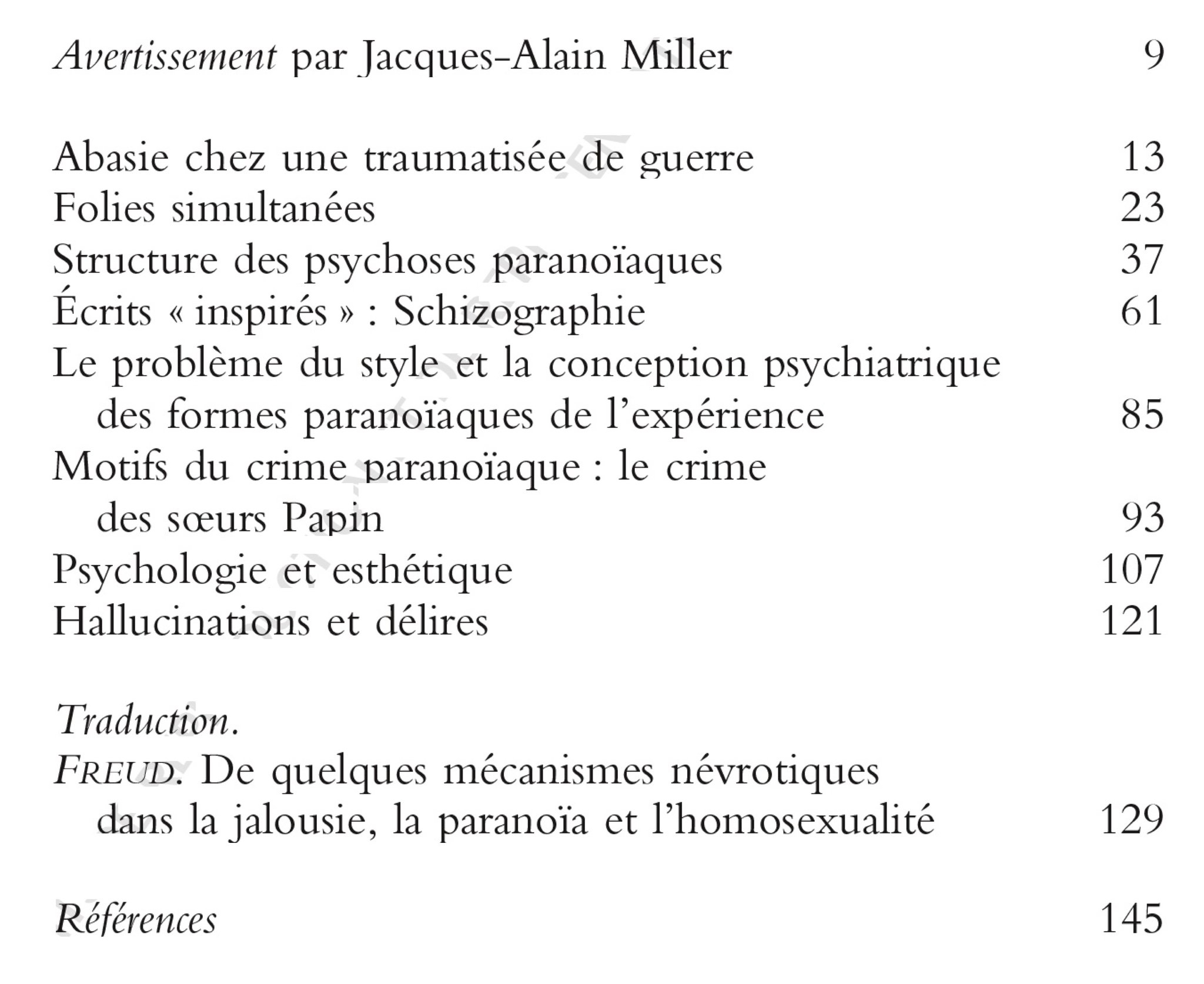
Update 5 Jan 2023: the table of contents is below. This shows that it includes the three texts which were in the initial edition of De la psychose paranoïaque dans ses rapports avec la personnalité, suivi de Premiers écrits sur la paranoïa, but which were not reprinted in the Seuil Points edition (which was just Lacan’s thesis). Dany Nobus says that an English translation of Premiers écrits has been approved.
Upon careful reflection,and taking @StuartElden's arguments into account,I've now recommended to Polity that this volume should also be translated into English,leaving out Lacan's own translation of Freud.Of the 8 texts,only 2 (items 5&6) were ever officially published in English https://t.co/HsMYVmCanl
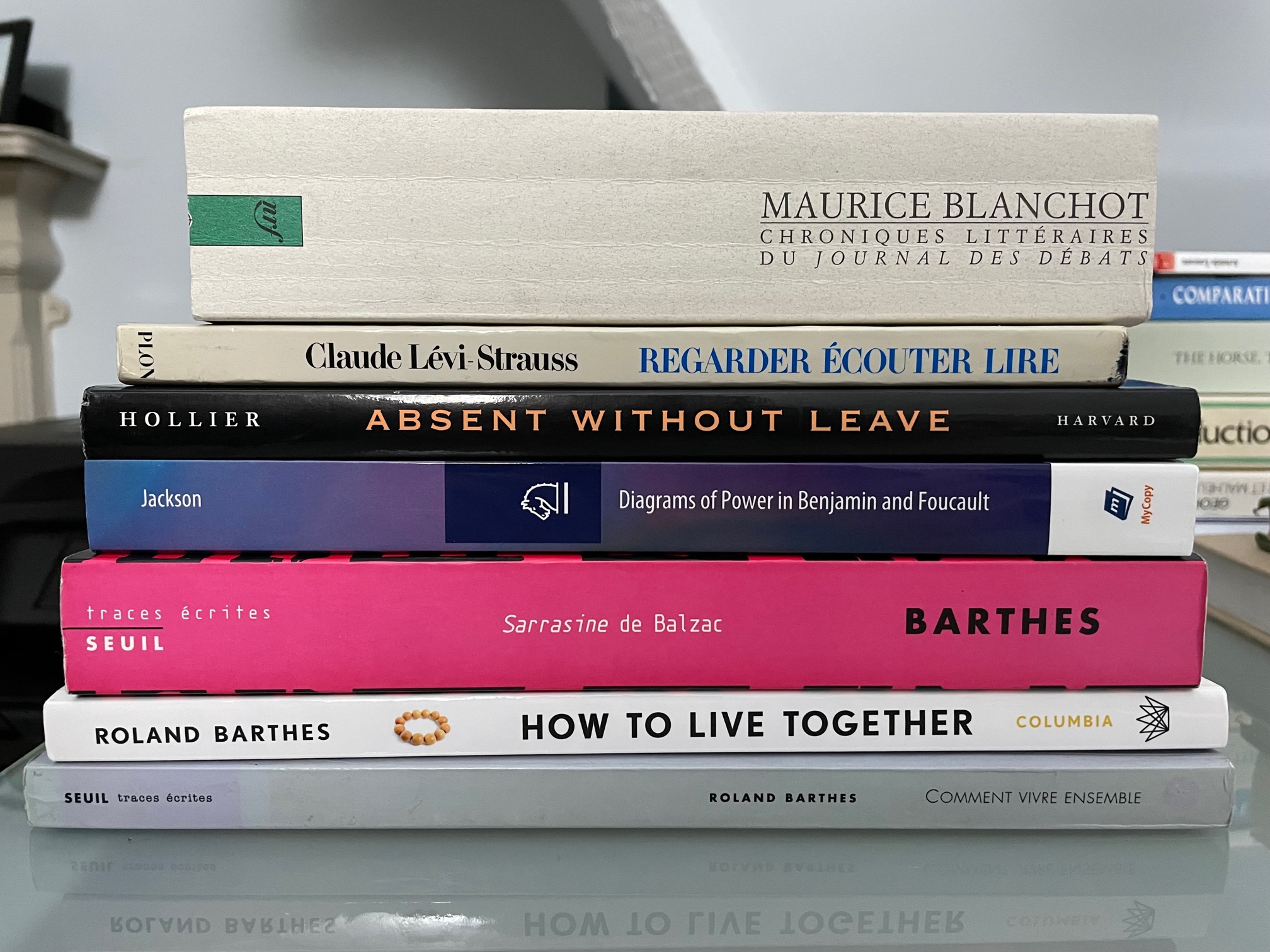
Mainly second-hand books bought for the Indo-European thought project, but also Mark Laurence Jackson, Diagrams of Power in Benjamin and Foucault: The Recluse of Architecture, in recompense for review work.
A must-read follow-up to The Structure of Scientific Revolutions, one of the most important books of the twentieth century.
This book contains the text of Thomas S. Kuhn’s unfinished book, The Plurality of Worlds: An Evolutionary Theory of Scientific Development, which Kuhn himself described as a return to the central claims of The Structure of Scientific Revolutions and the problems that it raised but did not resolve. The Plurality of Worlds is preceded by two related texts that Kuhn publicly delivered but never published in English: his paper “Scientific Knowledge as Historical Product” and his Shearman Memorial Lectures, “The Presence of Past Science.” An introduction by the editor describes the origins and structure of The Plurality of Worldsand sheds light on its central philosophical problems.
Kuhn’s aims in his last writings are bold. He sets out to develop an empirically grounded theory of meaning that would allow him to make sense of both the possibility of historical understanding and the inevitability of incommensurability between past and present science. In his view, incommensurability is fully compatible with a robust notion of the real world that science investigates, the rationality of scientific change, and the idea that scientific development is progressive.
Only a really expensive hardback listed, but this looks to be a major study.
Celestial Inclinations provides a new perspective on the life and career of the first Roman emperor Augustus (63 B.C.-A.D. 14). It presents the case that Augustus used his knowledge of the celestial sphere to confirm for himself and convey to others that the heavens supported his activities on earth and his inevitable greatness. The book is based on fresh assessments of ancient historical, literary, astronomical, astrological, and artistic sources for the years prior to and during the life of Augustus. Anne-Marie Lewis combines these sources with astronomical sky maps and astrological diagrams to offer fresh interpretations of critical events in the life of Augustus at a time when the celestial sphere had come to play an important cultural and political role. Some of those events involve the identification of the celestial object that appeared at the ludi in honor of Caesar in 44 B.C.; the Battle of Actium; the iconography of the Tellus Relief Panel on the Ara Pacis Augustae; the Ludi Saeculares; Augustus’ major building projects in Rome; and Augustus’ interactions with major figures of the period such as Cicero, Caesar, Agrippa, and Antonius.
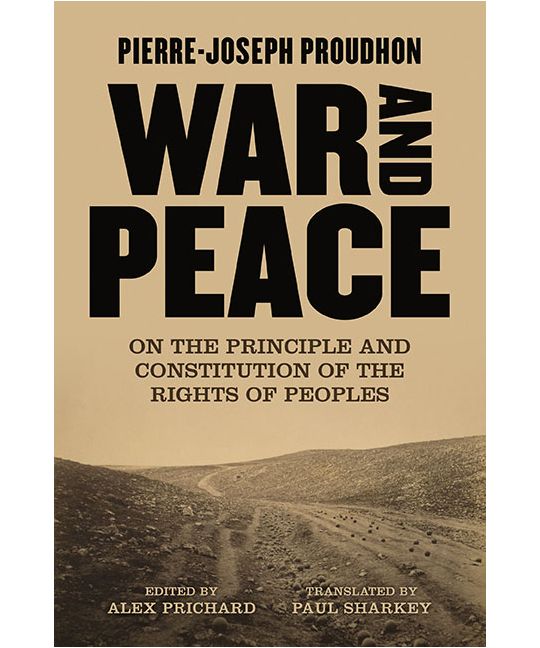
Proudhon’s anarchist theory of international relations, a 19th-century vision of what might have been and could still be.
War and Peace by Pierre-Joseph Proudhon, originally published in 1861, is still one of the only extended accounts of anarchist international theory and is one of the earliest in the history of socialist thought. It is a profound contribution to the traditions of jus gentium and just war theory, that puts force and power at the centre of analysis. Alex Prichard’s introduction describes both its specificity and the multiple lines of influence War and Peace had on thinkers as diverse as Tolstoy, Sorel, French sociology more broadly, and post-1945 Anglo-American International Relations theory.
In engaging essays, celebrated anthropologist Marilyn Strathern reflects on the complexities of social life.
Property, Substance, and Effect draws on Marilyn Strathern’s longstanding interest in the reification of social relations. If the world is shrinking in terms of resources and access to them, it is expanding in terms of new candidates for proprietorship. How new relations are brought into being is among the many questions about property, ownership, and knowledge that these essays bring together.
Twenty years have not diminished the interest in the book’s opening challenge: if one were inventing a method of enquiry by which to configure the complexity of social life, one might wish to invent something like the anthropologist’s ethnographic practice. A wide range of studies deliberately brings into conversation claims people make on one another through relations imagined in the form of body-substance along with the increasing visibility of conceptual or intellectual work as property. Whether one lives in Papua New Guinea or Great Britain, categories of knowledge are being dissolved and reformed at a tempo that calls for reflection—and for the kind of lateral reflection afforded through the “ethnographic effect.”
“A timely gift. An exercise in both retrospection and imagining worlds and relations otherwise, the book is full of mind-bending reflections on how we might think with a world marked, as ever, by scale-scrambling change. These essays offer something sorely needed right now: a brilliant model of how to embrace and think with incommensurability and instability.”
— Cori Hayden, author of When Nature Goes Public: The Making and Unmaking of Bioprospecting in Mexico
“Strathern’s reflections on the figures of nature, person, and commodity have if anything gained in actuality and acuity, and her contrastive analyses of Melanesia and Euro-America are absolutely indispensable to an understanding of contemporary themes such as the rights of nature, the ecological politics of property, and the constitution of racialized capital.”
— Alain Pottage, coeditor of Law, Anthropology, and the Constitution of the Social: Making Persons and Things
“A profound theoretical reflection on ethnographic activity, this book frames a set of analytical experiments where the intrinsic recursivity of the language of description as object, method, and instrument of analysis is taken to the highest point of epistemic tension. Marilyn Strathern continues here her paradigm-shifting work on knowledge as social relation and vice versa.”
Just an expensive hardback listed at the moment, unfortunately.
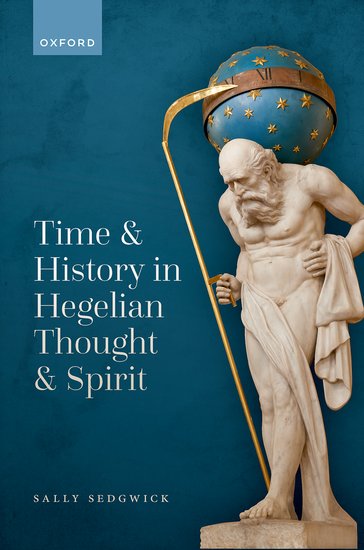
Time and History in Hegelian Thought and Spirit examines a conspicuous feature of Hegel’s major works: that they are progressive narratives. They advance from less to more perfect, abstract to concrete, indeterminate or empty to determinate. This is true, argues the author, of his lectures on aesthetics and on the history of philosophy, and it is also true of his most abstract work, the Science of Logic.
In answer to the question of why is it so important for Hegel to structure his various philosophical works as developmental narratives, this book defends the thesis that Hegel’s motivation is in part metaphysical, intending his developmental accounts to reveal something significant about who we are as thinking, willing natures. He undertakes his study of past in order to demonstrate that there have been advances in the nature of human thought or reason itself and in our resulting freedom and his concern with our reason’s development conveys his interest in how human reason is anchored in and shaped by its past. Ultimately, this book specifies the extent to which we can accurately attribute to Hegel the view that human reason and the freedom it affords us are indebted for their nature to this temporal order of nature and history.