‘An indispensable writer … Calvino, possesses the power of seeing into the deepest recesses of human minds and then bringing their dreams to life’ Salman Rushdie
The difference between life and literature; the good intentions of holiday reading; the avante-garde; the fate of the novel; the fantastical; the art of translation: these are just some of the ideas in The Written World and the Unwritten World. A collection of essays, articles, interviews, correspondence, notes and other occasional pieces on writing, reading and interpreting books, this work gives us new insight into Italo Calvino’s expansive, curious and generous mind.
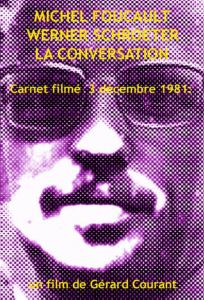
An English translation of the conversation between Foucault and Schroeter can be found in Foucault at the Movies
Fiche technique : Réalisation, montage, son, effets spéciaux : Gérard Courant. Voix : Michel Foucault, Werner Schroeter, Gérard Courant. Postproduction : Gérard Courant, Pierre Laudijois. Production : Les Amis de Cinématon, Les Archives de l’Art Cinématonique, La Fondation Gérard Courant.
Présentation
Michel Foucault Werner Schroeter, la conversation (1981) est, après Vivre à Naples et mourir (1978) et Il faut le sauver ! (1980) et avant Werner et Nenad (2009), la troisième des quatre rencontres cinématographiques que j’ai eues avec Werner Schroeter. À la différence des deux premières, cette fois-ci, une personnalité extérieure à l’oeuvre du cinéaste allemand s’est jointe à cette…
Avant que d’être psychanalyste, Lacan a été psychiatre. On n’aurait pas republié ses premiers écrits s’ils n’invitaient à une lecture après coup. Que nous apprennent-ils de la formation du futur analyste ?
Sa clinique est enracinée dans l’unicité du cas. Celui-ci n’est jamais choisi que pour sa « singularité ». Il faut qu’il présente un « caractère original », une « atypicité ». On pourrait y reconnaître une orientation vers le « un par un » qu’impose la pratique analytique.
La singularité du cas se retrouve au niveau du détail clinique, serré avec un souci de précision poussé à l’extrême de la minutie. Lacan fera état plus tard de son goût pour « la fidélité à l’enveloppe formelle du symptôme ».
Trois autres traits font traces de l’avenir. C’est l’usage du mot de structure pour désigner l’organisation d’une entité formant un tout…
Across three thematically-linked sections, this volume charts the development of competing geographical, national, and imperial identities and communities in early medieval England. Literary works in Old English and Latin are considered alongside theological and historical texts from a range of disciplinary perspectives. Accounts of travel, foreign contacts, conversion, migration, landscape, nation, empire, and conquest are set within the continual flow of people and ideas from East to West, from continent to island and back, across the period. The fifteen contributors investigate how the early medieval English positioned themselves spatially and temporally in relation to their insular neighbours and other peoples and cultures. Several chapters explore the impact of Greek and Latin learning on Old English literature, while others extend the discussion beyond the parameters of Europe to consider connections with Asia and the Far East. Together these essays reflect ideas of inclusivity and exclusivity, connectivity and apartness, multiculturalism and insularity that shaped pre-Conquest England.
Anchor and Burden, Molten Burden and Feels like Forever
The Aristocrats With Primuz Chamber Orchestra
Sel Balamir, ( )rphans
Big Big Train, Welcome to the Planet
Tim Bowness, Butterfly Mind
Miles Davis – That’s What Happened bootleg series 7 [my least favourite Miles period, but still….]
D’Virgilio, Jennings, Morse, Troika
Roger Eno, The Turning Year
Fractal Sextet, Fractal Sextet
Gavin Harrison, Sanity and Gravity (reissue)
King Crimson, In the Court of The Crimson King – King Crimson at 50 (box)
Volker Lankow, Places
David Longdon, Door One
Lonely Robot, Model Life
Magma, Kãrtëhl
Marillion, An Hour Before It’s Dark
The Mars Volta, The Mars Volta
Mask of Confidence, Mask of Confidence
The Pineapple Thief, Give It Back
Pink Floyd, Animals (remaster/5.1)
Porcupine Tree, Closure/Continuation
Pure Reason Revolution, Above Cirrus
Markus Reuter, Truce 2
Reuter Motzer Grohowski, Bleed
J.Peter Schwalm, Stephan Thelen, Transneptunian Planets
Derek Sherinian, The Vortex
Stephen Thelan, Fractal Guitar 3 (and Fractal Guitar 2 remixes)
Bernhard Wöstheinrich & Tobias Schößler, Der Ort
And live, I particularly enjoyed Big Big Train, Frost*, Marillion, Nick Mason’s Saucerful of Secrets, The Neal Morse Band, Porcupine Tree, Transatlantic, Van der Graaf Generator and the streaming of Nik Bärtsch’s Montags series at yourstage.live
At the end of each year I’ve posted a list of academic books I liked (2013, 2014, 2015, 2016, 2017, 2018, 2019, 2020, 2021). The criteria was simply that they were published in that year (or late the previous year), and that I read and appreciated them. Some of these are books I reviewed or endorsed, and some are by friends and colleagues. It’s of course biased by my interests and prejudices. I’m sure I’ve missed loads of other great books, and haven’t yet read all the ones I’ve bought or been sent, but I can at least say that these are all worth reading.
Articles
The Use and Misuse of Pleasure: Hadot contra Foucault on the Stoic Dichotomy Gaudium-Voluptas in Seneca
Matteo Johannes Stettler
The Subject of Desire and the Hermeneutics of Thoughts: Foucault’s Reading of Augustine and Cassian in Confessions of the Flesh
Herman Westerink
Philosophy From the texture of Everyday Life: The Critical-Analytic Methods of Foucault and J. L. Austin
Jasper Friedrich
Review essays
Foucault’s New Materialism: An Extended Review Essay of Thomas Lemke’s The Government of Things
Thomas Lemke, The Government of Things. New York: NYU Press, 2021. Pp. 312 (ISBN: 9781479808816 hardback)
Mark Olssen
Book Reviews
Marta Faustino and Gianfranco Ferraro (eds.), The Late Foucault: Ethical and Political Questions. London and New York: Bloomsbury Publishing, 2020. Pp. 304.
ISBN: 978-1350134355 (hardback).
Matteo Stettler
Michael Hardt joined Coop and Taylor for a look at his work with a focus on an article from he and Toni Negri titled, Empire, 20 Years On. We look back at some of the arguments made in the text and discuss a bit about Michael’s experience collaborating with Negri.