Indo-European thought project update 7: Working on Dumézil’s teaching, a few research resources, and some archival work in Paris

I’ve made some progress with the Indo-European project over the past few weeks. Not as much as I’d hoped, and it feels a bit unsystematic at this point, but early work is often like that. This has included a couple of trips to Paris to work through archival material, mainly at the Collège de France.

Both there and generally I’ve been working on Georges Dumézil, filling in some details about his work beyond what I wrote in the Introduction to the re-edition of Mitra-Varuna. In Paris, the concentration has been on his Collège de France teaching from 1949 to 1968. I’ve also been working on both his early teaching and the so-called bilan period – the years immediately after his retirement from teaching in which he brought together a number of his earlier studies, updated and extended them to provide a summary of his research. 

As I did with the Foucault work, I’ve also been sharing some research resources. These are often things I wanted to use or consult, looked for, and when I discovered they didn’t exist, set out to make my own. So, for example, I thought it would be useful to have a clearer sense of how Georges Dumézil’s work on the warrior function developed over time, from Aspects de la fonction guerrière chez les Indo-Européens in 1956 to Heur et malheur du Guerrier in 1969 and a second edition in 1985. They are basically three versions of the same book, but each expanded by about a third. But although there were some indications in secondary literature, there wasn’t what I wanted, so I did the comparison and shared the preliminary analysis here. [I should clarify that there are other works which discuss this function, notably Horace et les Curiaces from 1942.] Equally, Dumézil’s masterwork, the three-volume Mythe et épopée, has only been partly translated into English – none of the first volume, most of the second across three English books, and parts of the third – so I checked exactly what, and shared the results here. I’ll do more of these as the work progresses, and hope someone finds them useful.

I also shared a new Foucault resource –a list of the preannounced titles of Foucault’s seminars at the Collège de France, about which we still don’t know much. And a wrote a short post about an interdisciplinary seminar on structuralism in 1970 at which Foucault spoke about Dumézil’s work.

Romulus and Remus at the Square Samuel Paty

With Dumézil, there is a detailed list of his teaching at the Collège de France, which has been valuable for me as I’ve been working through the files in the archive of these lecture materials. It used to be online, but I can no longer find a link to share. That material was taken from the Annuaire du Collège de France, and uses both the reports on the courses and the pre-announced titles. I’ve mentioned before that Dumézil provides little detail in his course summaries. In contrast, Foucault or Lévi-Strauss shared sufficient information that these summaries were in each case collected as books, giving a good overall sense of their teaching. Dumézil was concerned that sharing too much would give less scrupulous people information he wanted to use himself in publications. And it does seem that he very often published material from his courses quite quickly afterwards. Foucault, in contrast, didn’t publish any of his courses, although some are clearly preparatory research for his books. I don’t know Lévi-Strauss as well, but my sense is that he is somewhere in the middle.

But while Dumézil’s Collège de France courses are all listed in a single document, I don’t think the same is true for his courses at the École Pratique des Hautes Études. The references for annual summaries are listed in Hervé Coutau-Bégarie’s bibliography, but there are a couple of omissions, and he only lists the reports after the courses had been delivered. But importantly, as with the Collège de France, courses were preannounced, so I slowly worked through the records to identify what Dumézil said they would be on. I’ve put together a preliminary list of these, which I will next work through in relation to the reports on what he actually did. Some of the preannounced titles are very vague, but others are more interesting. And, in time, this list will be helpful as I go through the archival papers relating to this teaching.

Dumézil taught at the Collège de France from 1949 until 1968, when he retired at the statutory age of 70. He taught at the EPHE from 1933 to 1935 as a temporary lecturer, and then from 1935 until 1968, for the last period in parallel to the Collège de France. Before 1933 he had taught in Warsaw, Istanbul and Uppsala. His courses directly informed some of his books, in the temporary years at the EPHE he delivered courses which became Ouranos-Varuna and Flamen-Brahman, and then a little later Mitra-Varuna. Often he simply seems to have written up his notes and published them. He also taught Armenian at the École des langues orientales in the 1930s and 40s.

One interesting thing is that a 20-year-old Roger Caillois attended his classes right from the start, both in the 1933-34 and 1934-35 years. Another is that in the 1934-35 year, another one of the temporary lecturers was A. Kojevenikoff, who gave a course on Hegel’s religious philosophy. He would soon change his name, and become Alexandre Kojève. These lectures on The Phenomenology of Spirit, which continued for a few years, are of course famous, even legendary. There are various – sometimes conflicting – reports about his extraordinary audience, but the list of attendees in the records for 1934-35 are already quite a rogues’ gallery – [Henri] Corbin, [?] Adler, [Raymond] Queneau, [Gaston] Fessard, [Georges] Bataille, [Jacques] Lacan, [Boris] Poplavski, [?] Stern, [Éric] Weil, Mme [?] Tatarinoff.

What I found extraordinary is that Dumézil never took a sabbatical. Foucault took one after six years at the Collège de France (in the 1976-77 year), and could presumably have taken another had he lived longer. But not Dumézil. There are records for each of the 19 years he taught there, and he gave two courses just about every year – there are a couple of instances where the course was a double-length one in consecutive hours. Foucault gave 13 courses in total, the last three as double-length, along with the seminars for 10 of those years. (The requirement was 26 hours of classes a year, of which no more than half could be seminars.) As far I know, Dumézil never ran a seminar there. I’ve done an initial pass through most of the Collège de France courses in the archive, and this was the main work in the last two visits to Paris. One more week there should complete that initial survey, but there is a lot more to do, both with these courses and teaching elsewhere.

At the EPHE, Dumézil taught every year from 1933-34 to 1967-68 with the exception of the year he was suspended from teaching. This was by the Vichy regime, because he had been a free-mason before the war. He regained his position about a year later, in a complicated story for which there are various sources. I’ll be digging into that more, of course. Checking the pre-announced courses did at least give me details of what he had planned to do. The teaching reports are a bit erratic for the beginning and end of the war, for obvious reasons, but I think I’ve found the crucial records.

I’ve also done a little bit of work on some other aspects of the project – finding out a bit about the Mission Paul Pelliot, which led to some of Émile Benveniste’s early publications; following up some references on some of the political questions which I will be exploring much more in time; and reading some of the work of André Leroi-Gourhan, who succeeded Dumézil at the Collège de France, and published one of his books in a series Dumézil edited. And I had a couple of half-days back the Bibliothèque nationale archives, working with the Foucault papers. There I was looking back at some materials I’d previously seen which mentioned Dumézil, and at a couple of other places where there is something related to him in the files – one a page of notes, another a mention in working notebooks. I am trying to resist getting drawn back into the Foucault material, which remains endlessly interesting, but this more focused visit was worthwhile for the new work.

Previous updates on this project can be found here, along with links to the resources and forthcoming publications, including the reedition of Dumézil’s Mitra-Varuna. There is a lot more about the Foucault work here. The final volume, The Archaeology of Foucault, is out next month!

Posted in Claude Lévi-Strauss, Emile Benveniste, Georges Dumézil, Mapping Indo-European Thought in Twentieth Century France, Michel Foucault, The Archaeology of Foucault | 1 Comment

Stephanie DeGooyer, Before Borders: A Legal and Literary History of Naturalisation – Johns Hopkins University Press, November 2022

Stephanie DeGooyer, Before Borders: A Legal and Literary History of Naturalisation – Johns Hopkins University Press, November 2022

An ambitious revisionist history of naturalization as a creative mechanism for national expansion.

Before borders determined who belonged in a country and who did not, lawyers and judges devised a legal fiction called naturalization to bypass the idea of feudal allegiance and integrate new subjects into their nations. At the same time, writers of prose fiction were attempting to undo centuries of rules about who could—and who could not—be a subject of literature. In Before Borders, Stephanie DeGooyer reconstructs how prose and legal fictions came together in the eighteenth century to dramatically reimagine national belonging through naturalization. The bureaucratic procedure of naturalization today was once a radically fictional way to create new citizens and literary subjects.

Through early modern court proceedings, the philosophy of John Locke, and the novels of Daniel Defoe, Laurence Sterne, Maria Edgeworth, and Mary Shelley, DeGooyer follows how naturalization evolved in England against the backdrop of imperial expansion. Political and philosophical proponents of naturalization argued that granting foreigners full political and civil rights would not only attract newcomers but also better attach them to English soil. However, it would take a new literary form—the novel—to fully realize this liberal vision of immigration. Together, these experiments in law and literature laid the groundwork for an alternative vision of subjecthood in England and its territories.

Reading eighteenth-century legal and prose fiction, DeGooyer draws attention to an overlooked period of immigration history and compels readers to reconsider the creative potential of naturalization.

Posted in Boundaries, John Locke, Uncategorized | Leave a comment

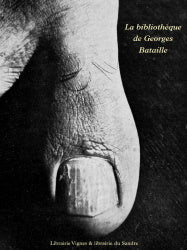
Parts of Georges Bataille’s library for sale (and a fascinating downloadable catalogue and inventaire)

Parts of Georges Bataille’s library are for sale – story here. As you’d expect, things are rather expensive…

A catalogue is available to buy – La bibliothèque de Georges Bataille – and to download as pdf here.

petit in-4, broché, couverture illustrée à rabats, non paginé (248 p.), nombreuses reproductions en couleur, index. Catalogue illustré comprenant une sélection chronologique de plus de 500 titres, la plupart dédicacés et emblématiques du parcours intellectuel de l’écrivain.

Update: an alternative link to the catalogue is here; and to the full inventaire here.

While this isn’t the whole of his library, the catalogue is interesting for telling us at least some of the books he owned. For example, it’s nice to know he did indeed have a copy of Henri Lefebvre’s book Nietzsche from 1939 – which, like his own work On Nietzsche was an attempt to rescue him from the Nazi appropriation. And I was pleasantly surprised to see he had a copy of Foucault’s Maladie mentale et psychologie, which appeared the year he died (1962).

Lots of stuff by Blanchot, Camus, Klossowski, Lacan (who married Bataille’s ex-wife), Nietzsche, Sartre (who wrote a really critical review of him)… Surprised to see only one thing by Walter Benjamin, who entrusted some of his papers to Bataille, who was among things in his life a numismatist at the Bibliothèque nationale de France.

The only trace of Georges Dumézil, who he discusses in a few places, is that Bataille had a copy of Mircea Eliade, Traité d’histoire des religions, for which Dumezil wrote the preface. There are some other things by Eliade, some dedicated to Bataille. I’ve only skimmed the catalogue, but it is well worth a look, and will become of lasting value, as this collection is sadly dispersed through its sale.

Update: there are a few early articles by Kostas Axelos, with dedications to Bataille. Axelos is, I think, the only person I’ve met who had met Bataille. “He was always so immaculately dressed. But the things he wrote!”

Update 2: A couple of years ago, during the first UK covid lockdown, I put together an attempt at a comprehensive list of English translations of works in George Bataille’s Oeuvres complètes and other French collections of his work.

Update 3: there is a wikipedia page with all the people mentioned in the catalogue and a link to their wikipedia pages – a useful resource. Thanks to David Palfrey for this.

Posted in Albert Camus, Friedrich Nietzsche, Georges Bataille, Georges Dumézil, Henri Lefebvre, Jacques Lacan, Jean-Paul Sartre, Michel Foucault, Mircea Eliade, Pierre Klossowski | 3 Comments

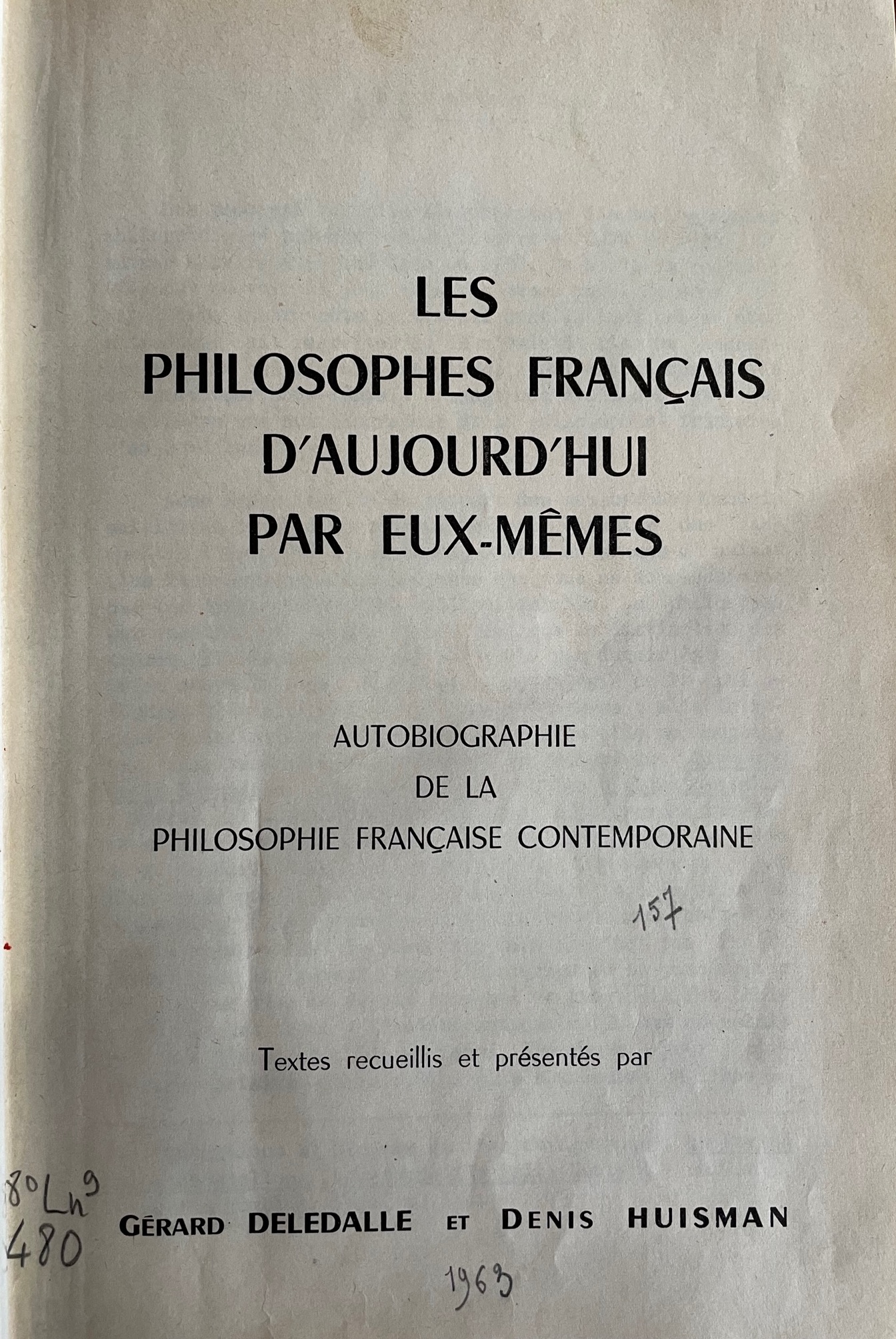
Gérard Deledalle and Denis Huisman (eds), Les philosophes français d’aujourd’hui par eux-mêmes: autobiographie de la philosophie française contemporaine, 1963 (table of contents)

Given the interest in the collection Gérard Deledalle and Denis Huisman (eds), Les philosophes français d’aujourd’hui par eux-mêmes: autobiographie de la philosophie française contemporaine, 1963, which I mentioned in the previous post, from which the Lefebvre piece at the Verso blog was taken, here’s the cover and table of contents. It’s not an easy book to find.

Despite the title, not all the pieces are written by the philosophers themselves – the piece on Sartre is by M. [Marc?] Beigbeder and the one on Merleau-Ponty is by Alphonse de Waelhens.

Clicking on each image will bring up a bigger file.

Posted in Emmanuel Levinas, Henri Lefebvre, Jean-Paul Sartre, Maurice Merleau-Ponty | 2 Comments

“I am not a good Communist” – Henri Lefebvre’s Autobiography from 1957, translated by David Fernbach at the Verso blog

“I am not a good Communist” – Henri Lefebvre’s Autobiography from 1957, translated by David Fernbach at the Verso blog

Thanks to Adam David Morton for the alert to this. The original was in a collection of autobiographical sketches by French philosophers – Gérard Deledalle and Denis Huisman (eds), Les philosophes français d’aujourd’hui par eux-mêmes: autobiographie de la philosophie française contemporaine, published with some delay in 1963. The pieces were written between 1956 and 1959, and some authors were dead by the time the book appeared. It is not the easiest book to find, but it’s an good collection – other pieces in the book include ones on Sartre and Merleau-Ponty, and by Roger Callois, Levinas and Jean Wahl [misspelt as Jean Whal]. Interestingly, it gives Lefebvre’s date of birth as 1905 – usually given as 1901, but I’ve seen 1895 too. Very good to have Lefebvre’s piece available in English.

[Update: following some interest, the table of contents of the French collection is here]

Originally published in: Richard [Gérard] Deledalle and Denis Huisman (eds), Les philosophes français d’aujourd’hui par eux-mêmes: autobiographie de la philosophie française contemporaine, CDU (Paris), 1963

A collection of philosophical autobiographies? A set of ‘intellectual’ itineraries? The very indiscretion of the project piqued my interest, and I await its results with curiosity. And yet, when I try to write my own contribution, I struggle to find the right style. I reflect. I sense that this reflection will produce something other than an autobiography. An essay, or a kind of essay. Why not?

I’m offered twelve pages. I’d need eight hundred if not fifteen hundred. I would have to tell a good number of anecdotes, a few love stories (painful and happy, dramatic, and burlesque) and a dozen political tales. As far as I am concerned, philosophical thought cannot be detached from a fairly dense and hellishly complicated web of events. I believe I’ve been involved in most of the great ideological and political struggles of our time: the formation and dissolution of surrealism, the formation and fragmentation of existentialism, the rehabilitation of Hegel, discussions on the essence of Marxist philosophy and the fate of philosophy – liquidation of bourgeois nationalism and formal individualism – today the critique and balance sheet of what is globally called ‘Stalinism’. Now, for me, as a thinking individual, ideas are bound up with men, women, intrigues, loves. One day, if the great historic criminals such as Beria leave us time, I shall say everything: what I have seen, what I have understood, what I have not understood, what I have accepted and why, and what I could not accept.

Posted in Henri Lefebvre | 1 Comment

Foucault’s seminars at the Collège de France – a list of their pre-announced titles

All of Foucault’s lecture courses at the Collège de France have been published and translated into English. Thirteen courses were delivered over a fourteen-year period from 1970-84 – Foucault took 1976-77 as a sabbatical year.

A detailed page about his parallel seminars with all the details, references and other information is here.

Much less is known about his seminars. Until 1981, Foucault ran a seminar class in parallel to the lectures. It was usually held on Monday afternoons or early evening. From 1981-82 he opted to increase the number of lecture hours instead, which is why the courses from The Hermeneutic of the Subject onwards have first and second hours for each week. In the course summaries which Foucault wrote for the Annuaire du Collège de France each year he reported both on the lecture course and, usually, on what had been done in the seminar. These summaries were available as pdfs on the Collège de France site but they seem to have been removed (several were mislabelled when they were available). They were collected in Résumé des cours in 1989, included in chronological order in Dits et écrits in 1994, and translated in the first volume of Essential Works in 1997. They were also included in each of the published courses.

But the Annuaire does not just report on what had happened in the current academic year, but also lists the courses to be delivered in the next. With his lectures, Foucault usually stuck to the announced topic, but occasionally not – ‘The Birth of Biopolitics’ in particular doesn’t reflect the topic very well, though Foucault kept the original title even if the material changed. Some of the course summaries did not provide the course title, but the editors took the ones pre-announced.

As far as I know, the seminar titles which were announced have not been collected, and it took a little work with the Annuaire to find them, so I’ve put this list together in the hope someone else might find it useful. 

Foucault’s Seminars at the Collège de France [pre-announced titles]

1970-71: Le fonctionnement du système pénal en France à partir du XIXe siècle

1971-72: Psychiatrie et pénalité au XIXe siècle

1972-73: Pierre Rivière et ses œuvres

1973-74: Explication de textes médicaux et juridiques du XIXe siècle

1974-75: L’expertise médico-légale en matière psychiatrique

1975-76: L’Utilisation des techniques psychiatriques en matière pénale

1976-77: no seminar [sabbatical year]

1977-78: La médicalisation en France depuis le XIXe siècle

1978-79: Problèmes de méthode en histoire des idées

1979-80: Libéralisme et Étatisme à la fin du XIXe siècle

1980-81: Problèmes du libéralisme au XIXe siècle

1981-82: no seminar

1982-83: no seminar

1983-84: no seminar

With regards to the seminars this is interesting for a few reasons – mainly that Foucault usually had a clear idea of what he intended, but that his reports suggest he didn’t always follow that exactly. In English, the I, Pierre Rivière book and The Foucault Effect give some indications of what was done. Foucault of course would publish on the ‘dangerous individual’, and some of the early seminars provide material he discussed in his lectures. In French, several of the people who presented their work went on to publish it.

[Some of these seminars led to collaborative publications, which I’ve listed here.]

I discuss some of this in my books Foucault: The Birth of Power and Foucault’s Last Decade, but I think a lot more could be done to uncover what actually took place in these seminars.

Perhaps the most interesting thing announced, but not ultimately fulfilled, was the 1978-79 seminar on ‘Problèmes de méthode en histoire des idées’.

And it’s striking to me, looking at the list, how much of this was focused on the 19th century.

The full list, with references, reports of what he says they actually discussed, and a few comments is here.

There are a lot more resources on this site relating to Foucault – bibliographies, audio and video files, some textual comparisons, some short translations, etc.

Posted in Foucault's Last Decade, Foucault: The Birth of Power, Michel Foucault | 2 Comments

Daniel Bertrand Monk and Michael Sorkin (eds.), Between Catastrophe and Revolution: Essays in Honor of Mike Davis – OR Books, 2021

Daniel Bertrand Monk and Michael Sorkin (eds.), Between Catastrophe and Revolution: Essays in Honor of Mike Davis – OR Books, 2021

It is all worse than we think. It is even worse than Mike Davis, for whom “every day is judgment day” (The Nation), could have imagined. The contributions to this volume are explorations of what Davis—in typical wry fashion—once referred to as the field of “disaster studies.” Collectively, they show how our “disaster imaginary” has been rendered inadequate by the existing order’s ability to feed off and coopt our resistance to it.

Contemporary mass protests are now subsumed as instances of an established, profitable politics of rage. Geopolitical conflict poses not as a threat to hegemonic power but rather serves the interests of a global market which capitalizes on lucrative, permanent war. Climate change itself, if it was ever thought to be a universalizing phenomenon, is now treated as an extensive market opportunity by global risk insurance conglomerates and predatory lenders who bet against any rescue of the planet.

Such catastrophic developments resist the language we use to describe and deconstruct them. The contributions to this volume seek to reimagine our understanding of disaster, and, following the example of Davis himself, to refuse outdated models of political transcendence as vigorously as they reject narratives of resignation.

Contributors: Mauro Caraccioli, Bruno Carvalho, Charmaine Chua, William Connolly, Mustafa Dikeç, Jairus Victor Grove, Waleed Hazbun, Andrew Herscher, China Miéville, Don Mitchell, Jacob Mundy, Ana Muñiz, Christian Parenti, Andrew Ross, Rob Wallace, Kenichi Okamoto, Alex Liebman, and Michael Sorkin.

“Some of the essays in this volume patiently argue; some sweep forward in righteous fury. All borrow Mike Davis’s grammar of catastrophe to anticipate a revolutionary moment when, at last, humanity pulls the handbrake. Whether they eulogise places and peoples laid waste by violence and war, or report on heating oceans and air and land, these essays are electrifying and urgently necessary.” —Laleh Khalili, author of Sinews of War and Trade

“Over the course of the decades, Mike Davis has mobilized his cool intelligence, breathtaking scholarly creativity, intellectual fearlessness and radical political imagination to illuminate the spatial violence and ecological madness of modern capitalism, as well as ongoing struggles for alternative forms of collective life. In this remarkable volume, several generations of radical thinkers engage with and take inspiration from Davis’s ideas. In so doing, they not only celebrate Davis’s wide-ranging insights, but illustrate their urgent importance for contemporary scholarship on the catastrophes and revolutions of our time.” —Neil Brenner, author of New Urban Spaces

Posted in Uncategorized | 1 Comment

Alexander Vasudevan, The Autonomous City: A History of Urban Squatting – Verso, new edition, January 2023

Alexander Vasudevan, The Autonomous City: A History of Urban Squatting – Verso, new edition, January 2023

The Autonomous City is the first popular history of squatting as practised in Europe and North America. Alex Vasudevan retraces the struggle for housing in Amsterdam, Berlin, Copenhagen, Detroit, Hamburg, London, Madrid, Milan, New York, and Vancouver. He looks at the organisation of alternative forms of housing—from Copenhagen’s Freetown Christiana to the squats of the Lower East Side—as well as the official response, including the recent criminalisation of squatting, the brutal eviction of squatters and their widespread vilification.

Pictured as a way to reimagine and reclaim the city, squatting offers an alternative to housing insecurity, oppressive property speculation and the negative effects of urban regeneration. We must, more than ever, reanimate and remake the urban environment as a site of radical social transformation.

Posted in Uncategorized | Leave a comment

Georges Dumézil’s Mythe et épopée series and its partial English translations

Towards the end of his career, Georges Dumézil began to produce some works summarising the results of his decades of research. The most important was the Mythe et épopée series published by Gallimard in three volumes in 1968, 1971 and 1973. 

  1. L’Idéologie des trois fonctions dans les épopées des peuples indo-européens
  2. Types épiques indo-européens : un héros, un sorcier, un roi 
  3. Histoires romaines

Each volume was revised in new editions in Dumézil’s lifetime, and they are still in print as separate volumes. There were plans for a fourth volume, but this was abandoned. In 1995 the three volumes were reprinted as a single volume in the Quarto series, a mammoth book which has both the original pagination of each volume and a running pagination for the volume as a whole – 1463 pages! 

For reasons that in retrospect don’t make a lot of sense, Mythe et épopée became, in Jaan Puhvel’s words, “a kind of quarry, subject to piecemeal extractions into the English language” (“Editor’s Preface, The Stakes of the Warrior, vii). This means the series has been incompletely translated. A page on this site tries to show what is, and what isn’t, available.

In brief, none of the first volume has been translated, although there was a plan for at least the first part; almost all of the second volume is translated, but in three English books (pictured), and quite a lot of the third volume is translated in Camillus: A Study of Indo-European Religion as Roman History (California, 1980).

The Stakes of the Warrior includes Appendix I, which provides some excerpts from Colonel Antoine Louis Polier, Mythologie des Indous (2 vols, 1809). One of Dumézil’s last books was Le Mahabarat et le Bhagavat de Colonel de Polier (Gallimard, 1986) in which he wrote a preface to introduce some chapters from Polier’s Mythologie. At the end of the 1986 edition of Mythe et Épopée II he recognises that the fragments of the appendix are there put back in their place.

With the exception of The Destiny of a King, all the above-mentioned English translations are out of print. 

The page is part of the research for a new project on Indo-European Thought in Twentieth-Century France. For some preliminary textual comparison of Dumézil’s major work on the warrior function, Heur et malheur du Guerrier, part-translated as The Destiny of the Warrior, see here.

Posted in Georges Dumézil, Mapping Indo-European Thought in Twentieth Century France | Leave a comment

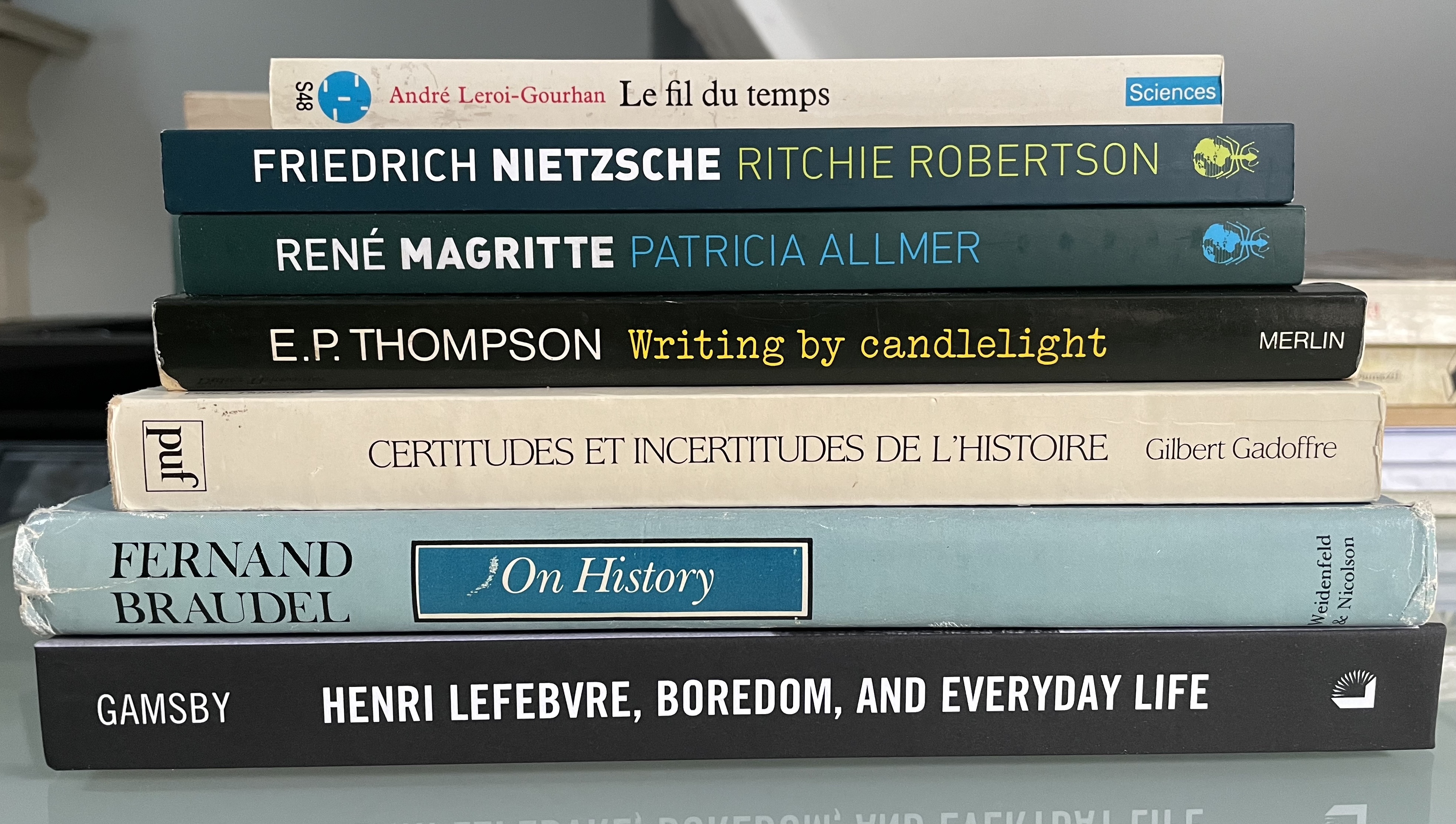
Books received – Leroi-Gourhan, Robertson, Allmer, Thompson, Gadoffre, Braudel, Gamsby

A few second-hand books, along with Ritchie Robertson’s Friedrich Nietzsche, Patricia Allmer, René Magritte and Patrick Gamsby, Henri Lefebvre, Boredom, and Everyday Life, in recompense for review work.

Posted in E. P. Thompson, Friedrich Nietzsche, Henri Lefebvre | Leave a comment