A 1970 French interdisciplinary seminar on structuralism, attended by Foucault, Canguilhem, Bourdieu, Serres, Thom et. al., its published traces and a request for help

This is a short account of an interesting event and a rather specialist request for help.

In the late 1960s, 1970s and early 1980s the Institut collégial européen organised a series of events, most of which were reported in their annual Bulletin. I’m looking for the one reporting on a September 1970 event on structuralism.

[update March 2026: I discuss this event in a lot more detail here.]

The structuralism event was held at the Institut national des sciences et techniques nucléaires de Saclay, about 20 km southwest of Paris. It was co-sponsored by the Collège de France. It was organized by the mathematician André Lichnerowicz, the literary historian Gilbert Gadoffre and the economist François Perroux. Foucault attended and gave a talk on Dumézil. Also in attendance were a range of people including Suzanne Bachelard, Pierre Bourdieu, Georges Canguilhem, André Martinet, Jacques Monod, Clémence Ramnoux, Michel Serres, Gilbert Simonden and René Thom… Roland Barthes was invited but according to Gadoffre, after dithering for a while, declined.

The Bibliothèque nationale de France has most of the Institut collégial européen Bulletins, but the sequence runs 1966-1969, 1971-1974, 1976-1982 (the Arsenal library has 1972-1976). There is no bulletin for 1970 in the BnF collection. I’m trying to work out if anything was actually published that year, or if it’s just the BnF has a missing number in the sequence.

Worldcat has no entry for a report in 1970. But the bulletins were generally reproduced typescripts, not formal books, so I don’t trust this entirely. Sélection et contestation is listed in some places with a publication date of 1970, but it is a report on a colloque from September 1969, and the BnF has this. 
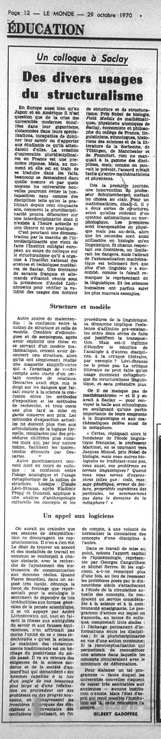
click for higher resolution

The 1970 event I’m interested in was reported in Le Monde on 29 October 1970. The event was used to launch a series of conversations on this theme, some papers of which were published in in an edited volume on Structure et dynamique des systèmes in 1976. I have a copy of this – copies can be found second-hand fairly easily – and of several of the subsequent volumes, which report on ongoing conversations. There were ones on L’idee de regulation dans les sciences, Analogie et connaissance, Information et communication, and Projet et programmation.

Structure et dynamique des systèmes includes a summary of the 1970 event by André Malan, but not its papers. From the way it reports Foucault’s contribution, it seems it was very close to a lecture he gave in Japan in October 1970, which was published in Japan in 1972 and is included in Dits et écrits and Essential Works as “Révenir à l’histoire”/”Return to History”. The French text is online. There is a manuscript which looks like this lecture in the archive.

I also know that there is a discussion of the interdisciplinary seminar series in Gilbert Gadoffre, un humaniste révolutionnaire: Entretiens avec Alice Gadoffre-Staath, Grâne/Paris: Créaphis, 2002, 144-49.

So it may well be that there was no Bulletin for 1970, because the report got folded into something much bigger. But equally there might have been a report, and if so I’d like to find it… Does anyone know anything which might help?


Posted in Clémence Ramnoux, Georges Canguilhem, Georges Dumézil, Michel Foucault, Michel Serres, Roland Barthes | 6 Comments

Bruno Latour, ‘Is Europe’s soil changing beneath our feet?’ at geopolitique.eu

Bruno Latour, ‘Is Europe’s soil changing beneath our feet?’

A late text by Latour, published yesterday at geopolitique.eu

I will begin with a text which will seem unusual: Jean Bollack’s translation from the beginning of Oedipus Rex when the priest is addressing Oedipus. This translation says:

“For our city, as you yourself can see,

is badly shaken—she cannot raise her head

above the depths of so much surging death 1 .”

In re-reading this text I found that it resonated perhaps too well with the distressing situation we are witnessing, in this collection of wars we find ourselves dealing with, and which is reflected in Sophocles’ play by the dreadful figure of the plague. Here, the priest is in the position of beggar; but we know right away that very quickly the king, the master, the authority which the priest implores will soon become himself the beggar, chased from the city of Thebes — blind, exiled, and begging for his bread.

Posted in Bruno Latour | 2 Comments

“Uncovering lines of escape: towards a concept of concrete utopia in the age of catastrophes,” by Étienne Balibar

“Uncovering lines of escape: towards a concept of concrete utopia in the age of catastrophes,” by Étienne Balibar

Clare O'Farrell's avatarFoucault News

See webpage as well
“Uncovering lines of escape: towards a concept of concrete utopia in the age of catastrophes,” by Étienne Balibar
1/13 | CRITICAL THEORETIC FOUNDATIONS FOR CONCRETE UTOPIAS WITH ÉTIENNE BALIBAR

Columbia Center for Contemporary Critical Thought
Wednesday, September 28, 2022
Maison Française, Columbia University

Etienne Balibar and Bernard E. Harcourt
read and discuss
Ernst Bloch, The Spirit of Utopia (1918)
Michel Foucault, “Of Other Spaces: Utopias and Heterotopias” (1967/1984)
Fredric Jameson, Archaeologies of the Future (2005)
Marx and Engels, The Communist Manifesto (1847)
Alex Williams and Nick Srnicek, Manifesto for an Accelerationist Politics (2013)
Erik Olin Wright, Envisioning Real Utopias (Verso 2010)
and Zapatista Army of National Liberation, Sixth Declaration of the Selva Lacandonia (2005)

~ ~ ~

~ ~ ~
In his lecture, “Uncovering lines of escape: towards a concept of concrete utopia in the age of catastrophes,” the philosopher Étienne Balibar develops three dimensions of…

View original post 126 more words

Posted in Uncategorized | 1 Comment

Spatial Delight – ten-part podcast about space, society, and power inspired by geographer Doreen Massey

A ten-part podcast about space, society, and power inspired by geographer Doreen Massey
https://thesociologicalreview.org/podcasts/spatial-delight/

Spatial Delight is a ten-part podcast about space, society, and power inspired by British geographer Doreen Massey. From a London laundromat to a public park in Berlin, from a contested waterfront in Kochi to the Egyptian desert, this series seeks to inspire listeners to think about space and place as full of power, and to imagine political alternatives to the current world order.

Thanks to dmf and various people on social media for the link.

Posted in Doreen Massey, Uncategorized | Leave a comment

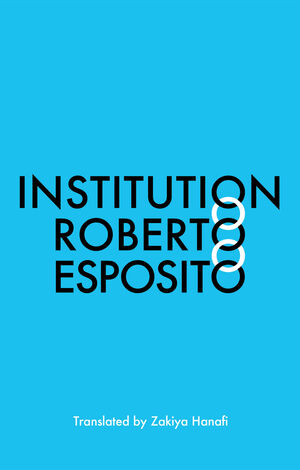
Roberto Esposito, Institution (2022)

Roberto Esposito, Institution, Polity, June 2022

Clare O'Farrell's avatarFoucault News

Roberto Esposito, Institution
Translated by Zakiya Hanafi, Polity Press, 2022.

Offer Details: To get 20% off this title, go to www.politybooks.com and use code PPBK1 at checkout.
Applies to paperback edition only. Offer expires 31 December 2022.

The pandemic has brought into sharp relief the fundamental relationship between institution and human life: at the very moment when the virus was threatening to destroy life, human beings called upon institutions – on governments, on health systems, on new norms of behavior – to combat the virus and preserve life. Drawing on this and other examples, Roberto Esposito argues that institutions and human life are not opposed to one another but rather two sides of a single figure that, together, delineate the vital character of institutions and the instituting power of life. What else is life, after all, if not a continuous institution, a capacity for self-regeneration along new and unexplored paths?…

View original post 58 more words

Posted in Uncategorized | 1 Comment

Bruno Latour (1947-2022) [updated]

Sorry to hear this news – Libération, L’Obs, Le Monde

Update: I’ll add other links here – Radio France, France Bleu

The Guardian obituary (and 2020 interview)

Adrian Ivakhiv at Immanence; Graham Harman at Object-Orientated Philosophy

Graham Harman, Bruno Latour: The Delusions of Modernity

Bruno Latour, ‘Is Europe’s soil changing beneath our feet?’ (a late text by Latour, published posthumously at geopolitique.eu)

Anthem’s archive of posts on Latour is here; this blog’s archive here

Ava Kofman has a piece at n+1

Update: Last year Latour generously engaged with one of my papers on terrain in a forum for Dialogues in Human Geography. Two years before we both contributed pieces to the excellent A Moving Border project. I only heard him speak once, and we didn’t meet in person, though the idea of a dialogue had been proposed around the border project.

There is a good thread on Latour from Tim Howles here

There is an older piece about publishing Latour in English here.

Posted in Bruno Latour, Uncategorized | 7 Comments

Indo-European thought project update 6: beginning the Leverhulme fellowship, my self-imposed guidelines for writing and time-discipline, and some summer cycling and writing

I’m in the incredibly privileged position of beginning a Leverhulme major research fellowship this week, to work on the Indo-European thought in Twentieth-Century France project. As a note to myself, I’m going to try to work with the guidelines I set myself seven years ago when I had a sabbatical year, when I completed Foucault: The Birth of Power and did much of the work for Shakespearean Territories.

Slightly adapted from the previous time:

  1. No email in the morning.
  2. Use the morning to write.
  3. Use afternoon (and frequently evening) for email, meetings, admin, editing, and reading.
  4. Facebook, Twitter, Feedly, etc. are not to be used on main computer; you have an iPad (kept in a different room) for that.
  5. Go to the British Library regularly, even if you don’t need to consult things. The Rare Books room is a place you’ve done a lot of good work before. Renew ticket to the Warburg Institute for the same reason.
  6. Concentrate on the primary literature; the secondary literature can come later.
  7. Try to only agree to do talks that move the writing forward.
  8. You really can’t take on any other writing or editing projects.
  9. Going to see Shakespeare in the theatre counts as research (for a possible future project).
  10. Go to Paris regularly.
  11. Long bike rides help with coming up with ideas.
  12. Analogue Sunday – or at least, no work.

I’ve begun this week mainly by trying to get my existing notes on Georges Dumézil into some sort of order.

In the last part of the summer I had a couple of weeks away in Wales – one in mid-Wales, near Builth Wells; the other in Penrhyndeudraeth in Snowdonia. I’ve been to the first place a few times, but the second was new to me. Both of these were writing and cycling breaks – basically if I wasn’t on the bike I was trying to write, or reading. I did a lot of cycling, the first week was entirely dry, which is highly unusual for Wales, and the second week I was dodging most of the rain and high winds. I did most of the famous climbs around Snowdonia I hadn’t done before (Crimea Pass, Llanberis Pass, Electric Mountain, Prenteg, Migneint Pass, Drys-Y-Cowd, etc.), including what is probably a new favourite climb in Wales, Stwlan dam. Not only is it as beautiful as many of the other rides, it also has some great hairpins and the road is closed to traffic. I also cycled both ways along the Dyfi forest road, between Aberangell and Aberliefenni, which was probably the toughest ride of the lot.

Stwlan dam

On these trips I finished the draft of a paper – in the end, the biggest challenge was getting it below the submission word limit. I also began work on another paper on Foucault’s Penal Theories and Institutions. Although I discuss this in Foucault: The Birth of Power, I’d made a pre-pandemic commitment to write something new on it. I wasn’t sure what else I had to say, but I think I’ve found a different way to approach it. With a lot of things I’ve done this summer I’m now waiting on others – reviewers, editors, co-authors… It would have been nice to have moved a few more things from the in progress/under review part of the cv to the forthcoming one. But there isn’t much I can do until some of these come back.

Much of the summer then was taken up with other, albeit often related, work, and quite a lot of reading. But now I’m fully committed to the Indo-European thought project.

I have a trip to Paris next week, when I’ll keep working through things in the Dumézil archive at the Collège de France, and do some work with printed sources at the Mitterand site of the BnF.

Previous updates on this project can be found here; and there is a lot more about the Foucault work here. Details of the reedition of Georges Dumézil’s Mitra-Varuna can be found here.

Posted in Cycling, Foucault: The Birth of Power, Georges Dumézil, Mapping Indo-European Thought in Twentieth Century France, Michel Foucault, Shakespearean Territories, Uncategorized, William Shakespeare, Writing | Leave a comment

Mark Neocleous, A Critical Theory of Police Power – new edition, Verso, January 2021 [and New Books discussion]

Updated with a link to the New Books podcast – https://newbooksnetwork.com/a-critical-theory-of-police-power

stuartelden's avatarProgressive Geographies

Mark Neocleous, A Critical Theory of Police Power – new edition, Verso, January 2021

[update – discussion of the new edition at the New Books podcast]

Putting police power into the centre of the picture of capitalism

The ubiquitous nature and political attraction of the concept of order has to be understood in conjunction with the idea of police. Since its first publication, this book has been one of the most powerful and wide-ranging critiques of the police power.

Neocleous argues for an expanded concept of police, able to account for the range of institutions through which policing takes place. These institutions are concerned not just with the maintenance and reproduction of order, but with its very fabrication, especially the fabrication of a social order founded on wage labour. By situating the police power in relation to both capital and the state and at the heart of the politics…

View original post 204 more words

Posted in Uncategorized | Leave a comment

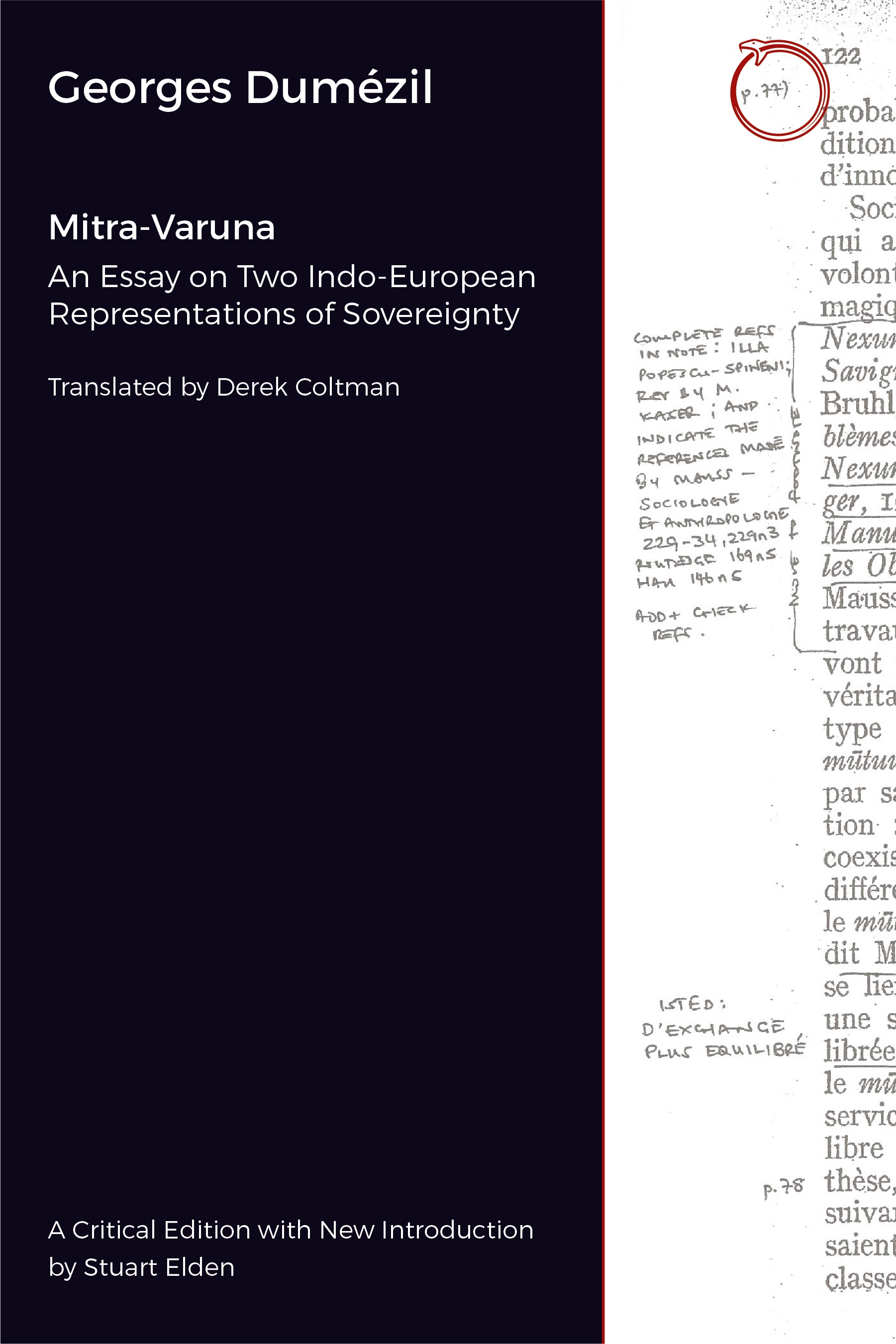
Georges Dumézil, Mitra-Varuna: An Essay on Two Indo-European Representations of Sovereignty, trans. Derek Coltman, ed. Stuart Elden – HAU books, June 2023

Georges Dumézil, Mitra-Varuna: An Essay on Two Indo-European Representations of Sovereignty, trans. Derek Coltman, ed. Stuart Elden – HAU books, June 2023.

Pre-order details at the University of Chicago Press site, who distribute HAU books.

A classic text that develops one prong of Dumézil’s tripartite hypothesis of Indo-European tribes: the sacred sovereign.
 
Georges Dumézil’s fascination with the myths and histories of India, Rome, Scandinavia, and the Celts yielded an idea that became his most influential scholarly legacy: the tripartite hypothesis, which divides Indo-European societal functions into three classes: the sacred sovereign, the warrior, and the producer. Mitra-Varuna, originally published in 1940, concentrates on the first function, that of sovereignty. Dumézil identifies two types of rulers, the first judicial and worldly, the second divine and supernatural. These figures, both priestly, are oppositional but complementary. The title nods to these roles, referring to the gods Mitra, a rational mediator, and Varuna, an awesome religious figure. 
 
Stuart Elden’s critical edition, based on the 1988 English translation by Derek Coltman, identifies variations between the first and second French editions and completes—and in places corrects—Dumézil’s references. The editor’s detailed introduction situates Mitra-Varuna within Dumézil’s career, outlines how his treatment of its themes developed over time, and relates the book to the political controversy around his ideas. Two new appendices contain passages that did not appear in the second French edition.

I’ve discussed something of the editing work here, and this is the first output of my new research project on Indo-European thought in twentieth-century France. This project is funded by a Leverhulme major research fellowship, to run for three years from 1 October 2022. I also have a chapter on Foucault’s use of Dumézil’s ideas on sovereignty forthcoming in the Handbook on Governmentality.

Posted in Georges Dumézil, Mapping Indo-European Thought in Twentieth Century France, Michel Foucault, Uncategorized | Leave a comment

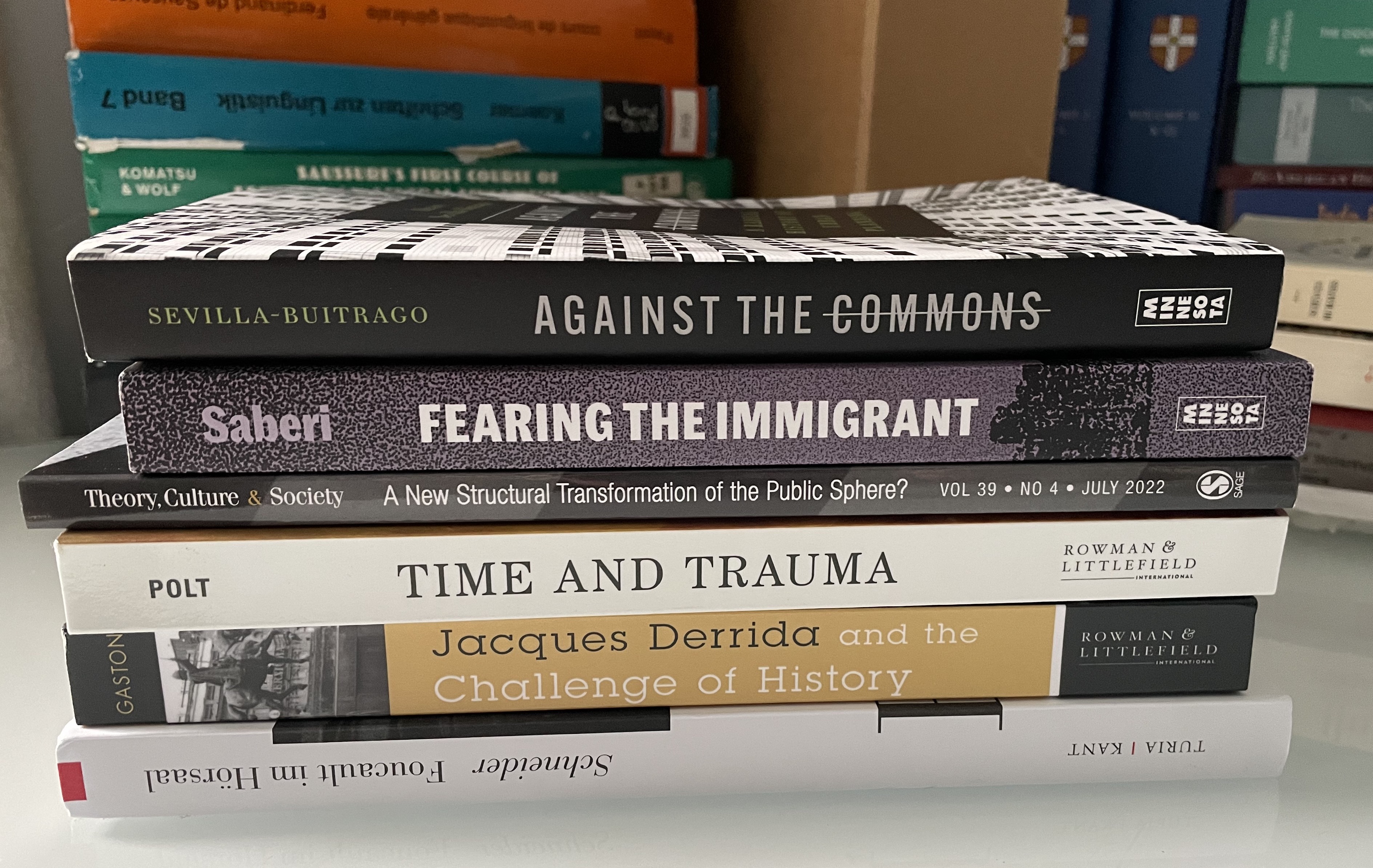
Books received – Sevilla-Buitrago, Saberi, TCS, Polity, Gaston,

Two excellent books I read in manuscript – Álvaro Sevilla-Buitrago, Against the Commons: A Radical History of Planning and Parastou Saberi, Fearing the Immigrant: Racialization and Urban Policy in Toronto, the new special issue of Theory, Culture & Society, Richard Polt, Time and Trauma: Thinking through Heidegger in the Thirties, Sean Gaston, Jacques Derrida and the Challenge of History, Ulrich Johannes Schneider, Foucault im Hörsaal: Über das mündliche Philosophieren 

University of Minnesota Press sent Álvaro and Parastou’s books; the Rowman ones were recompense for review work, and Ulrich generously sent a copy of his book.

Posted in Jacques Derrida, Martin Heidegger, Michel Foucault, Theory, Culture and Society, urban/urbanisation | 1 Comment