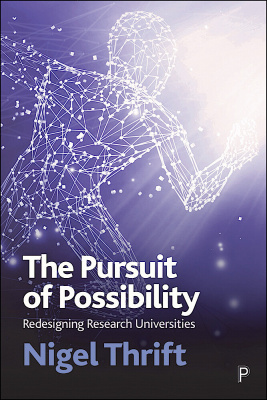
Nigel Thrift, The Pursuit of Possibility: Redesigning Research Universities – Policy Press, October 2022

Nigel Thrift, The Pursuit of Possibility: Redesigning Research Universities – Bristol University Press, October 2022

Are British research universities losing their way or are they finding a new way? 

Nigel Thrift, a well-known academic and a former Vice-Chancellor, explores recent changes in the British research university that threaten to erode the quality of these higher education institutions. He considers what a research university has now become by examining the quandaries that have arisen from a succession of misplaced strategies and false expectations.

Challenging both higher education policy and leadership, he argues that the focus on student number growth and a series of research policy missteps has upset research universities’ priorities just at a point in the history of planetary breakdown when their research is most needed.

Posted in Nigel Thrift | Leave a comment

Longer tributes to Bruno Latour – Justin Smith, Paul Edwards & Gabrielle Hecht, Adam Tooze, Laurent Jeanpierre

I shared some of the early tributes to Bruno Latour here. There are some longer discussions of his work and legacy in various places.

Justin H. Smith, A Locus of Care: Some Memories of the Life and Work of Bruno Latour (1947-2022)

Paul N. Edwards and Gabrielle Hecht, The Uncategorizable Bruno Latour (1947–2022), The Nation

Adam Tooze, Bruno Latour and the philosophy of life, The New Statesman

Laurent Jeanpierre, Bruno Latour : la destitution des Modernes, En attendant Nadeau

Happy to add further links – please add as comments.

The pieces in The New Statesman and The Nation may require registration or subscription.

Posted in Bruno Latour, Uncategorized | 1 Comment

Georges Dumézil’s The Destiny of the Warrior – a work in progress

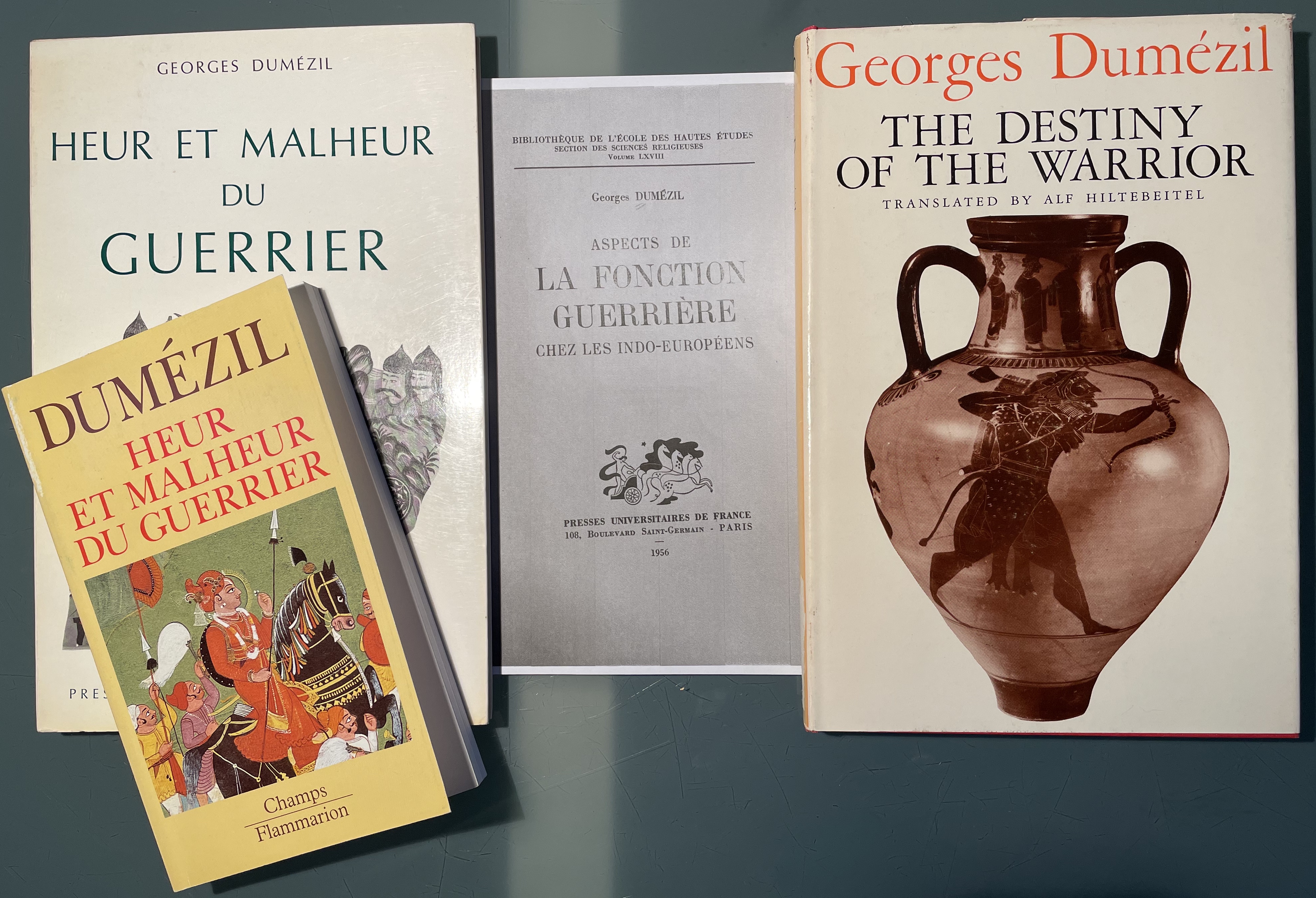
The 1969 edition, a reprint of the 1985 edition, a photocopy of the 1956 text and the English translation.

Mitra-Varuna is the best place to go, in English, for Dumézil’s views on the first function of sovereignty, and its twofold nature: the first judicial and worldly, the second divine and supernatural. In French, Les Dieux souverains des Indo-Européens (Gallimard 1977) updates and expands many of these analyses, but that’s not a text available in English. The second volume of Mythe et épopée, translated as three English books – The Stakes of the WarriorThe Plight of a Sorcerer and The Destiny of a King – discusses related questions. Except for The Destiny of a King those English volumes are out of print, but the forthcoming revised edition of Mitra-Varuna is an attempt to bring some of this work back into circulation.

For the second, martial function of Dumézil’s tripartite analysis – sovereigns, warriors, producers – an English reader could look at The Stakes of the Warrior, but I think a better place to start is The Destiny of the Warrior. Again, the book is unfortunately out of print.

The book has an interesting publishing history – a 1956 text, a revised version in 1969 and a new edition in 1985. Each of these adds material to the version before, with some cuts. On this page I’ve provided an initial indication of how and where these changes were made. The English translation is of the 1969 edition, and there is about a third of the final 1985 text which is not available in translation.

Posted in Georges Dumézil, Mapping Indo-European Thought in Twentieth Century France | Leave a comment

Where to start with reading Henri Lefebvre? – updated

My guide Where to start with reading Henri Lefebvre? has been updated. It’s just a minor update with an updated link to On the Rural and links to the recent books by Patrick Rumsby, Henri Lefebvre, Boredom and Everyday Life (Lexington) and Christian Schmid, Henri Lefebvre and the Theory of the Production of Space (Verso).

This comes in response to a question to me on Twitter. Where should you start with Henri Lefebvre?

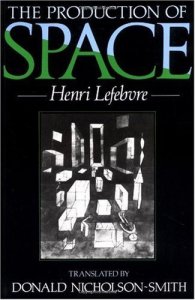
the-production-of-space-21054272

I think many people, especially in Geography, go to The Production of Space. That’s a major work, certainly, but I don’t think it’s a good place to start. It’s a difficult book, which was Lefebvre’s writing up – the theoretical culmination – of several years working on urban and, earlier, rural questions. All-too-often it is read through the lens of the first chapter – a broad, conceptual schema – and not balanced by the much more historical study found in later chapters. I’ve heard several people say that this was the first, and last, thing of Lefebvre they read, or started to read. Any serious engagement with Lefebvre has to come to terms with this book, but it’s not a good place to start.

continues here

Posted in Henri Lefebvre, Uncategorized | Leave a comment

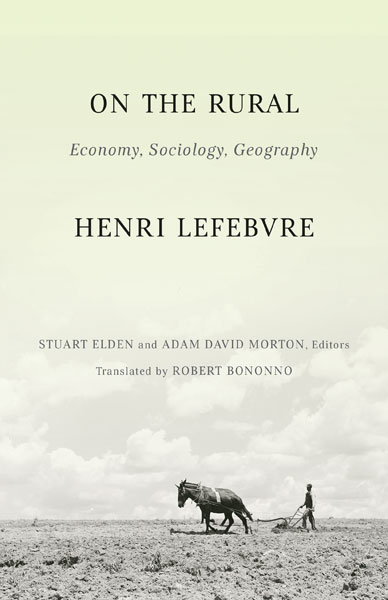
Henri Lefebvre, On the Rural: Economy, Sociology, Geography reviewed at Cleveland Review of Books by John Lepley (open access)

Henri Lefebvre, On the Rural: Economy, Sociology, Geography is reviewed at Cleveland Review of Books by John Lepley (open access). Here’s the final paragraph:

On the Rural is a remarkable collection. Far too many works about rural life and agriculture revolve around cliches and tropes. To be sure, Lefebvre documented customs and traditions, but he saw them in the context of a slowly-changing social landscape. These changes, moreover, were neither clear nor consistent. The slow transition of the French peasantry to farm laborers and to small capitalists was full of ambiguity, contingency, and irony. In an age of deep specialization, it’s also refreshing to read the work of someone who crossed disciplinary boundaries with ease. Lefebvre wrote as a historian, a sociologist, a geographer, a political-economist, and a philosopher. This makes for challenging reading at times but there are also brilliant passages that will goad readers on to the next page. In describing a Paris street, for example, Lefebvre’s prose is poetic: “Juxtaposed structures, from Roman ruins to banks, reproduce the ages of history in space, the succession of eras. The past is inscribed in the wounds of the stones themselves.” Just as in urban Paris, rural spaces are not devoid of history. They are products of human interventions, and On the Rural is an excellent place to learn about them. 

Posted in Adam David Morton, Henri Lefebvre | Leave a comment

Christian Schmid, Henri Lefebvre and the Theory of the Production of Space – Verso, November 2022

Christian Schmid, Henri Lefebvre and the Theory of the Production of Space – Verso, November 2022

This book presents an encompassing, detailed and thorough overview and reconstruction of Lefebvre’s theory of space and of the urban.

Henri Lefebvre belongs to the generation of the great French intellectuals and philosophers, together with his contemporaries Michel Foucault and Jean-Paul Sartre. His theory has experienced a remarkable revival over the last two decades, and is discussed and applied today in many disciplines in humanities and social sciences, particularly in urban studies, geography, urban sociology, urban anthropology, architecture and planning. Lefebvre, together with David Harvey, is one of the leading and most read theoreticians in these fields.

This book explains in an accessible way the theoretical and epistemological context of this work in French philosophy and in the German dialectic (Hegel, Marx, and Nietzsche), and reconstructs in detail the historical development of its different elements. It also gives an overview on the receptions of Lefebvre and discusses a wide range of applications of this theory in many research fields, such as urban and regional development, urbanization, urbanity, social space, and everyday life.

Posted in Henri Lefebvre | Leave a comment

Michel Serres, Les Cahiers de formation: 1960-1974, Œuvres complètes vol I – Pommier, October 2022

Michel Serres, Les Cahiers de formation: 1960-1974, Œuvres complètes vol I – Pommier, October 2022

There are two versions available – a reproduction of selected pages and a complete transcription.

En 1960, Michel Serres a trente ans. Il n’a encore publié aucun livre. Sur dix-huit cahiers manuscrits, il tient, de mai 1960 à mai 1974, une sorte de « journal philosophique », où il note ses réflexions, ses intuitions, ses trouvailles. Il a décidé de bâtir une œuvre. Dans ces cahiers, il s’y exerce.

Ce premier volume des Œuvres complètes contient la transcription intégrale de ces cahiers.

On y trouve, bien sûr, les esquisses de sa thèse, les brouillons de ses articles, des notes de lecture, mais aussi des réflexions sur l’époque, sur l’université, sur le monde et sur lui-même. Et une pensée qui chemine, inspirée par le souci de jeter des ponts entre le monde des sciences et celui des lettres et de la philosophie. Fort de sa double culture, Serres aspire à inventer un nouvel encyclopédisme : à « tracer des routes transversales » dans l’océan des savoirs. 

Dans le même temps, mesurant la puissance que nous donnent les sciences et les techniques, il nous alerte sur les dangers que cette « maîtrise » comporte : « […] l’homme de demain est condamné à la raison. […] Hors la sagesse, il n’y a plus, probablement, comme horizon que le suicide collectif et intellectuel. » Et il définit la mission du philosophe : penser ce « nouveau monde », pour le rendre habitable.

Préface et présentations par Roland Schaer.

La collection des Œuvres complètes de Michel Serres est dirigée par Sophie Bancquart, Bernadette Bensaude-Vincent, Roland Schaer et Frédéric Worms.

Posted in Uncategorized | Tagged | Leave a comment

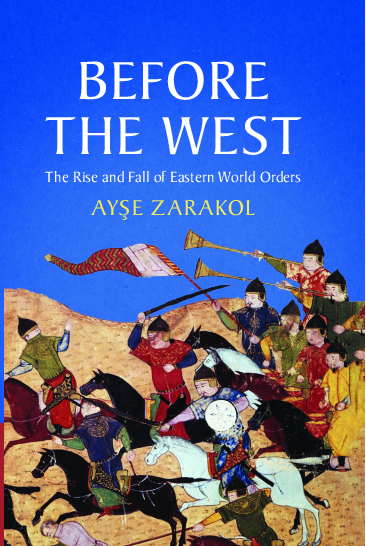
Ayşe Zarakol, Before the West: The Rise and Fall of Eastern World Orders – Cambridge University Press, February 2022

Ayşe Zarakol, Before the West: The Rise and Fall of Eastern World Orders – Cambridge University Press, February 2022

How would the history of international relations in ‘the East’ be written if we did not always read the ending – the Rise of the West and the decline of the East – into the past? What if we did not assume that Asia was just a residual category, a variant of ‘not-Europe’, but saw it as a space of with its own particular history and sociopolitical dynamics, not defined only by encounters with European colonialism? How would our understanding of sovereignty, as well as our theories about the causes of the decline of Great Powers and international orders, change as a result? For the first time, Before the West offers a grand narrative of (Eur)Asia as a space connected by normatively and institutionally overlapping successive world orders originating from the Mongol Empire. It also uses that history to rethink the foundational concepts and debates of international relations, such as order and decline.

‘Zarakol’s Before the West successfully challenges Eurocentrism not by running into its opposite, Sinocentrism, but by examining Asia and its interconnectedness to the rest of Eurasia. Against Sinocentric works that treat Mongols as ‘barbarians’, the author puts the Mongol empire at the center of analysis and underscores the high degree of centralization in the Chinggisid sovereignty model. Zarakol vividly demonstrates how ‘Asia was first made whole’ by Genghis Khan’s world conquest. She makes the provocative argument that the supposedly Chinese Ming emperors who overthrew the Mongol Yuan dynasty were in fact ‘Chinggisid sovereigns’, along with the contemporary Timurids in West Asia. This book is a gem in the genre of Global IR and macro-historical comparison.’ Victoria Hui, Associate Professor, Department of Political Science, University of Notre Dame

‘In this imaginative and iconoclastic book, Ayşe Zarakol turns some major received wisdoms of academic international relations on their head. Well before the modern world order was shaped by a rising West, the great empires of the East had formed world orders of their own, equally based on territorial sovereignty and universalistic in their aspirations. Charting the historical trajectories of these orders across five centuries, Zarakol encourages us to revise our standard accounts of the international system and especially those of the rise and decline of world orders. As such, this book is an invaluable contribution to the study of international relations in a global context.’ Jens Bartelson, Lund University

‘Before the West constitutes a tour de force. Ayşe Zarakol brilliantly reorients the Eurocentric focus in international relations scholarship by studying relations between Asian actors in their own right, rather than as derivative of European–Asian interaction. She creatively highlights the influence of the Chinggisid conceptualisations of sovereignty and world order. In so doing, Zarakol demonstrates that we need to focus on the intersubjective understanding of the world order in which those powers are embedded, rather than merely understand the rise and decline of great powers in material terms.’ Hendrik Spruyt, Northwestern University

‘“Brilliant” and “original” don’t begin to do justice to Zarakol’s book. After reading her reconstitution of the Mongol political order and its influence, you will never look at China, Russia or the political structure of Asia the same way again. European history too, especially the Habsburg empire, appears in a new light. Zarakol shows how much of world history, and even our modern age, was shaped by the Mongols’ pattern of highly centralised, aristocratic sovereignty joined to millennial destiny. The breadth and ambition of this book are staggering.  A must-read for global history.’ Jack A. Goldstone, George Mason University

‘In Before the West, Ayşe Zarakol provides a brilliant and illuminating macro-history of the rise and fall of Eastern world orders that forcefully challenges the conventional history of international relations. In addition to making a persuasive case to separate the rise and decline of the great powers from the rise and decline of world orders, Ayşe Zarakol provides a masterful explanation of the “decline of the East”. This compelling work that blends history and international relations theory is bound to make you see contemporary issues related to order, rise and decline in new light.’ Manjeet S. Pardesi, Victoria University of Wellington

‘This ingenious book does for IR what Marshall Hodgson did for world economic history. By avoiding Western teleology, Ayşe Zarakol brilliantly reveals the world of “international” relations that existed before the world of Westphalian Europe, but which has for so long been hidden behind the wall of Eurocentrism. Accordingly, the book provides a compelling example of how historical IR can tell us new things about the fundamentals of world politics.’ John M. Hobson FBA, University of Sheffield

Posted in Uncategorized | Leave a comment

Les archives de Michel Serres entrent à la Bibliothèque nationale de France (2022)

Michel Serres archives at the Bibliothèque nationale de France

Clare O'Farrell's avatarFoucault News

Les archives de Michel Serres entrent à la Bibliothèque nationale de France
Les Univers du livre, 05/10/2022

Ce mercred 5 octobre, la Bibliothèque nationale de France annonce que ses collections seront enrichies par un fonds d’archives de près de 300 cahiers, manuscrits et dactylographies d’œuvres du philosophe et académicien Michel Serres.

Michel Serres (1930-2019) s’était rapproché de la BnF pour la conservation de ses archives. Celles-ci viennent de faire leur entrée par voie de dation dans les collections du département des Manuscrits de la BnF.

Ce riche fonds d’archives composé de cahiers, mais aussi de manuscrits et dactylographies de ses œuvres, ainsi que des cours et conférences qui étaient le matériau de départ de ses livres, sera prochainement mis à disposition des chercheurs pour l’étude et la recherche.

Grande figure intellectuelle du XXe siècle, Michel Serres fut formé après-guerre à l’École navale, ainsi qu’aux mathématiques, aux lettres classiques et…

View original post 129 more words

Posted in Uncategorized | Leave a comment

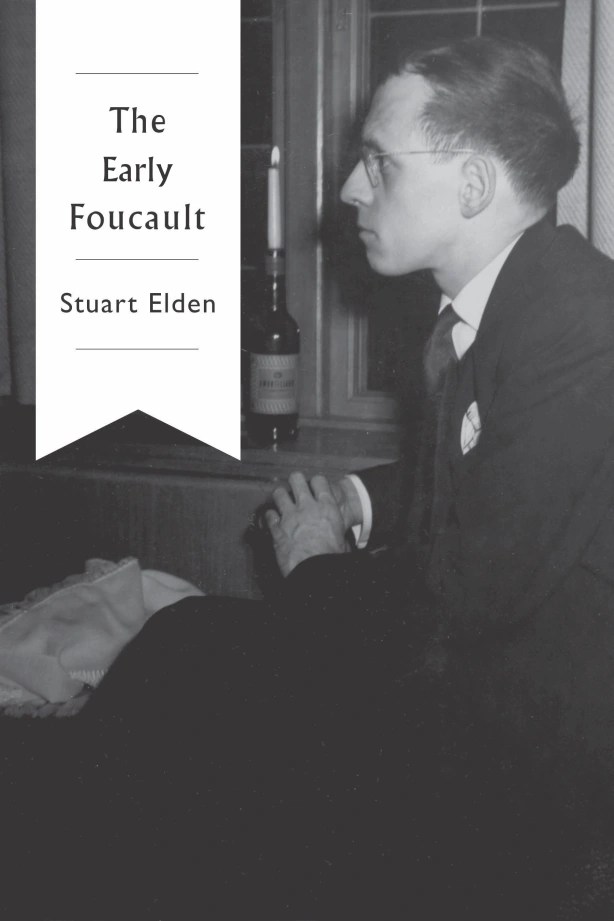
Two reviews of The Early Foucault (Polity, 2021) by Colin Koopman and Jasper Friedrich – and a note on Heidegger

There are two recent reviews of The Early Foucault by Colin Koopman at The Review of Politics (requires subscription) and Jasper Friedrich at Foucault Studies (open access). They are generous and appreciative, though not uncritical. I’m grateful to both for taking the time to engage.

Here’s the first two paragraphs of Koopman’s review:

Stuart Elden’s The Early Foucault is the third offering in a planned series of four volumes on the work of Michel Foucault. Succeeding Elden’s Foucault: The Birth of Power and Foucault’s Last Decade in terms of publication order, the book’s subject matter is chronologically first with respect to Foucault’s life, tracing his earliest thought in the 1950s up until the publication of his first major book, History of Madness. The fourth volume will be published next year and will be concerned with Foucault’s archaeological writings of the subsequent decade. The entire collection of four volumes will offer a summative study of the geneses and transformations of Foucault’s thought. Elden’s project on the whole is truly requisite for any serious scholar of Foucault. 

Elden’s methodology throughout all four volumes, and especially notable in this one, is a straight positivism. He is a digger in archives. He is a collector of facts. He is a collator of minute details, variations in dates on sheets of paper, nuances of manuscript revisions, and once-thought-lost material that has come to light by digging through the multiple archives where Foucault’s unpublished writings are entombed. 

And here’s the closing paragraph of Friedrich’s review:

In sum, The Early Foucault represents a fantastic resource for scholars interested in Foucault’s intellectual development, and especially his thought on psychology and mental illness. Since mental health seems to be a topic very much in vogue today, the appearance of Elden’s book is highly welcome and will no doubt contribute to the growing interest in Foucault’s earlier psychological thought as well as post-war French thought on politics and psychiatry more generally. This is not to mention the book’s highly interesting discussions of Foucault’s more philosophical engagement with Kant, Hegel, Heidegger, Nietzsche and others, which my highly selective review has not done justice to. If there is a critical comment to be made about The Early Foucault, it is that Elden is at times too attenive to detail to the extent that the reader loses sight of the bigger picture and the significance of the stream of information. Elden generally leaves the task of interpreting the wider ramifications of his detailed analyses to the reader—but to anyone who wishes to undertake this task, The Early Foucault provides an incomparable source of information. 

I’m not going to respond to all the points, but one issue in Koopman’s review did stick out.

His criticism comes in part through the emphasis in this book on Foucault’s engagement with Nietzsche and Heidegger, especially my stress on the latter. Koopman links this back to my first book, Mapping the Present: Heidegger, Foucault and the Project of a Spatial History (Continuum 2001; now with Bloomsbury). I am certainly not disavowing that early book (even if there are things I might now revisit and revise) but I don’t think it overly shaped my approach in these newer books – neither with regard to Heidegger nor space. Rather, I wanted to revisit Foucault’s work in the light of a mountain of new evidence, some published, some archival, which was unavailable in the late 1990s when I wrote Mapping the Present.

While Colin and I clearly disagree on the importance of Heidegger to Foucault generally, I do want to pick up on one point, when he says:

The only two figures from the history of philosophy who are given five lines worth of page references in Elden’s index are Nietzsche and Heidegger.

Heidegger is discussed a lot in this book, The Early Foucault, but that’s because he was someone Foucault was clearly reading very intensely in this period, as the archive shows. The preserved notes are extensive, much more so than other figures who might be seen as influential. Heidegger is also really important in Foucault’s work on Ludwig Binswanger, as has long been recognised, and the engagement with Binswanger is also crucial to this period.

I don’t discuss Heidegger nearly so much in the other books in this series, but in this one, yes, I do give him a lot of attention. Do I over-privilege him in the series as a whole? I really don’t think so. And all the other figures Koopman mentions are discussed in the series. Even in the book under review here, there is one chapter almost entirely devoted to Foucault’s translation and analysis of Kant’s Anthropology. The Heideggerian aspect of that reading is minor: much more attention is paid to Foucault’s translation choices. With Canguilhem, I wrote a whole book on him as a side-project to this Foucault series and he plays a significant role throughout. Deleuze is discussed particularly in Foucault: The Birth of Power and the forthcoming The Archaeology of Foucault.

The index-counting approach Colin uses is an imperfect way to gauge the importance of thinkers to a text, but the other volumes would give quite different balances. I actually think this series emphasises Nietzsche’s role in Foucault’s development far more than Heidegger. And here again I think the archival evidence supports my choice of focus. But I hardly underplay Kant, or for that matter, Hegel, or many other figures.

But again, I am grateful to Colin, and to Jasper, for taking the time to do these reviews.

Posted in Canguilhem (book), Foucault's Last Decade, Foucault: The Birth of Power, Friedrich Nietzsche, Georg Wilhelm Friedrich Hegel, Georges Canguilhem, Gilles Deleuze, Immanuel Kant, Ludwig Binswanger, Mapping the Present, Martin Heidegger, Michel Foucault, The Archaeology of Foucault, The Early Foucault | 2 Comments