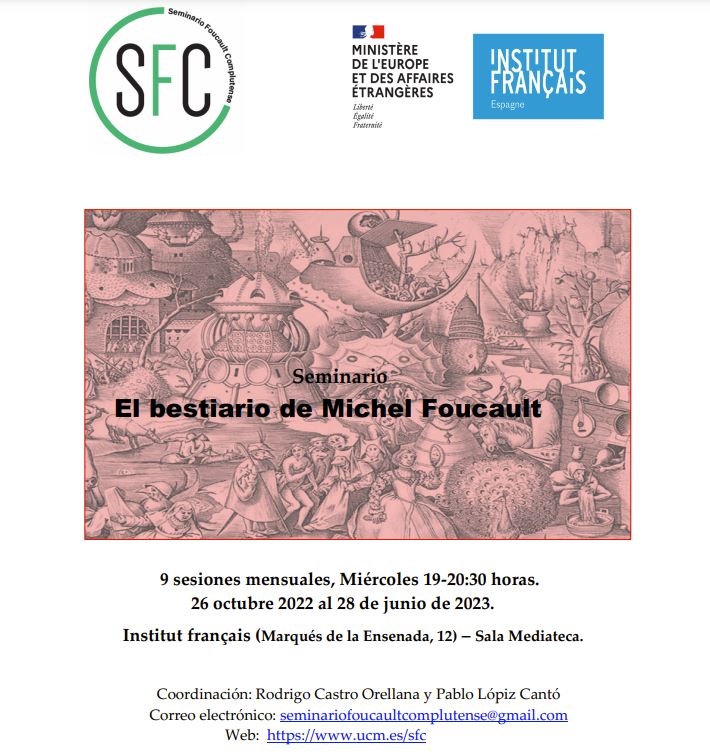
Me gustaría escribir la historia de los vencidos. Es un hermoso sueño, que muchos comparten: darle la palabra a quienes no pudieron tomarla hasta el presente, a los que fueron obligados al silencio por la historia, por la violencia de la historia, por todos los sistemas de dominación y de explotación.
Michel Foucault. “La torture, c’est la raison”, 1977.
Me parece que hasta el presente los historiadores de nuestra sociedad, de nuestra civilización, han intentado sobre todo penetrar en el secreto íntimo de nuestra civilización, su espíritu, el modo de construir la propia identidad, las cosas a las…
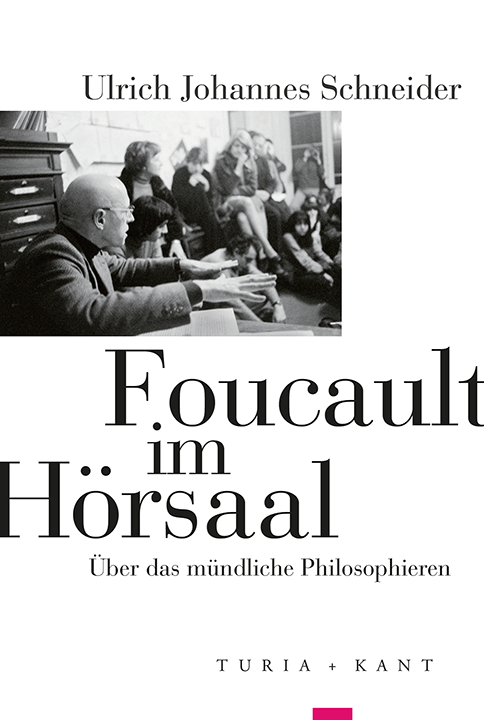
Im Hörsaal zeigt sich das europäische Philosophieren jederzeit mündlich und beweglich. Viele pilgerten zwischen 1970 und 1984 nach Paris, wo Michel Foucault dreizehn umfangreiche Vorlesungen hielt. Sein Publikum erstaunte vor dem Wechsel an Themen, Texten und Bildern. Foucault sprach über Machtverhältnisse, Strafregime und diskursive Ordnungen, er thematisierte die Sexualität, das Wahrsagen und wie gut zu leben sei. Seine Anekdoten und Geschichten faszinieren noch in den gedruckten Transkriptionen aller 150 Vorlesungsstunden. Der Essay Foucault im Hörsaal versucht den Nachvollzug des mündlichen Foucault und testet den Zusammenhang der mündlich vorgetragenen Gedankenentwicklung. Warum taucht dort – und nur dort – die Figur des Ödipus auf? Es gibt viele rote Fäden im Vortrag Foucaults, der explizit experimentierend ist und sich vom Charakter seiner Bücher deutlich absetzt. Foucault hat Vorlesungen eher wie politische Interventionen als lebhafte Ansprachen gestaltet; er adressiert seine Zuhörer als Zeitgenossen mit offenem Erwartungshorizont.
Contributions by Pierre Macherey, Nathan Brown, David Marriott, Nick Nesbitt, Ellen Rooney and Joseph Serrano
This collection revisits A Theory of Literary Production (1966) to show how Pierre Macherey’s remarkable—and still provocative—early work can contribute to contemporary discussions about the act of reading and the politics of formal analysis. Across a series of historically and philosophically contextualized readings, the volume’s contributors interrogate Macherey’s work on a range of pressing issues, including the development of a theory of reading and criticism, the relationship between the spoken and the unspoken, the labor of poetic determination and of literature’s resistance to ideological context, the literary relevance of a Spinozist materialism, the process of racial subjectification and the ontology of Blackness, and a theorization of the textual surface. Pierre Macherey and the Case of Literary Production also includes three new texts by Macherey, presented here in English for the first time: his postface to the revised French edition of A Theory of Literary Production; “Reading Althusser,” in which Macherey analyzes the concept of symptomatic reading; and a comprehensive interview in which Macherey reflects on the historical conditions of his early work, on the long arc of his career at the intersection of philosophy and literature, and on the ongoing importance of Louis Althusser’s thought.
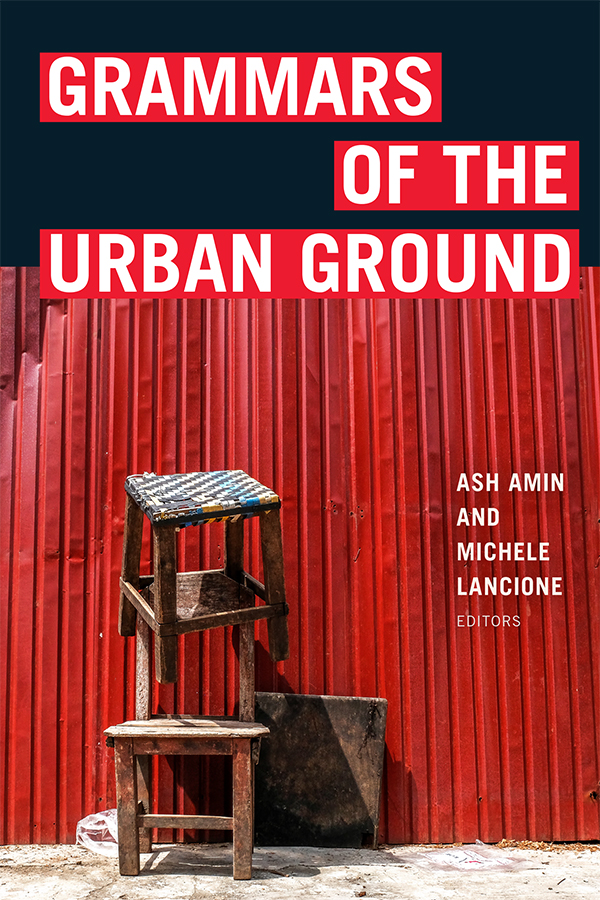
The contributors to Grammars of the Urban Grounddevelop a new conceptual framework and vocabulary for capturing the complex, ever-shifting, and interactive processes that shape contemporary cities. Building on Marxist, feminist, queer, and critical race theory as well as the ontological turn in urban studies, they propose a mode of analysis that resists the staple of siloed categories such as urban “economy,” “society,” and “politics.” In addition to addressing key concepts of urban studies such as dispossession and scale, the contributors examine the infrastructures of plutocratic life in London, reconfigure notions of gentrification as a process of racial banishment, and seek out alternative archives for knowledge about urban density. They also present case studies of city life in the margins and peripheries of São Paulo, Kinshasa, Nairobi, and Jakarta. In so doing, they offer a foundation for better understanding the connective and aggregative forces of city-making and the entanglements and relations that constitute cities and their everyday politics.
Contributors. Ash Amin, Teresa Caldeira, Filip De Boeck, Suzanne Hall, Caroline Knowles, Michele Lancione, Colin McFarlane, Natalie Oswin, Edgar Pieterse, Ananya Roy, AbdouMaliq Simone, Tatiana Thieme, Nigel Thrift, Mariana Valverde
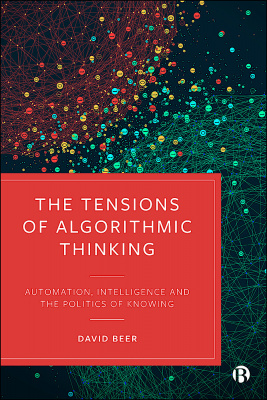
From machine learning and artificial intelligence to blockchain or simpler news-feed filtering, automated systems can transform the social world in ways that are just starting to be imagined.
Redefining these emergent technologies as the new systems of knowing, pioneering scholar David Beer examines the acute tensions they create and how they are changing what is known and what is knowable. Drawing on cases ranging from the art market and the smart home through to financial tech, AI patents and neural networks, he develops key concepts for understanding the framing, envisioning and implementation of algorithms.
This book will be of interest to anyone who is concerned with the rise of algorithmic thinking and the way it permeates society.
By highlighting the connections between domestic political struggles and overseas imperial structures, The Politics of Imperial Memory in France, 1850–1900 explains how and why French Republicans embraced colonial conquest as a central part of their political platform. Christina B. Carroll explores the meaning and value of empire in late-nineteenth-century France, arguing that ongoing disputes about the French state’s political organization intersected with racialized beliefs about European superiority over colonial others in French imperial thought. For much of this period, French writers and politicians did not always differentiate between continental and colonial empire. By employing a range of sources—from newspapers and pamphlets to textbooks and novels—Carroll demonstrates that the memory of older continental imperial models shaped French understandings of, and justifications for, their new colonial empire. She shows that the slow identification of the two types of empire emerged due to a politicized campaign led by colonial advocates who sought to defend overseas expansion against their opponents. This new model of colonial empire was shaped by a complicated set of influences, including political conflict, the legacy of both Napoleons, international competition, racial science, and French experiences in the colonies. The Politics of Imperial Memory in France, 1850–1900 skillfully weaves together knowledge from its wide-ranging source base to articulate how the meaning and history of empire became deeply intertwined with the meaning and history of the French nation.
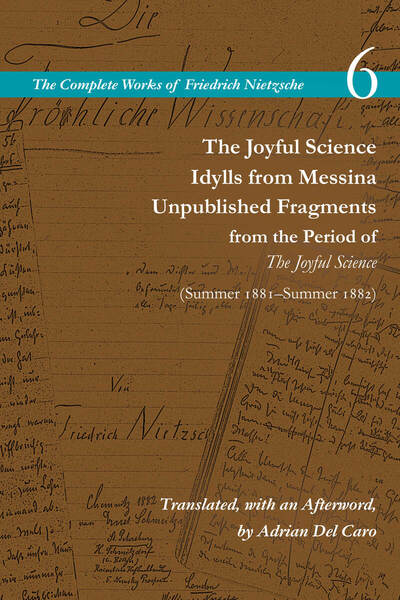
Written on the threshold of Thus Spoke Zarathustra during a high point of social, intellectual and psychic vibrancy, The Joyful Science (frequently translated as The Gay Science) is one of Nietzsche’s thematically tighter books. Here he debuts and practices the art of amor fati, love of fate, to explore what is “species preserving” in relation to happiness (Book One); inspiration and the role of art as they keep us mentally fit for inhabiting a world dominated by science (Book Two); the challenges of living authentically and overcoming after the death of God (Book Three); and the crescendo of life affirmation in which Nietzsche revealed the doctrine of eternal recurrence and previewed the figure of Zarathustra (Book Four). Invigorated and motivated by Thus Spoke Zarathustra and Beyond Good and Evil, Nietzsche in 1887 added a new preface, an appendix of poems, and Book Five, where he deepened the critique of science and displayed a more genealogical approach.
This volume provides the first English translation of the Idylls from Messina and, more importantly, it includes the first English translation of the notebooks of 1881–1882, in which Nietzsche first formulated the eternal recurrence. Structurally and stylistically, The Joyful Scienceremains Nietzsche’s most effective book of aphorisms, immediately after which he took on the voice and alter ego of Zarathustra in order to push beyond the boundaries of even the most liberating prose.
Characterized by shared, self-managed access to food, housing, and the basic conditions for a creative life, the commons are essential for communities to flourish and protect spaces of collective autonomy from capitalist encroachment. In a narrative spanning more than three centuries, Against the Commons provides a radical counterhistory of urban planning that explores how capitalism and spatial politics have evolved to address this challenge.
Highlighting episodes from preindustrial England, New York City and Chicago between the 1850s and the early 1900s, Weimar-era Berlin, and neoliberal Milan, Álvaro Sevilla-Buitrago shows how capitalist urbanization has eroded the egalitarian, convivial life-worlds around the commons. The book combines detailed archival research with provocative critical theory to illuminate past and ongoing struggles over land, shared resources, public space, neighborhoods, creativity, and spatial imaginaries.