Foucault and Praxis: On Genealogical Method and Abolition with Bernard Harcourt (2022)

Foucault and Praxis: On Genealogical Method and Abolition with Bernard Harcourt, Acid Horizon, Aug. 13, 2022

Clare O'Farrell's avatarFoucault News

Foucault and Praxis: On Genealogical Method and Abolition with Bernard Harcourt, Acid Horizon, Aug. 13, 2022

ABOUT THIS EPISODE
Acid Horizon hosts Bernard Harcourt, a distinguished critical theorist, legal advocate, and prolific writer and editor. Bernard joins the cast to discuss the legacy of Foucault’s work, its emergence within its historical milieu, and the practical implications it offers. Bernard also offers a concise explanation of what is meant by Foucault’s genealogical method and how we can best understand the normative aspects implicit in Foucault research.

Bernard Harcourt’s links:

Critique and Praxis: http://cup.columbia.edu/book/critique-and-praxis/9780231195720

“On Critical Genealogy”: https://papers.ssrn.com/sol3/papers.cfm?abstract_id=4147668

13/13 Seminars: https://cccct.law.columbia.edu/content/13-13

View original post

Posted in Uncategorized | Leave a comment

Parastou Saberi, Fearing the Immigrant: Racialization and Urban Policy in Toronto – University of Minnesota Press, August 2022

Now published – Parastou Saberi, Fearing the Immigrant: Racialization and Urban Policy in Toronto, University of Minnesota Press, 2022

stuartelden's avatarProgressive Geographies

Parastou Saberi, Fearing the Immigrant: Racialization and Urban Policy in Toronto – University of Minnesota Press, August 2022

The city of Toronto is often held up as a leader in diversity and inclusion. In Fearing the Immigrant, however, Parastou Saberi argues that Toronto’s urban policies are influenced by a territorialized and racialized security agenda—one that parallels the “War on Terror.” Focusing on the figure of the immigrant and so-called immigrant neighborhoods as the targets of urban policy, Saberi offers an innovative, multidisciplinary approach to the politics of racialization and the governing of alterity through space in contemporary cities.

A comprehensive study of urban policymaking in Canada’s largest city from the 1990s to the late 2010s, Fearing the Immigrant uses Toronto as a jumping-off point to understand how the nexus of development, racialization, and security works at the urban and international levels. Saberi situates urban policymaking in Toronto in relation to…

View original post 160 more words

Posted in Uncategorized | Leave a comment

Special Issue: Foucault’s Method Today. Continental Thought and Theory (2022)

Open access special issue of Continental Thought and Theory on ‘Foucault’s Method Today’

Clare O'Farrell's avatarFoucault News

CT&T: Continental Thought and Theory: A Journal of Intellectual Freedom
Volume 3, Issue 4, 2022 Foucault’s Method Today

“Foucault’s Method: Introduction to Issue”, Cindy Zeiher and Mike Grimshaw
“Notes on the Concept of Hyper-subjectivity—Foucault, Lacan, Illouz”, Rey Chow and Austin Sarfan
“Foucault v Freud: Unthought, Unconscious, and Kant’s ‘Rhapsody of Perceptions’”, Henry Krips
“Contemporary Implications of Michel Foucault”, Jean Allouch
“Post-Truth and the Controversy over Postmodernism. Or, was Trump Reading Foucault?”, Saul Newman
“Reassessing the Productive Hypothesis: How Foucault Taught us to Think About Sex and Self”, Christopher Breu
“Foucault after Baudrillard”, Rex Butler
“Flayed Bodies and the Re-turn of the Flesh: Foucault and Contemporary Gendered Bodies”, Talyor Adams and Rosemary Overell
“Lacan avec Foucault: Reflections on Monstrosity”, Leilane Andreoni, Manuella Mucury, Jorge e Adeodato, Rodrigo Gonsalves (former members of ‘Monstrosity’)
“The Glory of Nicocles: Foucault’s Greeks and the Inegalitarian Underside of the Professional-Managerial Class”, Matthew Sharpe
“Caesar’s Tear; or…

View original post 126 more words

Posted in Uncategorized | 1 Comment

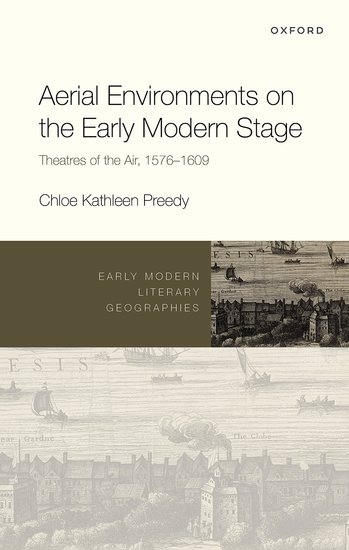
Chloe Kathleen Preedy, Aerial Environments on the Early Modern Stage: Theatres of the Air, 1576-1609 – OUP, September 2022

Chloe Kathleen Preedy, Aerial Environments on the Early Modern Stage: Theatres of the Air, 1576-1609 – OUP, September 2022

During the early days of the professional English theatre, dramatists including Dekker, Greene, Heywood, Jonson, Marlowe, Middleton, and Shakespeare wrote for playhouses that, though enclosed by surrounding walls, remained open to the ambient air and the sky above. The drama written for performance at these open-air venues drew attention to and reflected on its own relationship to the space of the air. At a time when theories of the imagination emphasized dramatic performance’s reliance upon and implication in the air from and through which its staged fictions were presented and received, plays written for performance at open-air venues frequently draw attention to the nature and significance of that elemental relationship. 

Aerial Environments on the Early Modern Stage considers the various ways in which the air is brought into presence within early modern drama, analyzing more than a hundred works that were performed at the London open-air playhouses between 1576 and 1609, with reference to theatrical atmospheres and aerial encounters. It explores how various theatrical effects and staging strategies foregrounded early modern drama’s relationship to, and impact on, the actual playhouse air. In considering open-air drama’s pervasive and ongoing attention to aerial imagery, actions, and representational strategies, the book suggest that playwrights and their companies developed a dramaturgical awareness that extended from the earth to encompass and make explicit the space of air.

Posted in Uncategorized | Leave a comment

Gëzim Visoka and Nicolas Lemay-Hébert, Normalization in World Politics – University of Michigan Press, 2022 (open access e-book)

Gëzim Visoka and Nicolas Lemay-Hébert, Normalization in World Politics – University of Michigan Press, 2022 (open access e-book)

As we face new challenges from climate change and the rise of populism in Western politics and beyond, there is little doubt that we are entering a new configuration of world politics. Driven by nostalgia for past certainties or fear of what is coming next, references to normalcy have been creeping into political discourse, with people either vying for a return to a past normalcy  or coping with the new normal.  

This book traces main discourses and practices associated with normalcy in world politics. Visoka and Lemay-Hébert mostly focus on how dominant states and international organizations try to manage global affairs through imposing normalcy over fragile states, restoring normalcy over disaster-affected states, and accepting normalcy over suppressive states. They show how discourses and practices come together in constituting normalization interventions and how in turn they play in shaping the dynamics of continuity and change in world politics.

Thanks to dmf for the link.

Update: Foucault News links to a New Books discussion:

Normalization.
A Discussion with Gëzim Visoka and Nicolas Lemay
New Books Network, Aug 16, 2022

In this episode of High Theory, Gëzim Visoka and Nicolas Lemay-Hebert tell us about normalization in international relations. Their research applies Foucault’s social theories of the normal and abnormal to the objects of political science: states, international organizations, and practices of intervention.

In the episode (and in their book) Gëzim and Nicolas reference Foucault’s Lectures at the College de France on the Abnormal (printed in English by Verso and Macmillan). They discuss three exemplary figures from Foucault’s work on the abnormal: the monster, the incorrigible, and the onanist. Each one has a corresponding figure in international politics.

Their new book Normalization in World Politics is available as an open access text from Michigan University Press. That means you can read it for free! Check it out, and learn all about the ways we produce, impose, and maintain normal and abnormal affairs in the international order.

Posted in Uncategorized | Leave a comment

Angharad Closs Stephens, National Affects: The Everyday Atmospheres of Being Political – Bloomsbury, September 2022

Angharad Closs Stephens, National Affects: The Everyday Atmospheres of Being Political – Bloomsbury, September 2022

Identity is widely acknowledged to be a felt experience, yet questions of atmosphere, mood and public sentiments are rarely made central to understanding the global politics of nationalism. This book asks what difference it makes when we address national identity as principally an affective force? National Affects traces how ideas about ‘us and them’ take form in ordinary spaces, in ways that are both deeply felt and hardly noticeable, in studies of global events that range from the London 2012 Olympic Games to responses to acts of terror, the European refugee crisis and ‘Brexit’. 

In this timely intervention, Angharad Closs Stephens addresses the affective dimensions of being together to open new angles in the study of nationalism and global politics. She asks how the nation is felt in everyday life, as well as differently experienced, and investigates different forms of enacting being together to generate new insights in the study of national identity. National Affects draws on academic theories in the study of Politics, International Relations and Human Geography, as well as stories, performance works and novels, to establish a new tone of critical enquiry. Informed by longstanding critical interrogations of the politics of ‘us and them’, this book argues that these ideas are not as stable as they are often made to seem.  

Drawing on a combination of artistic and academic interventions, this book offers a refreshing approach to conceptualising the politics of nationalism, identity and citizenship. In its focus on everyday atmospheres, it identifies new registers for intervening politically. Overall, National Affects outlines other ways of imagining and practising being political together, beyond the exclusionary politics of nationalism. 

Posted in Uncategorized | 1 Comment

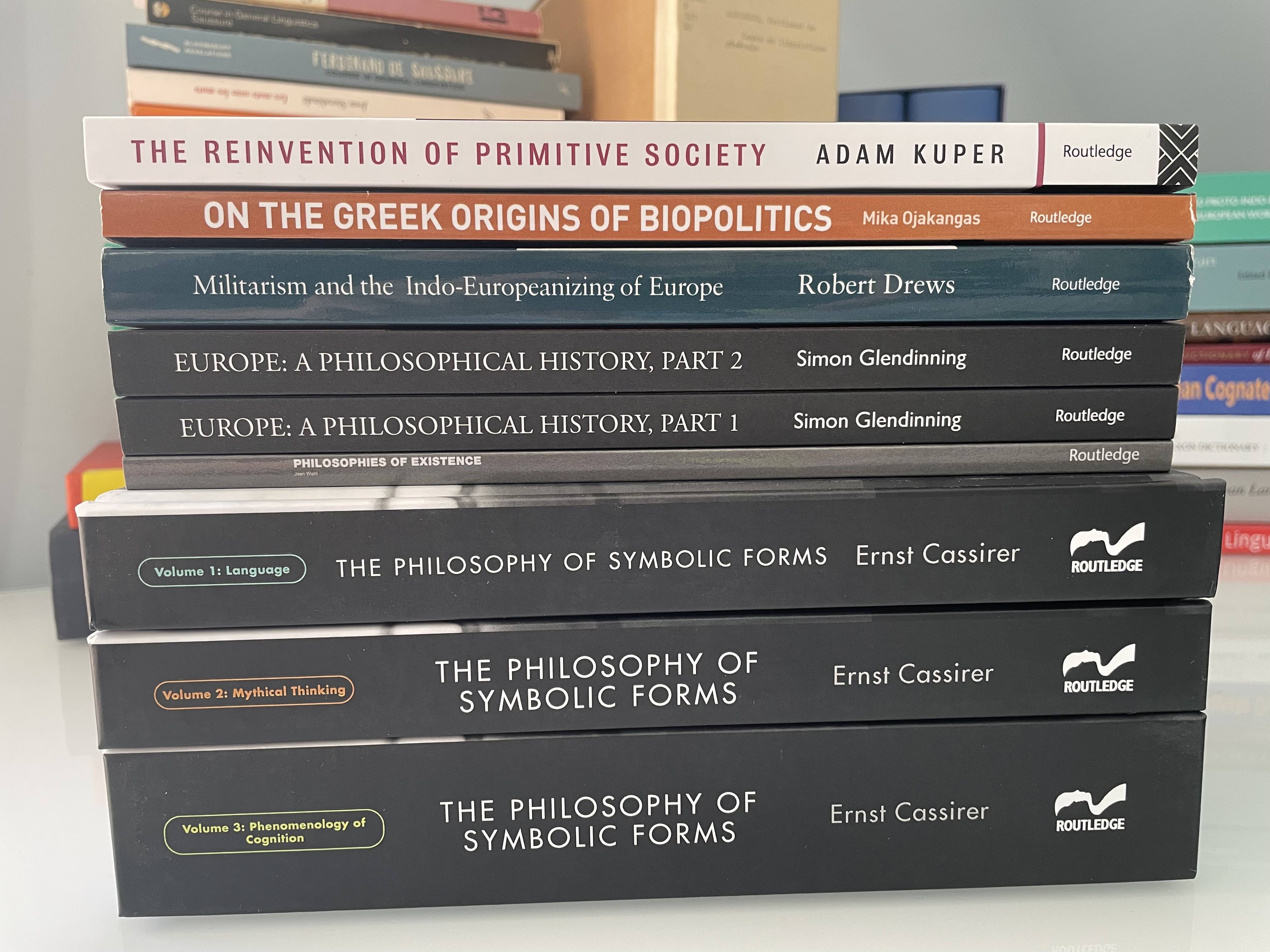
Books received – Kuper, Ojakangas, Drews, Glendinning, Cassirer

Books in recompense for review work, including the new translation of Ernst Cassirer’s The Philosophy of Symbolic Forms, and Simon Glendinning’s Europe: A Philosophical History.

Posted in Edward Casey, Mapping Indo-European Thought in Twentieth Century France, Uncategorized | Leave a comment

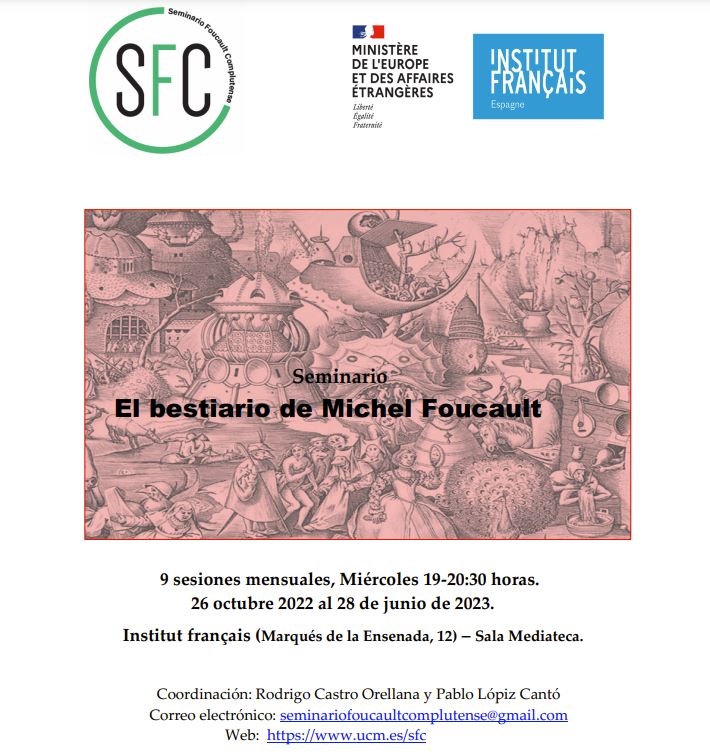
Seminario: El bestiario de Michel Foucault (2022-23)

Seminario: El bestiario de Michel Foucault (2022-23)

Clare O'Farrell's avatarFoucault News

Seminario: El bestiario de Michel Foucault

9 sesiones mensuales, Miércoles 19-20:30 horas.
Del 26 octubre 2022 al 28 de junio de 2023.

Institut français (Marqués de la Ensenada, 12) – Sala Mediateca.

Coordinación: Rodrigo Castro Orellana y Pablo Lópiz Cantó

Correo electrónico: seminariofoucaultcomplutense@gmail.com

Web:  https://www.ucm.es/sfc

Entrada libre y gratuita hasta completar aforo.

Me gustaría escribir la historia de los vencidos. Es un hermoso sueño, que muchos comparten: darle la palabra a quienes no pudieron tomarla hasta el presente, a los que fueron obligados al silencio por la historia, por la violencia de la historia, por todos los sistemas de dominación y de explotación.

Michel Foucault. “La torture, c’est la raison”, 1977.

Me parece que hasta el presente los historiadores de nuestra sociedad, de nuestra civilización, han intentado sobre todo penetrar en el secreto íntimo de nuestra civilización, su espíritu, el modo de construir la propia identidad, las cosas a las…

View original post 674 more words

Posted in Uncategorized | Leave a comment

Books received – Detienne, Benveniste, Olender, Dumézil, Rampling, Katz

Some second-hand books for the Indo-European thought project, along with Jennifer M. Rampling, The Experimental Fire: Inventing English Alchemy, 1300-1700, in recompense for review work, and Irit Katz, The Common Camp: Architecture of Power and Resistance in Israel-Palestine, which I endorsed.

Posted in Emile Benveniste, Georges Dumézil, Mapping Indo-European Thought in Twentieth Century France | 1 Comment

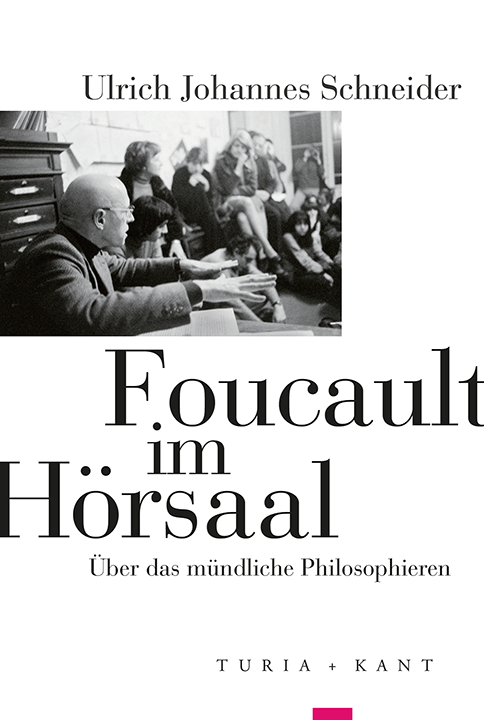
Ulrich Johannes Schneider, Foucault im Hörsaal: Über das mündliche Philosophieren – Verlag Turia + Kant, 2022

Ulrich Johannes Schneider, Foucault im Hörsaal: Über das mündliche Philosophieren – Verlag Turia + Kant, 2022

Im Hörsaal zeigt sich das europäische Philosophieren jederzeit mündlich und beweglich. Viele pilgerten zwischen 1970 und 1984 nach Paris, wo Michel Foucault dreizehn umfangreiche Vorlesungen hielt. Sein Publikum erstaunte vor dem Wechsel an Themen, Texten und Bildern. Foucault sprach über Machtverhältnisse, Strafregime und diskursive Ordnungen, er thematisierte die Sexualität, das Wahrsagen und wie gut zu leben sei. Seine Anekdoten und Geschichten faszinieren noch in den gedruckten Transkriptionen aller 150 Vorlesungsstunden. Der Essay Foucault im Hörsaal versucht den Nachvollzug des mündlichen Foucault und testet den Zusammenhang der mündlich vorgetragenen Gedankenentwicklung. Warum taucht dort – und nur dort – die Figur des Ödipus auf? Es gibt viele rote Fäden im Vortrag Foucaults, der explizit experimentierend ist und sich vom Charakter seiner Bücher deutlich absetzt. Foucault hat Vorlesungen eher wie politische Interventionen als lebhafte Ansprachen gestaltet; er adressiert seine Zuhörer als Zeitgenossen mit offenem Erwartungshorizont. 

Posted in Michel Foucault | Leave a comment