Contributions by Pierre Macherey, Nathan Brown, David Marriott, Nick Nesbitt, Ellen Rooney and Joseph Serrano
This collection revisits A Theory of Literary Production (1966) to show how Pierre Macherey’s remarkable—and still provocative—early work can contribute to contemporary discussions about the act of reading and the politics of formal analysis. Across a series of historically and philosophically contextualized readings, the volume’s contributors interrogate Macherey’s work on a range of pressing issues, including the development of a theory of reading and criticism, the relationship between the spoken and the unspoken, the labor of poetic determination and of literature’s resistance to ideological context, the literary relevance of a Spinozist materialism, the process of racial subjectification and the ontology of Blackness, and a theorization of the textual surface. Pierre Macherey and the Case of Literary Production also includes three new texts by Macherey, presented here in English for the first time: his postface to the revised French edition of A Theory of Literary Production; “Reading Althusser,” in which Macherey analyzes the concept of symptomatic reading; and a comprehensive interview in which Macherey reflects on the historical conditions of his early work, on the long arc of his career at the intersection of philosophy and literature, and on the ongoing importance of Louis Althusser’s thought.
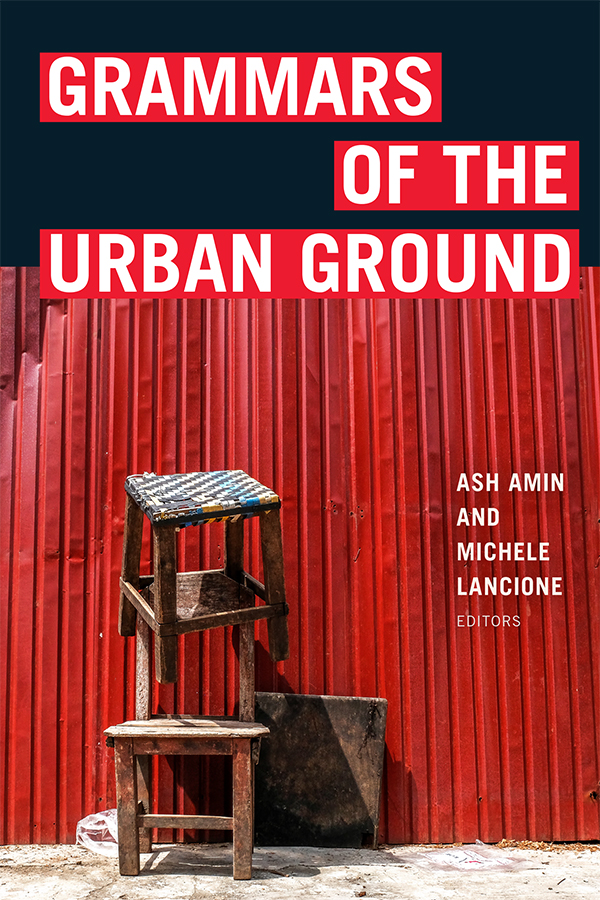
The contributors to Grammars of the Urban Grounddevelop a new conceptual framework and vocabulary for capturing the complex, ever-shifting, and interactive processes that shape contemporary cities. Building on Marxist, feminist, queer, and critical race theory as well as the ontological turn in urban studies, they propose a mode of analysis that resists the staple of siloed categories such as urban “economy,” “society,” and “politics.” In addition to addressing key concepts of urban studies such as dispossession and scale, the contributors examine the infrastructures of plutocratic life in London, reconfigure notions of gentrification as a process of racial banishment, and seek out alternative archives for knowledge about urban density. They also present case studies of city life in the margins and peripheries of São Paulo, Kinshasa, Nairobi, and Jakarta. In so doing, they offer a foundation for better understanding the connective and aggregative forces of city-making and the entanglements and relations that constitute cities and their everyday politics.
Contributors. Ash Amin, Teresa Caldeira, Filip De Boeck, Suzanne Hall, Caroline Knowles, Michele Lancione, Colin McFarlane, Natalie Oswin, Edgar Pieterse, Ananya Roy, AbdouMaliq Simone, Tatiana Thieme, Nigel Thrift, Mariana Valverde
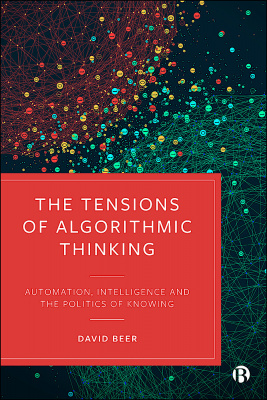
From machine learning and artificial intelligence to blockchain or simpler news-feed filtering, automated systems can transform the social world in ways that are just starting to be imagined.
Redefining these emergent technologies as the new systems of knowing, pioneering scholar David Beer examines the acute tensions they create and how they are changing what is known and what is knowable. Drawing on cases ranging from the art market and the smart home through to financial tech, AI patents and neural networks, he develops key concepts for understanding the framing, envisioning and implementation of algorithms.
This book will be of interest to anyone who is concerned with the rise of algorithmic thinking and the way it permeates society.
By highlighting the connections between domestic political struggles and overseas imperial structures, The Politics of Imperial Memory in France, 1850–1900 explains how and why French Republicans embraced colonial conquest as a central part of their political platform. Christina B. Carroll explores the meaning and value of empire in late-nineteenth-century France, arguing that ongoing disputes about the French state’s political organization intersected with racialized beliefs about European superiority over colonial others in French imperial thought. For much of this period, French writers and politicians did not always differentiate between continental and colonial empire. By employing a range of sources—from newspapers and pamphlets to textbooks and novels—Carroll demonstrates that the memory of older continental imperial models shaped French understandings of, and justifications for, their new colonial empire. She shows that the slow identification of the two types of empire emerged due to a politicized campaign led by colonial advocates who sought to defend overseas expansion against their opponents. This new model of colonial empire was shaped by a complicated set of influences, including political conflict, the legacy of both Napoleons, international competition, racial science, and French experiences in the colonies. The Politics of Imperial Memory in France, 1850–1900 skillfully weaves together knowledge from its wide-ranging source base to articulate how the meaning and history of empire became deeply intertwined with the meaning and history of the French nation.
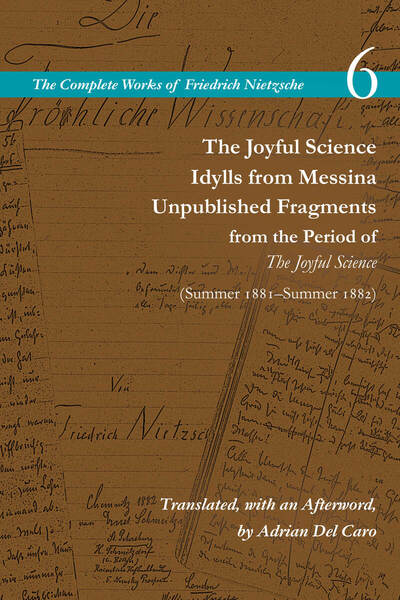
Written on the threshold of Thus Spoke Zarathustra during a high point of social, intellectual and psychic vibrancy, The Joyful Science (frequently translated as The Gay Science) is one of Nietzsche’s thematically tighter books. Here he debuts and practices the art of amor fati, love of fate, to explore what is “species preserving” in relation to happiness (Book One); inspiration and the role of art as they keep us mentally fit for inhabiting a world dominated by science (Book Two); the challenges of living authentically and overcoming after the death of God (Book Three); and the crescendo of life affirmation in which Nietzsche revealed the doctrine of eternal recurrence and previewed the figure of Zarathustra (Book Four). Invigorated and motivated by Thus Spoke Zarathustra and Beyond Good and Evil, Nietzsche in 1887 added a new preface, an appendix of poems, and Book Five, where he deepened the critique of science and displayed a more genealogical approach.
This volume provides the first English translation of the Idylls from Messina and, more importantly, it includes the first English translation of the notebooks of 1881–1882, in which Nietzsche first formulated the eternal recurrence. Structurally and stylistically, The Joyful Scienceremains Nietzsche’s most effective book of aphorisms, immediately after which he took on the voice and alter ego of Zarathustra in order to push beyond the boundaries of even the most liberating prose.
Characterized by shared, self-managed access to food, housing, and the basic conditions for a creative life, the commons are essential for communities to flourish and protect spaces of collective autonomy from capitalist encroachment. In a narrative spanning more than three centuries, Against the Commons provides a radical counterhistory of urban planning that explores how capitalism and spatial politics have evolved to address this challenge.
Highlighting episodes from preindustrial England, New York City and Chicago between the 1850s and the early 1900s, Weimar-era Berlin, and neoliberal Milan, Álvaro Sevilla-Buitrago shows how capitalist urbanization has eroded the egalitarian, convivial life-worlds around the commons. The book combines detailed archival research with provocative critical theory to illuminate past and ongoing struggles over land, shared resources, public space, neighborhoods, creativity, and spatial imaginaries.
Richard Lynch has updated his very valuable bibliography of Foucault’s shorter works in English translation. You can find the bibliography and associated material on this page on Foucault News
In his discussion of the socio-ecological crisis of capitalism, Jason Moore dismisses the theoretical tendency to describe ‘twin’ social and environmental crises, arguing that ‘these are in fact a singular process of transformation that today we call a crisis’ (2011: 136). In order to interrogate the singular socio-ecological crisis further, this conference proposes ‘territorial bodies’ as a critical framework for readings of contemporary world culture, synthesising interdisciplinary approaches to embodiment and violence studies. It considers how the ‘territorial body’ offers an analytical tool for addressing urgent social, ecological, and political challenges, from ecological breakdown to the rise of statelessness, to violence against women and racial exploitation. Key questions include:
How is the intersection between bodies and territories registered in world culture today?
How do cultural registrations work to locate the body as a distinct site of socio-ecological crisis?
What happens to our conception of a ‘culture in crisis’ when explored through the lens of ‘territorial bodies’?
The concept of ‘territorial bodies’ takes inspiration from the Latin American feminist transnational concept of ‘body-territory’, which has been used as a ‘strategic’ tool to engender new forms of global solidarity, linking multi-form violence at various scales (Gago, 2020: 95). More broadly, ‘body-territory’ becomes a lens through which to critique overlapping forms of violence in an era of socio-ecological crisis. The expanded notion of ‘territorial bodies’ offers a new methodology to explore and critique the registration of socio-ecological crisis in contemporary world culture.
Territorial Bodies: World Culture in Crisis will be a one-day interdisciplinary conference, bringing together scholars from across the humanities. We aim to rethink dominant notions of crisis, using the framework of “territorial bodies” to generate new modes of understanding crisis in neoliberal culture. Our hope is that the conference will lead to an edited collection via the Warwick Series in the Humanities, Routledge.
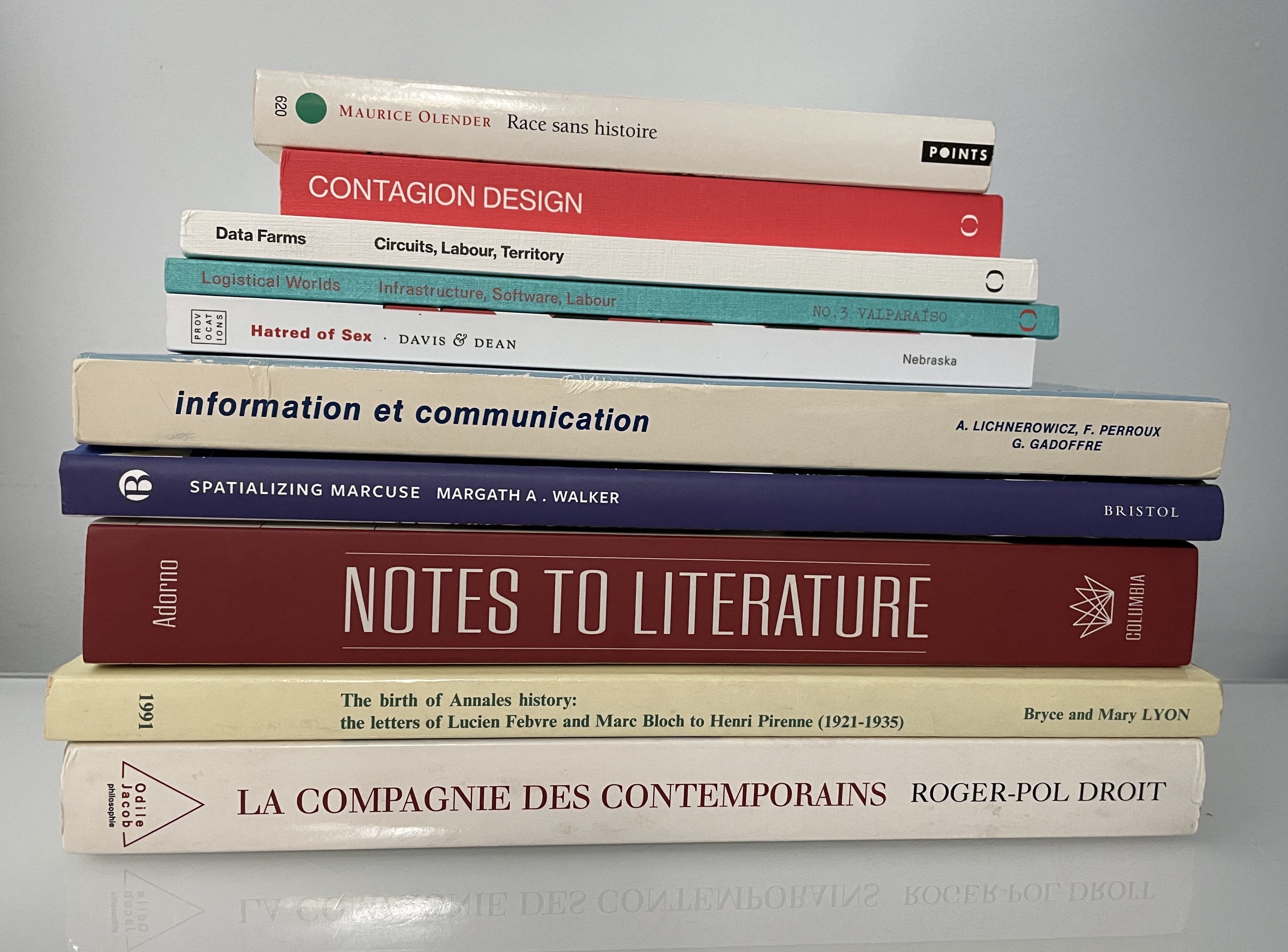
Oliver generously sent a copy of Hatred of Sex, and Brett Neilson the three books from Open Humanities Press. I endorsed Margath’s important study of Marcuse. The others were picked up second-hand.
This book critically challenges the usual territorial understanding of borders by examining the often messy internal, transborder, ambiguous, and in-between spaces that co-exist with traditional borders. By considering those less visible aspects of borders, the book develops an inclusive understanding of how contemporary borders are structured and how they influence human identity, mobility, and belonging.
The introduction and conclusion provide theoretical and contextual framing, while chapters explore topics of global labor and refugees, unrecognized states, ethnic networks, cyberspace, transboundary resource conflicts, and indigenous and religious spaces that rarely register on conventional maps or commonplace understandings of territory. In the end, the volume demonstrates that, despite being “invisible” on most maps, these borders have a very real, material, and tangible presence and consequences for those people who live within, alongside, and across them.