Abstract
A ‘way out’ expresses a movement which looks completely different depending on whether one views it prospectively or retrospectively: in the first instance, it signifies ‘to emerge from’, which suggests a relationship of continuity; in the second it signifies ‘to breach a threshold’, a distancing, that is to say, a rupture. Which of these two meanings should we ascribe to the expression ‘Foucault’s way out of Hegel’ – that of a connection, which emerges when we look behind us, or that of a disjunction, which appears when we look ahead? That of a line of descent, which obliges us to contend with a legacy, or that of rejection, thus a refusal to accept it? This is the very question that we want to confront.
Keywords
dialectic, Foucault, Hegel, subjectification, thought
Book presentation of “Disalienation. Politics, Philosophy, and Radical Psychiatry in Postwar France” by Camille Robcis. This event takes place on 13/06/2022 at the Centre d’histoire de Sciences Po in Paris (1 Place Saint-Thomas-d’Aquin, 75007 Paris). You can download the leaflet with more information about the event below.
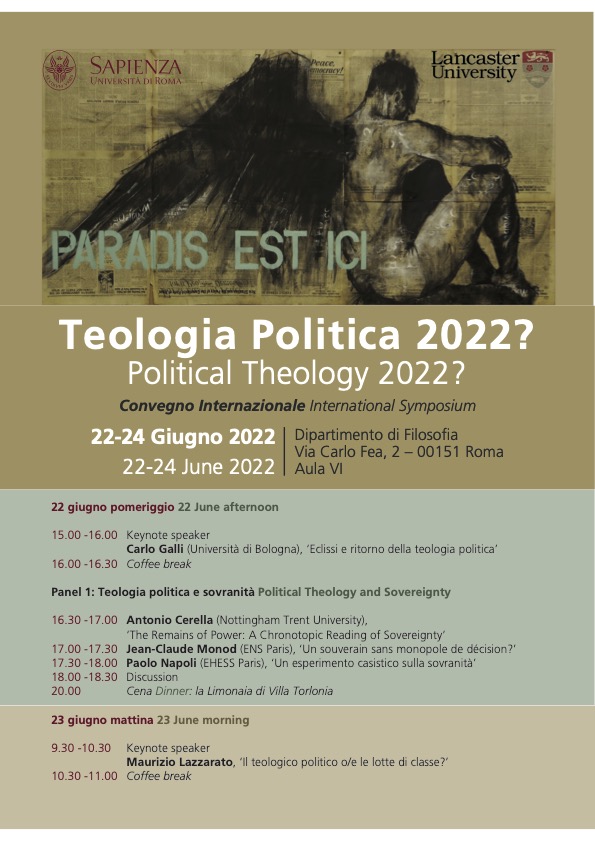
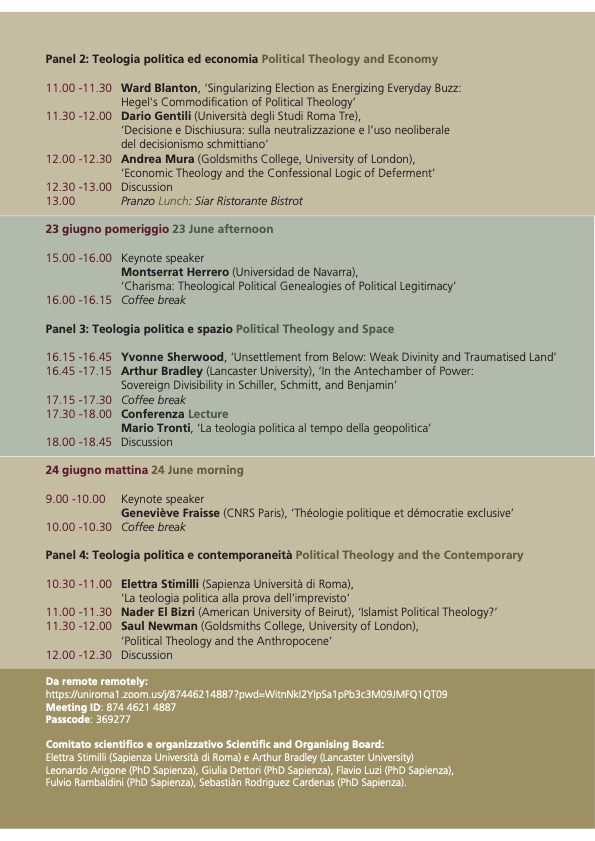
Teologia politica 2022? Political Theology 2022? – University of Rome La Sapienza, 22-24 June
Organised by Arthur Bradley and Elettra Stimilli, with speakers including Carlo Galli, Maurizio Lazzarato, Paolo Napoli and Mario Tronti. It will also be live-streamed. The pdf of the programme is available here
In the tumultuous early years of the Weimar Republic, Carl Schmitt published his Political Theology: Four Essays on Sovereignty (1922). This international symposium revisits the old question of “political theology,” exactly 100 years after Schmitt’s seminal text, in a new time of political crisis. To what extent is political theology still capable of speaking to the world of 1922?
To be sure, our political context uncannily resembles the period in which Schmitt wrote Political Theology – political crises of legitimacy, financial crashes, right-wing nationalisms, anti-liberal populisms and even a global pandemic. However, we are also facing a set of entirely new and singular political challenges that Schmitt could not have anticipated and which may lie beyond the reach of any “political theology.” In returning to the political theological archive, this symposium will seek to extend it to consider such critical contemporary issues as: Europe, Covid-19, climate change, immigration and refugee crises, neoliberal capitalism and globalization, big tech and data, religious fundamentalisms, new processes of racialization and gender issues.
In this symposium, we bring together world-leading figures in different disciplines (philosophy, theology and religious studies, politics and international relations, comparative literature) to re-pose the question of political theology in the present. What, if anything, does political theology still have to say to the world of 2022 and beyond? Is it worth trying to construct new political theologies of institutions, economy, climate change, immigration, racialization, and gender or do we need to imagine different approaches? Finally, what is left of political theology 100 years after Schmitt — or is it now time to write its obituary?
‘Shylock or Timon? The Immanent Critique of Karl Kraus and Shakespeare’s Theatre of Judgement’
Alison Findlay (Lancaster University):
‘Shakespeare and the Contagious Public Sphere of Performance’
16.00: Tea (Temple Pavilion)
16.30: Chair: Stuart Elden (University of Warwick)
John Joughin:‘Shakespeare’s Stranger-Subject: Bloch, Job, Lear and life without a why’
17.30: Round Table Discussion Chair: Jennifer Rust (Saint Louis University)
Tickets are £20 (includes admission and sandwich lunch at the Bell Inn) + Eventbrite admin fees. All proceeds go to support Garrick’s Temple.
Free tickets (with lunch) for students are available from the Shakespeare and Philosophy project. For those, please email info(at)shakespeareandphilosophy.net.
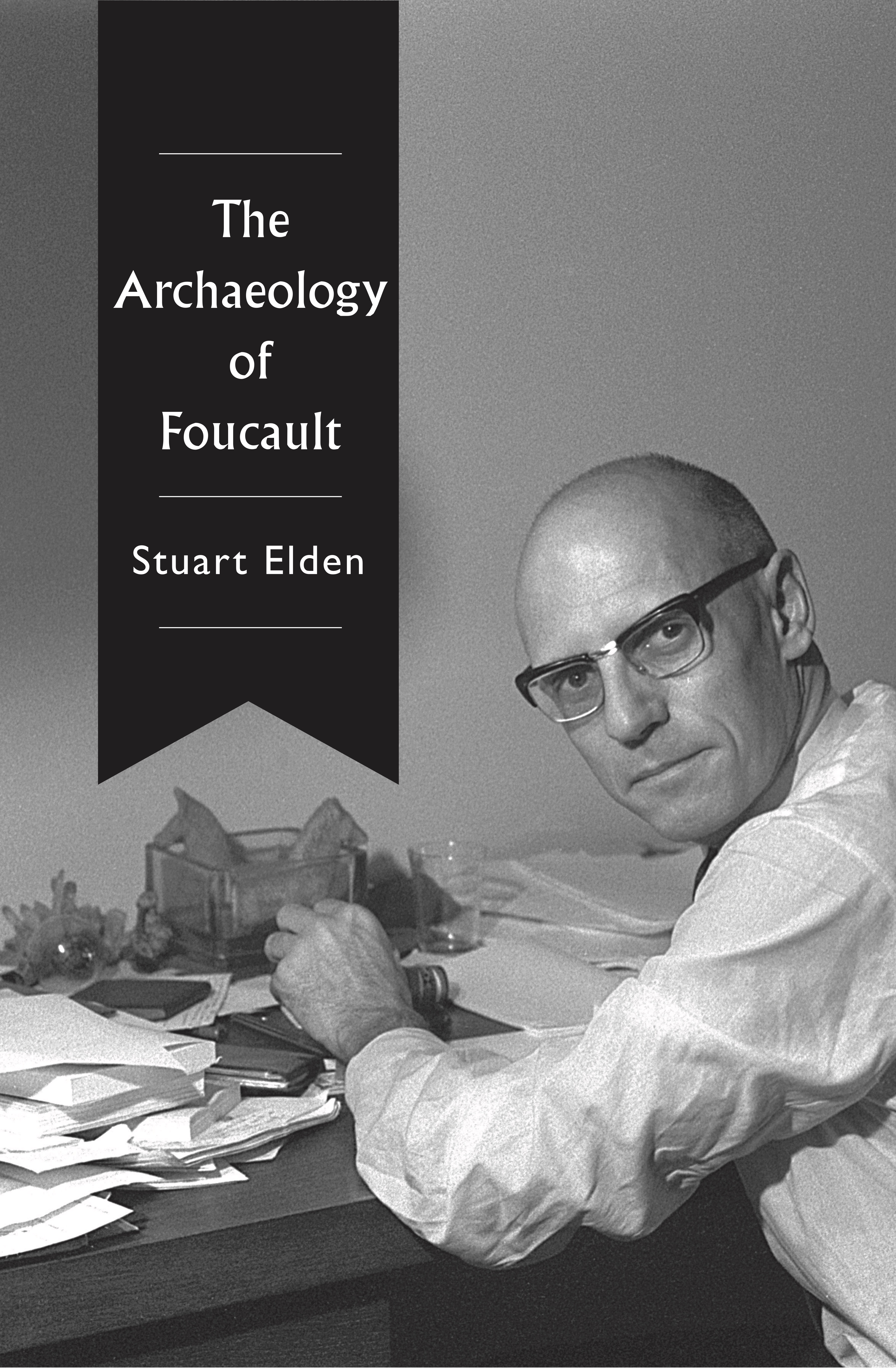
The final book in my series of studies of Foucault, The Archaeology of Foucault, is due for publication with Polity in December 2022.
On 20 May 1961 Foucault defended his two doctoral theses; on 2 December 1970 he gave his inaugural lecture at the Collège de France. Between these significant dates, he published four books, travelled widely and wrote extensively on literature, the visual arts, linguistics and philosophy. He taught both psychology and philosophy, beginning his explorations of the question of sexuality.
Weaving together analyses of published and unpublished material, much of which has only recently become available, this book is a comprehensive study of this crucial period of Foucault’s career. As well as his major texts, it discusses his initial visits to Brazil, Japan and the USA, his time in Tunisia, and his editorial work for Critique and the complete works of Nietzsche and Bataille.
It was in this period that Foucault developed the historical-philosophical approach he called ‘archaeology’. For Foucault ‘archaeology’ meant the elaboration of the archive, which he understood as the rules which make possible specific claims. In its detailed study of Foucault’s archive, this book is also an archaeology of Foucault in a more literal sense, as a digging down, an uncovering, both excavation and reconstruction.
This book completes a four-volume series of major intellectual histories of Michel Foucault, exploring newly released archival material and covering the French thinker’s entire academic career. Foucault’s Last Decade was published by Polity in 2016; Foucault: The Birth of Power followed in 2017; and The Early Foucault in 2021.
There is more about the research and writing process behind this book here.
Since I posted this last week I have made some progress – an update is at the end of the original post. Many thanks to those who contacted me about this – a few useful leads.
Update: There is an English translation of the Gopatha Brahmana in an unpublished 1969 Indian dissertation, so I’ve been able to check that reference. And the passage from the Kathaka Brahmana is transliterated and translated in Muir, Original Sanskrit Texts, so that helps resolve that issue.
I am looking for help with some of the more challenging references in my editorial work with Georges Dumézil’s Mitra-Varuna. I have checked hundreds of references, correcting some and completing many, but these are the ones I am still stuck with. Any help would be much appreciated.
Texts I cannot locate except in Sanskrit
Are there English, French, German (or any Western European) translations of
– Maitrayani Samhita (IV, 8, 1 and V, 2, 5)
– Taiitriya Brahmana (I, 7, 10, 1 and I, 1, 4, 7)
– Kathaka Brahmana (II, 30, 1)
– Gopatha Brahmana (II, 1, 2)
There are six references in total between these four texts. I am fairly sure there are no complete translations, though there are critical editions of the Sanskrit (often with German titles and apparatus). For example, Dumézil used Leopold von Schroeder (ed.),Maitrāyaṇī saṃhitā, Leipzig: F.A. Brockhaus, four volumes 1881-86…
[Update: some progress on all of these is reported at the end of this post.]
I am looking for help with some of the more challenging references in my editorial work with Georges Dumézil’s Mitra-Varuna. I have checked hundreds of references, correcting some and completing many, but these are the ones I am still stuck with. Any help would be much appreciated.
Texts I cannot locate except in Sanskrit
Are there English, French, German (or any Western European) translations of
– Maitrayani Samhita (IV, 8, 1 and V, 2, 5)
– Taiitriya Brahmana (I, 7, 10, 1 and I, 1, 4, 7)
– Kathaka Brahmana (II, 30, 1)
– Gopatha Brahmana (II, 1, 2)
There are six references in total between these four texts. I am fairly sure there are no complete translations, though there are critical editions of the Sanskrit (often with German titles and apparatus). For example, Dumézil used Leopold von Schroeder (ed.), Maitrāyaṇī saṃhitā, Leipzig: F.A. Brockhaus, four volumes 1881-86. Are there good (and clearly organised) places like readers which might include these specific passages?
Texts where the reference is wrong
There are some references which are clearly wrong, and in most cases I’ve been able to find the correct reference. There are others where his reference may be correct to the edition he used, but there is different arrangement in ones with wider circulation, so I’ve cited both his location and a more accessible one. But I’m stuck with one.
Dumézil references Rg Veda IV, 53, 6, concerning Savitr as a god who sends to sleep. I can’t see how this is correct, though he also references VII, 45, 1, which does seems right. My best guess is the first reference should be to IV, 53, 7, which mentions Savitr being favourable by night and day. Any ideas?
Secondary Sources
Dumézil mentions that someone called M.P. Arnold (this possibly means Monsieur P. Arnold), wrote a book called Mavors. In 1948 Dumézil says this was ‘just published’, but I am unable to find a reference anywhere. Mavors is Mars, the god of war, but searching for Arnold and Mars just leads to Schwarzenegger’s movie Total Recall… This may be Paul Arnold, who Dumézil knew, but he didn’t publish a book around this time which looks an obvious connection. Perhaps his 1947 book Le Dieu de Baudelaire? A Mlle Arnold attended a course Dumézil taught, so it’s possible the book was published under a married name, but I’m still drawing a blank.
Update 27 May:
Since I posted this last week, I’ve made some progress.
Both passages from Taiitriya Brahmana can be found in J. Muir, Original Sanskrit Texts – Vol V, 58 and Vol I, 186, with the latter having the reference I, 1, 4, 4. Dumézil references Muir in Mitra-Varuna and it may well be his source, rather than an edition of the text itself. Muir provides transliteration and English translations of selected passages.
There is also a German translation of Maitrayani Samhita, by Kyoko Amano published in 2009. Unfortunately this is only of the first two books, I did find a transliterated text, and since Dumézil quotes the passage from IV, 8, 1 I have checked the reference which is correct. However V, 2, 5 seems to be a mistake, since there are only four books in the ediitons I’ve found. But there is a discussion of the topic mentioned in II, 5, 7. The German translation indicates this is probably the passage he had in mind. It’s an odd reference error to have made,(V, 2, 5 to II [2], 5, 7) but this is the best I have so far.
I’ve been unable to check the Gopatha Brahmana directly, but this is the reference given by others, including Nicholas J. Allen, “Śiva and Indo-European Ideology: One Line of Thought”, International Journal of Hindu Studies 11 (2), 2007, 191-207. So I am reasonably sure it is correct, but would still like to verify it if possible, along with the Kathaka Brahmana reference.
Having checked a better edition of the Rg Veda, I now think Dumézil’s reference is correct
It appears the piece by Arnold might be an article, though Dumézil clearly says book [livre]. I have a reference but I’m still trying to find this – the British Library has the journal, but not the right issue.
Update 29 May:
There is an English translation of the Gopatha Brahmana, but it is in an unpublished 1969 Indian dissertation, which I hadn’t found before, but have now seen. So I’ve been able to check that reference. And the passage from the Kathaka Brahmana is transliterated and translated in Muir, Original Sanskrit Texts, so that helps resolve that issue. If I can find the Arnold article then I think I’m done…
Update 7 June:
I now have the Arnold article, which is a close thematic fit to the topic Dumézil indicates. Although it isn’t a book, otherwise it makes sense of the reference.
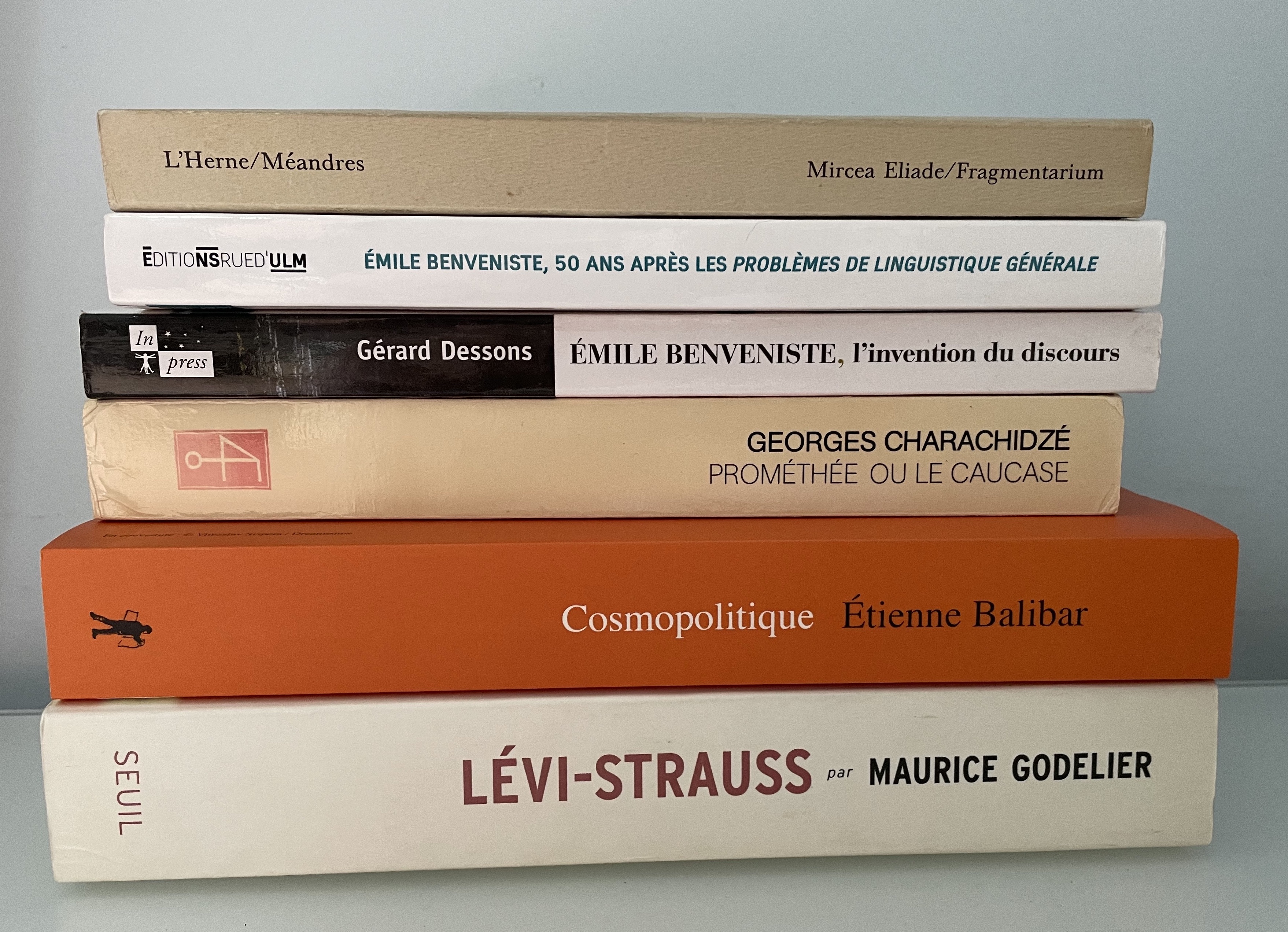
Mainly second-hand books for the Indo-European thought project, along with Étienne Balibar, Cosmopolitique, the third volume in his Écrits series, and Maurice Godelier’s study of Lévi-Strauss (available in English from Verso, translated by Nora Scott), both bought in Paris.
Georges Canguilhem was one of the most influential historians and philosophers of science of 20th-century France. Michel Foucault, Louis Althusser, Alain Badiou and other important thinkers of the stressed the importance of Canguilhem’s ideas and methods for the development of their own thinking as well as for shaping the intellectual field in which they positioned themselves. There is, however, much more to Canguilhem’s work than a series of delimited and specialised studies in epistemology and the history of science. The workshop will explore the wider philosophical implications of Canguilhem’s historical epistemology and reveal a more nuanced and complex picture of this author. Our aim will be to present Canguilhem as a ‘philosopher’, exploring a variety of topics, from his engagements with the history of philosophy to his ethical and political reflections, passing through his reflections…