Warwick Continental Philosophy Conference 2021/2022
Continental Philosophy and Global Challenges
Historical perspectives through practical engagements
09-11 June 2022
University of Warwick (UK) Conference Venue:
Department of Philosophy, University of Warwick
Coventry, United Kingdom
Keynote Speakers:
Prof. Bernard Harcourt (Columbia Law School)
Dr Elena Louisa Lange (University of Zurich)
TBA
Call for Abstracts
The aim of the fourth edition of the WCPC is to explore the ways in which continental philosophy has addressed and continues to address ‘global challenges’ – a term we use to indicate phenomena that can be described as problems affecting the entire globe and concerning the whole of humanity as well as non-human agents. More specifically, we aim to interrogate the kind of temporality that underlies the notion of global challenges both in philosophical reflection and in ensuing political practices.
In speaking of the temporality of such a concept, we are specifically thinking about the drive to…
Séminaire organisé dans le cadre des activités pédagogiques et de recherche du Département de Philosophie de l’Université de Paris 8, du LLCP (EA, 4008), du GRAF (Groupe de Recherche sur les Archives Foucaldiennes), du Collège international de Philosophie, et du séminaire permanent « Foucault à Paris 8 ». Activité soutenue par le Centre Michel Foucault et la revue materiali foucaultiani.
La généalogie comprise comme méthode surgit tardivement dans le corpus nietzschéen, dans La Généalogie de la morale en 1887, et ne procède pas directement de l’élaboration du concept d’inactualité, ni de celui d’histoire, tels du moins qu’ils sont déployés dans la deuxième Considération inactuelle (1874). L’histoire de l’élaboration des…
This is an open access title available under the terms of a CC BY-NC-ND 4.0 International licence. It is free to read at Oxford Scholarship Online and offered as a free PDF download from OUP and selected open access locations.
Are algorithms ruling the world today? Is artificial intelligence making life-and-death decisions? Are social media companies able to manipulate elections? As we are confronted with public and academic anxieties about unprecedented changes, this book offers a different analytical prism through which these transformations can be explored. Claudia Aradau and Tobias Blanke develop conceptual and methodological tools to understand how algorithmic operations shape the government of self and other. They explore the emergence of algorithmic reason through rationalities, materializations, and interventions, and trace how algorithmic rationalities of decomposition, recomposition, and partitioning are materialized in the construction of dangerous others, the power of platforms, and the production of economic value. The book provides a global trandisciplinary perspective on algorithmic operations, drawing on qualitative and digital methods to investigate controversies ranging from mass surveillance and the Cambridge Analytica scandal in the UK to predictive policing in the US, and from the use of facial recognition in China and drone targeting in Pakistan to the regulation of hate speech in Germany
The original (1985) edition of this work attempted to cover the main lines of development of phonological theory from the end of the 19th century through the early 1980s. Much work of importance, both theoretical and historiographic, has appeared in subsequent years, and the present edition tries to bring the story up to the end of the 20th century, as the title promised. This has involved an overall editing of the text, in the process correcting some errors of fact and interpretation, as well as the addition of new material and many new references.
Review: Confessions of the Flesh (The History of Sexuality 4)
Michel Foucault, edited by Frederic Gros and translated by Robert Hurley
Vintage, $17 (paper)
When Foucault died from complications of AIDS, he left the series entitled History of Sexuality at least one volume shy of completion. For decades since, ardent readers of Foucault have fantasized that they would receive an “answer” from the sky once they could read the unpublished book, Confessions of the Flesh. Sometimes, I joined them. Now it has been published, in both French and English, and they—we—have in our hands as much as Foucault wrote of what might have been. Is this stitched-together volume an “answer” from the sky? Was shouting Foucault’s name a question?
The book has traveled a winding road to publication. In 1976, on the back…
Edward (E.P.) Thompson and Dorothy Thompson resources page on the Verso site
Edward and Dorothy Thompson were historians and activists. They met in 1945, and worked together on the international youth brigade which helped to build the railway in Tito’s Yugoslavia. Soon afterwards they married and settled in Halifax, West Yorkshire, where they both taught in extramural adult education. They made a dynamic and idealistic team, determined to use their considerable energy to create a better world. A succession of houses in Yorkshire and the English midlands were constantly filled with interesting people and lively discussion. Alongside their work as historians, writers and teachers, Edward and Dorothy worked tirelessly for the peace movement, being early supporters of the Campaign for Nuclear Disarmament and founder members of the later European Nuclear Disarmament, which encouraged dialogue across the iron curtain. Both of them published seminal works in their fields, and each was the other’s first editor and critic.
Includes bibliographies and other resources, including some audio and video
Update June 2025: a revised and expanded version of this post is here.
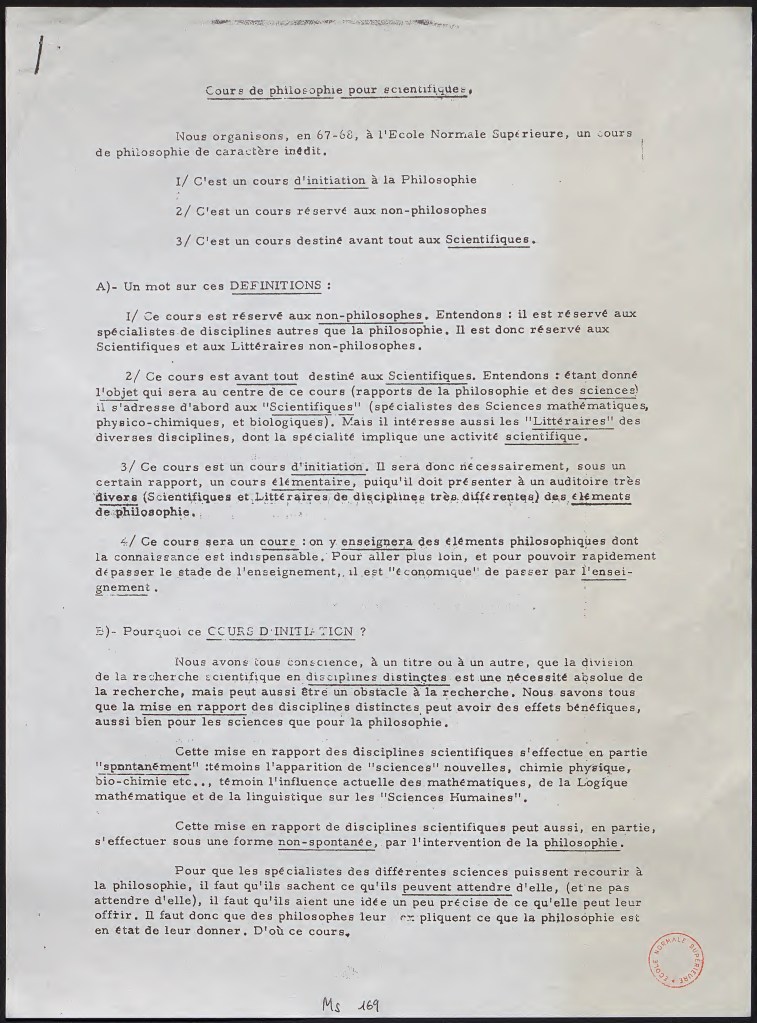
Between 1967 and 1968 Louis Althusser and some of his students delivered a course at the ENS pitched as philosophy for scientists or non-philosophers.
Some parts of the course have been published, including Alain Badiou’s Le concept du modèle in 1969 and Michel Fichant and Michel Pécheux, Sur L’histoire des sciences shortly afterwards. Badiou’s text was reissued by Fayard in 2007 and translated as The Concept of Modelby re:press that same year.
These early volumes indicate others to follow, including an Introduction by Althusser, Expérience et Expérimentation by Pierre Macherey and Etienne Balibar, and a Conclusion provisoire.
The series as listed in the Badiou and Fichant/Pécheux volumes
Between Badiou’s book and the Fichant/Pécheux one the structure of the series changed, with François Regnault withdrawing his contribution, and the third and fifth volumes being merged. Of the second plan, only Althusser’s Introduction was published, as Philosophie et philosophie spontanée des savants (1967), but only in 1974; translated in Philosophy and the Spontaneous Philosophy of the Scientists. The French text is, I think, out of print, but available on Gallica.
Pierre Macherey is very good on the history of the course and the series, in a piece translated in Parrhesia in 2009. He indicates that a fifth lecture which Althusser planned for the concluding volume was published posthumously in Althusser’s Écrits philosophiques et politiques, under the title ‘Du coté de la philosophie’.
In that piece, Macherey mentions that the original roneotypes of the course materials were available at the ENS archives, donated by Balibar. But at some point they have also been made available online to read or download at archive.org
Louis Althusser. Cours de philosophie pour scientifiques organisés à l’Ecole normale supérieure
Papier. Documents ronéotypés. 175 f. 325 x 240 mm.
Cours organisés par Louis Althusser : 5 cours de Louis Althusser, 3 cours de Pierre Macherey, 3 cours d’ Etienne Balibar, et 1 cours de François Regnault.
The first page is below.
I found this out because I’m interested in some earlier Althusser seminars, particularly the 1962-63 one where he spoke about Foucault (Balibar’s notes from that are at IMEC). The 1964-65 seminar led to the famous Reading Capital volume. Some of the Althusser texts mentioned above, and the Badiou one, are reasonably well known. The Fichant and Pëcheux volume is interesting for some of the debates about epistemology and science which Foucault and Canguilhem were involved with. But the availability of the archive material was news to me, which is what prompted this post.
I’ll be speaking about my ongoing Foucault work, and particularly the book on the 1960s, in an online seminar for the University of Cambridge on 31 January 2022 at 5-6.30pm. The public registration link for the seminar is here.
Genèse et structure de la Phénoménologie de l’esprit de Hegel, la thèse principale de Jean Hyppolite, publiée pour la première fois en 1946, constitue une véritable opération de transfert culturel qui a permis à des générations d’étudiants et de chercheurs d’approcher l’œuvre de Hegel.
A welcome reedition of Hyppolite’s classic text, long out of print.