The June 2022 edition of Transversal: International Journal for the Historiography of Science will present a special issue dedicated to the work of Michel Foucault. The aim is to bring together analyses and reflections on the history of the relationship between Michel Foucault’s work and the historiography of the sciences.
Several axes may guide contributors to this special issue. The first axis concerns the classical relationship between Michel Foucault’s work and the French historical epistemology or philosophical history of the sciences (Gaston Bachelard, Alexandre Koyré, Jean Cavaillès, and Georges Canguilhem). From a methodological point of view, numerous commentators have already highlighted the significance of this tradition in the French philosopher’s books written in the 1960s. Foucault’s first important works on psychiatry, medicine, and the human sciences prolong but, at the same time, produce a series of significant displacements concerning…
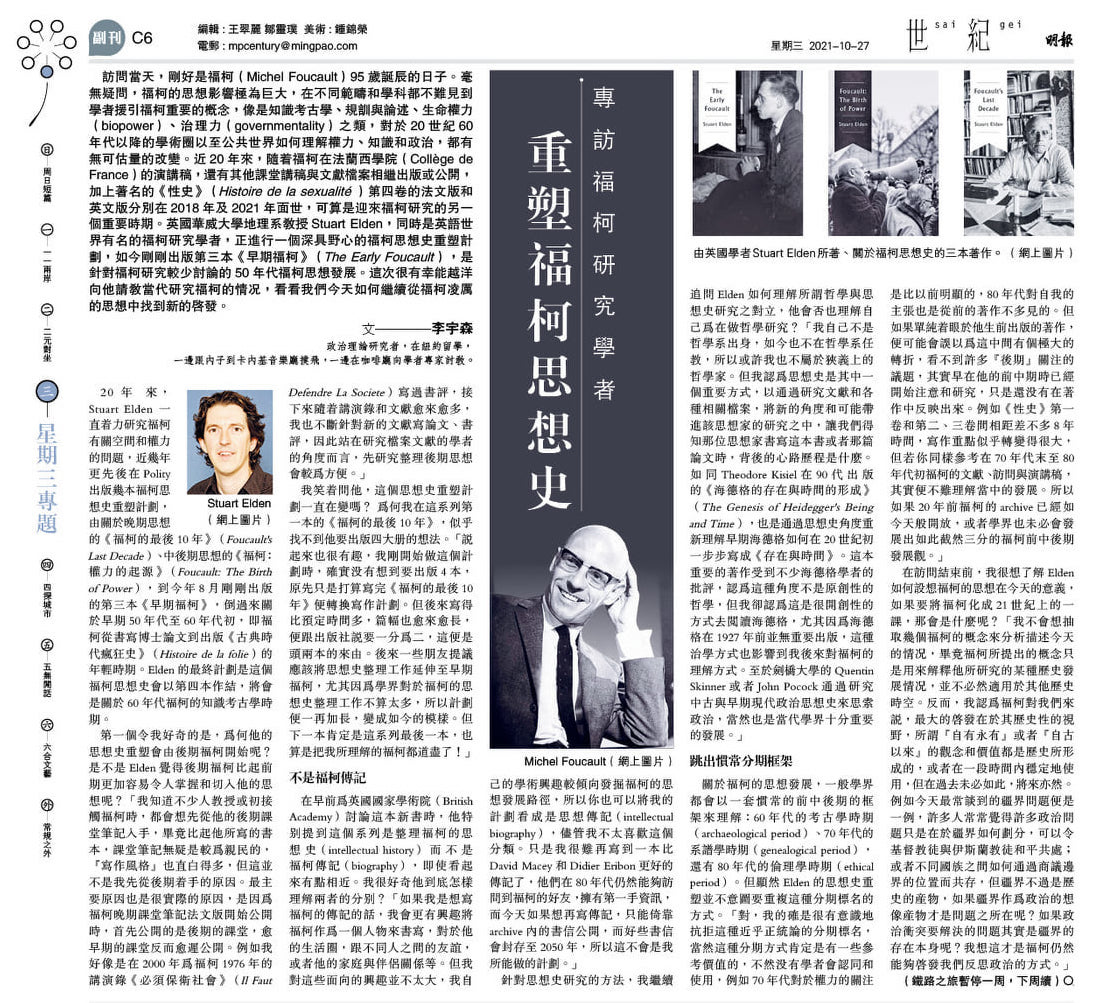
I recently did an interview with Samuel Lee about my work on Foucault. This has been published in Chinese in Ming Pao Daily, with an English version here.
There is also an edited audio recording of part of our conversation on the Politeia podcast. Many thanks to Samuel for the invitation and the questions, and for the work of translation.
Henri Lefebvre, On the Rural: Economy, Sociology, Geography – edited by Stuart Elden and Adam David Morton, translated by Robert Bononno and others, University of Minnesota Press, March 2022
Now listed on the University of Minnesota Press site, with description and cover.
On the Rural is the first English collection to translate Lefebvre’s crucial but lesser-known writings on rural sociology and political economy, presenting a wide-ranging approach to understanding the historical and rural sociology of precapitalist social forms, their endurance today, and conditions of dispossession and uneven development.
In On the Rural, Stuart Elden and Adam David Morton present Lefebvre’s key works on rural questions, including the first half of his book Du rural à l’urbain and supplementary texts, two of which are largely unknown conference presentations published outside France. On the Rural offers methodological orientations for addressing questions of economy, sociology, and geography by deploying insights from spatial political economy to decipher the rural as a terrain and stake of capitalist transformation. By doing so, it reveals the production of the rural as a key site of capitalist development and as a space of struggle.
This volume delivers a careful translation—supplemented with extensive notes and a substantive introduction—to cement Lefebvre’s central contribution to the political economy of rural sociology and geography.
While the start of term was as busy as ever, I have managed to keep a bit of time each week to work on this project. So far at least this term seems more manageable than the equivalent last year, and teaching is mainly in-person, with only one seminar on Teams for those students unable to come to campus for medical or travel reasons.
With the writing, some of the initial work was picking up on a few things left over from Paris, where I’d made notes to check things when back home. Although these were generally small things, ticking each of them off helped with a sense of making little, incremental progress.
One task was stitching the different sections of the chapter on The Order of Things together. While I usually work on chapter drafts as a whole, with this one I felt fairly happy with some sections, and so had a working for the bit on the Brazil course that I could work on while in Paris. It was similar with the Nietzsche chapter, where most of it was in good shape except for the bit on the Vincennes course. These chapters are now reintegrated and largely complete drafts.
With the Vincennes course I had to do quite a bit of reconstructive work. The materials are fragmentary, and not necessarily sequential. Only some pages are numbered, and while there is a flow to some arrangements of notes, others are more disorganised. And even the consecutively numbered sections seem unlikely to have been delivered in the order they appear. Fortunately, a student posted their notes online (now unavailable), and while I follow general practice in not relying on those notes for content, they do help with a likely sequence. My discussion uses these notes to establish a framework, within which the details come from the extant manuscripts. There are enough passages where the student notes accord with Foucault’s that I think this is a valid way to proceed. There are a lot of references to Nietzsche’s works in Foucault’s notes, and so I spent a bit of time looking at these in the translations Foucault used in the classroom, as well as the German and English for my own quotations. Interestingly, Foucault often used older translations, which were available to his students in cheaper pocket editions, rather than, for example, the Pierre Klossowski one of Le Gai savoir which he had co-edited a couple of years before. But he also indicated issues with these translations. It helps that some time back I was able to see Foucault’s reading notes on Nietzsche from the 1950s which helped indicate which editions he used – principally the Großoktavausgabe and the Henri Albert translations, as well as some of the others then available. Elsewhere in this chapter I have a discussion of Foucault’s involvement in the French translation of the Colli and Montinari edition, then just beginning in German and Italian.
I discuss the early 1970s American Nietzsche lectures – Montréal, Buffalo and Rio – in Foucault: The Birth of Power, but I return to these briefly here as I think there are some interesting textual issues, particularly relating to how Foucault reused material from Paris when lecturing elsewhere, and how this sits in relation to the currently published versions of this material. In relation to this I’ve written a longer research note on “What is an Author?” which can be read here. In brief, I don’t think one of the two texts in English, and the one with the widest circulation, is what it says it is. This is the Buffalo version of the lecture in Textual Strategies, which has been reprinted in The Foucault Reader and Essential Works, without the important qualifications in the editorial material of the original. That English text is the sole published source, because despite the lecture being given in French, the French version in Dits et écrits is a back-translation. Instead of it being the Buffalo lecture, it’s actually a different translation of the Paris lecture, cut and part-supplemented. On the basis of what is currently published we don’t really know what Foucault said in Buffalo.
I have a short draft section on Foucault’s work with the Fouchet commission on education reform, but I’m not sure I can add much to Eribon’s foundational account, which used the commission’s archives. Macey’s biography here is largely drawing on Eribon, and so I feel what I might say is very familiar. There are a couple of interviews where Foucault talks about education around this time, but they are both in English and so fairly well-known. Étienne Burin des Roziers – who had been Foucault’s boss in Poland – briefly recalls this in his tribute to Foucault, as he was now working for the government. (In the process of looking at this tribute, I realised to my horror that I misspelt his name in The Early Foucault…)
I am back in Paris for a few days in early November, over reading week, hoping to complete some more of the archival work. For that to be worthwhile I had to do quite a bit of work with the chapter on The Archaeology of Knowledge, which also discusses Foucault’s time in Tunisia. Since time in Paris is so precious, especially at the moment, I want to do work there which I can only do there.
With Tunisia, there are a lot of reports of what he taught there, which are not entirely consistent. I ended up making a table of all the bits of evidence I could find – biographies, newspaper announcements, reports by friends and students, the archival traces – and using this to work out what he probably taught, and to some extent when. Some reports which appear to be of different things are possibly the same course; one reference to a course is probably to a document which looks like an abandoned draft of a book. I am now fairly content with the narrative I have, though still need to add a lot of detail. The best records of his teaching are parts of the university course on Descartes, along with student notes and an outline, and the public course on ‘The place of man in modern Western thought’.
I’m now looking forward to examining, again, the draft material leading up to The Archaeology of Knowledge. That’s the main task for the days in Paris. If time allows, I will try to look at the archival material relating to the 1960s sexuality courses.
Previous updates on this book are here. The Early Foucault was published by Polity in June 2021, and updates for its writing are here. A list of the resources on this site relating to Foucault – bibliographies, audio and video files, some textual comparisons, some short translations, etc. – can be found here. The earlier books in this series are Foucault: The Birth of Power and Foucault’s Last Decade, both available from Polity.
An interesting looking collection of essays, which also reprints one of my early pieces on territory, with a brief new afterword. A shame about the price, of course…
This collection seeks to illustrate the state of the art in territoriological research, both empirical and theoretical. The volume gathers together a series of original, previously unpublished essays exploring the newly emerging territorial formations in culture, politics and society.
While the globalisation debate of the 1990s largely pivoted around a ‘general deterritorialisation’ hypothesis, since the 2000s it has become apparent that, rather than effacing territories, global connections are added to them, and represent a further factor in the increase of territorial complexity. Key questions follow, such as: How can we further the knowledge around territorial complexities and the ways in which different processes of territorialisation co-exist and interact, integrating scientific advances from a plurality of disciplines? Where and what forms does territorial complexity assume, and how do complex territories operate in specific instances to be studied in-depth? Which technological, political and cultural facets of territories should be tackled to make sense of the life of territories? How and by what different or combined methods can we describe territories, and do justice to their articulations and meanings? How can the territoriological vocabulary relate to contemporary social theory advancements such as ANT, the ontological turn, the mobilities paradigm, sensory urbanism, and atmospheres research? How can territorial phenomena be studied across disciplinary boundaries? Territories, Environments, Politics casts a fresh perspective onto a number of key contemporary socio-spatial phenomena. Refraining from the attempt to ossify territoriology into some disciplinary straightjacket, the collection aims to illustrate the scope of current territoriological research, its domain, its promises, its theoretical advancements, and its methodological reflection in the making.
Scholars interested in social research will find in this collection a rich and imaginative theoretical-methodological toolkit. Students in human geography, anthropology and sociology, socio-legal studies, architecture and urban planning will find Territories, Environments, Politics of interest.
The next volume of the courses and manuscripts before the Collège de France is a really interesting one. I discuss this in The Early Foucault, but it will be interesting to see how the manuscript has been edited and contextualised. Philippe Sabot’s forthcoming paper in the Theory, Culture and Society special issue also discusses this manuscript.
En octobre 1954, Michel Foucault, alors assistant en psychologie à Lille, écrit à son ami Jean-Paul Aron au sujet d’un texte qu’il est en train de rédiger : « La thèse est passée en deux mois du néant à la 150e page. Je suis moi-même fort surpris de ce livre-champignon : non seulement de sa croissance, qui exige bien des retouches, mais aussi de sa tournure ; il a pris tout de suite l’allure d’une interrogation sur la notion de monde dans la phénoménologie, qui m’a mené à toute une interprétation de Husserl, qu’on dira certainement heideggérienne, mais qui ne l’est pas, je crois. Je me demande en tout cas comment j’ai pu jouer au psychologue pendant plusieurs années. » Le manuscrit édité dans ce volume correspond sans doute à ce projet de thèse que Foucault n’a plus évoqué par la suite. De ce silence, comme de quelques remarques ultérieures, on a pu déduire que Foucault avait une vision surtout négative de la phénoménologie. Phénoménologie et Psychologie montre pourtant qu’il avait le plus grand respect pour la pensée de Husserl, dont on constatera que le jeune philosophe avait une maîtrise remarquable. Pour lui, la phénoménologie husserlienne permet à la philosophie de se dégager des impasses de la psychologie. Ressaisie dans sa radicalité transcendantale, la phénoménologie ne se concentre plus en effet sur le sujet ou la conscience, mais elle dévoile sa portée proprement ontologique en s’orientant résolument vers le monde. À travers son interprétation de Husserl, Foucault définit donc pour la première fois son propre projet philosophique, liant expérience, sujet, vérité et langage.
The first book to show that racial exclusion was behind all of the United States’ immigration laws–from Chinese Exclusion through the Trump presidency.
While many Americans believe there have always been rules about who could enter the country, the reality is that the first national immigration law was not passed until 1875, ninety-nine years after the Declaration of Independence. As the first non-white Chinese immigrants arrived, Congress passed laws to ban them. In each era that followed, the fear of “the great replacement” of whites with non-white immigrations drove the push for more restrictions. Although the US is often mythologized as a nation of immigrants, the mainstreaming of anti-immigrant politics by Trump in 2016 was a reversion to the ugly norm of the past.
Journal editors struggle to find reviewers; authors face unreasonable delays with their papers being reviewed. Reviewers receive a lot of requests. Peer review is particularly challenged in the present moment. But it has been creaking for a long time. Without thinking I have a solution that will fix it, a few minor ideas, based on my experience as author, reviewer, board member, and editor, both with established publishers and with a start-up independent journal. The key point here is that there is not a simple solution; and that the responses need to be from all parts of the process.
Authors – only submit papers which are ready, try to get comments from supervisors/mentors/colleagues first. Too many submitted papers are a draft or two away from being ready for review. Do some basic research on the journal you’re submitting to – too many papers are sent to an inappropriate journal. Remember, each paper you submit carries an implicit requirement to review in your turn.
Colleagues – be willing to read papers for people, especially early career, to help them shape a piece, decide an appropriate journal, etc. Certainly be willing to sit down with the author, a paper and its reviews and help guide the resubmission process. This can be done informally, or through research group/cluster or department-level inititives – manuscript development support, workshops, etc.
Editors – make decisions yourself or as part of an editorial team. Not all papers need to go for review. Don’t use reviewers unless you think this paper has a good chance of appearing in the journal. Don’t waste the reviewer resource. Try to pick reviewers with a bit more thought than ‘this is a paper on X; Y has worked on X; let’s ask Y’. Try to find earlier career researchers rather than just the usual suspects. Use your board for the really tricky papers, not as a default option. When a revised paper comes back, do you need reviewers again, and do you need reviewers again now? If the author clearly hasn’t addressed the reports sufficiently, or provided a list of changes made, send it back to them first, rather than straight to reviewers.
Be willing to work with reviewers, especially early career reviewers, to say – this was a great review; or please don’t copyedit a paper; or you have clearly spent far too much time on this; or this is inappropriate reviewer behaviour; etc. If a reviewer says ‘no’ then move on, don’t argue with them. You have no idea what else they are doing, life situation, etc. If they offer alternative suggestions be grateful, but don’t expect this as a default – thinking of suitable names takes time, which if they had they might well have done the review. Asking your board members for advice on suitable reviewers on a paper might be a more appropriate use of their role than always asking them to review.
Reviewers – either accept or decline within a few days; don’t sit on requests. Do your fair share, but don’t feel you have to do everything asked (a rough guide is here). A clear no is better than a yes that never appears. Suggest alternatives if you can. If you accept to do a review, block out some time in your diary in the next month or so to do the review. You should know roughly how long the average paper takes you to review. If you can’t find that time in your diary, then you can’t take on the review. If you’re struggling to meet the deadline, talk to the editor/journal manager. Most editors will be grateful for a review that you say will be delivered by a specific date, even if that is a bit longer than normal. And much rather that than a yes that turns into a no.
Publishers – make it clear that you will invest resource in thorough copyediting and if necessary language assistance, and then make it clear to reviewers they should review on the basis of the ideas and argument, not the language used or (to an extent) presentation. Allow authors to submit in any recognised/consistent reference style, and make it clear that they should follow your journal’s style only after conditional acceptance. Make your review websites easy to navigate and use. Provide adequate support to your editors to allow them to do their job, and especially the part of their job only academic editors can do.
I’m sure I’ve missed things, and equally sure not all of these would suit every journal all the time. But it’s a collective problem that needs each part of the process to do something. Maybe our institutions should do something too to recognise this work. And of course, not all requests to review come from journals, but that’s a wider point. I should say I remain unconvinced by the ‘pay reviewers’ argument, unless we also want to pay to submit, and/or for reviews to be done even more transactionally than they are now. It would also be a real problem for journals published by small presses, or independent ones, even if we think the big publishers are making unreasonable profits.
Update: to clarify, by ‘early/earlier career researchers’ I mean people with PhDs, i.e. post-docs, beginning lecturers/assistant professors. I don’t mean PhD researchers.