Richard Bourke & Quentin Skinner (eds.), History in the Humanities and Social Sciences – Cambridge University Press, December 2022

Richard Bourke & Quentin Skinner (eds.), History in the Humanities and Social Sciences – Cambridge University Press, December 2022

This interdisciplinary volume explores the relationship between history and a range of disciplines in the humanities and social sciences: economics, political science, political theory, international relations, sociology, philosophy, law, literature and anthropology. The relevance of historical approaches within these disciplines has shifted over the centuries. Many of them, like law and economics, originally depended on self-consciously historical procedures. These included the marshalling of evidence from past experience, philological techniques and source criticism. Between the late nineteenth and the middle of the twentieth century, the influence of new methods of research, many indebted to models favoured by the natural sciences, such as statistical, analytical or empirical approaches, secured an expanding intellectual authority while the hegemony of historical methods declined in relative terms. In the aftermath of this change, the essays collected in History in the Humanities and Social Sciences reflect from a variety of angles on the relevance of historical concerns to representative disciplines as they are configured today.

Posted in Quentin Skinnner | Leave a comment

Antipode tribute to Gordon MacLeod with open access papers

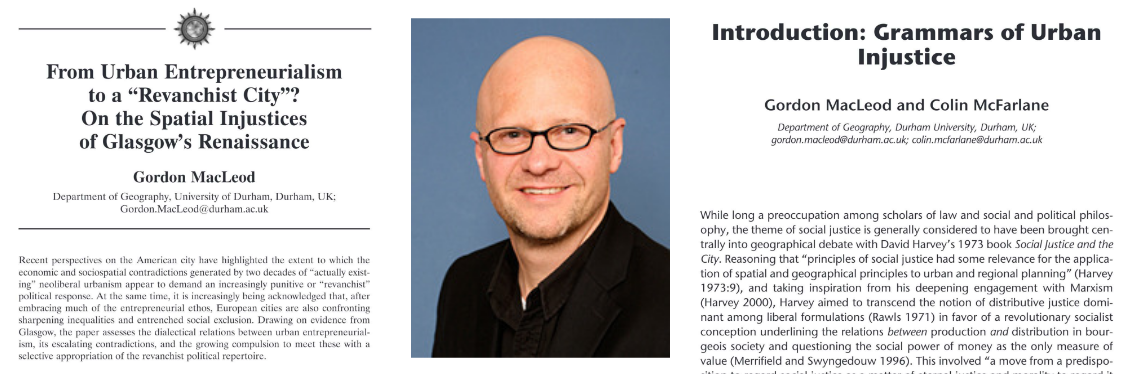
The Editorial Collective and the broader Antipode community have been deeply saddened to learn of the untimely death of Gordon MacLeod. Gordon was a singular voice in critical geography who was a good friend to Antipode and responsible for publishing a number of key articles in the journal. In tribute we have made his contributions to the journal free to view. They demonstrate both key aspects of his contribution to the discipline and his broader political engagement and energy.

As his Antipode contributions demonstrate, his work was animated by an incisive theoretical rigour which was put to work to make sense of particular situations and contexts. The passion with which he did this comes through strongly in his classic analysis of the inequalities of Glasgow’s urban renewal, an article which unfortunately remains all too prescient twenty years on. A deep commitment to questions of social justice informed his works, as the “Grammars of Urban Injustice” Symposium that he co-edited with his friend and colleague Colin McFarlane makes clear. His conviction that working towards social justice involved challenging entrenched spatial inequalities has left us an important body of work with which to continue that struggle.

David Featherstone, Glasgow, 22 November 2022

The open access papers are listed here.

Posted in Uncategorized | Leave a comment

Henri Lefebvre, On the Rural – 40% off outside the Americas

Henri Lefebvre, On the Rural is currently available at 40% off outside the Americas from Combined Academic Publishers.

You need to sign up to their newsletter to access the sale.

Posted in Henri Lefebvre | Leave a comment

Two new reviews of Henri Lefebvre, On the Rural (University of Minnesota Press, 2022)

Two new reviews of Henri Lefebvre, On the Rural: Economy, Sociology, Geography (University of Minnesota Press, 2022)

Caleb Gallemore in New Political Science

Joseph Pierce in Economic Geography

Both require subscription, unfortunately.

Here’s the start of Pierce’s review:

Stuart Elden and Adam David Morton, as editors of On the Rural, have assembled a strange, slightly lumpy set of conference presentations, chapters, scholarly essays, and even a review essay of another text into a volume that illustrates a key arc in the intellectual life of Henri Lefebvre: his slow journey from a focus on agrarian and peasant concerns to a focus on the urban. In the end, I think the book reveals more to today’s urban scholars than to its ruralists. Yet, precisely where the text fits in the canon surrounding Lefebvre’s writing is hard to definitively articulate because of how his work 1 has been extended by Anglophone scholars since the 1990s. This is a worthwhile book, but I think it will leave some audiences cold and others uneasy about the implications it has for the past thirty years of scholarship building on Lefebvre in translation.

Elden and Morton’s lengthy introduction serves as an excellent interpretive orientation to the text—which is good, because this amalgamation absolutely requires one. The introduction is eloquent, readable, and usefully knits the various texts together, pro- viding essential historic and scholarly context for the chapters that follow. At a high level, the book is organized largely chronologically from the late 1940s to the early 1960s, with two exceptions: the introduction to From the Rural to the Urban, which sits at the beginning of this volume but was initially published in French in 1969; and The Marxist-Leninist Theory of Ground Rent, positioned in the middle of the volume but first published in French [actually Spanish, SE] in 1964. I will return to the latter of these in a moment.

And the end of Gallemore’s review:

In closing, a few words of caution are in order. First, Lefebvre can be a very frustrating writer, even with the help of a carefully curated translation and a very clear introductory essay from the volume’s editors. I suspect that for most readers (certainly including myself), multiple readings will be necessary for the ideas in these essays to be of use or inspiration. On the other hand, it is certainly a testimony to the depth of these materials that they reward multiple readings. Second, as the editors note in their introduction, Lefebvre’s analysis of gender is almost nonexistent and, where present, relatively superficial. The same is generally true for issues of race. In short, for those wishing to go beyond a fairly strict class analysis of agricultural transitions to capitalism, it will be absolutely necessary to put Lefebvre in dialogue with other authors. Third, while the empirical detail present in some of these essays is quite impressive and sheds light on Lefebvre as a sociologist and historian, it may be a bit irrelevant to those not already interested in European agricultural history. Still, as existence proofs of some of Lefebvre’s claims, even these sections can be interesting. This is particularly the case for the final essay in the volume, which provides a detailed history of the complex institutional struggles over land control in the area sur- rounding a village in the Pyrenees, illustrating the complex ways past institutional choices impinge on current practices.

In short, On the Rural is likely to intrigue readers with a diverse set of interests, but they will be best served to approach the volume with a clear idea of what they hope to get out of it, alongside a recognition that getting something out of it may require some fairly careful textual work. It is a valuable contribution to the body of Lefebvre’s work available in English translation.

An earlier review in Cleveland Review of Books by John Lepley is available open access.

Posted in Adam David Morton, Henri Lefebvre, Uncategorized | Leave a comment

Serge Livrozet (1939-2022)

News of the death of Serge Livrozet, who worked with Foucault in the GIP in the early 1970s, along with a link to the documentary about him by Nicolas Drolc, La Mort se mérite.

Clare O'Farrell's avatarFoucault News

L’écrivain Serge Livrozet, anarchiste et militant anti-carcéral, est mort à 83 ans
franceinfo: Culture 30/11/2022

Figure des milieux anarchistes, il fut l’un des meneurs des révoltes qui ébranlèrent les prisons françaises dans les années 70. Il s’est éteint chez lui dans la région niçoise, “des suites d’une longue maladie”, ont annoncé mercredi ses proches à l’AFP.

Il était une figure des milieux anarchistes et anti-carcéraux, du Comité d’action des prisonniers de Michel Foucault à Mai-68 et il avait participé aux débuts du quotidien Libération. Serge Livrozet est mort dans la région de Nice à 83 ans, ont annoncé mercredi ses proches à l’AFP. L’intellectuel s’est éteint “des suites d’une longue maladie”, ont-ils précisé, rappelant qu’il fut “l’un des meneurs des révoltes qui secouèrent les prisons françaises dans les années 1970”.

Plombier, perceur de coffres-forts, puis écrivain
Né le 21 octobre 1939 à Toulon, issu d’un milieu modeste, Serge Livrozet racontait…

View original post 157 more words

Posted in Uncategorized | Leave a comment

Special Issue – Call for papers: Foucault’s Legacy in Contemporary Thinking (2022)

Special Issue of Foucault Studies – Call for papers: Foucault’s Legacy in Contemporary Thinking: Forty Years Later (1984-2024)

Clare O'Farrell's avatarFoucault News

Special Issue – Call for papers: Foucault’s Legacy in Contemporary Thinking

Foucault Studies and special issue editors Valentina Antoniol and Stefano Marino invite authors to reflect on Foucault’s legacy forty years after his untimely death in 1984 and submit their manuscripts for this special issue.

Please see the following document for more details on the topic and submission details:

Call for Paper – Foucault’s Legacy in Contemporary Thinking

Please note that the referencing and footnotes must be in accordance with the Foucault Studies guidelines. Please see attached document for guidance:

Foucault Studies Author Guidelines footnotes references

Foucault’s Legacy in Contemporary Thinking: Forty Years Later (1984-2024)

Special issue editors
Valentina Antoniol, University of Bologna Stefano Marino, University of Bologna

Introduction
Michel Foucault has been undoubtedly one of the most important and most influential intel- lectuals of the 20th century. With such seminal works as Histoire de la folie à l’âge classique

View original post 522 more words

Posted in Uncategorized | Leave a comment

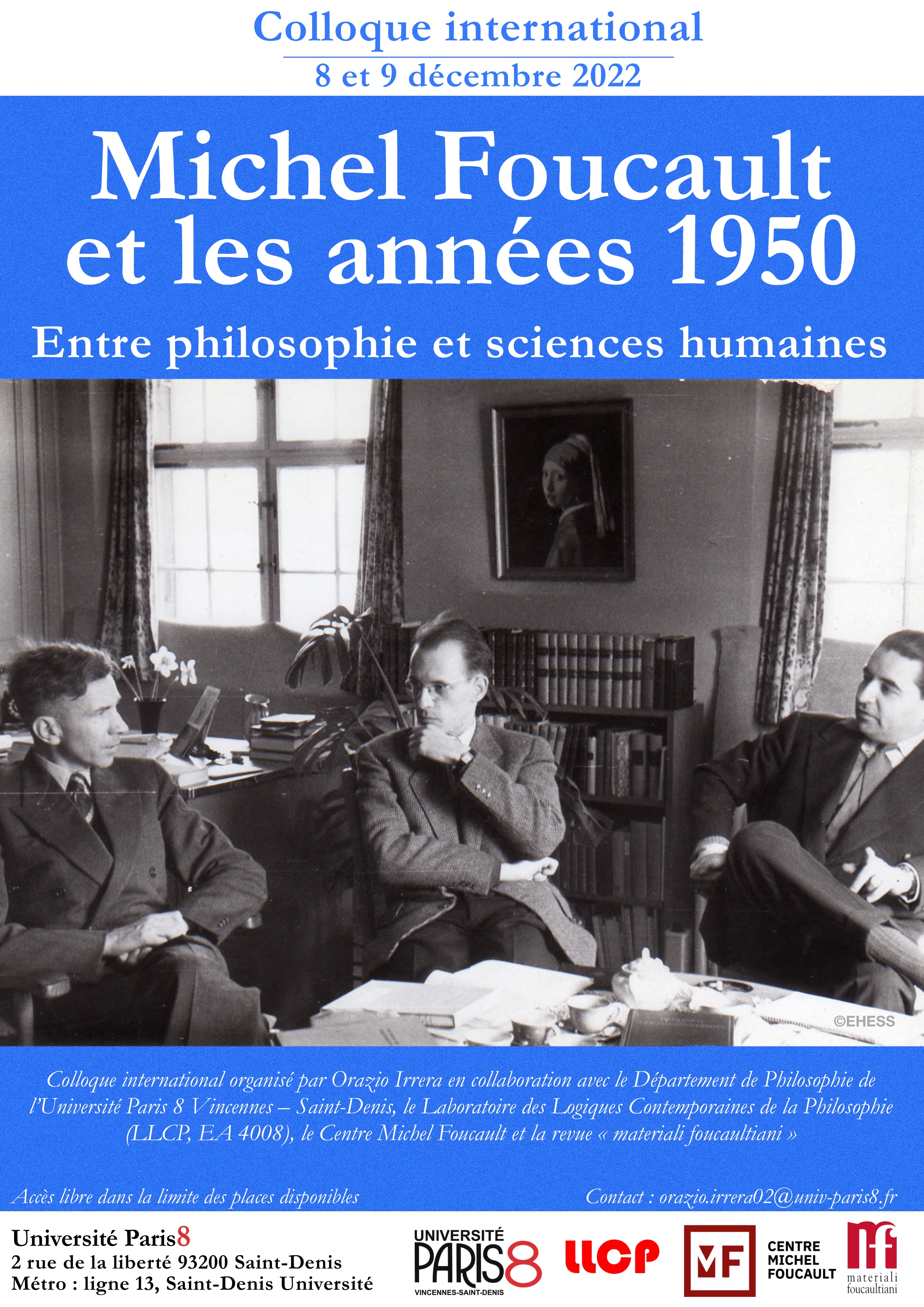
Colloque international. Michel Foucault et les années 1950 Entre philosophie et sciences humaines (2022)

Colloque international: Michel Foucault et les années 1950
Entre philosophie et sciences humaines, 8 et 9 décembre 2022 | Université Paris 8

Clare O'Farrell's avatarFoucault News

Colloque international
Michel Foucault et les années 1950
Entre philosophie et sciences humaines

8 et 9 décembre 2022 | Université Paris 8

Accès libre dans la limite des places disponibles.
Contact : orazio.irrera02@univ-paris8.fr

Programme PDF

Colloque international organisé par Orazio IRRERA en collaboration avec le Département de Philosophie de l’Université Paris 8 Vincennes – Saint-Denis, le Laboratoire des Logiques Contemporaines de la Philosophie (LLCP, EA 4008), le Centre Michel Foucault et la revue « materiali foucaultiani ».

La tout récente parution des trois volumes de la série « Cours et travaux de Michel Foucault avant le Collège de France » dans la collection « Hautes études » chez les éditeurs EHESS-Gallimard-Seuil, Binswanger et l’analyse existentielle (2021), Phénoménologie et psychologie (2021), La question anthropologique. Cours. 1954-1955 (2022), dont l’édition a été réalisée à partir des matériaux inédits du Fonds Michel Foucault déposé à la Bibliothèque nationale (NAF 28730), contribue à jeter…

View original post 912 more words

Posted in Uncategorized | Leave a comment

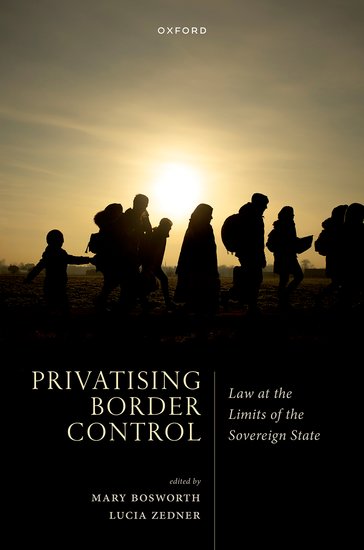
Mary Bosworth and Lucia Zedner (eds.), Privatising Border Control: Law at the Limits of the Sovereign State – Oxford University Press, January 2023

Mary Bosworth and Lucia Zedner, Privatising Border Control: Law at the Limits of the Sovereign State – Oxford University Press, January 2023

In recent years, many breaches of immigration law have been criminalised. Foreign nationals are now routinely identified in court and in prison as subjects for deportation. Police at the border and within the territory refer foreign suspects to immigration authorities for expulsion. Within the immigration system, new institutions and practices rely on criminal justice logic and methods. In these examples, it is not the state that controls the national border: instead, it is often privately contracted companies. 

This collection of essays explores the growing use of the private sector and private actors in border control and its implications for our understanding of state sovereignty and citizenship. Privatising Border Control is an important empirical and theoretical contribution to the growing, interdisciplinary body of scholarship on border control. It also contributes to the academic inquiry into the growing privatisation of policing and punishment. These domains, once regarded as central to the state’s police power and its monopoly on violence, are increasingly outsourced to private providers. 

With contributions from scholars across a range of jurisdictions and disciplines, including Criminology, Law, and Political Science, Privatising Border Control provides a novel and comparative account of contemporary border control policy and practice. This is a must-read for academics, practitioners, and policymakers interested in immigration law and the growing use of the private sector and private actors in border control.

Posted in Boundaries, Politics, Uncategorized | 1 Comment

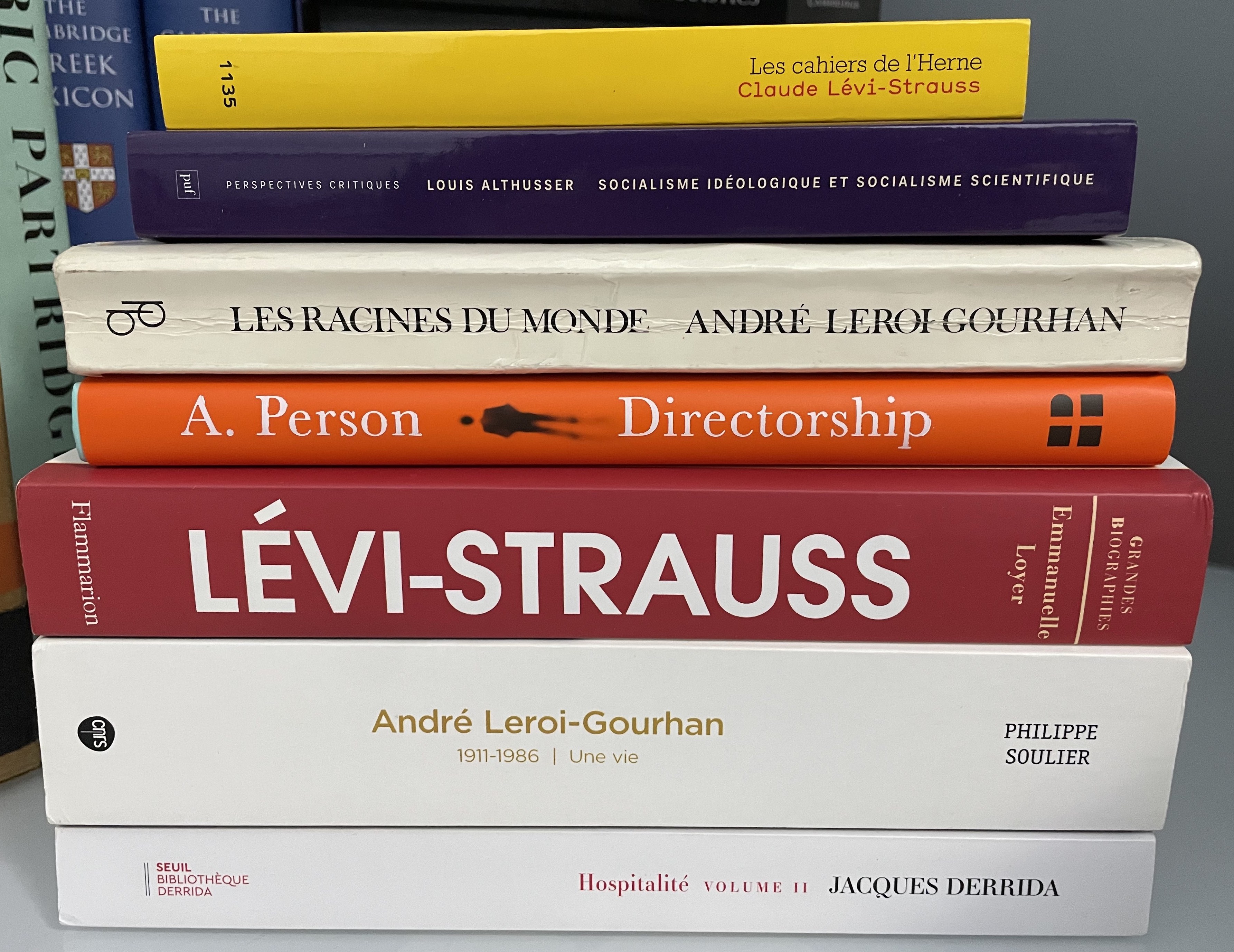
Books received – Lévi-Strauss, Althusser, Leroi-Gourhan, Person, Loyer, Soulier, Derrida

Mainly bought new and second-hand in Paris, but also A. Person, Directorship: Searching for Politics’ Copernican Moment, sent to me anonymously by the author.

Posted in Claude Lévi-Strauss, Jacques Derrida, Louis Althusser, Uncategorized | Leave a comment

Foucault on the radio, 1975 – a different, edited translation of an interesting interview

In 1975, Foucault was interviewed by Jacques Chancel on the radio. It is reprinted in Dits et écrits as text 161, “Radioscopie de Michel Foucault”. The French text is here and the recording here.

Comparing the transcription and the recording shows that it has been cleaned up quite a bit – the recording is a bit more informal in places, and some of the hesitations or the bits where Foucault and Chancel talk over each other have been tidied.

The translation which I knew about before is included in Foucault: Live as ‘Talk Show’. Like other translations in that collection it isn’t always entirely reliable, and it’s possible that it was made direct from the recording, rather than the publication. Especially towards the end, some bits are not translated.

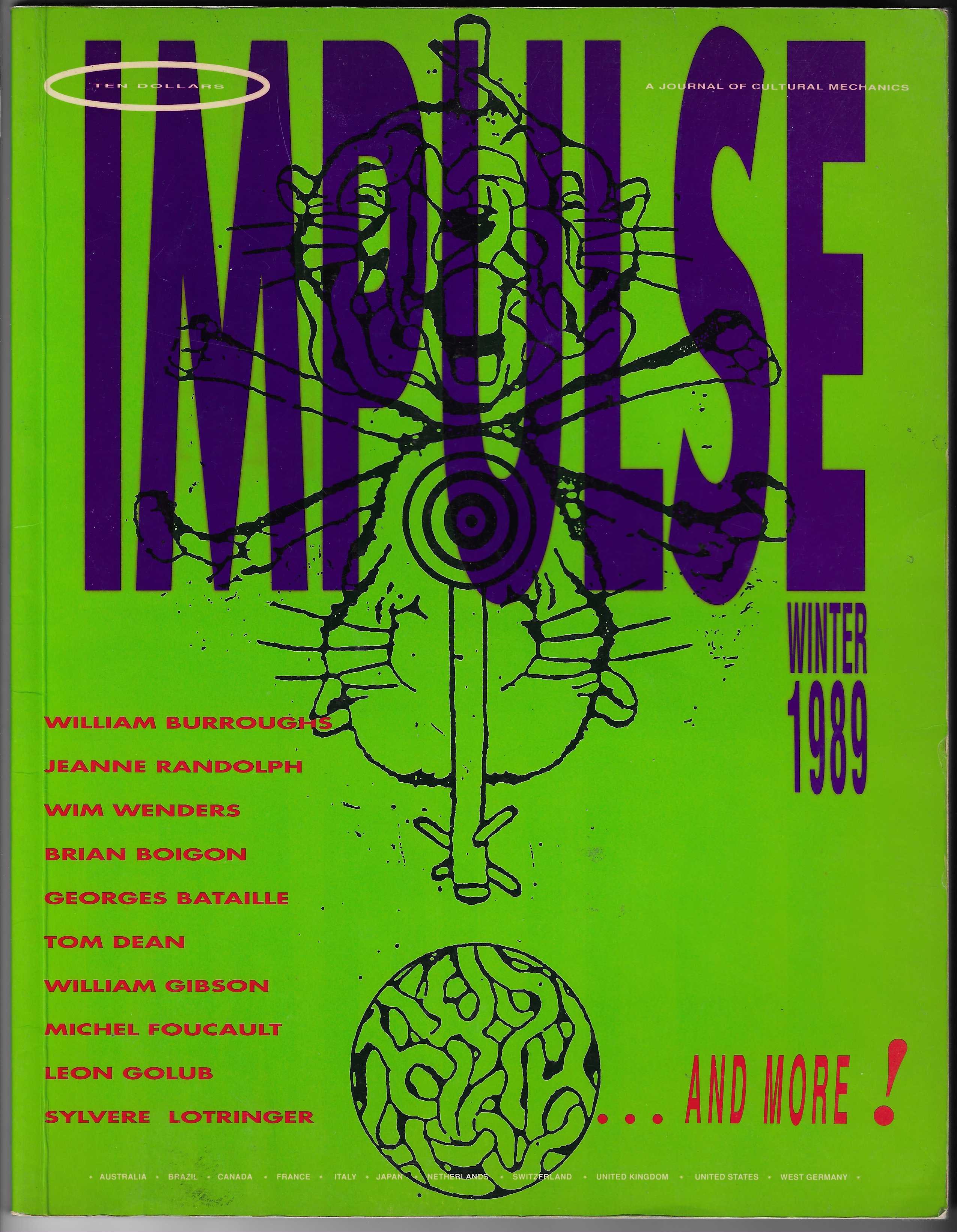
But there is a different, albeit heavily edited, translation of this interesting interview, which appeared in Impulse, Vol 15 No 1, Winter 1989, pp. 50-55. It was transcribed by Lisa Webster, and translated by Ronald B. DeSousa.

The scans are taken from a copy of Impulse from the library of Amy White, an artist based in the US, who brought this version of the interview to my attention. A pdf of the translation is available here.

Posted in Michel Foucault | 1 Comment