Georges Dumézil’s Mythe et épopée series and its partial English translations

Towards the end of his career, Georges Dumézil began to produce some works summarising the results of his decades of research. The most important was the Mythe et épopée series published by Gallimard in three volumes in 1968, 1971 and 1973. 

  1. L’Idéologie des trois fonctions dans les épopées des peuples indo-européens
  2. Types épiques indo-européens : un héros, un sorcier, un roi 
  3. Histoires romaines

Each volume was revised in new editions in Dumézil’s lifetime, and they are still in print as separate volumes. There were plans for a fourth volume, but this was abandoned. In 1995 the three volumes were reprinted as a single volume in the Quarto series, a mammoth book which has both the original pagination of each volume and a running pagination for the volume as a whole – 1463 pages! 

For reasons that in retrospect don’t make a lot of sense, Mythe et épopée became, in Jaan Puhvel’s words, “a kind of quarry, subject to piecemeal extractions into the English language” (“Editor’s Preface, The Stakes of the Warrior, vii). This means the series has been incompletely translated. A page on this site tries to show what is, and what isn’t, available.

In brief, none of the first volume has been translated, although there was a plan for at least the first part; almost all of the second volume is translated, but in three English books (pictured), and quite a lot of the third volume is translated in Camillus: A Study of Indo-European Religion as Roman History (California, 1980).

The Stakes of the Warrior includes Appendix I, which provides some excerpts from Colonel Antoine Louis Polier, Mythologie des Indous (2 vols, 1809). One of Dumézil’s last books was Le Mahabarat et le Bhagavat de Colonel de Polier (Gallimard, 1986) in which he wrote a preface to introduce some chapters from Polier’s Mythologie. At the end of the 1986 edition of Mythe et Épopée II he recognises that the fragments of the appendix are there put back in their place.

With the exception of The Destiny of a King, all the above-mentioned English translations are out of print. 

The page is part of the research for a new project on Indo-European Thought in Twentieth-Century France. For some preliminary textual comparison of Dumézil’s major work on the warrior function, Heur et malheur du Guerrier, part-translated as The Destiny of the Warrior, see here.
Posted in Georges Dumézil, Mapping Indo-European Thought in Twentieth Century France | Leave a comment

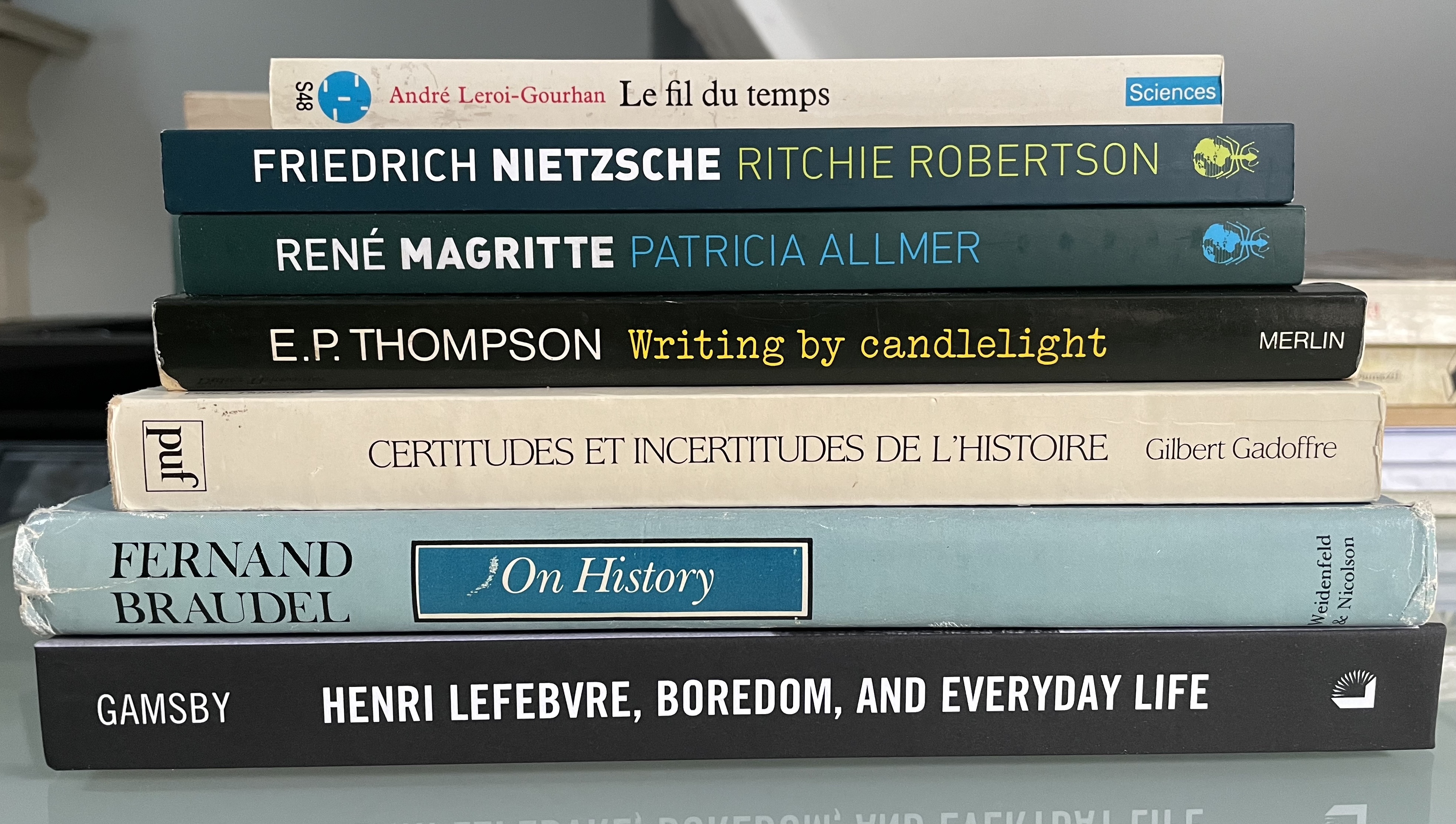
Books received – Leroi-Gourhan, Robertson, Allmer, Thompson, Gadoffre, Braudel, Gamsby

A few second-hand books, along with Ritchie Robertson’s Friedrich Nietzsche, Patricia Allmer, René Magritte and Patrick Gamsby, Henri Lefebvre, Boredom, and Everyday Life, in recompense for review work.

Posted in E. P. Thompson, Friedrich Nietzsche, Henri Lefebvre | Leave a comment

Émile Benveniste, Problems in General Linguistics, Expanded Edition – HAU Books, August 2021 [now listed as February 2023]

stuartelden's avatarProgressive Geographies

Émile Benveniste, Problems in General Linguistics, Expanded Edition – HAU Books, distributed by University of Chicago Press, August 2021 [now listed as February 2023]

First published fifty years ago, Émile Benveniste’s two-volumeProblèmes de linguistique générale revolutionized the study of linguistics and remain among the most influential texts in the field. This expanded edition of the first volume presents the original English translation by Mary ElizabethMeek, produced in close collaboration with Benveniste himself, along with his hitherto untranslated articles on play, translation, singular and plural forms, and Indigenous North American languages. These works are contextualized by an introduction by editor Jordan K. Skinner and a preface by Roland Barthes.

This new edition will delight linguists and philosophers already familiar with Benveniste and introduce his work to a new generation of students. Benveniste studies are going through an enthusiastic revival in Europe; after reading this book, readers elsewhere will understand…

View original post 85 more words

Posted in Uncategorized | 1 Comment

Daniel Hartley, Marxism Literary Criticism: An Introductory Reading Guide

Daniel Hartley, Marxism Literary Criticism: An Introductory Reading Guide

English at historicalmaterialism.org; French at Revue Période

Marxist literary criticism investigates literature’s role in the class struggle. The best general introductions in English remain Terry Eagleton’s Marxism and Literary Criticism (Routledge, 2002 [1976]) and, a more difficult but foundational book, Fredric Jameson’s Marxism and Form (Princeton UP, 1971). The best anthology in English remains Terry Eagleton and Drew Milne’s Marxist Literary Theory: A Reader (Blackwell, 1996). The bibliographic essay that follows does not aim to be exhaustive; because it is quite long, I have indicated what I take to be the major texts of the tradition with a double asterisk and bold font: **.

Posted in Uncategorized | Leave a comment

Paolo Virno, The Idea of World: Public Intellect and Use of Life, translated by Lorenzo Chiesa – Seagull Books, September 2022

Paolo Virno, The Idea of World: Public Intellect and Use of Life, translated by Lorenzo Chiesa – Seagull Books, September 2022

A philosophical exploration of what capitalistic societies truly mean for the individual.
 
A short vade mecum for unrepentant materialism, The Idea of World collects three essays by Italian philosopher Paulo Virno that are intricately wrapped around one another. The first essay, “Mundanity,” tries to clarify what the term “world,” as referred to as the perceptual and historical context of our existence, means—both with and against Kant and Wittgenstein. How should we understand expressions such as “worldly people,” “the course of the world,” or “getting by in this world”? The second, “Virtuosity and Revolution,” is a minor political treatise. Virno puts forward a set of concepts capable of confronting the magnetic storm that has knocked out the compasses that every reflection on the public sphere has relied on since the seventeenth century. The third, “The Use of Life”, is the shorthand delineation of a research program on the notion of use. What exactly are we doing when we use a hammer, a time span, or an ironic sentence? And, above all, what does the use of the self—of one’s own life, which lies at the basis of all uses—amount to in human existence?
 
Presenting his ideas in three distinct vignettes, Virno examines how the philosophy of language, anthropology, and political theory are inextricably linked.

Posted in Paolo Virno, Uncategorized | Leave a comment

Foucault Studies. New Issue (September 2022)

Foucault Studies 32 (September 2022)

Clare O'Farrell's avatarFoucault News

Foucault Studies. Number 32, September 2022

Editorial
Sverre Raffnsøe

Articles
Foucault and Brown: Disciplinary Intersections
Niki Kasumi Clements

Askesis and Critique: Foucault and Benjamin
Ori Rotlevy

UK Lockdown Governmentalities: What Does It Mean to Govern in 2020?
Seb Sander

Book Reviews
Chloë Taylor, Foucault, Feminism and Sex Crimes: An Anti-Carceral Analysis. New York, and London: Routledge, 2019. Pp. 272.
ISBN: 9781138367319 (hardback).
Kurt Borg

Aliraza Javaid, Masculinities, Sexualities and Love. Abingdon & New York: Routledge, 2019. Pp. 189.
ISBN: 978-0-8153-8065-8 (hardback).
Andrea Colombo

Cory Wimberly, How Propaganda Became Public Relations: Foucault and the Corporate Government of the Public. Routledge: New York, 2020. Pp. 214.
ISBN: 978-0-367-26314-0 (hardback).
Fabio Cescon

Niki Kasumi Clements, Sites of the Ascetic Self: John Cassian and Christian Ethical Formation. Notre Dame, Indiana: University of Notre Dame Press, 2020. Pp. 280.
ISBN: 978-0-268-10785-7 (hardback).
William Tilleczek

Thomas Lemke, The Government of Things: Foucault and…

View original post 76 more words

Posted in Uncategorized | Leave a comment

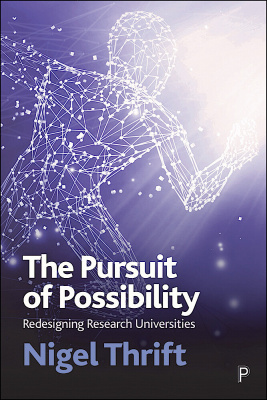
Nigel Thrift, The Pursuit of Possibility: Redesigning Research Universities – Policy Press, October 2022

Nigel Thrift, The Pursuit of Possibility: Redesigning Research Universities – Bristol University Press, October 2022

Are British research universities losing their way or are they finding a new way? 

Nigel Thrift, a well-known academic and a former Vice-Chancellor, explores recent changes in the British research university that threaten to erode the quality of these higher education institutions. He considers what a research university has now become by examining the quandaries that have arisen from a succession of misplaced strategies and false expectations.

Challenging both higher education policy and leadership, he argues that the focus on student number growth and a series of research policy missteps has upset research universities’ priorities just at a point in the history of planetary breakdown when their research is most needed.

Posted in Nigel Thrift | Leave a comment

Longer tributes to Bruno Latour – Justin Smith, Paul Edwards & Gabrielle Hecht, Adam Tooze, Laurent Jeanpierre

I shared some of the early tributes to Bruno Latour here. There are some longer discussions of his work and legacy in various places.

Justin H. Smith, A Locus of Care: Some Memories of the Life and Work of Bruno Latour (1947-2022)

Paul N. Edwards and Gabrielle Hecht, The Uncategorizable Bruno Latour (1947–2022), The Nation

Adam Tooze, Bruno Latour and the philosophy of life, The New Statesman

Laurent Jeanpierre, Bruno Latour : la destitution des Modernes, En attendant Nadeau

Happy to add further links – please add as comments.

The pieces in The New Statesman and The Nation may require registration or subscription.

Posted in Bruno Latour, Uncategorized | 1 Comment

Georges Dumézil’s The Destiny of the Warrior – a work in progress

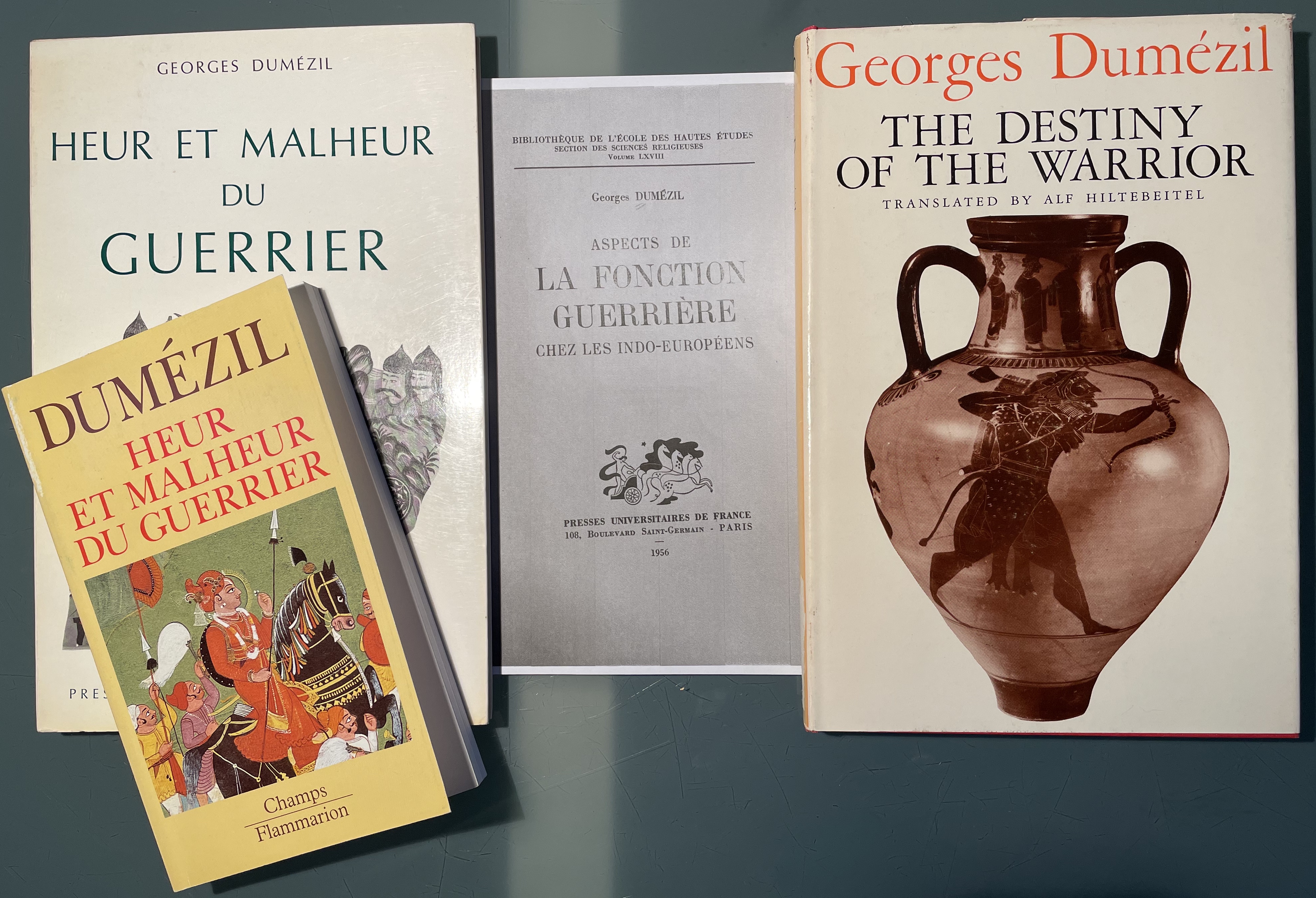
The 1969 edition, a reprint of the 1985 edition, a photocopy of the 1956 text and the English translation.

Mitra-Varuna is the best place to go, in English, for Dumézil’s views on the first function of sovereignty, and its twofold nature: the first judicial and worldly, the second divine and supernatural. In French, Les Dieux souverains des Indo-Européens (Gallimard 1977) updates and expands many of these analyses, but that’s not a text available in English. The second volume of Mythe et épopée, translated as three English books – The Stakes of the Warrior, The Plight of a Sorcerer and The Destiny of a King – discusses related questions. Except for The Destiny of a King those English volumes are out of print, but the forthcoming revised edition of Mitra-Varuna is an attempt to bring some of this work back into circulation.

For the second, martial function of Dumézil’s tripartite analysis – sovereigns, warriors, producers – an English reader could look at The Stakes of the Warrior, but I think a better place to start is The Destiny of the Warrior. Again, the book is unfortunately out of print.

The book has an interesting publishing history – a 1956 text, a revised version in 1969 and a new edition in 1985. Each of these adds material to the version before, with some cuts. On this page I’ve provided an initial indication of how and where these changes were made. The English translation is of the 1969 edition, and there is about a third of the final 1985 text which is not available in translation.

Posted in Georges Dumézil, Mapping Indo-European Thought in Twentieth Century France | Leave a comment

Where to start with reading Henri Lefebvre? – updated

My guide Where to start with reading Henri Lefebvre? has been updated. It’s just a minor update with an updated link to On the Rural and links to the recent books by Patrick Rumsby, Henri Lefebvre, Boredom and Everyday Life (Lexington) and Christian Schmid, Henri Lefebvre and the Theory of the Production of Space (Verso).

This comes in response to a question to me on Twitter. Where should you start with Henri Lefebvre?

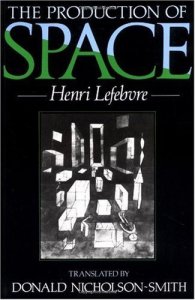
the-production-of-space-21054272

I think many people, especially in Geography, go to The Production of Space. That’s a major work, certainly, but I don’t think it’s a good place to start. It’s a difficult book, which was Lefebvre’s writing up – the theoretical culmination – of several years working on urban and, earlier, rural questions. All-too-often it is read through the lens of the first chapter – a broad, conceptual schema – and not balanced by the much more historical study found in later chapters. I’ve heard several people say that this was the first, and last, thing of Lefebvre they read, or started to read. Any serious engagement with Lefebvre has to come to terms with this book, but it’s not a good place to start.

continues here…

Posted in Henri Lefebvre, Uncategorized | Leave a comment