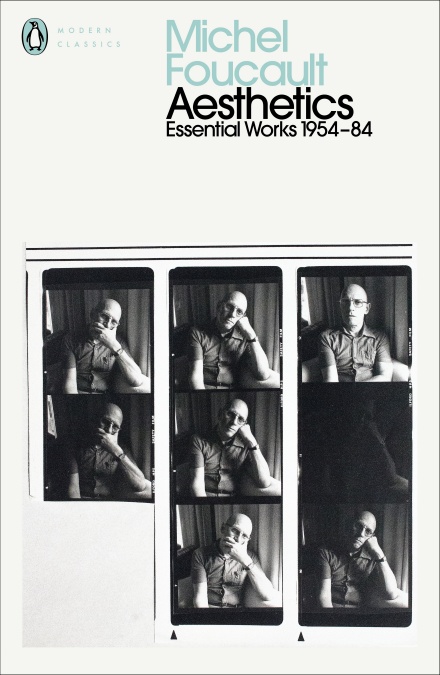
A minor note on the two versions of Foucault’s ‘This is Not a Pipe’, and the problems of the translation in Essential Works

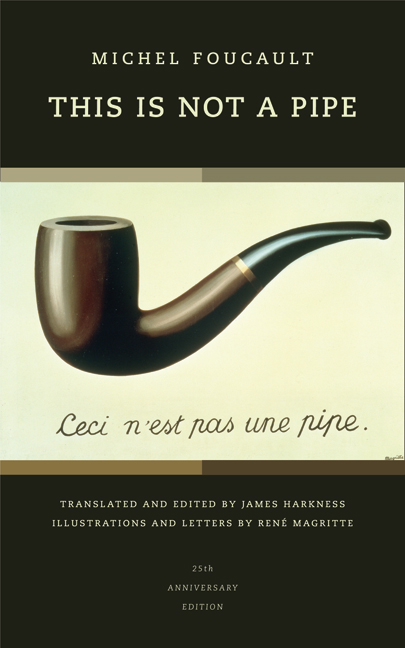
Foucault’s text on René Magritte, “Ceci n’est pas une pipe”, was published first in French in 1968 (reprinted in Dits et écrits as text 53), and then in a revised and expanded form as a book in 1973. The 1973 book was translated as This is not a Pipe by James Harkness in 1981. When Essential Works collection translated selections from Dits et écrits in volume 2, it included a translation of the 1968 text, for which the Harkness text was used as the basis, even though it was a translation of the 1973 version. This made sense – the texts were similar enough. But the Essential Works translation follows the Harkness too closely, and while it recognises the major edits, it misses several smaller points where the two French texts differ.

It is perhaps especially problematic when the revised text changes some instances of similitude to ressemblance, or vice versa, with Foucault writing a new paragraph which explains how he differentiates the terms (in the book French p. 61; English p. 44). But the English translation of the 1968 text does not always recognise what Foucault originally wrote, which leads to a confusing read.

For most readers, the 1973 text, either in French or English, should be the reference, since this was the expanded and revised version. But an anglophone reader wanting to see what Foucault published in 1968 cannot rely on Essential Works.

The order I’ve presented these examples follows the order the texts were written/translated. But note Essential Works is supposed to be a translation of the 1968 text; while Harkness translates the 1973 book.

Example 1

1968 article: Sept discours dans un seul énoncé. Mais il n’en fallait pas moins pour abattre la fortresse où la ressemblance était prisonnière de l’affirmation (Dits et écrits I, 648).

1973 book: Sept discours dans un seul énoncé. Mais il n’en fallait pas moins pour abattre la fortresse où la similitude était prisonière de l’assertion de ressemblance (Ceci n’est pas une pipe, 71).

Harkness translation: Seven discourses in a single statement – more than enough to demolish the fortress where similitude was held prisoner to the assertion of resemblance (This is Not a Pipe, 49).

Essential Works: Seven discourses in a single statement – more than enough to demolish the fortress where similitude was the prisoner of the assertion of resemblance (Essential Works II, 200).

Essential Works clearly follows Harkness, with a minor amendment, which means its translation is partly of the 1973 sentence, even though it is supposed to be a translation of the 1968 text. What Foucault actually said in 1968:

Seven discourses in a single statement [énoncé] – more than enough to demolish the fortress where resemblance was the prisoner of the affirmation.

Example 2

1968 article: Le second principe pose l’équivalence entre le fait de la similitude et l’affirmation d’un lien représentatif (DE I, 643)

1973 book: Le second principe qui a longtemps régi la peinture pose l’équivalence entre le fait de la ressemblance et l’affirmation d’un lien représentatif (42)

Harkness: The second principle that long ruled painting posits an equivalence between the fact of resemblance and the affirmation of a representative bond (34)

Essential Works: The second principle posits an equivalence between the fact of resemblance and the affirmation of a representative bond (EW II, 195)

In other words, Essential Works has recognised the 1973 text added a brief phrase, which it rightly omits, but missed the change of similitude to ressemblance. It is supposed to be a translation of the 1968, and should have ‘similitude’.

Example 3

1968 article: Séparation rigoureuse entre signes linguistiques et éléments plastiques; équivalence de la similitude et de l’affirmation (DE I, 650)

1973 book: Séparation entre signes linguistiques et éléments plastiques; équivalence de la ressemblance et de l’affirmation (77)

Harkness: Separation between linguistic signs and plastic elements; equivalence of resemblance and affirmation (53)

Essential Works: Rigorous separation between linguistic signs and plastic elements: equivalence of resemblance and affirmation (EW II, 201)

Essential Works misses the important change again, even though it recognises that ‘rigorous’ is present in 1968 and not in 1973.

These are far from the only changes between 1968 and 1973. Those changes are very extensive. But these are three important small ones which are unrecognised in Essential Works. There are other more minor examples of things where Essential Works follows the 1973 text (and Harkness’s translation) instead of the 1968 text of which it claims to be a translation.

Update 26 July 2021: There is another translation of Foucault’s text, by Richard Howard, as “Ceci n’est pas une pipe“, October 1, Spring 1976, 6-21. At the time of writing it is open access. This is a translation of the 1968 text, even though it is dated to 1963, and includes the two letters from Magritte, which only appear in the 1973 book version.

There are lots of other resources on this site relating to Foucault – bibliographies, audio and video files, some other textual comparisons, some short translations, etc. They are listed here.
Posted in Michel Foucault, The Archaeology of Foucault | 4 Comments

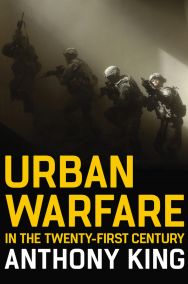
Anthony King, Urban Warfare in the Twenty-First Century – Polity, July 2021

Anthony King, Urban Warfare in the Twenty-First Century – Polity, July 2021

Over the last two decades, warfare has migrated into cities. From Mosul to Mumbai, Aleppo to Marawi, the major military battles of our time have taken place in densely populated urban areas.  Why has this happened? What are the defining characteristics and the military and political implications of urban warfare today?

Leading sociologist Anthony King answers these critical questions through close analysis of recent urban battles and their historical antecedents.  Exploring the changing typography and evolving tactics of the urban battlescape, he shows that whilst some methods used in urban battle are not new, operations in cities have become highly distinctive.  Today, urban warfare has coalesced into gruelling micro-sieges, which extend from street level – and below – to the airspace high above the city – as combatants fight for individual buildings, streets, and districts.  At the same time, digitalized social media and information networks have communicated these battles to global audiences across the urban archipelago, with these spectators often becoming active participants in the fight.

A timely reminder of the costs and the horror of war and violence in cities, this book offers an invaluable interdisciplinary introduction to urban warfare in the new millennium for students of international security, urban studies, and military science.

Posted in Uncategorized | Leave a comment

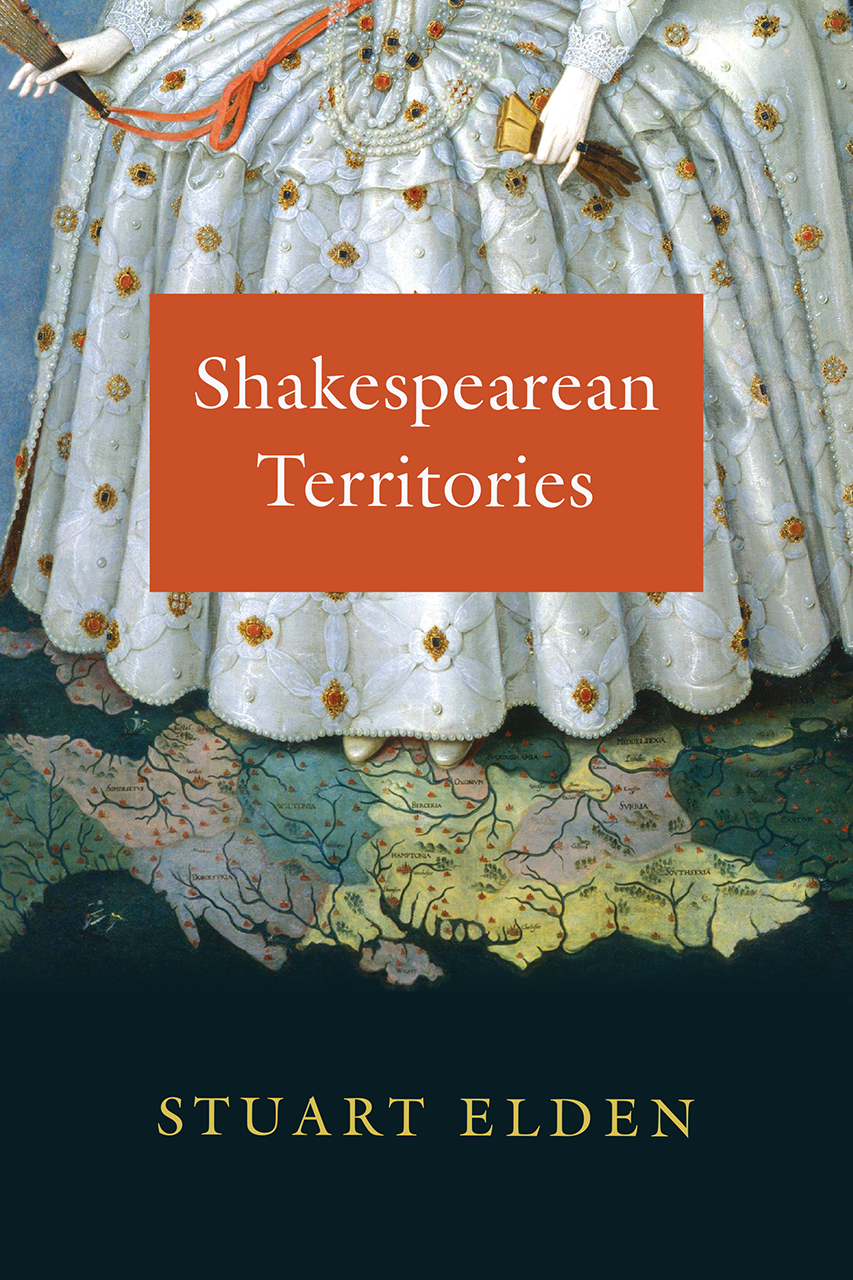
Gavin Hollis reviews Shakespearean Territories in Renaissance Quarterly (open access)

Gavin Hollis generously reviews my 2018 book Shakespearean Territories in Renaissance Quarterly (open access).

The work of the prolific political theorist and geographer Stuart Elden merits further engagement by literary historians of early modernity, in particular anyone interested in matters of geography and hydrography, space, place, nation, empire, mapping, policing, and resistance. Which is quite a lot of us. Shakespearean Territories is Elden’s third book-length exploration of territory as a key term for interrogating the long histories of biological and geopolitical convergences—or what Elden calls “the spatial extent of sovereignty.” Territory, he argues, is not mere political background, nor should we understand it simply as the site or product of inter- and intra-national contestations—as the place where de-territorialization and re-territorialization happen. Rather, argues Elden, territory is a process that is continually negotiated through a range of historically contingent practices and techniques designed to measure, manage, and master land. The first book in his unofficial trilogy, Terror and Territory (2009), is focused on the post–Cold War period, in particular the War on Terror, while the second, The Birth of Territory(2013), takes a longer view, tracing back to classical antiquity the emergence of territory as a contested geopolitical/biopolitical category. As its title suggests, the focus of Shakespearean Territories is narrower, but in its unraveling of the many ways in which territory is envisaged in Shakespeare’s work it is as conceptually capacious as the earlier books. [continues here]

Posted in Shakespearean Territories, Territory, Terror and Territory, The Birth of Territory | Leave a comment

Stuart Elden, ‘Terrain, Politics, History’ – Dialogues in Human Geography article with responses from Gastón Gordillo, Kimberley Peters, Bruno Latour, Rachael Squire and Deborah P. Dixon, and a reply (most open access)

My 2019 Dialogues in Human Geography lecture, ‘Terrain, Politics, History‘ has been published in the journal (open access).

The responses are by:

Gastón Gordillo, The power of terrain: The affective materiality of planet Earth in the age of revolution (open access)

Kimberley Peters, For the place of terrain and materialist ‘re’-returns: Experience, life, force, and the importance of the socio-cultural

Bruno Latour, The Anthill and the Beam: A Response to Elden

Deborah P. Dixon, Drift in an Anthropocene: On the work of terrain (open access)

Rachael Squire, Where theories of terrain might land: Towards ‘pluriversal’ engagements with terrain (open access)

The last piece is my reply – The limits of territory and terrain (open access)

Many thanks to Gastón, Kim, Bruno, Deborah and Rachael for their engagement with this work. As I say in the response it was strange to reply to the responses eighteen months after I wrote the paper – it’s now almost two years since I completed it. A lot has happened since then. I’m also grateful to the journal’s editorial team – especially Rob Kitchin for the initial invitation, Jeremy Crampton for chairing the session and Reuben Rose-Redwood as managing editor.

Posted in Bruno Latour, Gaston Gordillo, Jeremy Crampton, terrain, Territory | 4 Comments

Alain Brossat et Daniele Lorenzini (dir.), Foucault et… Les liaisons dangereuses de Michel Foucault – Vrin, August 2021

Alain Brossat et Daniele Lorenzini (dir.), Foucault et… Les liaisons dangereuses de Michel Foucault – Vrin, August 2021

Michel Foucault est un philosophe qui, loin de plancher sur d’autres philosophes, avance avec et contre eux – et contre pas moins qu’avec, au vu du caractère distinctement agonistique de sa pensée.
Dans ce volume, il « dialogue » successivement avec douze philosophes et écrivains de tous les temps – des auteurs dont les œuvres soutiennent et traversent la sienne, dans une perpétuelle tension. Chacune de ces encontres est mise en scène par un spécialiste de Foucault. Tout se joue autour du « et » : de Foucault et Platon à Foucault et Althusser ou Genet en passant par Machiavel, Hegel, Said et bien d’autres. Le « et », ici, rapproche et éloigne à la fois.
Selon cette approche, l’œuvre perd son caractère de forteresse pour devenir un nœud, dans un réseau : celui de la philosophie vivante qui se construit et se poursuit dans d’infinies circulations et interactions. Une toile d’araignée dont le centre provisoire serait ici une pensée nommée Michel Foucault.

Posted in Michel Foucault | 2 Comments

The Archaeology of Foucault update 7: more UK library work on Foucault and Dumézil; Foucault work on literature and art

Now that marking is complete, and the end of term is here, it’s been great to regain time and focus for this work. Some of the nice comments I had about The Early Foucault helped to encourage this. I’m not tired of this book, but I am impatient to move it forward, at least to get it to a point where all that remains is archival work once travel becomes possible again without periods of self-isolation.

I had some productive days at the British Library in June, across a couple of visits. The length of the visits means that I’m largely using the time to check small details or survey works which I might need to read in more detail. Some of this work was looking at the books Foucault reviewed or otherwise referenced.

I continue to work on Foucault’s literary essays in the first half of the 1960s, along with his links to the journals Tel Quel and Critique. There is some good secondary literature on Tel Quel – books by Patrick ffrench, Niilo KauppiDanielle Marx-Scouras and Philippe Forest, for example. (Interestingly, these books all appeared within a few years of each other in 1994-96.) There is also the useful Tel Quel Reader with the translation of some key essays, including Foucault’s “Distance, Aspect, Origin”. The literature on Critique seems more limited, with the signal exception of an excellent study by Sylvie Patron, Critique, 1946-1996: Une Encyclopédie de l’esprit moderne.

I think that this is one of the approaches I employ in this research, which is something that opens up some different perspectives. Instead of just approaching the question of Foucault and X by looking at the literature on Foucault which might mention X, and thereby go over many of the old and sometimes tired debates, I try to read the literature on X, partly for what it might say about Foucault certainly, but also more generally. In places this provides some new angles, and certainly lots of things to follow-up.

Foucault’s appreciation of Pierre Klossowski’s work is quite well-known, though this tends to be through some comments in interviews and his essay “The Prose of Actaeon”. Melissa Pawelski doctoral research on Foucault and translation alerted me to look again at Foucault’s review of Klossowski’s translation of Virgil’s Aeneid, and a note by Daniel Defert led me to look at what Klossowski Foucault might have been reading in 1963. Klossowski’s major book on Nietzsche was not published until 1969, and there is a letter from Foucault to Klossowski praising this, and another one on La monnaie vivante [Living Currency] but at least some of the engagement comes much earlier. The reading goes back to the 1950s, when Foucault read Bataille’s journal Acéphale, to which Klossowski contributed, but there is certainly a renewed interest in the early-mid 1960s.

One of the last literary texts Foucault wrote was a two-part lecture on the Marquis de Sade, which he gave in North America – at SUNY Buffalo in 1970, in Montréal in 1971 and at Cornell in 1972. I have begun quite a long discussion of this, but it wasn’t working in the chapter on literature. Instead, I’ve moved this to the book’s Coda, and I think it works better there – both chronologically, and probably in terms of the argument.

In the second half of the 1960s, Foucault writes some very important pieces on artists – the ones on Velásquez, Magritte and Manet are the best known. All these will be discussed in the book. There are also some interesting small essays on art, some published in Foucault’s lifetime, others since, and a few as yet only available in the archive. A couple of the small pieces he did publish, on Erwin Panofsky and Maxime Defert, led to some interesting things I hadn’t previously considered. There are a few later pieces from the mid-1970s, which while outside the chronological scope of this book, fit thematically. In trying to locate one late piece, which Foucault wrote under a pseudonym, I went down a long but ultimately fruitless rabbit-hole. The first source I read (A), reports a publication in a well-known outlet, commissioned by a named figure, but provides no date or other reference. Hunting around, including in the electronic archive of the outlet, provides no answer. So, I went looking for other sources, including a biography of the person named (B). That reports nearly the same story, and seems to be C’s source. But the person named also wrote a memoir (C). The author of B seems to have read C, and reported the story with a slight difference. A read B, and inferred something which wasn’t actually said. Had they read C, they’d have realised their error. The piece was written but not published, and ultimately lost, with the original probably destroyed. All this would have been much easier if people actually cited their sources.

I’m also digging into what is probably well-trodden ground on the relation between Foucault and Sartre, and to a lesser extent, de Beauvoir; and his relation to structuralism. A lot of this revolves around the early critical reaction to Les Mots et les choses/The Order of Things. Some of these pieces are collected in the useful Regards critiques volume, but some of the other required a bit of work with old French newspapers and journals. There are also some relatively minor pieces by Foucault on the (very odd) Jean-Pierre Brisset, which I’m not currently sure how to discuss.

The wordcount of the draft chapters and working files is getting close to the length of the book itself. I do always struggle with keeping to limits, but this is fairly normal for me. A graph of the cumulative word count for one of my books would look like a billhook – going upwards and past the limit and then curving back down as I cut out things in the final stages. Fortunately, with this book the agreed word limit is a bit higher than the others at 110,000 words – the length which The Early Foucault was in its final form. (The Birth of Power was 94,000 words; Foucault’s Last Decade 102,000 words.)

The intention, as with the others in this series, is that I am writing this book both as a standalone study and to fit into the sequence. When I was writing Foucault’s Last Decade I’d originally intended that to be the only book, but at quite a late stage I decided in discussion with Polity that it would work better to take some material out and develop that into Foucault: The Birth of Power. So, I finished Foucault’s Last Decade knowing that there would be this other volume, and The Birth of Power was completed fairly soon after, knowing how it needed to end. At that stage I didn’t think I’d be writing more, but fairly soon after decided to treat the earlier period, and a but later that it should be two books to complete the sequence. But while with the others I either had in mind a book which would come either before or after it, with this book I have both. It has to follow The Early Foucault and lead into Foucault: The Birth of Power. In other words, this book has to fill a gap with a restriction on either side. That has its own challenges.

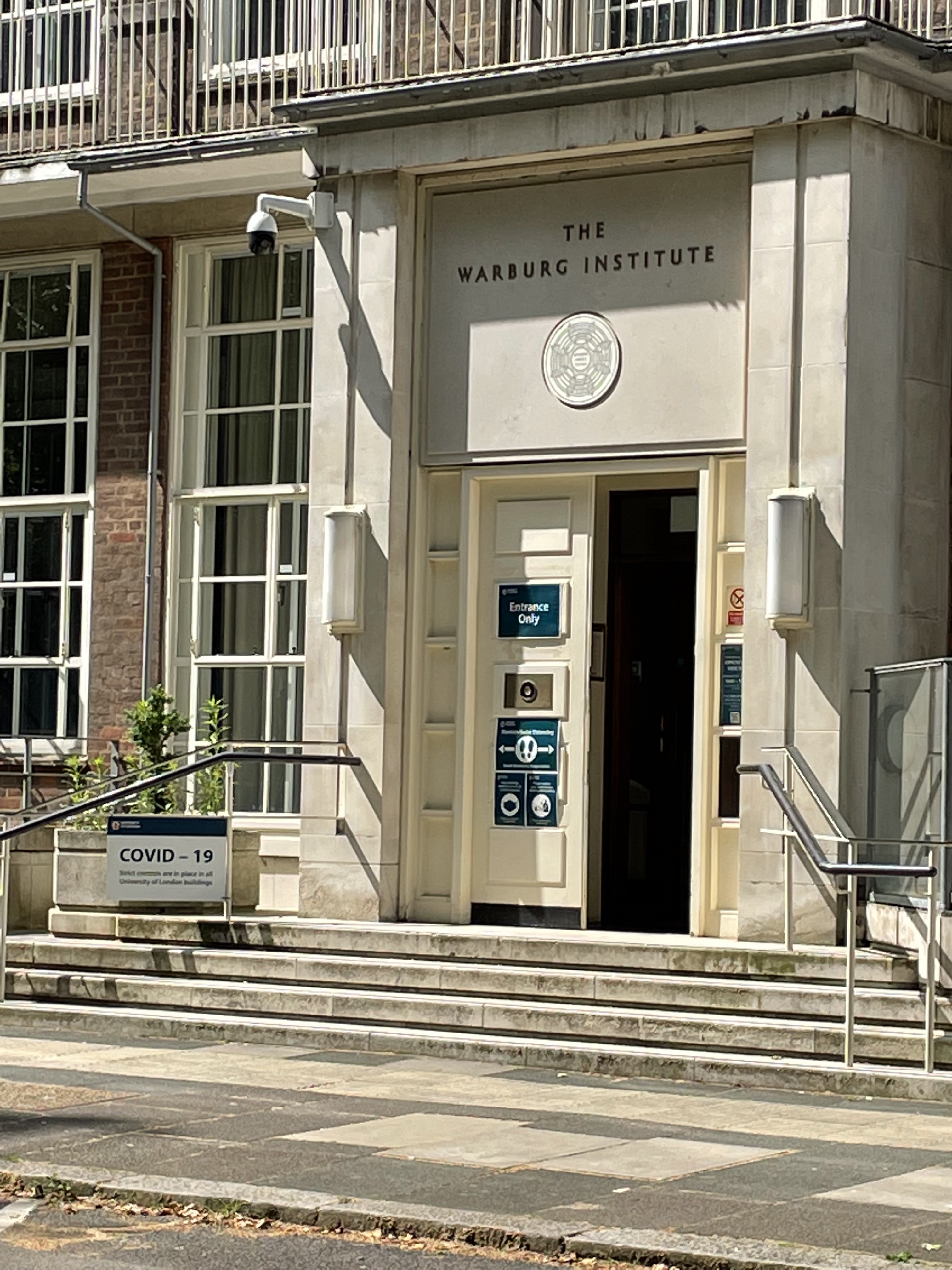
I also had a couple of visits to the Warburg Institute library which has one of the UK’s few copies of the 1940 edition of Georges Dumézil’s Mitra-Varuna. As I mentioned in the previous update I’m editing a revised edition of this text for HAU books. I have a photocopy of the 1948 text, and I’m annotating that as I do the slow, word-by-word comparison to track the changes between editions. I’m about two thirds of the way through. So far, I’m finding enough changes for this to be worthwhile and interesting work, but not so many that notes to a critical edition would be overwhelming. Dumézil indicates the most substantive changes are to a late chapter and the conclusion though, so this remains very much work in progress.

The Foucault book and the Dumézil editing work are the two main projects over the summer. The copy-editing and proofs for the Lefebvre rural collection will take up time, as will the final editing work on the Foucault theme issue for Theory, Culture and Society, and some other nearly complete pieces. But as much as possible I’ve tried to complete the work on those other pieces in the last couple of weeks, and get some consolidated time this summer to make progress on this Foucault book.

Previous updates on this book are hereThe Early Foucault was published by Polity in June 2021, and updates for its writing are here. A list of the resources on this site relating to Foucault – bibliographies, audio and video files, some textual comparisons, some short translations, etc. – can be found here. The earlier books in this series are Foucault: The Birth of Power and Foucault’s Last Decade, both available from Polity.

Posted in Georges Dumézil, Pierre Klossowski, The Archaeology of Foucault, The Early Foucault | 2 Comments

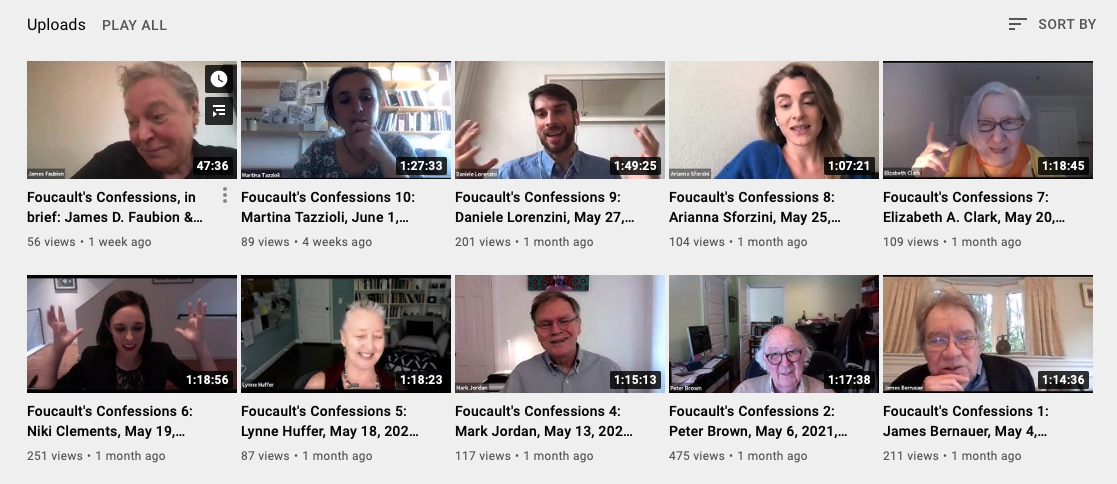
Foucault’s Confessions videos – James Faubion, Martina Tazzioli, Daniele Lorenzini, Arianna Sforzini, Elizabeth Clark, Niki Kasumi Clements, Lynne Huffer, Mark Jordan, Peter Brown, James Bernauer

Conference: Foucault’s confessions videos (2021) – the videos from the series organised by Niki Kasumi Clements, all available on YouTube

thanks to Foucault Studies for the link

Posted in Uncategorized | 1 Comment

Lauren Berlant (1957-2021) – tributes from University of Chicago, Duke University Press and Critical Inquiry (with open access papers)

The news of the sad death of Lauren Berlant has been all over social media, with many heartfelt tributes to the impact of their work. I won’t try to link to all of them, but these three are useful. University of Chicago, Duke University Press and Critical Inquiry

The last has links to their work in the journal, all made open access.

There is an interview conducted by David Seitz at the Society and Space site (open access) and one in The New Yorker (may require subscription).

If people know of other pieces being made open access in tribute, please comment and I’ll add them.

Posted in Lauren Berlant, Uncategorized | 2 Comments

Rachael Squire, Undersea Geopolitics: Sealab, Science, and the Cold War – Rowman, July 2021

Now with cover and endorsements – all details here

stuartelden's avatarProgressive Geographies

Rachael Squire, Undersea Geopolitics: Sealab, Science, and the Cold War – Rowman, July 2021

This book furthers academic scholarship in cutting-edge areas of geographical and geopolitical writing by drawing on a series of little-studied undersea living projects conducted by the US Navy during the Cold War (Project Genesis, Sealab I, II and III). Supported by an engaging and novel empirical setting, the central themes of the book revolve around the practice and construct of ‘territory’, ‘terrain’, the ‘elemental’ and the interrelationships between these material phenomenon and both human and non-human bodies. Furthermore, the book will point to future research trajectories in the form of ‘extreme geographies’ to better understand living practices in a world that is increasingly submerged and extreme.

Rachael Squire is a political geographer and lecturer in human geography at Royal Holloway, University of London. Her research engages with the concepts of territory, embodiment, and ‘volume’ with a…

View original post 160 more words

Posted in Uncategorized | Leave a comment

Books received – Farge, Todorov, Badir, Ornicar? Benjamin, Olssen, Jones, Rennie, Forest, Ortigues

Some older books bought second-hand, along with the recent books Arlette Farge, Instants de Vie, Sémir Badir. Magritte et les philosophes, Foucault – Duby – Dumézil – Changeux – Thom, Cinq grands entretiens au Champ Freudien, the new critical edition of Walter Benjamin’s Toward the Critique of Violence, Mark Olssen, Constructing Foucault’s Ethics, Bryan S. Rennie, Reconstructing Eliade, and proof of Reece Jones’s forthcoming White Borders: The History of Race and immigration in the United States from Chinese Exclusion to the Border Wall.

Mark Olssen and Reece Jones’s books were sent by the publishers, and the Rennie book was recompense for review work.

Posted in Georges Dumézil, Michel Foucault, Mircea Eliade | Leave a comment