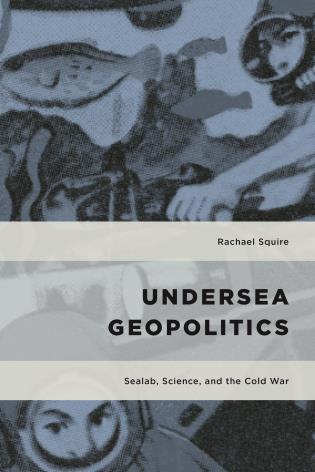
This book furthers academic scholarship in cutting-edge areas of geographical and geopolitical writing by drawing on a series of little-studied undersea living projects conducted by the US Navy during the Cold War (Project Genesis, Sealab I, II and III). Supported by an engaging and novel empirical setting, the central themes of the book revolve around the practice and construct of ‘territory’, ‘terrain’, the ‘elemental’ and the interrelationships between these material phenomenon and both human and non-human bodies. Furthermore, the book will point to future research trajectories in the form of ‘extreme geographies’ to better understand living practices in a world that is increasingly submerged and extreme.
Rachael Squire is a political geographer and lecturer in human geography at Royal Holloway, University of London. Her research engages with the concepts of territory, embodiment, and ‘volume’ with a particular focus on the space of the sea.
Update: pleased to be one of the two people writing an endorsement of this book:
Extending critical geopolitical analysis to investigate an unlikely venue, Rachel Squire brilliantly shows how American cold war geopolitical culture was a combination of science, masculinity and exploration. This fascinating account of a nearly forgotten scientific project explores the underwater world of Sealab, its aquanauts, scientists and their dangerous experimental habitat, built in the quest to dominate the frontier space of the ocean. — Simon Dalby, Balsillie School of International Affairs, Wilfrid Laurier University
A fascinating study of a little-known story in the Cold War. Using archival and other historical sources, Squire takes us beneath the surface to explore the world of Sealab with its multiple geographies. Engagingly written and conceptually innovative, this is an important contribution to political geography and wider debates about territory, volume and materiality. — Stuart Elden, Professor of Political Theory and Geography, University of Warwick
This looks a really interesting study of Baldus, who was significant in the argument I make in The Birth of Territory. At over 700 pages, it’s clearly a major work, but unfortunately the book is only in hardback and prohibitively priced.
Dante Fedele’s new work of reference reveals the medieval foundations of international law through a comprehensive study of a key figure of late medieval legal scholarship: Baldus de Ubaldis (1327-1400). A student of Bartolus de Sassoferrato, Baldus wrote both extensive commentaries on Roman, canon and feudal law and thousands of consilia originating from particular cases. His writings dealt with numerous issues related to sovereignty, territorial jurisdiction, diplomacy and war, combining a rich conspectus of earlier scholarship with highly creative ideas that exercised a profound influence on later juristic thought. The detailed picture of the international law doctrines elaborated by a prominent medieval jurist offered in this study contributes to our understanding of the intellectual archaeology of international law.
“Dr. Fedele’s monograph will no doubt become a necessary work of reference for any scholar interested in the history of international law. […] Beyond the specific doctrines on particular areas of international law, Dr. Fedele’s study of Baldus shows how in the area of international governance, jurists sought to marshal different expressions of normativity.” – Alain Wijffels, Foreword
The new translation of Jean Cavaillès, On Logic and the Theory of Science, some second-hand books by Eliade, a collective volume on Vincennes, the reedition of Foucault’s first two Collège de France courses, a special issue of the Carceral Notebooks on ‘Foucault and the Politics of Resistance in Brazil’, and Derrida’s Donner le temps II.
The Foucault lecture courses are the new editions. There is an interesting editorial note about this new edition, which notes that there is a difference in how the first courses published differ from the later ones. The initial courses (‘Society Must Be Defended’ and Abnormal, for instance) made limited use of the manuscripts, but largely transcribed the recordings. The courses published later made much more extensive use of written material. The series plans to re-edit courses with more attention to manuscripts, so the earliest published courses will have the most work. These two volumes, which were the first two courses delivered, were both later in the publication cycle, and also only used manuscripts as no recordings existed (or, at least, were known about). So there is probably relatively little that has changed here. But the potential changes will be greater in the courses to follow, since the recordings and manuscripts differ quite extensively – Foucault extemporised, cut material, etc. So there could be some interesting material to come.
Two other notes on this. Unfortunately the pagination between the original and these pocket editions differs. That’s going to make references start to differ as these editions supersede the initial ones. And I have no idea if Palgrave (or Penguin or Verso for the two earliest published) will do revised editions of the translations to take these revisions into account.
The Kant volume is, I think, the only volume of this series I didn’t have before.
I’ve grumbled before about the appearance of books in a series, which is certainly the case with the way CUP have changed the format and size of these Kant texts. The red part on the spine seems to have been short-lived, etc. The Hegel ones all look the same, but then, it’s early in that series, and surprisingly, all of these books from CUP were print on demand.
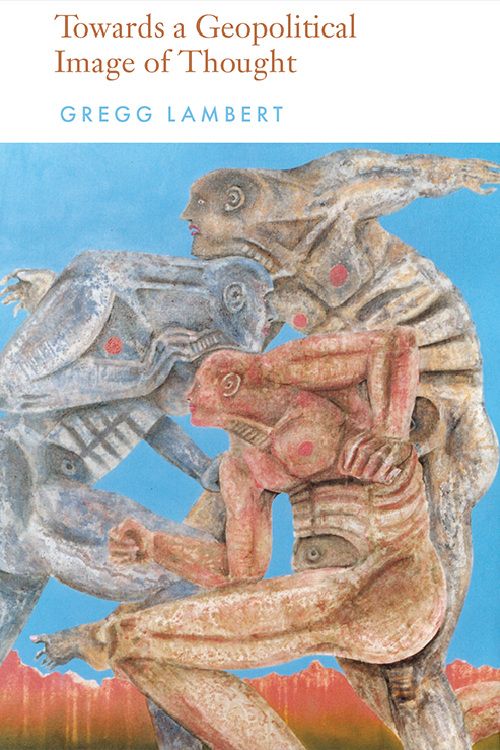
Radically reorientates the future direction of Continental philosophy according to a geo-political image of thought
Presents the notion of ‘geophilosophy’ as an alternative to contemporary theories of political theology
Offers a defence of Lyotard’s concept of le differend as charting the future of continental philosophy
Highlights the role of collective identification in the creation of conceptual personae and ‘isms’ in the history of continental thought
Shows Nietzsche’s influence on the uniquely modern role of the ‘conceptual persona’ in the philosophy of Deleuze
Drawing from his previous writings on the search for a new image of thought and the vitalist role of ‘conceptual personae’ in the history of philosophy, Gregg Lambert proposes a new geo-political image of thought that is uniquely commensurate with the globalisation of contemporary continental philosophy.
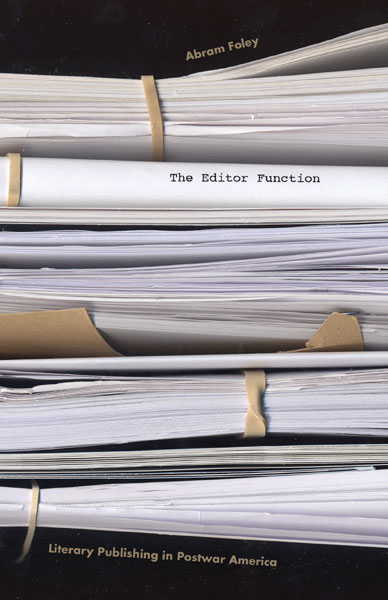
Michel Foucault famously theorized “the author function” in his 1969 essay “What Is an Author?” proposing that the existence of the author limits textual meaning. Abram Foley shows a similar critique at work in the labor of several postwar editors who sought to question and undo the corporate “editorial/industrial complex.” Marking an end to the powerful trope of the editor as gatekeeper, The Editor Functiondemonstrates how practices of editing and publishing constitute their own kinds of thought, calling on us to rethink what we read and how.
The Editor Function follows avant-garde American literary editors and the publishing practices they developed to compete against the postwar corporate consolidation of the publishing industry. Foley studies editing and publishing through archival readings and small press and literary journal publishing lists as unique sites for literary inquiry. Pairing histories and analyses of well- and lesser-known figures and publishing formations, from Cid Corman’s Origin and Nathaniel Mackey’s Hambone to Dalkey Archive Press and Semiotext(e), Foley offers the first in-depth engagement with major publishing initiatives in the postwar United States.
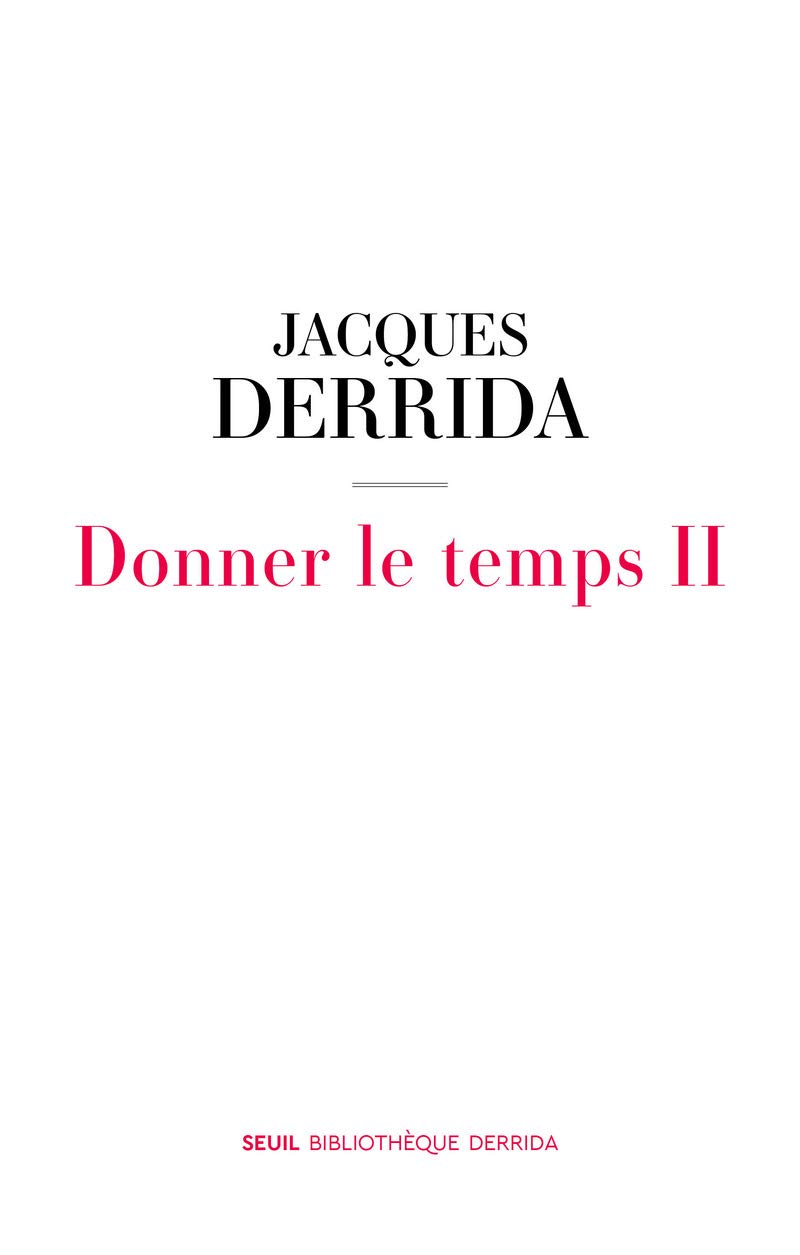
Jacques Derrida, Donner le temps II – Seuil, April 2021
« Donner, est-ce possible ? » C’est la question que pose Jacques Derrida dans Donner le temps. 1. La fausse monnaie (1991). Un don ne peut jamais s’annoncer comme tel. Dès lors qu’il engage dans le cercle de l’échange économique et de la dette, le don semble s’annuler dans l’équivalence symbolique qui l’aura toujours réduit à l’objet d’un calcul, d’une ruse qui prétend donner généreusement mais non sans attendre quelque récompense en retour. Un don, s’il y en a, ne peut jamais se faire présent, c’est-à-dire qu’il ne peut jamais se présenter ni pour le donataire ni pour le donateur. Pour donner – si une telle chose est possible – il faudrait, peut-être, renoncer au présent.
Indiqué comme un premier tome, Donner le temps en promettait clairement un second à venir. Le présent volume fournit les éléments de cette pièce manquante en donnant à lire les neuf dernières séances du séminaire donné par Jacques Derrida à l’École normale supérieure en 1978-1979 sous le titre « Donner – le temps ». Après être passé par des lectures de Baudelaire, Mauss, Benveniste, Lévi-Strauss et Lacan, Jacques Derrida tourne son attention vers la présence subtile mais décisive du don chez Heidegger, lisant des textes qui sont parmi les plus riches et les plus énigmatiques de son corpus, dont L’Origine de l’oeuvre d’art, La Chose, Être et Temps et, surtout, Temps et Être. Suivant la trace de l’expression allemande « es gibt » (« il y a », plus littéralement « ça donne ») dans la pensée heideggérienne, Derrida donne à penser quelque « chose » qui n’est pas (une chose) mais qu’il y a, ainsi qu’un donner encore plus originaire que le temps et l’être.
Édition établie par Laura Odello, Peter Szendy et Rodrigo Therezo. Préface de Rodrigo Therezo.
There doesn’t seem to be a publisher page, but it’s listed at many online bookstores.
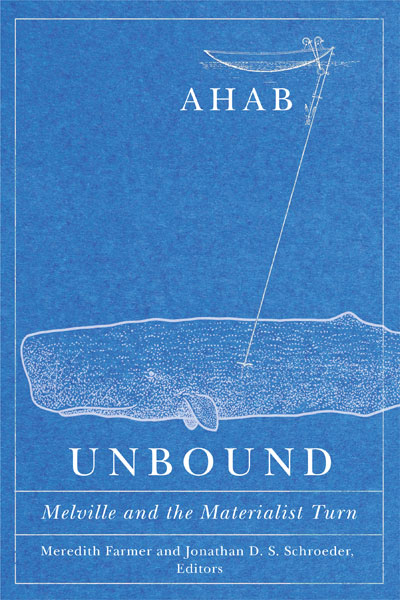
Herman Melville’s Captain Ahab is perennially seen as the paradigm of a controlling, tyrannical agent. Ahab Unbound leaves his position as a Cold War icon behind, recasting him as a contingent figure, transformed by his environment—by chemistry, electromagnetism, entomology, meteorology, diet, illness, pain, trauma, and neurons firing—in ways that unexpectedly force us to see him as worthy of our empathy and our compassion.
In sixteen essays by leading scholars, Ahab Unbound advances an urgent inquiry into Melville’s emergence as a center of gravity for materialist work, reframing his infamous whaling captain in terms of pressing conversations in animal studies, critical race and ethnic studies, disability studies, environmental humanities, medical humanities, political theory, and posthumanism. By taking Ahab as a focal point, we gather and give shape to the multitude of ways that materialism produces criticism in our current moment. Collectively, these readings challenge our thinking about the boundaries of both persons and nations, along with the racist and environmental violence caused by categories like the person and the human.
Ahab Unbound makes a compelling case for both the vitality of materialist inquiry and the continued resonance of Melville’s work.
Contributors: Branka Arsić, Columbia U; Christopher Castiglia, Pennsylvania State U; Colin Dayan, Vanderbilt U; Christian P. Haines, Pennsylvania State U; Bonnie Honig, Brown U; Jonathan Lamb, Vanderbilt U; Pilar Martínez Benedí, U of L’Aquila, Italy; Steve Mentz, St. John’s College; John Modern, Franklin and Marshall College; Mark D. Noble, Georgia State U; Samuel Otter, U of California, Berkeley; Donald E. Pease, Dartmouth College; Ralph James Savarese, Grinnell College; Russell Sbriglia, Seton Hall U; Michael D. Snediker, U of Houston; Matthew A. Taylor, U of North Carolina at Chapel Hill; Ivy Wilson, Northwestern U.
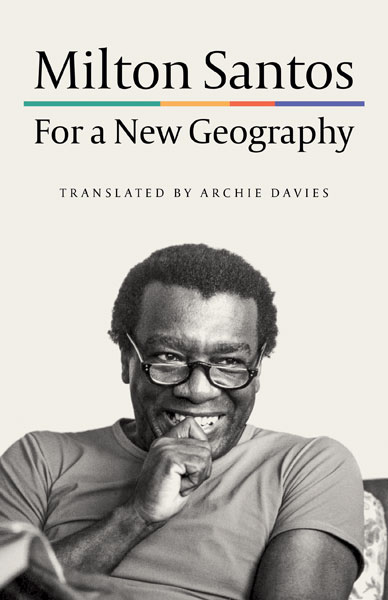
Milton Santos, For a New Geography, translated by Archie Davis – University of Minnesota Press, November 2021
[Update there is a New Books Network discussion with the translator here]
Originally published in 1978 in Portuguese, For a New Geography is a milestone in the history of critical geography and it marked the emergence of its author, Milton Santos (1926–2001), as a major interpreter of geographical thought, a prominent Afro-Brazilian public intellectual, and one of the foremost global theorists of space.
Published in the midst of a crisis in geographical thought, For a New Geography functioned as a bridge between geography’s past and its future. In advancing his vision of a geography of action and liberation, Santos begins by turning to the roots of modern geography and its colonial legacies. Moving from a critique of the shortcomings of geography from the field’s foundations as a modern science to the outline of a new field of critical geography, he sets forth both an ontology of space and a methodology for geography. In so doing, he introduces novel theoretical categories to the analysis of space. It is, in short, both a critique of the Northern, Anglo-centric discipline from within and a systematic critique of its flaws and assumptions from outside.
Critical geography has developed in the past four decades into a heterogeneous and creative field of inquiry. Though accruing a set of theoretical touchstones in the process, it has become detached from a longer and broader history of geographical thought. For a New Geographyreconciles these divergent histories. Arriving in English at a time of renewed interest in alternative geographical traditions and the history of radical geography, it takes its place in the canonical works of critical geography.