Ziad Elmarsafy, Esoteric Islam in Modern French Thought: Massignon, Corbin, Jambet – Bloomsbury, January 2021

Ziad Elmarsafy, Esoteric Islam in Modern French Thought: Massignon, Corbin, Jambet – Bloomsbury, January 2021

Why would a devout Catholic, a committed Protestant, and a Maoist atheist devote their lives and work to the study of esoteric aspects of Islam? How are these aspects ‘good to think with’? What are the theoretical and intellectual problems to which they provide solutions? These are the questions at the heart of Esoteric Islam in Modern French Thought. The three French specialists of Islam described above form an intellectual and personal genealogy that structures the core of the text: Massignon taught Corbin, who taught Jambet in his turn. Each of them found in the esoteric a solution to otherwise insurmountable problems: desire for Massignon, certainty for Corbin, and resurrection/immortality for Jambet. Over the course of three long chapters focused on the life and work of each writer, the book maps the central place of esoteric Islam in the intellectual life of twentieth and twenty-first century France.

“In this remarkable work, Ziad Elmarsafy re-opens the esoteric archive of modern French Islam. It requires a scholar of exceptional cultural, philosophical and linguistic range to even begin to do justice to Massignon, Corbin and Jambet’s work and Elmarsafy is that scholar. As he reconstructs the intellectual history of French engagements with esoteric Islam, Elmarsafy not only tells a story that has never properly been told before, but creates an entirely new genealogy of the evolution of modern French thought that forces us to re-pose classic questions about truth, subjectivity and freedom we thought we had already answered. Finally, and most importantly, however, this book beautifully exemplifies its own central argument about French esoteric Islam: Elmarsafy’s deeply affirmative readings of Massignon, Corbin and Jambet are distinguished throughout by the very intellectual hospitality or openness to the other that characterises their own engagements with the Islamic tradition. This is a major intellectual achievement by one of the most important scholars of comparative literature and thought working today and we are all in his debt.” –  Arthur Bradley, Professor of Comparative Literature, Lancaster University, UK, 

Posted in Uncategorized | Leave a comment

Stuart Elden, The Early Foucault, Polity, June 2021 – three endorsements

Stuart Elden, The Early Foucault – Polity, June 2021

Three really generous endorsements for the book, from people whose own work I really admire.

‘Elden’s compendious coverage of Foucault’s intellectual career constitutes the contemporary apogee of scholarship on Foucault.’
Mark G. E. Kelly, Western Sydney University

‘This is a work of immense scholarship. Stuart Elden provides a wealth of contextual information on Foucault’s less familiar early career.’
Clare O’Farrell, Queensland University of Technology

‘Stuart Elden’s comprehensive, finely crafted investigation of the early Foucault is much more than a contribution to Foucault studies. It’s an exemplary guide to writing intellectual history.’
Michael J. Shapiro, University of Hawai’i, Manoa

The proofs and index for the book are complete, so just waiting to see the finished thing. Here’s the back cover description:

It was not until 1961 that Foucault published his first major book,  History of Madness. He had been working as an academic for a decade, publishing a few works including a short book, teaching in Lille and Paris, organizing cultural programmes and lecturing in Uppsala, Warsaw and Hamburg. Although he published little in this period, Foucault wrote much more, some of which has been preserved and only recently become available to researchers.

Drawing on archives in France, Germany, Switzerland, Sweden and the USA, this is the most detailed study yet of Foucault’s early career. It recounts his debt to teachers including Louis Althusser, Jean Hyppolite, Maurice Merleau-Ponty and Jean Wahl; his diploma thesis on Hegel; and his early teaching career. It explores his initial encounters with Georges Canguilhem, Jacques Lacan, and Georges Dumézil, and analyses his sustained reading of Friedrich Nietzsche, Edmund Husserl and Martin Heidegger. Also included are detailed discussions of his translations of Ludwig Binswanger, Victor von Weizsäcker, and Immanuel Kant; his clinical work with Georges and Jacqueline Verdeaux; and his cultural work outside of France.

Investigating how Foucault came to write  History of Madness, Stuart Elden shows this great thinker’s deep engagement with phenomenology, anthropology and psychology. An outstanding, meticulous work of intellectual history,  The Early Foucault sheds new light on the formation of a major twentieth-century figure.

This book is the third of four major intellectual histories of Michel Foucault, exploring newly released archival material and covering the French thinker’s entire academic career.  Foucault’s Last Decade was published by Polity in 2016;  Foucault: The Birth of Power followed in 2017; and  The Archaeology of Foucault will publish in the early 2020s.

Posted in Michel Foucault, The Early Foucault | 2 Comments

Books received – Martinet, Lévi-Strauss, Althusser, Saussure, Faustino & Ferraro

Mainly second-hand books for the Foucault work, and related projects, but also a copy of the new collection The Late Foucault, edited by Martin Faustino and Gianfranco Ferraro, sent by the publisher.

Posted in Claude Lévi-Strauss, Louis Althusser, Michel Foucault | Leave a comment

Daniele Lorenzini on Foucault and Descartes (open access and video abstract) – part of Theory, Culture & Society Special Issue: ‘Foucault Before the Collège de France’

Now with a video abstract – paper is open access

stuartelden's avatarProgressive Geographies

Daniele Lorenzini’s article “Philosophical Discourse and Ascetic Practice: On Foucault’s Readings of Descartes’Meditations” is now available open access. The article is part of a Theory, Culture & Society Special Issue: ‘Foucault Before the Collège de France’ which I’m co-editing with Daniele and Orazio Irrera.

The other papers so far available are listed here, along with two video abstracts. My article is open access too; the others require subscription.

View original post

Posted in Uncategorized | 1 Comment

Sloterdijk’s Anthropotechnics – special issue of Angelaki edited by Patrick Roney and Andrea Rossi (part open-access)

Sloterdijk’s Anthropotechnics – special issue of Angelaki edited by Patrick Roney and Andrea Rossi

Contributions by Thomas Macho, Sascha Rashof, Patrick Roney, Serge Trottein, Gary E Aylesworth, Christina Howells, Andrea Rossi, Antonio Lucci, Oliver Davis, Andrea Capra, and Robert Hughes. The editorial and the articles by Davis and Hughes are open access, but the rest requires subscription.

Posted in Uncategorized | 2 Comments

Michael Saward, Democratic Design – Oxford University Press, February 2021

Michael Saward, Democratic Design – Oxford University Press, 2021

Democracy faces stern tests around the world in the twenty-first century. Democratic Design argues that to respond effectively and creatively, democrats need to work with a versatile new toolkit of concepts and institutions. The book assembles this toolkit — the democratic design framework — through an original blend of design thinking and democratic theory and practice. It shows how to use the framework to renew and enliven our ideas of democracy across a range of contexts.

The book explores a wide range of institutions, from the familiar (such as parliamentary procedures) to the innovative (such as citizens’ assemblies). It underlines the importance of systemic and contextual design, and the practical enactment of democratic values such as equality, freedom and participation.

Democratic Design shows how a comprehensive approach to rethinking the present and future of democratic governance is possible, indeed essential. It draws together, and moves beyond, the best of existing theories and models by devising a new framework that is both practical and theoretically robust.

Posted in Uncategorized | Leave a comment

Reece Jones, White Borders: The History of Race and Immigration in the United States from Chinese Exclusion to the Border Wall – Beacon 2021

Reece Jones, White Borders: The History of Race and Immigration in the United States from Chinese Exclusion to the Border Wall – Beacon, September 2021

The first book to show that racial exclusion was behind all of the United States’ immigration laws–from Chinese Exclusion through the Trump presidency.

While many Americans believe there have always been rules about who could enter the country, the reality is that the first national immigration law was not passed until 1875, ninety-nine years after the Declaration of Independence. As the first non-white Chinese immigrants arrived, Congress passed laws to ban them. In each era that followed, the fear of “the great replacement” of whites with non-white immigrations drove the push for more restrictions. Although the US is often mythologized as a nation of immigrants, the mainstreaming of anti-immigrant politics by Trump in 2016 was a reversion to the ugly norm of the past.

In White Borders, Jones reveals that since the arrival of the first slave ship in 1619, the English Colonies that became the US were based on the dual foundation of open immigration for whites from Northern Europe and racial exclusion of slaves from Africa, Native Americans, and, eventually, immigrants from other parts of the world. He exposes the connections between the Chinese Exclusion laws of the 1880s, the “Keep America American” nativism of the 1920s, and the “Build the Wall” chants of the 2010s. Along the way, we meet a bizarre cast of characters such as John Tanton, Cordelia Scaife May, and Stephen Miller who have moved fringe ideas about “white genocide” and “race suicide” into mainstream political discourse. This exposé proves that while immigration crackdowns are justified as protecting American jobs and workers, they have always been about saving the fleeting idea of a white America.

White Borders is a searing indictment of the US immigration restrictions from Chinese Exclusion through the Trump presidency. This powerful and meticulously argued book reveals that while immigration crackdowns are justified as protecting jobs and workers, they’ve always been about saving and protecting the racist idea of a white America.”
—Ibram X. Kendi, National Book Award–winning author of Stamped from the Beginning and How to Be an Antiracist

“With eloquent prose and masterful storytelling, Reece Jones narrates the hard history of immigration policies of the US settler colonial state that was founded and rooted in white supremacy, from Chinese exclusion to the border wall.”
—Roxanne Dunbar-Ortiz, author of An Indigenous Peoples’ History of the United States

Posted in Uncategorized | 1 Comment

Carl Schmitt’s Early Legal-Theoretical Writings – Cambridge University Press, May 2021

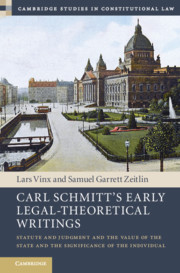
Carl Schmitt’s Early Legal-Theoretical Writings: Statute and Judgment and the Value of the State and the Significance of the Individual, edited and translated by Lars Vine and Samuel Garrett Zeitlin – Cambridge University Press, May 2021

Many of Carl Schmitt’s major works have by now been translated, with two notable exceptions: Schmitt’s two early monographs Statute and Judgment (first published in 1912) and The Value of the State and the Significance of the Individual (first published in 1914). In these two works Schmitt presents a theory of adjudication as well as an account of the state’s role in the realization of the rule of law, which together form the theoretical basis on which Schmitt later developed his political and constitutional theory. This new book makes these two key texts available in English translation for the first time, together with an introduction that relates the texts to their historical context, to Schmitt’s other works, and to contemporary discussions in legal and constitutional theory.

Posted in Uncategorized | Leave a comment

Paul A. Bové, Love’s Shadow – Harvard University Press, January 2021

Paul A. Bové, Love’s Shadow – Harvard University Press, January 2021

A case for literary critics and other humanists to stop wallowing in their aestheticized helplessness and instead turn to poetry, comedy, and love.

Literary criticism is an agent of despair, and its poster child is Walter Benjamin. Critics have spent decades stewing in his melancholy. What if, instead, we dared to love poetry, to choose comedy over Hamlet’s tragedy, or to pursue romance over Benjamin’s suicide on the edge of France, of Europe, and of civilization itself?

Paul A. Bové challenges young lit critters to throw away their shades and let the sun shine in. Love’s Shadow is his three-step manifesto for a new literary criticism that risks sentimentality and melodrama and eschews self-consciousness. The first step is to choose poetry. There has been since the time of Plato a battle between philosophy and poetry. Philosophy has championed misogyny, while poetry has championed women, like Shakespeare’s Rosalind. Philosophy is ever so stringent; try instead the sober cheerfulness of Wallace Stevens. Bové’s second step is to choose the essay. He praises Benjamin’s great friend and sometime antagonist Theodor Adorno, who gloried in writing essays, not dissertations and treatises. The third step is to choose love. If you want a Baroque hero, make that hero Rembrandt, who brought lovers to life in his paintings.

Putting aside passivity and cynicism would amount to a revolution in literary studies. Bové seeks nothing less, and he has a program for achieving it.

“An intellectual feast of the highest order. Bové’s monumental work is both magisterial and personal. He holds himself and others to the highest standards of poetic and critical excellence. And he writes with a strong sense of righteous indignation about the failures of the academy, the deterioration of intellectual integrity, and the decay of the life of the mind in our market-driven time.”—Cornel West

“A bracing journey into the mind’s powers, this book is a dynamic invitation to think thought through and to imagine otherwise, an uncompromising feat of inquiry, especially necessary in these sodden times. For anyone who believes close reading or literary criticism is dead, Bové’s pages—especially his heady retrieval of poetic making in ‘The Auroras of Autumn’—bear witness to their indelible presence.”—Colin Dayan, author of In the Belly of Her Ghost and Animal Quintet

“Modern criticism, Paul A. Bové suggests, has fallen in love with the ruins of meaning. We all are tempted by this perspective; who could entirely resist the sorrowful vision of Walter Benjamin’s angel, history piling up as mere debris? But there are alternatives, and this book explores in subtle detail the work of those—notably Rembrandt, Shakespeare, Stevens, and Adorno—who can teach us what some alternatives are.”—Michael Wood, author of On Empson and Alfred Hitchcock: The Man Who Knew Too Much

“Bové’s thinking has brought him to a fundamental insight about poetry and poetics: reality and its pressures cannot constrain humans’ ability to imagine the criteria required to meet their dreams. At once responsive and inventive, Bové’s book makes the case for the creativity and power of imagination that delights in movement of thought. I have not felt as elated by an intellectual experience since first reading Nietzsche’s On Truth and Lie in an Extra-Moral Sense.”—Donald E. Pease, author of The New American Exceptionalism

Posted in Uncategorized | 1 Comment

Nathalie Sowa, ‘Ten Things I’ve Learned Designing for a University Press’, University of Chicago Press, Blog

Nathalie Sowa, ‘Ten Things I’ve Learned Designing for a University Press‘, University of Chicago Press, Blog

We’re often introduced to a book through its cover. Catching our eye on a bookstore display, in a social media post, or shared by a favorite reviewer, covers give us a glimpse into what each book holds. But how does a cover come into existence? What goes into the process and how do designers dream them up? We checked in with Natalie Sowa, one of our very own in-house designers, to hear about working in book design. In turn, she offers the ten things she’s learned while designing covers for a university press.

Some very interesting reflections on cover design, a crucial part of book production but where authors have little insight (and often little involvement). I’ve been very pleased with the covers of my University of Chicago Press books, and those with Polity, but really unhappy with some of the ones earlier in my career.

Posted in Uncategorized | Leave a comment