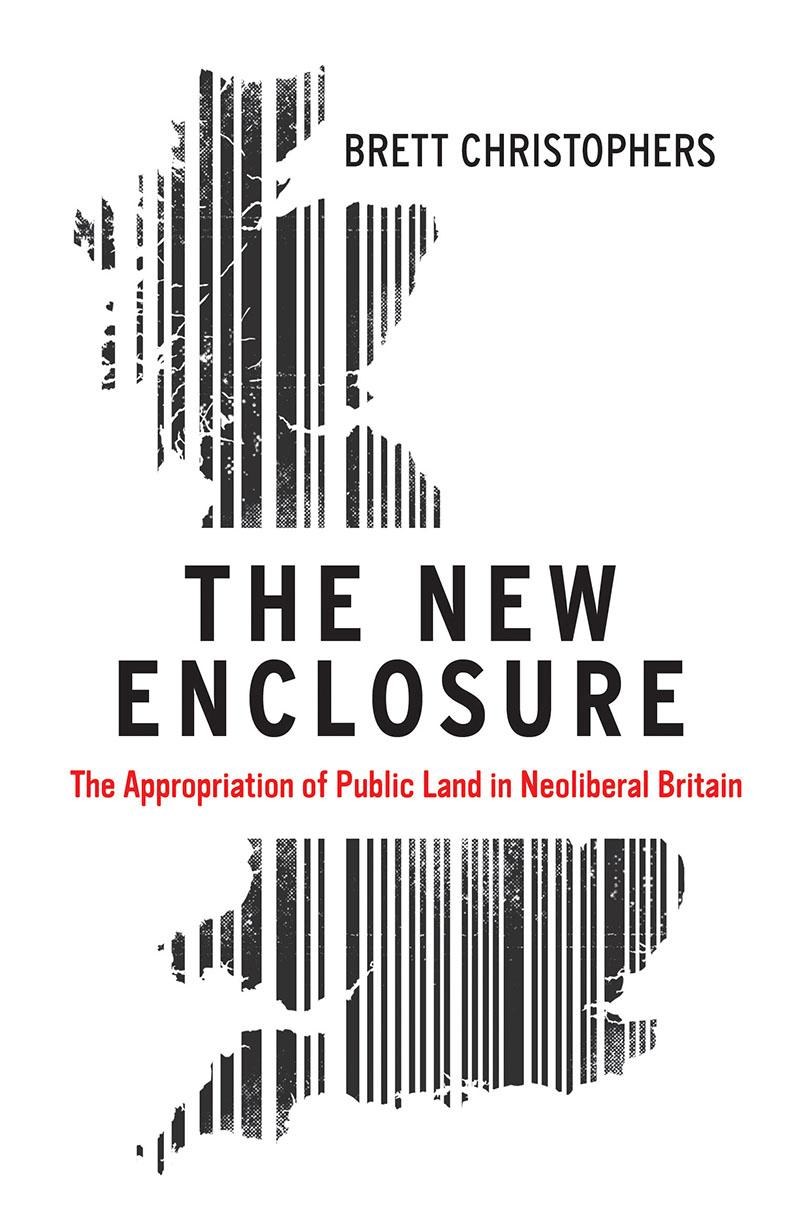
The pre-recorded lecture is following by a live discussion – November 13, 6-8pm (GMT) – details and registration here. [update: the recording is now below]
Discussants: Brett Christophers, Mary Robertson and Grace Blakeley
PLEASE NOTE: All events for HM Online are free to register, however we would ask comrades who are able to please consider making a donation, which would help us enormously in covering the costs of putting of this programme of events. You can donate by selecting the ‘donation’ ticket type at registration.
Accessibility is important for us, and we are looking into using Live Captions, but availability will depend on our financial capacities and on your support. Thank you.
Once you have registered, a link to the live session will be emailed to you on the day of the event. For any technical queries please contact historicalmaterialism@soas.ac.uk
Please consider subscribing to the Historical Materialism journal, published by BRILL, who are currently offering a 25% discount on individual subscriptions, valid until the end of the year. To use the offer, quote the discount code 70997 when subscribing at: www.brill.com/hima
Great to see the Polity page for this book is now up, and to be able to share the cover and description here.
It was not until 1961 that Foucault published his first major book, History of Madness. He had been working as an academic for a decade, publishing a few works including a short book, teaching in Lille and Paris, organizing cultural programmes and lecturing in Uppsala, Warsaw and Hamburg. Although he published little in this period, Foucault wrote much more, some of which has been preserved and only recently become available to researchers. Drawing on archives in France, Germany, Switzerland, Sweden and the USA, this is the most detailed study yet of Foucault’s early career. It recounts his debt to teachers including Louis Althusser, Jean Hyppolite, Maurice Merleau-Ponty and Jean Wahl; his diploma thesis on Hegel; and his early teaching career. It explores his initial encounters with Georges Canguilhem, Jacques Lacan, and Georges Dumézil, and analyses his sustained reading of Friedrich Nietzsche, Edmund Husserl and Martin Heidegger. Also included are detailed discussions of his translations of Ludwig Binswanger, Victor von Weizsäcker, and Immanuel Kant; his clinical work with Georges and Jacqueline Verdeaux; and his cultural work outside of France.
Investigating how Foucault came to write History of Madness, Stuart Elden shows this great thinker’s deep engagement with phenomenology, anthropology and psychology. An outstanding, meticulous work of intellectual history, The Early Foucault sheds new light on the formation of a major twentieth-century figure.
This book is the third of four major intellectual histories of Michel Foucault, exploring newly released archival material and covering the French thinker’s entire academic career. Foucault’s Last Decade was published by Polity in 2016; Foucault: The Birth of Power followed in 2017; and The Archaeology of Foucault will publish in the early 2020s.
In Biopolitics of the More-Than-Human Joseph Pugliese examines the concept of the biopolitical through a nonanthropocentric lens, arguing that more-than-human entities—from soil and orchards to animals and water—are actors and agents in their own right with legitimate claims to justice. Examining occupied Palestine, Guantánamo, and sites of US drone strikes in Afghanistan, Pakistan, Somalia, and Yemen, Pugliese challenges notions of human exceptionalism by arguing that more-than-human victims of war and colonialism are entangled with and subject to the same violent biopolitical regimes as humans. He also draws on Indigenous epistemologies that invest more-than-human entities with judicial standing to argue for an ethico-legal framework that will enable the realization of ecological justice. Bringing the more-than-human world into the purview of justice, Pugliese makes visible the ecological effects of human war that would otherwise remain outside the domains of biopolitics and law.
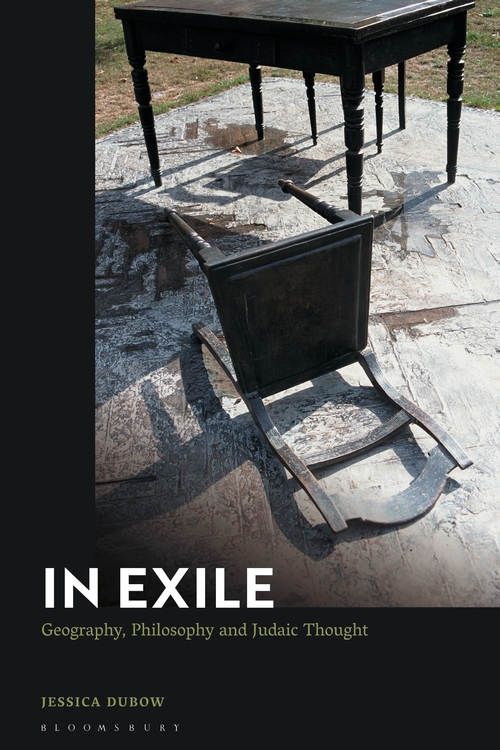
In In Exile, Jessica Dubow situates exile in a new context in which it holds both critical capacity and political potential. She not only outlines the origin of the relationship between geography and philosophy in the Judaic intellectual tradition; but also makes secular claims out of Judaism’s theological sources.
Analysing key Jewish intellectual figures such as Walter Benjamin, Isaiah Berlin and Hannah Arendt, Dubow presents exile as a form of thought and action and reconsiders attachments of identity, history, time, and territory. In her unique combination of geography, philosophy and some of the key themes in Judaic thought, she has constructed more than a study of interdisciplinary fluidity. She delivers a striking case for understanding the critical imagination in spatial terms and traces this back to a fundamental – if forgotten – exilic pull at the heart of Judaic thought.
Update: The Introduction can be read open access here.
Human twins have many meanings and different histories. They have been seen as gods and monsters, signs of danger, death and sexual deviance. They are taken as objects of wonder and violent repression, the subjects of scientific experiment. Now millions are born through fertility technologies. Their history is often buried in philosophies and medical theories, religious and scientific practices, and countless stories of devotion and tragedy.
In this history of superstitions and marvels, fantasies and experiments William Viney – himself a twin – shows how the use and abuse of twins has helped to shape the world in which we live. This book has been written for twins and for anyone interested in their historical, global and political impact.
Nigel Clark, Bronislaw Szerszynski, Planetary Social Thought: The Anthropocene Challenge to the Social Sciences – Polity, January 2021
The Anthropocene has emerged as perhaps the scientific concept of the new millennium. Going further than earlier conceptions of the human–environment relationship, Anthropocene science proposes that human activity is tipping the whole Earth system into a new state, with unpredictable consequences. Social life has become a central ingredient in the dynamics of the planet itself.
How should the social sciences respond to the opportunities and challenges posed by this development? In this innovative book, Clark and Szerszynski argue that social thinkers need to revise their own presuppositions about the social: to understand it as the product of a dynamic planet, self-organizing over deep time. They outline ‘planetary social thought’: a transdisciplinary way of thinking social life with and through the Earth. Using a range of case studies, they show how familiar social processes can be radically recast when looked at through a planetary lens, revealing how the world-transforming powers of human social life have always depended on the forging of relations with the inhuman potentialities of our home planet.
Presenting a social theory of the planetary, this book will be essential reading for students and scholars interested in humanity’s relation to the changing Earth.
I’ve mentioned before the project to diigitise Foucault’s reading notes which are now archived at the Bibliothèque national de France.
Two interesting pieces report on the project. First, a presentation given at a recent conference which gives an indication of how this will look: Marie-Laure Massot, Jean-Philippe Moreux, Vincent Ventresque, “Expérimenter Transkribus sur les fiches de lecture de Michel Foucault”, presentation; abstract
Intervention dans le cadre du colloque de clôture du projet ANR Foucault Fiches de lecture Seconde partie « Editer Michel Foucault (1994-2021) », le 26 septembre 2020 à la BnF, intitulée “Expérimenter Transkribus sur les fiches de lecture de Michel Foucault”. Entre 1994 et 2021, les textes du philosophe Michel Foucault ont fait l’objet d’une édition posthume. Un colloque dont la seconde partie a lieu à la BnF revient sur les questions qui se sont posées lors de cette entreprise de longue haleine. Cette présentation est en quelque sorte l’histoire d’une collaboration réussie entre deux projets, l’un national et thématique, l’ANR Foucault fiches de lecture et l’autre européen et plus générique : le projet Transkribus-Read qui souhaiterait révolutionner l’accès aux documents manuscrits en développant des outils numériques innovants : présentation des fonctionnalités et des usages de Transkribus, une plateforme de reconnaissance et d’enrichissement de documents d’archives, et résultats des tests réalisés pour transcrire automatiquement l’écriture de Michel Foucault. En annexe un document ressource et un scénario pour tester le logiciel Transkribus sur les fiches de lecture du philosophe.
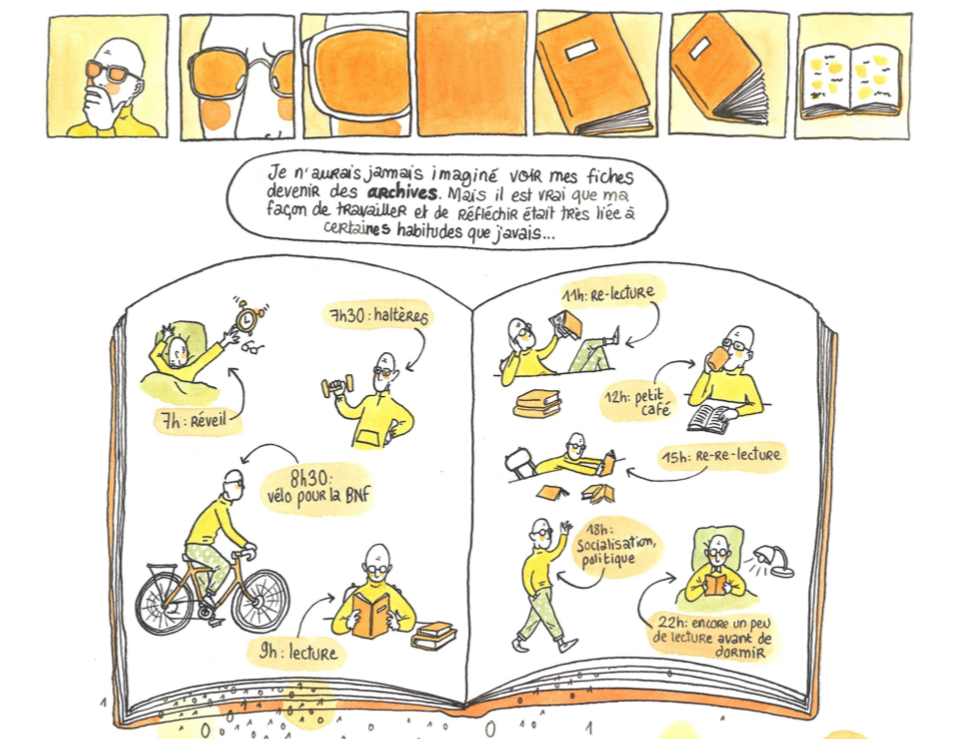
Second, an innovative graphic novel style presentation of the ideas behind it: Adèle Huguet, Carolina Verlengia, Marie-Laure Massot, “Mise en BD du projet Foucault fiches de lecture”, paper, abstract
En proposant la numérisation des fiches de lecture de Michel Foucault (1926-1984) conservées à la BnF, le projet Foucault Fiches de Lecture vise une approche de son oeuvre fondée sur l’analyse des pratiques de lecture du philosophe et de ses cheminements de pensée. Ce corpus de plusieurs milliers de feuillets contient une collection considérable de citations et de références, organisées et commentées par Foucault pour la préparation de ses livres et de ses cours. Il ne s’agit pas seulement de rendre accessibles les sources du philosophe, mais de contribuer à l’élaboration d’une herméneutique philosophique, reposant sur l’analyse des pratiques documentaires et des styles de travail de Foucault. La plateforme FFL-EMAN, véritable espace de consultation et de recherche des documents de travail du philosophe, permet à la communauté scientifique et plus largement au public de participer à ce projet d’envergure coordonné par Michel Senellart, puis Laurent Dartigues et financé de 2017 à 2020 par l’Agence Nationale de la recherche.
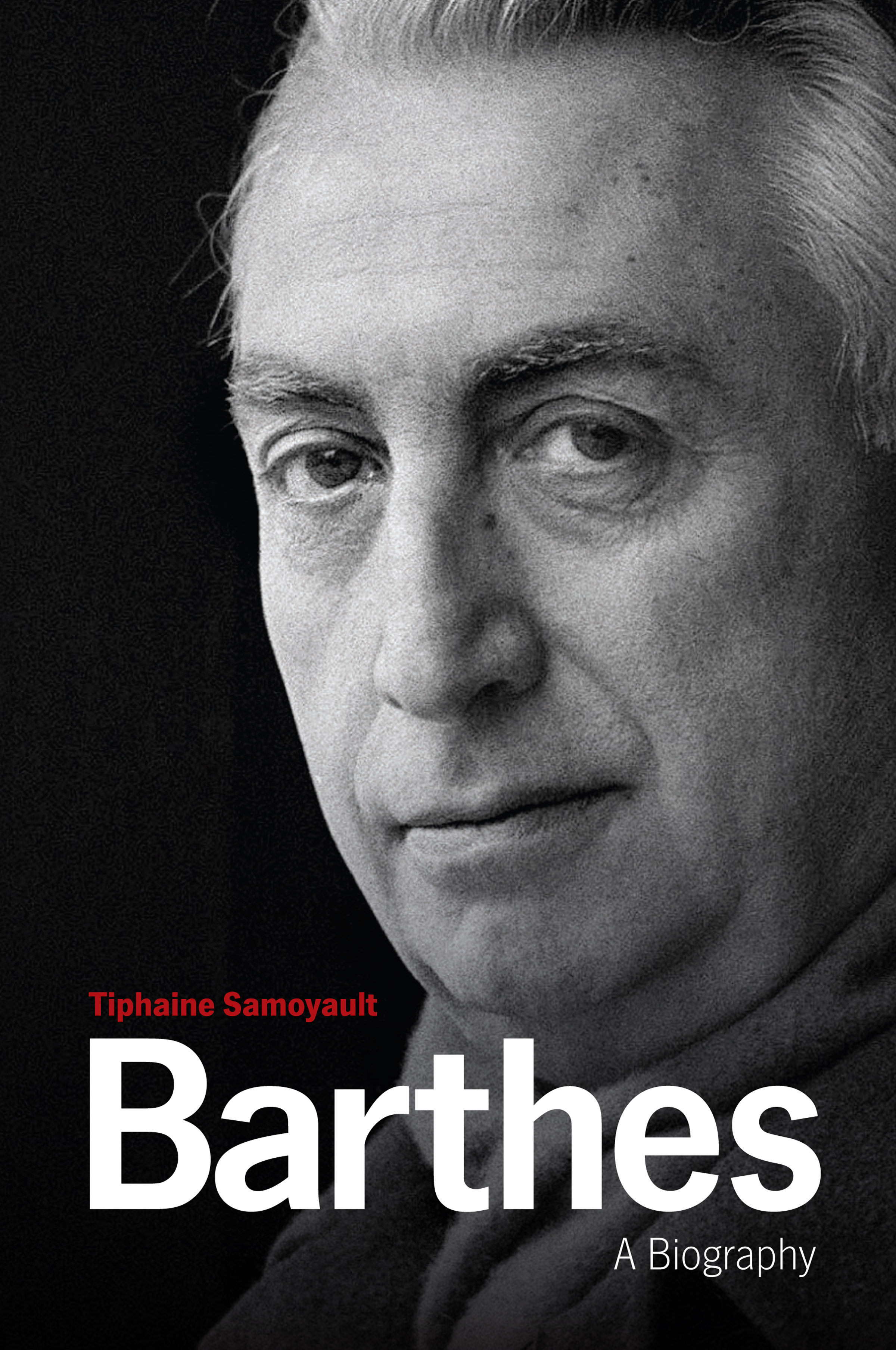
Tiphanie Samoyault on the process of writing her biography of Roland Barthes
I worked hard, taking the historian’s approach to begin with: spent whole days consulting the archives; moving on to interviews (which weren’t actually that useful because my interviewees all remembered the very same traits, fixed like legends in their memory); reading the work in chronological order of its writing. This is an interesting point and one on which I would like to dwell for a moment. Most of the time we read authors from the past – even the recent past – in the wrong order, according to spatial or thematic contiguity. If you’re writing the biography of a writer or an intellectual, it is interesting to see how the work unfolds over time, it is the temporal contiguities that matter and that are revelatory. I would say that at certain points I shed new light on the work as a result of this chronological reading. During all of this, I had no sense of how I was going to move from the research to the writing.
And then one day it happened: I realized that in order to start writing the truth of his life (or at least what I thought was the truth of his life), I had to cut across the legend. Because since his death Barthes has become a kind of mythological figure. That’s why I began by narrating his death, the idea was to cut across that legend so as to be able to write his life. I had at least 20 different stories about Barthes’ death, which is a recent event, with facts that differed enormously from one story to the next, and what do you do with all those stories, obviously stories that not only feature in memories but also in novels, histories, short stories? By beginning with this chapter about his death I was able to start writing. And after that I didn’t stop, it all came very quickly and it was very easy because I was writing ‘in company’. Every morning, when I sat back down at my desk to write, I felt as though I were returning to a friend. And then in the end, when I encountered Barthes’ death again, it was no longer a legend, it was a fact: true, real, concrete. And that was when I turned off my computer, went out into the street and cried.
Tiphanie Samoyault and Sunil Manghani, “On Barthes’ Biography: A Dialogue”, Theory, Culture & Society 37 (4), 2020,43-63, 48-49.
The interview is open access (at least at the moment). The French edition of the book was published by Seuil in 2015; and translated by Andrew Brown for Polity in 2017.
Rita Felski and Stephen Muecke (eds.), Latour and the Humanities – Johns Hopkins University Press, September 2020
How does the work of influential theorist Bruno Latour offer a fresh angle on the practices and purposes of the humanities?
In recent years, defenses of the humanities have tended to argue along predictable lines: the humanities foster empathy, the humanities encourage critical thinking, the humanities offer a counterweight to the cold calculations of the natural and social sciences. The essays in Latour and the Humanities take a different approach. Exploring the relevance of theorist Bruno Latour’s work, they argue for attachments and entanglements between the humanities and the sciences while looking closely at the interests, institutions, and intellectual projects that shape the humanities within and beyond the university.
The collection, which is written by a group of highly distinguished scholars from around the world, is divided into two sections. In the first part, authors engage in depth with Latour’s work while also rethinking the ties between the humanities and the sciences. Essays argue for greater attention to the nonhuman world, the urgency of climate change, and more nuanced views of universities as institutions. The second half of the volume contains essays that reflect on Latour’s influence on the practices of specific disciplines, including art, the digital humanities, film studies, and political theory.
Inspiring conversation about the relevance of actor-network-theory for research and teaching in the humanities, Latour and the Humanities offers a substantial introduction to Latour’s work while discussing the humanities without falling back on the genres of either the sermon or the jeremiad. This volume will be of interest to all those searching for fresh perspectives on the value and importance of humanistic disciplines and thought.
Contributors: David J. Alworth, Anders Blok, Claudia Breger, Dipesh Chakrabarty, Yves Citton, Steven Connor, Gerard de Vries, Simon During, Rita Felski, Francis Halsall, Graham Harman, Antoine Hennion, Casper Bruun Jensen, Bruno Latour, Heather Love, Patrice Maniglier, Stephen Muecke, Barbara Herrnstein Smith, Nigel Thrift, Michael Witmore
First published as What is Rhythmanalysis?, this title is now available as part of the Bloomsbury Research Methods series.
In recent years, there has been growing interest in Henri Lefebvre’s posthumously published volume, Rhythmanalysis. For Lefebvre and subsequent scholars, rhythmanalysis is a research strategy which offers a means of thinking space and time together in the study of everyday life, and this remains its strength and appeal.
This book addresses the task of how to do rhythmanalysis. It discusses the history and development of rhythmanalysis from Lefebvre to the present day in a range of fields including cultural history and studies of place, work and nature. For Lefebvre, it is necessary to be ‘grasped by’ a rhythm at a bodily level in order to grasp it. And yet we also need critical distance to fully understand it. Rhythmanalysis is therefore both corporeal and conceptual. This book considers how the body is directly deployed as a research tool in rhythmanalytical research as well as how audio-visual methods can get at rhythm beyond the capacity of the senses to perceive it. In particular, the book includes detailed discussion of research on different forms of mobility – from driving to dancing – and on the social life of markets – from finance to fish.
Dawn Lyon highlights the gains, limitations and lively potential of rhythmanalysis for spatially, temporally and sensually attuned practices of research. This engaging text will be of interest to students and researchers in sociology, criminology, socio-legal studies, geography, urban studies, architecture, anthropology, economics and cultural studies.