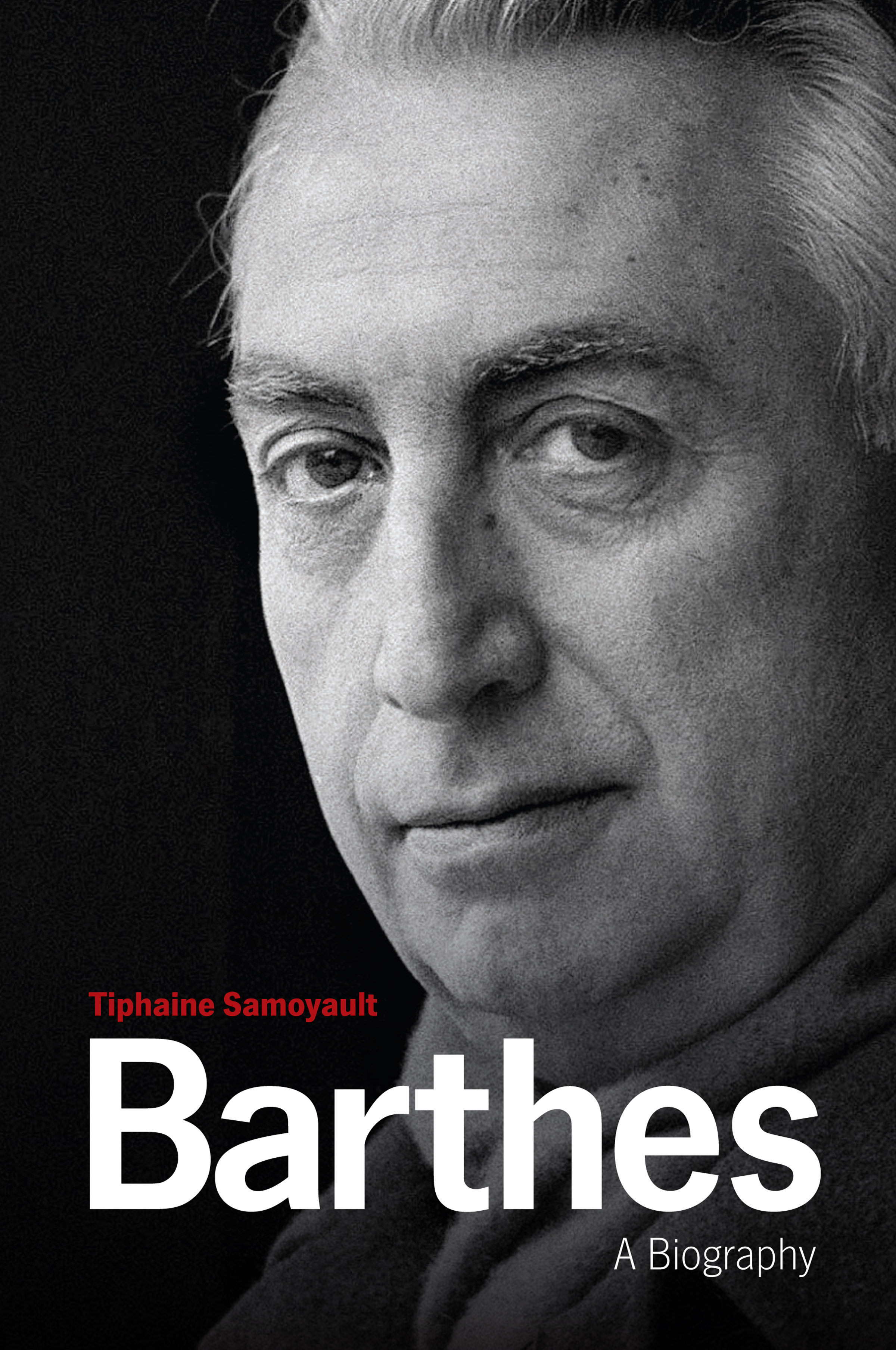
Tiphanie Samoyault on the process of writing her biography of Roland Barthes (Seuil 2015; Polity 2017)

Tiphanie Samoyault on the process of writing her biography of Roland Barthes

I worked hard, taking the historian’s approach to begin with: spent whole days consulting the archives; moving on to interviews (which weren’t actually that useful because my interviewees all remembered the very same traits, fixed like legends in their memory); reading the work in chronological order of its writing. This is an interesting point and one on which I would like to dwell for a moment. Most of the time we read authors from the past – even the recent past – in the wrong order, according to spatial or thematic contiguity. If you’re writing the biography of a writer or an intellectual, it is interesting to see how the work unfolds over time, it is the temporal contiguities that matter and that are revelatory. I would say that at certain points I shed new light on the work as a result of this chronological reading. During all of this, I had no sense of how I was going to move from the research to the writing.

And then one day it happened: I realized that in order to start writing the truth of his life (or at least what I thought was the truth of his life), I had to cut across the legend. Because since his death Barthes has become a kind of mythological figure. That’s why I began by narrating his death, the idea was to cut across that legend so as to be able to write his life. I had at least 20 different stories about Barthes’ death, which is a recent event, with facts that differed enormously from one story to the next, and what do you do with all those stories, obviously stories that not only feature in memories but also in novels, histories, short stories? By beginning with this chapter about his death I was able to start writing. And after that I didn’t stop, it all came very quickly and it was very easy because I was writing ‘in company’. Every morning, when I sat back down at my desk to write, I felt as though I were returning to a friend. And then in the end, when I encountered Barthes’ death again, it was no longer a legend, it was a fact: true, real, concrete. And that was when I turned off my computer, went out into the street and cried.

Tiphanie Samoyault and Sunil Manghani, “On Barthes’ Biography: A Dialogue”, Theory, Culture & Society 37 (4), 2020,43-63, 48-49.


The interview is open access (at least at the moment). The French edition of the book was published by Seuil in 2015; and translated by Andrew Brown for Polity in 2017.

Posted in Uncategorized | Leave a comment

Rita Felski and Stephen Muecke (eds.), Latour and the Humanities – Johns Hopkins University Press, September 2020

Rita Felski and Stephen Muecke (eds.), Latour and the Humanities – Johns Hopkins University Press, September 2020

How does the work of influential theorist Bruno Latour offer a fresh angle on the practices and purposes of the humanities?

In recent years, defenses of the humanities have tended to argue along predictable lines: the humanities foster empathy, the humanities encourage critical thinking, the humanities offer a counterweight to the cold calculations of the natural and social sciences. The essays in Latour and the Humanities take a different approach. Exploring the relevance of theorist Bruno Latour’s work, they argue for attachments and entanglements between the humanities and the sciences while looking closely at the interests, institutions, and intellectual projects that shape the humanities within and beyond the university.

The collection, which is written by a group of highly distinguished scholars from around the world, is divided into two sections. In the first part, authors engage in depth with Latour’s work while also rethinking the ties between the humanities and the sciences. Essays argue for greater attention to the nonhuman world, the urgency of climate change, and more nuanced views of universities as institutions. The second half of the volume contains essays that reflect on Latour’s influence on the practices of specific disciplines, including art, the digital humanities, film studies, and political theory.

Inspiring conversation about the relevance of actor-network-theory for research and teaching in the humanities, Latour and the Humanities offers a substantial introduction to Latour’s work while discussing the humanities without falling back on the genres of either the sermon or the jeremiad. This volume will be of interest to all those searching for fresh perspectives on the value and importance of humanistic disciplines and thought.

Contributors: David J. Alworth, Anders Blok, Claudia Breger, Dipesh Chakrabarty, Yves Citton, Steven Connor, Gerard de Vries, Simon During, Rita Felski, Francis Halsall, Graham Harman, Antoine Hennion, Casper Bruun Jensen, Bruno Latour, Heather Love, Patrice Maniglier, Stephen Muecke, Barbara Herrnstein Smith, Nigel Thrift, Michael Witmore

Posted in Bruno Latour, Graham Harman, Nigel Thrift | Leave a comment

Dawn Lyon, Rhythmanalysis: Research Methods – Bloomsbury, December 2020

Dawn Lyon, Rhythmanalysis: Research Methods – Bloomsbury, December 2020

First published as What is Rhythmanalysis?, this title is now available as part of the Bloomsbury Research Methods series.

In recent years, there has been growing interest in Henri Lefebvre’s posthumously published volume, Rhythmanalysis. For Lefebvre and subsequent scholars, rhythmanalysis is a research strategy which offers a means of thinking space and time together in the study of everyday life, and this remains its strength and appeal.

This book addresses the task of how to do rhythmanalysis. It discusses the history and development of rhythmanalysis from Lefebvre to the present day in a range of fields including cultural history and studies of place, work and nature. For Lefebvre, it is necessary to be ‘grasped by’ a rhythm at a bodily level in order to grasp it. And yet we also need critical distance to fully understand it. Rhythmanalysis is therefore both corporeal and conceptual. This book considers how the body is directly deployed as a research tool in rhythmanalytical research as well as how audio-visual methods can get at rhythm beyond the capacity of the senses to perceive it. In particular, the book includes detailed discussion of research on different forms of mobility – from driving to dancing – and on the social life of markets – from finance to fish.

Dawn Lyon highlights the gains, limitations and lively potential of rhythmanalysis for spatially, temporally and sensually attuned practices of research. This engaging text will be of interest to students and researchers in sociology, criminology, socio-legal studies, geography, urban studies, architecture, anthropology, economics and cultural studies.

Posted in Henri Lefebvre | Leave a comment

Azucena G. Blanco, Literature and Politics in the Later Foucault – De Gruyter, November 2020 (currently open access e-book)

Azucena G. Blanco, Literature and Politics in the Later Foucault – De Gruyter, November 2020.

This appears to be currently open access as an e-book.

This study proposes a revised interpretation of Foucault’s views on literature. It has been argued that the philosopher’s interest in literature was limited to the 1960s and of a mostly depoliticized nature. However, Foucault’s previously unpublished later works suggest a different reality, showing a sustained interest in literature and its politics. In the light of this new material, the book repositions Foucault’s ideas within recent debates on the politics of literature.

Posted in Michel Foucault | 3 Comments

Christopher Harker, Spacing Debt: Obligations, Violence, and Endurance in Ramallah, Palestine – Duke University Press, December 2020

Now updated with a link to the open access Introduction

stuartelden's avatarProgressive Geographies

Christopher Harker, Spacing Debt: Obligations, Violence, and Endurance in Ramallah, Palestine – Duke University Press, December 2020

In Spacing Debt Christopher Harker demonstrates that financial debt is as much a spatial phenomenon as it is a temporal and social one. Harker traces the emergence of debt in Ramallah after 2008 as part of the financialization of the Palestinian economy under Israeli settler colonialism. Debt contributes to processes through which Palestinians are kept economically unstable and subordinate. He draws extensively on residents’ accounts of living with the explosion of personal debt to highlight the entanglement of consumer credit with other obligatory relations among family, friends, and institutions. Harker offers a new geographical theorization of debt, showing how debt affects urban space, including the movement of bodies through the city, localized economies, and the political violence associated with occupation. Bringing cultural and urban imaginaries into conversation with monetized debt, Harker shows how…

View original post 108 more words

Posted in Uncategorized | 1 Comment

Samantha Rose Hill, Hannah Arendt and the politics of truth – Open Democracy; and details of her book on Arendt – Reaktion, May 2021

Samantha Rose Hill, Hannah Arendt and the politics of truth – Open Democracy

Her book Hannah Arendt is forthcoming with Reaktion in 2021

Hannah Arendt is one of the most renowned political thinkers of the twentieth century and her work has never been more relevant than it is today. Born in Germany in 1906, Arendt published her first book at the age of 23, before turning away from the world of academic philosophy to reckon with the rise of the Third Reich. After the War, Arendt became one of the most prominent – and controversial – public intellectuals of her time, publishing influential works such as The Origins of TotalitarianismThe Human Condition and Eichmann in Jerusalem.

Samantha Rose Hill weaves together new biographical detail, archival documents, poems and correspondence to reveal a woman whose passion for the life of the mind was nourished by her love of the world.

Posted in Hannah Arendt | Leave a comment

Bahriye Kemal, Writing Cyprus: Postcolonial and Partitioned Literatures of Place and Space – Routledge, October 2019

Bahriye Kemal, Writing Cyprus: Postcolonial and Partitioned Literatures of Place and Space – Routledge, October 2019

Bahriye Kemal’s ground-breaking new work serves as the first study of the literatures of Cyprus from a postcolonial and partition perspective. Her book explores Anglophone, Hellenophone and Turkophone writings from the 1920s to the present.

Drawing on Yi-Fu Tuan’s humanistic geography and Henri Lefebvre’s Marxist philosophy, Kemal proposes a new interdisciplinary spatial model, at once theoretical and empirical, that demonstrates the power of space and place in postcolonial partition cases. The book shows the ways that place and space determine identity so as to create identifications; together these places, spaces and identifications are always in production. In analysing practices of writing, inventing, experiencing, reading, and construction, the book offers a distinct ‘solidarity’ that captures the ‘truth of space’ and place for the production of multiple-mutable Cypruses shaped by and for multiple-mutable selves, ending in a ‘differential’ Cyprus, Mediterranean, and world.

Writing Cyprus offers not only a nuanced understanding of the actual and active production of colonialism, postcolonialism and partition that dismantles the dominant binary legacy of historical-political deadlock discourse, but a fruitful model for understanding other sites of conflict and division

Posted in Uncategorized | Leave a comment

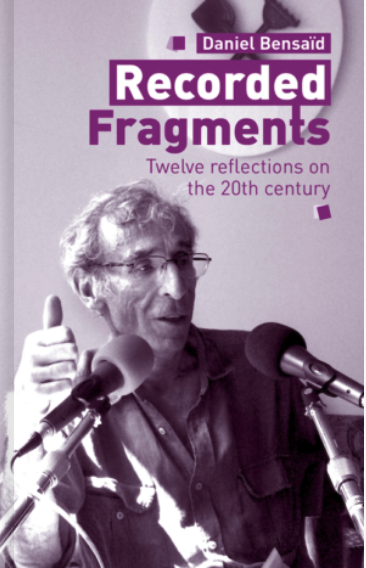
Daniel Bensaïd, Recorded Fragments: Twelve reflections on the 20th century – Resistance Books, November 2020

Daniel Bensaïd, Recorded Fragments: Twelve reflections on the 20th century – Resistance Books, November 2020

These interviews with Daniel Bensaïd were broadcast in 2008 on the radio station Fréquence Paris Plurielle. Through them, Bensaïd gives his insight into twelve significant events including the October Revolution, the Spanish Civil War, the assassination of Lumumba, the 1973 coup in Chile, and the fall of the Berlin Wall. These milestones of the ‘short twentieth century’ are necessarily a biased and partial choice. In this book, one reads some of the main analyses that structure Daniel Bensaïd’s thinking at the beginning of the 21st century.

Posted in Uncategorized | Leave a comment

Mark Cousins (1947-2020)

Sorry to hear this news of Mark Cousins – co-author of one of the first books on Foucault and an important figure in architectural theory.

Clare O'Farrell's avatarFoucault News

Ryan Dillon, Mark Morris, Denis Macshane
Mark Cousins: Architectural theorist who captivated experts and enthusiasts alike, Independent, 22 October 2020

(photo: Pichan Sujaritsatit)
For more than 30 years, Mark Cousins’s Friday evening lectures at the Architectural Association were the place to be, not only for those who worked and studied at the school in London, but for people from all walks of life. An intellectual and theoretician, he was much loved by students and staff alike; a constant presence in the spaces of the AA and always ready to engage in or instigate an impromptu conversation.
[…]

Cousins was widely recognised as one of the best minds amongst his contemporaries, and a brilliant speaker, whether sitting around a dinner table or standing behind a lectern delivering countless talks and lectures. Despite co-authoring (with Athar Hussein) Michel Foucault (1984), his only completed book, he was mostly unable to translate…

View original post 113 more words

Posted in Uncategorized | Leave a comment

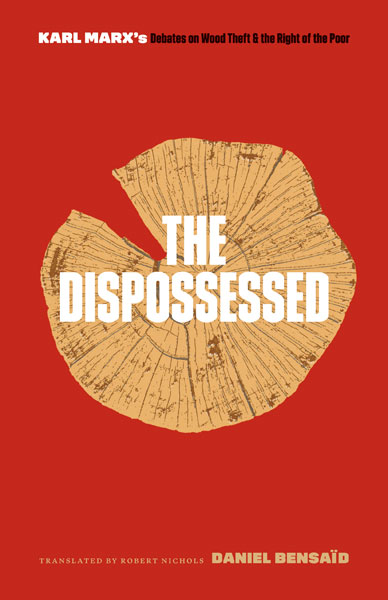
Daniel Bensaïd, The Dispossessed: Karl Marx’s Debates on Wood Theft and the Right of the Poor – University of Minnesota Press, March 2021

Daniel Bensaïd, The Dispossessed: Karl Marx’s Debates on Wood Theft and the Right of the Poor – University of Minnesota Press, translated by Robert Nichols, March 2021

The politics of dispossession are everywhere. Troubling developments in intellectual property, genomics, and biotechnology are undermining established concepts of property, while land appropriation and ecological crises reconfigure basic institutions of ownership. In The Dispossessed, Daniel Bensaïd examines Karl Marx’s early writings to establish a new framework for addressing the rights of the poor, the idea of the commons, and private property as a social institution.

In his series of articles from 1842–43 about Rhineland parliamentary debates over the privatization of public lands and criminalization of poverty under the rubric of the “theft of wood,” Marx identified broader anxieties about customary law, property rights, and capitalist efforts to privatize the commons. Bensaïd studies these writings to interrogate how dispossession continues to function today as a key modality of power. Brilliantly tacking between past and present, The Dispossessed discloses continuity and rupture in our relationships to property and, through that, to one another.

In addition to Bensaïd’s prescient work of political philosophy, The Dispossessed includes new translations of Marx’s original “theft of wood” articles and an introductory essay by Robert Nichols that lucidly contextualizes the essays.

Posted in Uncategorized | 1 Comment