NYU and Bologna talks cancelled

Unfortunately two forthcoming talks, at New York University on 26 March 2020 and at the University of Bologna on 12 May 2020, have been cancelled. The organisers and I hope they can been rearranged for a later date.

I cut my time in Uppsala short last week, and now won’t get to the Yale and Princeton libraries I’d planned to visit on the US trip. I’ve also had to cancel a few days in Paris. Most of these things were cancelled shortly before more and more things started to get restricted. All minor in the big picture, of course.

Posted in Conferences, Michel Foucault, The Early Foucault, Uncategorized | 2 Comments

Books received – Cacciari, Webster, Shakespeare, Jardine, Butler, Lefebvre, Iyengar, Beaufret

IMG_2165.jpg

Mainly in recompense for review work for Bloomsbury, including the final volume of the Arden Shakespeare Third Series, and Alice Jardine’s biography of Julia Kristeva, along with Judith Butler’s new book The Force of Nonviolence, Henri Lefebvre, Hegel, Marx, Nietzsche or the Realm of Shadows, and the first volume of Jean Beaufret’s Leçons de Philosophie.

Posted in Henri Lefebvre, Judith Butler, Julia Kristeva, Uncategorized, William Shakespeare | 1 Comment

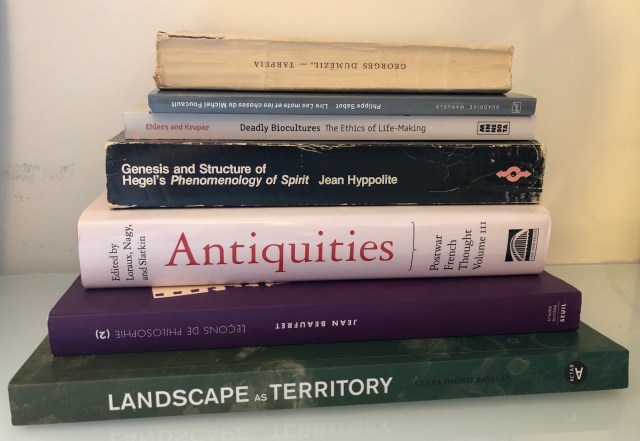
Books received – Dumézil, Sabot, Ehlers and Krupar, Hyppolite, Loraux et al, Beaufret, Landscape as Territory

A mixed pile of things, mainly bought second-hand; along with two books I was sent – Nadine Ehlers and Shiloh Krupar, Deadly Biocultures: The Ethics of Life-Making, and Landscape as Territory, edited by Clara Olóriz Sanjuán. The last has a transcription of a lecture I gave at the Architectural Association. It’s a visually stunning collection and I’m looking forward to the other contributions.

IMG_2166.jpg

Posted in Georg Wilhelm Friedrich Hegel, Georges Dumézil, Michel Foucault, Territory, Uncategorized | Leave a comment

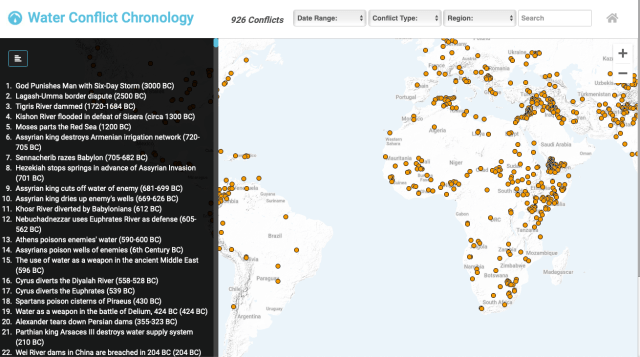
Mapping water conflicts

Screenshot 2020-02-28 at 09.50.58

http://www.worldwater.org/conflict/map/ – thanks to dmf for the link to this and the podcast in a previous post.

Posted in Uncategorized | Leave a comment

Interstitial – Podcast on space and consequences of our designs

Interstitial – Podcast on space and consequences of our designs

Each episode features one author on a new book that offers critical ways of understanding the worlds we make. Transdisciplinary perspectives from across the arts, social sciences, and humanities every Tuesday. Produced by David Huber.

Posted in Uncategorized | Leave a comment

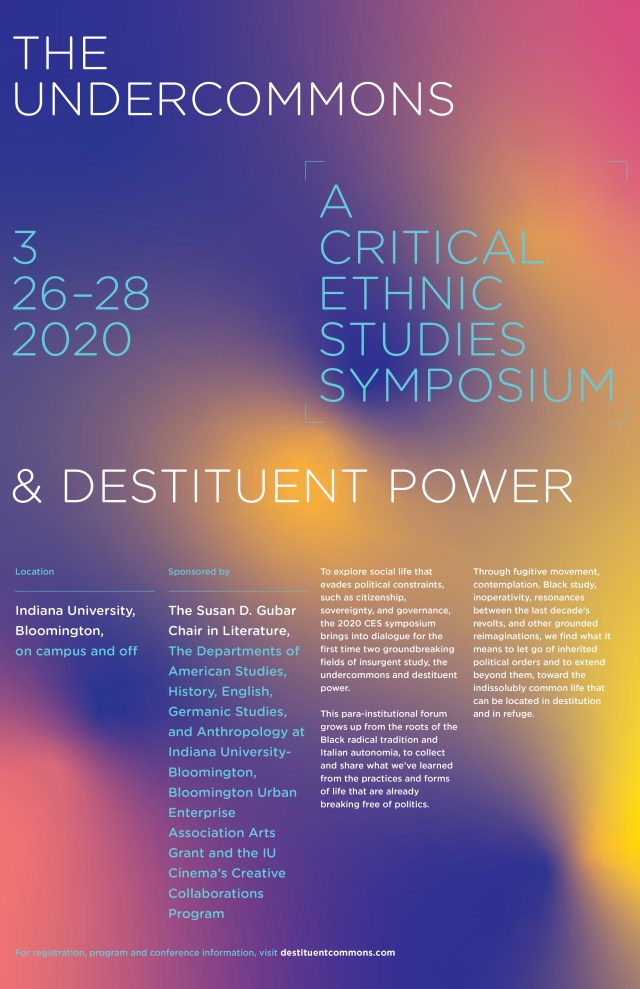
The Undercommons and Destituent Power, Indiana University, March 26-28, 2020

Copy of dest con no bleed-01.jpgThe Undercommons and Destituent Power, Indiana University, March 26-28, 2020 – full details here.

On March 26-28, 2020, Indiana University’s annual Critical Ethnic Studies symposium will bring into dialogue two fields of insurgent study: the undercommons and destituent power.

To explore social life that evades political constraints, such as citizenship, sovereignty, and governance, we turn to the groundbreaking work of Fred Moten, Stefano Harney and Giorgio Agamben.

This para-institutional forum grows up from the roots of the Black radical tradition and Italian autonomia, to collect and share what we’ve learned from the practices and forms of life that are already breaking free of politics.

Through fugitive movement, contemplation, Black study, inoperativity, resonances between the last decade’s revolts, and other grounded reimaginations, we find what it means to let go of inherited political orders and to extend beyond them, toward the indissolubly common life that can be located in destitution and in refuge.

Posted in Uncategorized | Leave a comment

On Geographies of Violence: Michael Watts interviewed by Stuart Elden (Society and Space archive)

5e3c4eb362272561035bea67_boarding-oil-platform-2005On Geographies of Violence: Michael Watts interviewed by Stuart Elden

An interview I did with Michael Watts a few years ago has been reposted on the Society and Space magazine site. Many thanks to Natalie Oswin for making this available again.

Posted in Uncategorized | 1 Comment

Books bought in Paris – Foucault, Merleau-Ponty, Mbembe, Poitevin, Sabot, Sforzini

IMG_2021.jpg

I’ve tried to be fairly disciplined, given I’ve got to carry everything home, but a few books old and new that I’ve picked up over the past few weeks.

Posted in Achille Mbembe, Georges Dumézil, Maurice Merleau-Ponty, Michel Foucault, Uncategorized | 2 Comments

The Raymond Williams Recordings

News of a fascinating project to make available some recordings of Raymond Williams.

Raymond Williams Society's avatarThe Raymond Williams Society

On the Raymond Williams Society blog for February we have details of a new project by Phil O’Brien on a fascinating collection of recordings of lectures and readings given by Williams in the 1970s and ’80s.

View original post 912 more words

Posted in Uncategorized | Leave a comment

Achille Mbembe, Brutalisme, Éditions de la Découverte, February 2020

9782348057496Achille Mbembe, Brutalisme, Éditions de la Découverte, February 2020

Just out, the new book from Achille Mbembe.

Toutes les sphères de l’existence sont désormais pénétrées par le capital, et la mise en ordre des sociétés humaines s’effectue dorénavant selon une seule et même directive, celle de la computation numérique. Mais alors que tout pousse vers une unification sans précédent de la planète, le vieux monde des corps et des distances, de la matière et des étendues, des espaces et des frontières, persiste en se métamorphosant. Cette transformation de l’horizon du calcul se conjugue paradoxalement avec un retour spectaculaire de l’animisme, qui s’exprime non sur le modèle du culte des ancêtres, mais du culte de soi et de nos multiples doubles que sont les objets.
Avec le devenir-artificiel de l’humanité et son pendant, le devenir-humain des machines, une sorte d’épreuve existentielle est donc engagée. L’être ne s’éprouve plus désormais qu’en tant qu’assemblage indissociablement humain et non humain. La transformation de la force en dernier mot de la vérité de l’être signe l’entrée dans le dernier âge de l’homme, celui de l’être fabricable dans un monde fabriqué. À cet âge, Achille Mbembe donne ici le nom de brutalisme, le grand fardeau de fer de notre époque, le poids des matières brutes.
La transformation de l’humanité en matière et énergie est le projet ultime du brutalisme. En détaillant la monumentalité et le gigantisme d’un tel projet, cet essai plaide en faveur d’une refondation de la communauté des humains en solidarité avec l’ensemble du vivant, qui n’adviendra cependant qu’à condition de réparer ce qui a été brisé.

Update: Terence Blake translates the French description to English here.

Update 2: Mbembe’s earlier book Sur la postcolonie has just been reissued.

Posted in Achille Mbembe, Uncategorized | 3 Comments