Cancelled – Advances in Political Geography workshop, St John’s College, University of Oxford, 28 May 2020

The Advances in Political Geography workshop, to be held at St John’s College, University of Oxford, on 28 May 2020 has been cancelled. This means that all my forthcoming talks have now been cancelled, though the organisers and I hope that some can be rearranged at some future point. I was due to speak in Oxford on “Foucault in the Archives”. Audio recordings of two previous talks on that work are available here.

Posted in Conferences, Michel Foucault, The Early Foucault, Uncategorized | Leave a comment

The Early Foucault Update 31: IMEC, Paris, Uppsala and the impact of the coronavirus

As an earlier post said, I’ve had to cancel two talks – in New York and Bologna – and some archival work because of the current medical situation. There is a bit more on that below, but as much as possible I’m trying to continue work on The Early Foucault manuscript, as concentration and other tasks allow, and with restrictions about what I can access. The responses to a post about what this blog should and shouldn’t do over the coming weeks were that I should continue to post things as and when appropriate, so I will continue to do that. Most of what is written below is about the work I did before everything started to change. I hope it is of interest and gives a sense of how I have been working on this book over the past few weeks.


The second half of my time in France in February was spent first at IMEC, and then back in Paris. I’ve spoken before about what a wonderful place IMEC is to work – the setting, the beautiful reading room, the good food, company and helpful staff. It really is a joy to work here, and my only regret is that I don’t need to use it more.

While there, I mainly worked with the Louis Althusser collection – going back over some things I’d seen before, and some new material. Althusser kept notes on the students he prepared for the agrégation exam, including Foucault and Derrida, and these give some useful information. He moved from being a teacher to a friend and colleague when Foucault passed the agrégation on the second attempt in 1951. A decade later, when History of Madness came out, Foucault sent him a copy, and Althusser read it and annotated it extensively. That copy is in the archive at IMEC. He writes about the experience of reading the book in a couple of letters to Franca Madonia. He then presented on it on a seminar at the ENS, and Etienne Balibar’s notes on that seminar are also at IMEC. At the moment I think my discussion of Althusser’s engagement with the book will sit alongside a discussion of Derrida’s critique of it in my study of the 1960s, and for that I want to see Derrida’s copy of History of Madness, which is at Princeton.

I also looked, again, at Jacques Lagrange’s notes on Foucault’s teaching at the ENS, which are also at IMEC. Although I’m very cautious about using student notes as a source for what was actually said, they are helpful as a reference point for topics taught and when. There are some other student notes in Paris, and what remains of Foucault’s own course manuscripts are at the BNF. I’m not the only person trying to put these pieces together, as I know the editors of these texts are doing something similar, but between these three sources we can, I think, reconstruct some sense of what and how Foucault taught. Having these three sources in three different locations makes that work difficult, so I try to take full notes in each place so I can compare.

The last research I did at IMEC was to look at some of the other books from Althusser’s library, mainly Foucault’s 1960s works, and at some of things they have in the Jean Wahl collection. I didn’t order up things from the archive of Wahl, but used the library collection – several of Wahl’s many courses were published, but copies can be very hard to find. I also made use of the ‘inventaire’ for the collection which is really helpful in dating things. Wahl was an important teacher for Foucault, and a key source for his initial engagement with Heidegger.

Back in Paris, I had some long days between the Richelieu and Mitterand sites of the BNF. Mitterand is open until 8pm, so I’d leave Richelieu a bit before it closed at 6pm to do another couple of hours. At the Richelieu, I worked through the last boxes I hadn’t yet seen of the Foucault archive relating to the 1950s, did a little preliminary work for the 1960s book, and then used the remaining time to go back over some boxes I’d seen before. My approach has been to do a first pass of things and make what is effectively my own inventory, so that I know where to look again at some future point. I went back through some 1950s boxes I’d seen in December, now with a better sense of what I was looking for, and indeed, what I was looking at. There are some grey areas between notes from lectures, notes for lectures, reading notes and plans for writing. I also went back over the course manuscripts and the Hegel thesis which I’ve looked at quite a few times. I could have used a couple more days – I slightly misjudged the work required on one box. At the Mitterand, I looked at some more of the publications of Jean Delay, Georges and Jacqueline Verdeaux which related to their work at the Sainte-Anne hospital and Fresnes prison; published things relating to Foucault’s studying and teaching – course lists, study programmes, etc. – and whole lot of secondary literature that is hard to find in the UK.

Back in the UK briefly, I gave a talk about this Foucault work to a small Theory, Culture and Society seminar (audio recording available here), and had a few hours at the British Library fixing a few references.

The next thing was a trip to Uppsala. I’ve been twice before as side trips from Stockholm – once to give a lecture, and once for preliminary research on this book. This time I did a few small things – going back over the teaching catalogues for Foucault’s time here, looking at a few difficult to find references – but the major task was examining how Foucault used the Bibliotheca Walleriana. An earlier update about two days here in 2017 discussed Foucault’s time as a lecturer in Uppsala, and said how extensively he used this collection – a bequest by Erik Waller of almost 21,000 books in the history of science, mainly of medicine. The account I gave of that was based on the biographies, which indicated that it was an invaluable resource for the History of Madness. So, the major purpose of this visit was to work with the collection that Foucault used, following up on references in the book.

The first job was to see which texts Foucault referenced were in the collection here. Foucault provides a bibliography to the History of Madness – a few general studies and then lists for each of the three parts. There are about 250 references. The Bibliotheca Walleriana catalogue is divided thematically, with sections on Medicine, History of Medicine and other categories. Within those, authors are listed alphabetically by name, and then within those by work. Each book has a unique reference number. Cataloguing it must have been a huge task. So, did Waller have a copy of a book listed in Foucault’s bibliography? I first checked Medicine, then History of Medicine, and then the author index to see if I’d missed any or if it was listed elsewhere. This took a long time – the catalogue is in two volumes, totally almost 1,000 pages.

I’d imagined I’d find the majority of Foucault’s references here. But that isn’t what I found at all. Only about a fifth of the things listed in Foucault’s bibliography are in the catalogue, and only about half of those are the same edition. Foucault’s references are multi-lingual, but he lists a few books in French translation which Waller has in the original Latin, German or English edition. Several of these books went through multiple editions, and Foucault sometimes lists an earlier or later edition to the one Waller had. In total I found only 25 references which were definitively the same as the listing in the Waller catalogue. That seems to me to be what might be expected simply by the coincidence of Foucault’s research topic and Waller’s scope of collection, or even a bit less. Far more of the books Foucault references can be found in Paris. This has led me to revise the section of my book discussing how Foucault wrote his study. On the weekend I was there I took a walk out to the site of the old Ulleråker mental hospital which Foucault mentions.

Ulleraker 1.jpg

“… fifteen years ago, on the road which goes from Uppsala to Stockholm, I saw an establishment which looked like a very comfortable French school building” (Foucault in 1972)

This certainly wasn’t a wasted trip, though I’m glad that this was a short trip with the possibility of a later follow-up once I had an idea of the scale of the task. I was able to look at a few of the books Foucault referenced that they have here, but a few others useful things too. The Bibliotheca Walleriana would have been useful for the research for Birth of the Clinic. There is a long reference list in that book, and I’ve done some preliminary checking for references. But that book of Foucault’s will be discussed in my study of the 1960s, so it isn’t immediately pressing.

I had a trip to Yale and Princeton booked for later this month, with one to Paris in mid-April. Unfortunately given travel restrictions both those trips had to be cancelled. I actually came back from Uppsala a few days early as I wanted to avoid the risk of being stuck. This has also meant the cancellation of talks in New York and Bologna, hopefully both of which can be rescheduled.

This has left a large hole in my diary over the Easter break, and I’m trying to see what I can do with this manuscript in that time. The inability to travel has thrown my plans out, since there were a few things I wanted to look at before completing this manuscript, though most of the work I was going to do in the USA was for the 1960s book. I’m trying to work out how I can fix things for this manuscript without travel. I’ll then focus on another project – editing translations and co-writing an introduction – before turning back to Foucault in the 1960s in the summer. Hopefully travel will be easier later in the year, though everything is completely uncertain at the moment. In the current situation, my research on Foucault is obviously a very minor concern, though I’m struck by the relevance of so much of his work.


The earlier updates on this project are here; and the previous books Foucault’s Last Decade and Foucault: The Birth of Power are available from Polity. The related book Canguilhem came out in 2019, and is discussed a bit more here. Several Foucault research resources such as bibliographies, short translations, textual comparisons and so on, produced while doing the work for these books, are available here.

Posted in Michel Foucault, The Archaeology of Foucault, The Early Foucault, Uncategorized | 5 Comments

François Ewald, The Birth of Solidarity: The History of the French Welfare State – Duke University Press, May 2020 (with open access Introduction)

978-1-4780-0823-1_prFrançois Ewald, The Birth of Solidarity: The History of the French Welfare State – Duke University Press, May 2020, edited by Melinda Cooper and translated by Timothy Scott Johnson

The Introduction is available open access here.

François Ewald’s landmark The Birth of Solidarity—first published in French in 1986, revised in 1996, with the revised edition appearing here in English for the first time—is one of the most important historical and philosophical studies of the rise of the welfare state. Theorizing the origins of social insurance, Ewald shows how the growing problem of industrial accidents in France throughout the nineteenth century tested the limits of classical liberalism and its notions of individual responsibility. As workers and capitalists confronted each other over the problem of workplace accidents, they transformed the older practice of commercial insurance into an instrument of state intervention, thereby creating an entirely new conception of law, the state, and social solidarity. What emerged was a new system of social insurance guaranteed by the state. The Birth of Solidarity is a classic work of social and political theory that will appeal to all those interested in labor power, the making and dismantling of the welfare state, and Foucauldian notions of governmentality, security, risk, and the limits of liberalism.

“Ingenious and trenchant, François Ewald’s The Birth of Solidarity offers an arresting insight into the politicization of probability. Abounding in legal and historical detail, the book deftly demonstrates how industrial power integrated French society by assuming the risk of accidents. Ewald’s critical theory of the rules of judicial decision-making is a tour de force. His critique of law brilliantly unveils the birth of the twentieth-century insurantial society that is now itself at risk.” — Bernard E. Harcourt, author of The Illusion of Free Markets: Punishment and the Myth of Natural Order

“François Ewald’s seminal book is not only a major contribution to the history of the welfare state but a significant work of social and political theory in its own right, notably in the way Ewald applies a Foucauldian perspective to understanding the significance of concepts such as responsibility, insurance, and solidarity to modern forms of government. The Birth of Solidarity is a landmark in French political thought.” — Michael C. Behrent, coeditor of Foucault and Neoliberalism

Posted in Uncategorized | Leave a comment

Michele Lancione and Abdoumaliq Simone, David Harvey, Alain Badiou, Panagiotis Sotiris, William Davies and Angela Last on Covid-19

A few pieces by geographers, sociologists and philosophers – presented without commentary

[Update: an updated list is available here – thanks to people for sending additional links. I’ll try to keep that page updated as I see more]

Michele Lancione and Abdoumaliq Simone, Bio-austerity and Solidarity in the Covid-19 Space of Emergency – Episode One and Episode Two (Society and Space)

David Harvey, Anti-Capitalist Politics in the Time of COVID-19 (Reading Marx’s Capital)

Alain Badiou, On the Epidemic Situation (Verso blog)

Panagiotis Sotiris, Against Agamben: Is a Democratic Biopolitics Possible? (Viewpoint)

William Davies, The last global crisis didn’t change the world. But this one could (The Guardian)

Angela Last, Covid-19, ‘European Science’ and the Plague (Discover Society)

Update: Catherine Malabou, To Quarantine from Quarantine: Rousseau, Robinson Crusoe, and “I” (Critical Inquiry)

Mike Davis, The monster is finally at the door (LINKS)

Rob Wallace, Notes on a novel Coronavirus (MR Online)

M. Foucault, G. Agamben, J.L. Nancy, R. Esposito, S. Benvenuto, D. Dwivedi, S. Mohan, R. Ronchi, M. de Carolis, Coronavirus and philosophers (European Journal of Psychoanalysis)

Update 2: Gordon Hull, Why We Are Not Bare Life: What’s wrong with Agamben’s Thoughts on Coronavirus (New APPS)

And Žižek has a book on this already forthcoming…

Posted in Alain Badiou, David Harvey, Giorgio Agamben, Society and Space, Uncategorized | 4 Comments

Some Moments from the Foucault Archives – two audio recordings of talks at Warwick and TCS

Earlier this year I gave two talks on my work for The Early Foucault, discussing how I am using archives to trace this story. I recorded both talks, but was not planning on sharing them until I’d given some others on the same topic. Since those talks have either been cancelled or seem unlikely to go ahead, and as my work is developing in any case, I thought I’d share them now. Hopefully someone will find them of interest.

Four Moments from the Foucault Archives (23 minutes) – given at “Foucault at Warwick II”, University of Warwick, 17 January 2020. Discusses Foucault’s practical work in psychology, his links to Roland Kuhn and Ludwig Binswanger, a 1957 radio lecture on anthropology, and his secondary thesis on Kant

Foucault in the Archives (35 minutes) – given at a Theory, Culture and Society workshop, London, 27 February 2020. Discusses all the above themes, but also what Foucault studied in Paris and especially for the agrégation, the dating of early publications and his teaching in Uppsala


Foucault in 1957.jpgMy work on this book, as with so much else, has been disrupted by current events. I plan to share an update in the next day or two on the work I did before everything changed.

Posted in Michel Foucault, The Early Foucault, Uncategorized | 3 Comments

Nadine Ehlers and Shiloh Krupar, Deadly Biocultures: The Ethics of Life-Making -UMP, December 2019

imageNadine Ehlers and Shiloh Krupar, Deadly Biocultures: The Ethics of Life-Making -University of Minnesota Press, 2020

I’ve noted this book before, in a post of ‘books received’, but seems especially relevant to the present moment.

In their seemingly relentless pursuit of life, do contemporary U.S. “biocultures”—where biomedicine extends beyond the formal institutions of the clinic, hospital, and lab to everyday cultural practices—also engage in a deadly endeavor? Challenging us to question their implications, Deadly Biocultures shows that efforts to “make live” are accompanied by the twin operation of “let die”: they validate and enhance lives seen as economically viable, self-sustaining, productive, and oriented toward the future and optimism while reinforcing inequitable distributions of life based on race, class, gender, and dis/ability. Affirming life can obscure death, create deadly conditions, and even kill.

Deadly Biocultures examines the affirmation to hope, target, thrive, secure, and green in the respective biocultures of cancer, race-based health, fatness, aging, and the afterlife. Its chapters focus on specific practices, technologies, or techniques that ostensibly affirm life and suggest life’s inextricable links to capital but that also engender a politics of death and erasure. The authors ultimately ask: what alternative social forms and individual practices might be mapped onto or intersect with biomedicine for more equitable biofutures?


Nadine Ehlers and Shiloh Krupar have written a brilliant book about the Janus-faced nature of neoliberal biopolitics. Focusing on a diverse range of topics, from race-based medicine to the ‘war on cancer,’ they superbly show how practices and technologies aimed at fostering life in liberal democratic regimes perversely produce vulnerability, death-in-life, and even death itself.

Jonathan Xavier Inda, author of Racial Prescriptions: Pharmaceuticals, Difference, and the Politics of Life


Posted in Uncategorized | Leave a comment

Free e-books from Verso, Haymarket, Cambridge UP; open access journals and e-books from JSTOR

I’ve shared a couple of these on Twitter, but putting them in the same place. Will add others if I see them, or please add as comments.

1FREE_quarantine_EBOOKS-Free Quarantine Ebooks from Verso – Reading in a time of coronavirus: download your free ebooks until April 2.

Ten Free Ebooks from Haymarket Books: Angela Y Davis, Naomi Klein and others

“You can search all open access content on JSTOR without a login – there’s more than 6,000 ebooks and over 150 journals”: jstor.org/open/ [Clarification: this appears just to be the stuff that was already open access, not a wider opening up of the archive]

And the Cambridge UP textbooks previously mentioned are available here.

Update: World e-book here (looks good for people with children)

JHU Press – free access to Project Muse: “The collection’s 1,400 books and 97 journals will be accessible for free through May 31 to help university students complete coursework at home”

Posted in Uncategorized | 1 Comment

Cambridge University Press textbooks open access

Cambridge University Press is making higher education textbooks in HTML format free to access online during the coronavirus outbreak.
https://www.cambridge.org/core/what-we-publish/textbooks#

Thanks to dmf for posting this as a comment – reposting here to give it more exposure.

COVID19 HE textbooks banner

Cambridge University Press is making higher education textbooks in HTML format free to access online during the coronavirus outbreak.

Over 700 textbooks, published and currently available, on Cambridge Core are available regardless of whether textbooks were previously purchased.

We recommend a Laptop/Desktop computer with Google Chrome for the best viewing experience. Textbook content is read only and cannot be downloaded.

Free access is available until the end of May 2020.

Posted in Uncategorized | 1 Comment

Progressive Geographies over the coming weeks and months – what is, and isn’t appropriate at this time?

I’m not entirely sure how much or what kind of blogging to do over the coming weeks. This blog has been quieter over the past few weeks anyway, and with the current situation most of what I post seems increasingly irrelevant. At the moment, I don’t feel I have anything to add to the chorus of commentary about coronavirus itself, despite the connection to some themes of my previous work – Foucault’s work on medicine and public health, surveillance and so on; Canguilhem’s interest in biology and medicine; Shakespeare on contagion…

So, I’m torn. It’s having an effect on my own work, in a very minor way, with the cancellation of some talks and all forthcoming archival work. But I am still trying to do some writing, and had an update on the work I’ve recently done for The Early Foucault ready to post. I also have a couple of recordings of talks that I was planning on sharing. So, some degree of normal service, or inappropriate in the current situation? Comments welcome.

Update: I should have added that in 2014-15 I put together a reading list on the Ebola crisis. This was because of a personal connection to what was happening, and a sense that there wasn’t a comparable place providing links. I did give one short talk on Ebola, and it’s continued to be part of my Geopolitics Today teaching at Warwick.

Posted in Uncategorized | 8 Comments

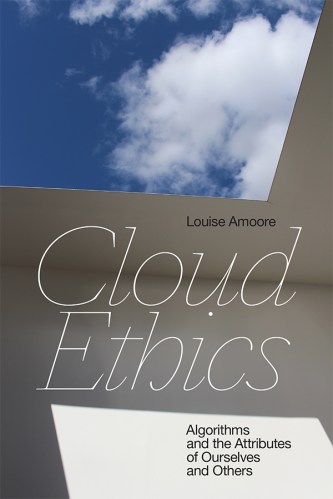
Louise Amoore, Cloud Ethics: Algorithms and the Attributes of Ourselves and Others – Duke UP, May 2020 (and link to Introduction)

978-1-4780-0831-6_prLouise Amoore, Cloud Ethics: Algorithms and the Attributes of Ourselves and Others – Duke University Press, May 2020.

Great to see this book is imminent – the Introduction can be read here.

In Cloud Ethics Louise Amoore examines how machine learning algorithms are transforming the ethics and politics of contemporary society. Conceptualizing algorithms as ethicopolitical entities that are entangled with the data attributes of people, Amoore outlines how algorithms give incomplete accounts of themselves, learn through relationships with human practices, and exist in the world in ways that exceed their source code. In these ways, algorithms and their relations to people cannot be understood by simply examining their code, nor can ethics be encoded into algorithms. Instead, Amoore locates the ethical responsibility of algorithms in the conditions of partiality and opacity that haunt both human and algorithmic decisions. To this end, she proposes what she calls cloud ethics—an approach to holding algorithms accountable by engaging with the social and technical conditions under which they emerge and operate.
“Beautifully written and richly documented, Louise Amoore’s Cloud Ethicsanalyzes the workings of algorithms in contemporary society, from those assessing security risks to self-learning and self-programming neural nets. She draws on her extensive interviews with experts in the field to explore the nuances of algorithmic doubt and certainty. Finally, she calls for a new ethics of doubt in which the individual components of algorithms are scrutinized to open new spaces for critique that can ‘crack open’ the seemingly certain fabulations of algorithmic calculation. Technically stunning and critically informed, this book is required reading for anyone interested in how to resist the current trends toward algorithmic governmentality.” — N. Katherine Hayles, Distinguished Research Professor of English, University of California, Los Angeles
“Calling for an embrace of the contingency and doubt that is inherent in the structure and working of algorithms, this important book refuses mythologies of certainty and machinic omnipotence. Framing computation as a partial accounting, Cloud Ethics moves beyond the unproductive binaries of ‘good’ and ‘bad,’ to consider algorithms as generative of complex political possibilities.” — Caren Kaplan, author of Aerial Aftermaths: Wartime from Above
Posted in Louise Amoore, Uncategorized | Leave a comment