Geoffroy de Lagasnerie, Foucault against Neoliberalism? translated by Matthew Maclellan – Rowman June 2020

9781786615275Geoffroy de Lagasnerie, Foucault against Neoliberalism? translated by Matthew Maclellan – Rowman, June 2020

In the late 1970s, Michel Foucault dedicated a number of controversial lectures on the subject of neoliberalism. Had Foucault been seduced by neoliberalism? Did France’s premier leftist intellectual, near the end of his career, turn to the right? In this book, Geoffroy de Lagasnerie argues that far from abandoning the left, Foucault’s analysis of neoliberalism was a means of probing the limits and lacunae of traditional political philosophy, social contract theory, Marxism, and psychoanalysis. For Lagasnerie, Foucault’s analysis was an attempt to discover neoliberalism’s singularity, understand its appeal, and unearth its emancipatory potential in order to construct a new art of rebelliousness. By reading Foucault’s lectures on neoliberalism as a means of developing new practices of emancipation, Lagasnerie offers an original and compelling account of Michel Foucault’s most controversial work.


Posted in Michel Foucault, Uncategorized | 1 Comment

Kirsten Simonsen and Lasse Koefoed, Geographies of Embodiment: Critical Phenomenology and the World of Strangers – Sage, Society and Space book series, 2020

106812_book_item_106812Kirsten Simonsen and Lasse Koefoed, Geographies of Embodiment: Critical Phenomenology and the World of Strangers – Sage, 2020

This is the latest book in the Society and Space series

Geographies of Embodiment provides a critical discussion of the literatures on the body and embodiment, and humanism and post-humanism, and develops arguments about “otherness” and “encounter” which have become key ideas in urban studies, and studies of the city. It situates these arguments in a wider political context, looking at power-relations through case studies at urban, national and transnational scales.

These arguments are situated across disciplinary boundaries, at the borderline between between philosophy and social science that is associated to critical phenomenology, and reaches across Human Geography, Sociology, Philosophy, Anthropology, Cultural Studies and Urban Studies.

Geographies of Embodiment by Koefoed and Simonsen presents articulate and sophisticated insights into issues about encounters, space and bodies through a practice-orientated reading of phenomenology. The book draws upon four projects over the last fifteen years about cities, encounters and nationalism to offer critical and engaging readings of encounters, embodiment, and the politics of urban life. This is an important text for critical and engaged scholars working in human geography, urban studies and racial and ethnic studies.

Peter Hopkins, Professor of Social Geography, Newcastle University

Rarely do I think that any book is a ‘must-read’, but that is surely the case with Geographies of Embodiment: Phenomenology and Strangers.  Located on the border between philosophy and social science, this is a deeply theoretical book that is anchored by significant empirical research.  Koefoed and Simonsen have written a powerful argument for a new humanism, one that is rooted in complex critical theories and phenomenological philosophies, yet is supported by important empirical work on the geographies of embodiment, practice and difference.  The result is a book that makes us rethink present understandings of humanism, especially as the ‘human’ in humanism is (re)made in embodied spatial practice.

Lawrence D. Berg, Professor in Critical Geography at the University of British Columbia

Posted in Uncategorized | Leave a comment

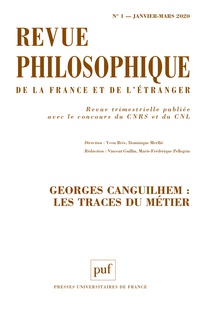
‘Georges Canguilhem : les traces du métier’ – special issue of Revue philosophique de la France et de l’étranger 2020/1

RPHI_201_L204Georges Canguilhem : les traces du métier – special issue of Revue philosophique de la France et de l’étranger 2020/1. Includes pieces by Giuseppe Bianco, Jean-François Braunstein, Xavier Roth, Gisèle Sapiro and others. Articles are in French, and requires subscription.

The new wave of studies on Canguilhem is related to the creation of an archival center gathering his manuscripts at the CAPHES library and to the publication of his complete works. The heterogeneity of Canguilhem’s writings, which cover sixty years of philosophical activity, could be better grasped if we consider it as the material trace of a profession, that of philosopher, taking place in different contexts and historical periods.


Posted in Georges Canguilhem, Uncategorized | Leave a comment

‘Territory without Borders’ – my 2011 piece translated into Turkish by Utku Özmakas

photo-1444594924945-61856795933bTerritory without Borders‘ – my short 2011 piece published in the Harvard International Review has been translated into Turkish by Utku Özmakas. Many thanks to Utku for doing this translation – and for alerting me and the journal that the piece had disappeared. It’s now available again – both pieces open access.

The piece was written while The Birth of Territory was in production, and I try to argue that while borders are crucial – and I give some examples in 2011 that have intensified today – I try to disentangle the relation between territory and borders.

Rather, what I want to do here is to raise the question of whether we can think territory without dependence on borders. This does not mean we should conceive of a territory without borders, an imagined space which has neither limit nor end. Instead, we should stop using a notion of “border,” “boundary,” or “boundedness” as the key element to define territory, as a concept. I want to suggest that the standard definition of territory as a bordered, bounded or defined space is actually an impediment to understandings of geopolitical relations. In short, I think we need a better theory of territory. We should not take the standard definition of territory as a bounded space under the control of a group, perhaps a state, straight-forwardly. As I look back through history to trace the emergence of modern territorial notions, I hope to address two key questions. How did a singular conception of territory emerge out of the divergent systems of organization that have historically characterized global political culture? And how does that definition inform the modern understanding of global political relations?

It’s a short piece, but I give a very brief summary of the history I trace in The Birth of Territory, and connect it up to some contemporary issues.

Posted in Boundaries, Territory, Uncategorized | 2 Comments

Michel Foucault, Binswanger et l’analyse existentielle, edited by Elisabetta Basso – EHESS/Gallimard/Seuil, April 2020

Michel Foucault, Binswanger et l’analyse existentielle, edited by Elisabetta Basso – EHESS/Gallimard/Seuil, forthcoming April 2020. Nothing on the publisher sites yet, but it is listed in online bookstores. More details when available.

This is a substantial text by Foucault which seems to have begun as a course at Lille, but is developed into a more polished manuscript, which may have been intended as a thesis. Foucault published a long introduction to Binswanger’s ‘Dream and Existence’ in 1954, but this manuscript is distinct from that work. This edition is part of a new  series of publications from Foucault’s archive before the Collège de France. It is the second to be published, after the two courses on sexuality that appeared in late 2018. I discuss this text in The Early Foucault, and it will be good to have an edited version of this manuscript available before I complete that book.

Posted in Michel Foucault, The Early Foucault, Uncategorized | 1 Comment

Post-Kantian Philosophy at Warwick – audio and video; conference on 5-6 June 2020

Post-Kantian Philosophy at Warwick – audio and video recordings

Daniele Lorenzini, Simon Critchley, Keith-Ansell Pearson, Stephen Houlgate, Miguel de Beistegui and others.

More details on the Centre here. The Centre’s conference this year is on 5-6 June 2020 – call for abstracts here.

Posted in Uncategorized | Leave a comment

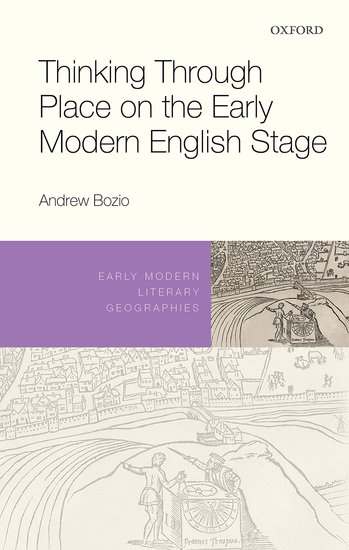
Andrew Bozio, Thinking Through Place on the Early Modern English Stage – OUP (Early Modern Literary Geographies), 2020

Andrew Bozio, Thinking Through Place on the Early Modern English Stage, OUP, 2020 – part of the Early Modern Literary Geographies series.

Thinking Through Place on the Early Modern English Stage argues that environment and embodied thought continually shaped one another in the performance of early modern English drama. It demonstrates this, first, by establishing how characters think through their surroundings —not only how they orient themselves within unfamiliar or otherwise strange locations, but also how their environs function as the scaffolding for perception, memory, and other forms of embodied thought. It then contends that these moments of thinking through place theorize and thematize the work that playgoers undertook in reimagining the stage as the setting of the dramatic fiction. By tracing the relationship between these two registers of thought in such plays as The Malcontent, Dido Queen of Carthage, Tamburlaine, King Lear, The Knight of the Burning Pestle, and Bartholomew Fair, this book shows that drama makes visible the often invisible means by which embodied subjects acquire a sense of their surroundings. It also reveals how, in doing so, theater altered the way that playgoers perceived, experienced, and imagined place in early modern England.

Posted in William Shakespeare | Leave a comment

In the Trenches of History – an ARTE/rbb documentary on Ernst Jünger from 2019, German with English subtitles

In the Trenches of History – an ARTE/rbb documentary on Ernst Jünger from 2019, German with English subtitles

Posted in Uncategorized | Leave a comment

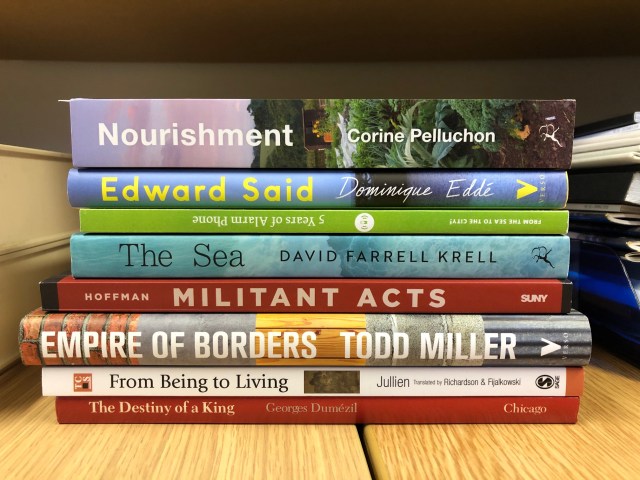
Books received – Pelluchon, Eddé, Alarm Phone, Farrell Krell, Hoffmann, Miller, Jullien, Dumézil


Books received – Corine Pelluchon, Nourishment: A Philosophy of the Political BodyDominique Eddé, Edward Said: His Thought as a Novel; 5 Years of Alarm Phone (also available as a free download); David Farrell Krell, The Sea: A Philosophical Encounter; Marcelo Hoffmann, Militant Acts: The Role of Investigations in Radical Political Struggles; Todd Miller, Empire of Borders: The Expansion of the US Border around the World; François Jullien, From Being to Living: A Euro-Chinese Lexicon of Thought; Georges Dumézil, The Destiny of a King.

Corine and Marcelo kindly sent copies of their books, and 5 Years of Alarm Phone was a gift from my colleague Maurice Stierl; Jullien’s book was sent by Sage. The rest were bought from the Verso sale or second-hand.

Posted in David Farrell Krell, Edward Said, Georges Dumézil, Politics | Leave a comment

The North American Arctic: Themes in Regional Security, edited by Dwayne Ryan Menezes and Heather N. Nicol, UCL Press, 2019 (free download)

The North American Arctic: Themes in Regional Security, edited by Dwayne Ryan Menezes and Heather N. Nicol, UCL Press, 2019 (free download)

The North American Arctic addresses the emergence of a new security relationship within the North American North. It focuses on current and emerging security issues that confront the North American Arctic and that shape relationships between and with neighbouring states (Alaska in the US; Yukon, Northwest Territories and Nunavut in Canada; Greenland and Russia).

Identifying the degree to which ‘domain awareness’ has redefined the traditional military focus, while a new human rights discourse undercuts traditional ways of managing sovereignty and territory, the volume’s contributors question normative security arrangements. Although security itself is not an obsolete concept, our understanding of what constitutes real human-centred security has become outdated. The contributors argue that there are new regionally specific threats originating from a wide range of events and possibilities, and very different subjectivities that can be brought to understand the shape of Arctic security and security relationships in the twenty-first century.

The North American Arctic provides a framework or lens through which many new developments are assessed in order to understand their impact on a changing circumpolar region at different scales – from the level of community to the broader national and regional scale.

Posted in Uncategorized | Leave a comment