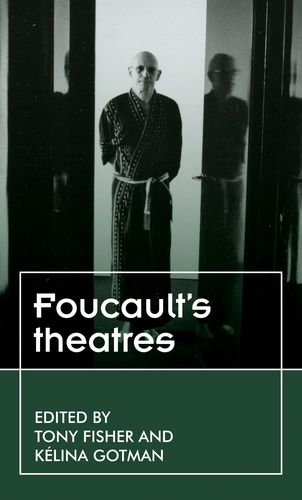
Tony Fisher and Kélina Gotman (eds.), Foucault’s Theatres – Manchester University Press, October 2019

F's Theatres.pngTony Fisher and Kélina Gotman (eds.), Foucault’s Theatres – Manchester University Press, October 2019

The volume contributes to a new articulation of theatre and performance studies via Foucault’s critical thought. With cutting edge studies by established and emerging writers in areas such as dramaturgy, film, music, cultural history and journalism, the volume aims to be accessible for both experienced researchers and advanced students encountering Foucault’s work for the first time. The introduction sets out a thorough and informative assessment of Foucault’s relevance to theatre and performance studies and to our present cultural moment – it rereads his profound engagement with questions of truth, power and politics, in light of previously unknown writings and lectures. Unique to this volume is the discovery of a ‘theatrical’ Foucault – the profound affinity of his thinking with questions of performativity. This discovery makes accessible the ‘performance turn’ to readers of Foucault, while opening up ways of reading Foucault’s oeuvre ‘theatrically’.

Introduction: theatre, performance, Foucault Tony Fisher and Kélina Gotman
1 Foucault’s philosophical theatres Mark D. Jordan
2 The dramas of knowledge: Foucault’s genealogical theatre of truth Aline Wiame
3 Foucault live! A Voice That Still Eludes the Tomb of the Text. Magnolia Pauker
4 Foucault, Oedipus, Négritude Kélina Gotman
5 Foucault’s critical dramaturgies Mark Robson
6 Heterotopia and the mapping of unreal spaces on stage Joanne Tompkins
7 Foucault and Shakespeare: the theatre of madness Stuart Elden
8 Philosophical phantasms: ‘the Platonic differential’ and ‘Zarathustra’s laughter’ Mischa Twitchin
9 Cage and Foucault: musical timekeeping and the security state Steve Potter
10 Foucault and the Iranian Revolution: reassessed Tracey Nicholls
11 Sightlines: Foucault and Naturalist theatre Dan Rebellato
12 Theatre of poverty: popular illegalism in the nineteenth century Tony Fisher
13 The philosophical scene: an interview with Moriaki Watanabe Michel Foucault (translated by Robert Bononno)
14 After words, afterwards: teaching Foucault Ann Pellegrini

Posted in Uncategorized | Leave a comment

Jeremy Black, Maps of War: Mapping Conflict through the Centuries – discussion at New Books Network

9781844863440.jpgJeremy Black, Maps of War: Mapping Conflict through the Centuries (Conway, 2016) – new discussion at New Books Network.

Thanks to dmf for the link.


Posted in Uncategorized | Leave a comment

Caliban and the Witch: A Verso Roundtable

Caliban and the Witch: A Verso Roundtable

Carrington-self-potrait-

Leonora Carrington, Self-Portrait, (c. 1937-1938), The Pierre and Maria-Gaetana Matisse Collection, 2002, © 2019 Artists Rights Society (ARS), New York

This October, Verso is hosting a roundtable on Silvia Federici’s incantatory and incendiary Caliban and the Witch: Women, the Body, and Primitive Accumulation (2004), inviting reflections from activists, writers, and scholars to discuss the provocations of Federici’s arguments on capitalism and colonialism, bodies and reproduction, race and slavery—and the powerful figure of the witch.Check back as we add more contributions over the week.

All Organizing is Magic – Sarah Jaffe examines the echoes of witchcraft in contemporary anti-capitalist discourse and practice.

Wrath, Line, and SubstancePeter Linebaugh explicates the intellectual traditions which Silvia Federici drew from and transcended in her innovative study of witchcraft and the origin of capitalism.

Learning from Witchy and Wayward WomenAlys Weinbaum shows how Federici’s work illuminates capital’s fundamental drive to dominate reporductive processes.

A Gathering Against History– Ariella Aïsha Azoulay argues that the persecution of unruly, ‘unproductive’ women in Europe during the transition to capitalism paralleled the subjection of ‘indigenous’ populations under colonial rule.


Posted in Uncategorized | Leave a comment

CFP: Interstices Journal of Architecture and Related Arts Issue 20:2020 Political Matters – Spatial Thinking of the Alternative

CALL FOR PAPERS:

Interstices Journal of Architecture and Related Arts
Issue 20:2020 Political Matters: Spatial Thinking of the Alternative

Issue Editors: Farzaneh Haghighi (University of Auckland) & Nikolina Bobic (University of Plymouth)
Deadline for paper submission:  9th December 2019 – 5:00pm NZT
https://interstices.ac.nz/index.php/Interstices/announcement/view/2

At a time when the Western political climate is synonymous with Brexit, Donald Trump and Boris Johnston, the Christchurch terrorist attack, Australia’s Manus Island detention centres, the US-Mexico border and the global refugee crisis, the urgency of addressing the relationship between politics and space is more pressing than ever. To answer the question of what it means for space to be political beyond it merely being an expression of hegemonic orders, we follow Hannah Arendt’s celebration of political action, and her stance that political questions are far too serious to be left to politicians (1970). We draw upon Chantal Mouffe’s concept of agonism and the impossibility of a final reconciliation in thinking the political (2013). We acknowledge Paul Virilio’s thinking on negative horizon whereby perception is not just dependent upon the framing and mastering of the rhetoric of media and memory, but rather this mastery is also framed and dependent upon seeing abysses (1989, 2005, 2009). Finally, we emphasise Michel Foucault’s reconceptualisation of power as being productive rather than oppressive (1980). To make sense of, and come to grips with, this contemporary landscape requires a detailed reflection and analysis at different levels – individual, social, cultural, environmental, technological, medical, economic or legal.

Comprehending the complex forms of surveillance and governance in the age of contemporaneity requires one to problematise the limits of spatial politics in the society of control (1995). Indeed, it may require a different placing and questioning of ideas, events and spaces than the norm. Questioning and disrupting the limits of the norm may enable frictions and generate new knowledge. This issue of Interstices seeks papers that address the complexity at the nexus of architecture, urbanism, sociology, human geography and political philosophy, and focuses on the following themes:

  • Power, Memory and Identity
  • The Spectacle and the Screen
  • Housing, Urban Commons and the Social
  • Events, Flows and Public Space
  • Territories, Walls and Peripheries

Discussion on the convolutedness of control societies are also oriented towards formulating the hopeful, active and productive role space may have in the formation of social movements and in transforming everyday life – in other words, where we become active participants in the cities we live in, rather than passive designers or consumers serving the interest of market economies. It is where liberating spaces for thinking differently can thrive. Likewise, it is where access to, and dwelling in, space is enabled. It is where we can engage with questions of conflict, security and territorial stability, however, not at the expense of dehumanising the Other. Moreover, the implication of these explorations for architectural pedagogy remains a fruitful opportunity for political agency and we encourage submissions on this topic as well. The thematic call on Political Matters: Spatial Thinking on the Alternative for Issue 20 of Interstices: Journal of Architecture and Related Arts seeks ambitious, innovative and rigorous scholarship of 5,000-word papers. The proposed schedule is outlined below:

14th August 2019: Call for 5,000-word papers issued
9th December 2019: Deadline for 5,000-word paper submissions
July 2020: Estimated journal publication

Please submit all papers to: susan.hedges@aut.ac.nz

For journal submission guidelines see: https://interstices.ac.nz/index.php/Interstices/Style_Guide
For all Interstices matters see: https://interstices.ac.nz/index.php/Interstices


CALL FOR Creative Design Research Projects:

Interstices Journal of Architecture and Related Arts
Issue 20:2020 Political Matters: Spatial Thinking of the Alternative

Issue Editors: Farzaneh Haghighi (University of Auckland) & Nikolina Bobic (University of Plymouth)
Deadline for submission: 31 January 2020- 5:00pm NZT
https://interstices.ac.nz/index.php/Interstices/announcement/view/3

Continuing our commitment to publishing the work of emerging designer researchers, Interstices: Journal of Architecture & Related Arts invite postgraduate or recently graduated researchers in architecture and related art and design fields to submit projects for the journal’s peer-reviewed, creative design research section. Projects should be complete at the time of submission and are to include an explanatory synopsis of 1,500 words. Project documentation and the synopsis should conform to the following requirements:

  • Be original and unpublished previously
  • In the case of visual material, include no more than eight indicative views of the proposal
  • In the case of moving image, animated sequences, or audio works, not exceed four minutes duration
  • Include a scholarly and critically situating synopsis for the project coauthored by both the project’s creator and the supervisor(s) involved (if applicable). The synopsis should bear the name of the researcher as the primary author and the supervisor (if included) as the secondary author
  • Exhibit, if feasible, a relationship with the journal issue theme. See – the current call for papers for Issue 20 | Political Matters – https://interstices.ac.nz/index.php/Interstices/announcement/view/2

Submissions will be considered for inclusion in Issue 20 of Interstices: Journal of Architecture & Related Arts, scheduled for publication in mid – 2020. All submission will be blind refereed by an invited panel.

Visit our website to view the Guidelines for Submissions for details about the reviewing process, copyright issues and formatting: https://interstices.ac.nz/index.php/Interstices/Style_Guide.
Please submit all Creative Design Research Projects to: andrew.douglas@auckland.ac.nz

Posted in Uncategorized | Leave a comment

Łukasz Stanek, Architecture in Global Socialism: Eastern Europe, West Africa, and the Middle East in the Cold War – Princeton U Press, January 2020

9780691168708.jpgŁukasz Stanek, Architecture in Global Socialism: Eastern Europe, West Africa, and the Middle East in the Cold War – Princeton U Press, January 2020

In the course of the Cold War, architects, planners, and construction companies from socialist Eastern Europe engaged in a vibrant collaboration with those in West Africa and the Middle East in order to bring modernization to the developing world. Architecture in Global Socialism shows how their collaboration reshaped five cities in the Global South: Accra, Lagos, Baghdad, Abu Dhabi, and Kuwait City.

Łukasz Stanek describes how local authorities and professionals in these cities drew on Soviet prefabrication systems, Hungarian and Polish planning methods, Yugoslav and Bulgarian construction materials, Romanian and East German standard designs, and manual laborers from across Eastern Europe. He explores how the socialist development path was adapted to tropical conditions in Ghana in the 1960s, and how Eastern European architectural traditions were given new life in 1970s Nigeria. He looks at how the differences between socialist foreign trade and the emerging global construction market were exploited in the Middle East in the closing decades of the Cold War. Stanek demonstrates how these and other practices of global cooperation by socialist countries—what he calls socialist worldmaking—left their enduring mark on urban landscapes in the postcolonial world.

Featuring an extensive collection of previously unpublished images, Architecture in Global Socialism draws on original archival research on four continents and a wealth of in-depth interviews. This incisive book presents a new understanding of global urbanization and its architecture through the lens of socialist internationalism, challenging long-held notions about modernization and development in the Global South.

I interviewed Lukasz about his earlier work on Lefebvre for Society and Space some years ago, and he discussed this project towards the end of his comments. It’s great to see it published.


Posted in Uncategorized | Leave a comment

‘There is always in history this possibility of the unexpected’: Interview with Carlo Ginzburg

Screen_Shot_2019-10-22_at_15.10.00-.pngAlso at the Verso blog – ‘There is always in history this possibility of the unexpected’: Interview with Carlo Ginzburg

Carlo Ginzburg, author of The Cheese and the Worms, is one of Europe’s most influential historians. In this interview with Claire Zalc, Ginzburg discusses the influence of his parents – the novelist Natalia Ginzburg and scholar of Russian literature Leone Ginzburg – his childhood in Fascist Italy, historical method, Aby Warburg, and the continuing importance of historical scholarship.

Posted in Uncategorized | Leave a comment

Christopher Law on Judith Butler, Anti-Semitism and the force of discourse

Force_of_Nonviolence.jpgChristopher Law on Judith Butler, Anti-Semitism and the force of discourse at the Verso blog. Butler’s book The Force of Nonviolence: The Ethical in the Political is forthcoming from Verso in 2020:

Here’s the book’s description:

Judith Butler’s new book shows how an ethic of nonviolence must be connected to a broader political struggle for social equality. Further, it argues that nonviolence is often misunderstood as a passive practice that emanates from a calm region of the soul, or as an individualist ethical relation to existing forms of power. But, in fact, nonviolence is an ethical position found in the midst of the political field. An aggressive form of nonviolence accepts that hostility is part of our psychic constitution, but values ambivalence as a way of checking the conversion of aggression into violence. One contemporary challenge to a politics of nonviolence points out that there is a difference of opinion on what counts as violence and nonviolence. The distinction between them can be mobilised in the service of ratifying the state’s monopoly on violence.

Considering nonviolence as an ethical problem within a political philosophy requires a critique of individualism as well as an understanding of the psychosocial dimensions of violence. Butler draws upon Foucault, Fanon, Freud, and Benjamin to consider how the interdiction against violence fails to include lives regarded as ungrievable. By considering how ‘racial phantasms’ inform justifications of state and administrative violence, Butler tracks how violence is often attributed to those who are most severely exposed to its lethal effects. The struggle for nonviolence is found in movements for social transformation that reframe the grievability of lives in light of social equality and whose ethical claims follow from an insight into the interdependency of life as the basis of social and political equality.

Posted in Judith Butler, Uncategorized | Leave a comment

Tarik Kochi, Global Justice and Social Conflict: The Foundations of Liberal Order and International Law – Routledge, 2019

9780367406813Tarik Kochi, Global Justice and Social Conflict: The Foundations of Liberal Order and International Law – Routledge, 2019

Global Justice and Social Conflict offers a ground-breaking historical and theoretical reappraisal of the ideas that underpin and sustain the global liberal order, international law and neoliberal rationality.

Across the 20th and 21st centuries, liberalism, and increasingly neoliberalism, have dominated the construction and shape of the global political order, the global economy and international law. For some, this development has been directed by a vision of ‘global justice’. Yet, for many, the world has been marked by a history and continued experience of injustice, inequality, indignity, insecurity, poverty and war – a reality in which attempts to realise an idea of justice cannot be detached from acts of violence and widespread social conflict. In this book Tarik Kochi argues that to think seriously about global justice we need to understand how both liberalism and neoliberalism have pushed aside rival ideas of social and economic justice in the name of private property, individualistic rights, state security and capitalist ‘free’ markets. Ranging from ancient concepts of natural law and republican constitutionalism, to early modern ideas of natural rights and political economy, and to contemporary discourses of human rights, humanitarian war and global constitutionalism, Kochi shows how the key foundational elements of a now globalised political, economic and juridical tradition are constituted and continually beset by struggles over what counts as justice and over how to realise it. Engaging with a wide range of thinkers and reaching provocatively across a breadth of subject areas, Kochi investigates the roots of many globalised struggles over justice, human rights, democracy and equality, and offers an alternative constitutional understanding of the future of emancipatory politics and international law.

Global Justice and Social Conflict will be essential reading for scholars and students with an interest in international law, international relations, international political economy, intellectual history, and critical and political theory.

The good news is that, unlike many Routledge books, this is available in paperback as well as hardback and ebook. There is also a promotional 20% discount code of FLR40.

Posted in Uncategorized | 1 Comment

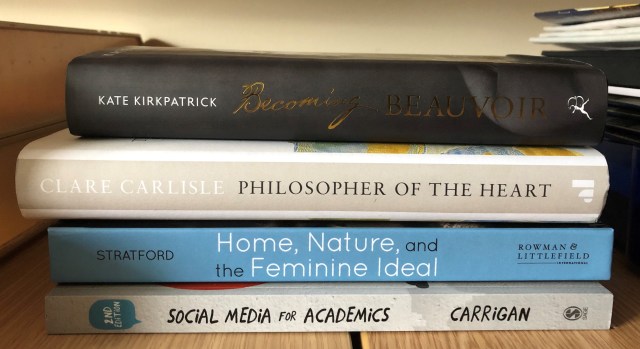
Books received – Kirkpatrick, Carlisle, Stratford, Carrigan

books-1.jpgKate Kirkpatrick, Becoming Beauvoir; Clare Carlisle, Philosopher of the Heart: The Restless Life of Søren Kierkegaard; Elaine Stratford, Home, Nature and the Feminine Ideal: Geographies of the Interior and of Empire; and Mark Carrigan, Social Media for Academics, second edition. Elaine and Mark’s books were sent by the publishers – I was interviewed for the first edition of Mark’s book.

Posted in Simone de Beauvoir, Uncategorized | Leave a comment

Cat Moir, Ernst Bloch’s Speculative Materialism: Ontology, Epistemology, Politics – Brill 2019; paperback forthcoming with Haymarket, December 2020

2019-10-25-Ernst-Block-Cat-Moir.jpgCat Moir, Ernst Bloch’s Speculative Materialism: Ontology, Epistemology, Politics – Brill 2019; paperback forthcoming with Haymarket, December 2020

In Ernst Bloch’s Speculative Materialism: Ontology, Epistemology, Politics, Cat Moir offers a new interpretation of the philosophy of Ernst Bloch. The reception of Bloch’s work has seen him variously painted as a naïve realist, a romantic nature philosopher, a totalitarian thinker, and an irrationalist whose obscure literary style stands in for a lack of systematic rigour. Moir challenges these conceptions of Bloch by reconstructing the ontological, epistemological, and political dimensions of his speculative materialism. Through a close, historically contextualised reading of Bloch’s major work of ontology, Das Materialismusproblem, seine Geschichte und Substanz (The Materialism Problem, its History and Substance), Moir presents Bloch as one of the twentieth century’s most significant critical thinkers.

Currently only an expensive hardback, but since it’s part of the Historical Materialism series, this should mean a paperback will follow. There’s also a discussion of the book at the University of Sydney on 25 October 2019.

Posted in Uncategorized | 1 Comment