
 The new Radical Philosophy issue is now online, with a dossier in memoriam of Sabah Mahmood, and contributions by Angela Davis, Elsa Dorlin, Gayatri Chakravorty Spivak and many others.
Open access here – https://www.radicalphilosophy.com
The new Radical Philosophy issue is now online, with a dossier in memoriam of Sabah Mahmood, and contributions by Angela Davis, Elsa Dorlin, Gayatri Chakravorty Spivak and many others.
Open access here – https://www.radicalphilosophy.com
New issue of New Perspectives published – open access

Editorial
1. Looking. Again.
Benjamin Tallis
Essay
James Der Derian
2. A Quantum of InsecurityResearch Articles
Julia Bethwaite & Anni Kangas
3. Parties, Pavilions and Protests: The Heteronomous World Politics of the Russian Pavilion at the Venice BiennaleJózsef Golovics
4. Addressing the EU’s East-West Brain Drain: Why a Tax Solution Would Be in Vain
Forecast
5. Russia and the World: IMEMO Forecast 2019
Forum
6. Publicism, Truth-Pluralism and the Usefulness Problem in International Relations
Patrick Thaddeus Jackson, Emma Mc Cluskey, Maximilian Mayer, Nicholas Ross Smith, Seán Molloy & Nicholas MichelsenCultural Cut
7. Prague at the End of History
Derek Sayer
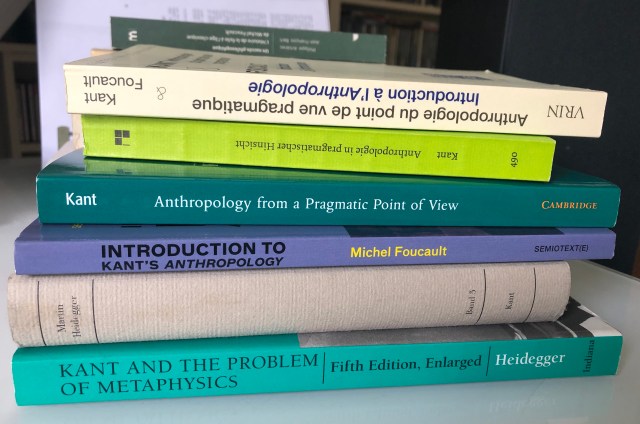 Thankfully, this book manuscript has been the main focus again of work over the past month.
I’ve been continuing to work on Foucault’s relation to Dumézil, on Foucault’s time in Warsaw and Hamburg, and other things in the later 1950s. I had a couple of days in Paris where I was able to resolve a lot of small issues with texts that I can’t access in the UK, as well as return to a box of materials at the archive. Work included rechecking material on microfilm and newspapers, tiny details that perhaps cumulatively add up to something. Following up a reference in one of Didier Eribon’s studies led me to a text that isn’t in any of the Foucault anthologies and which I’d previously not known about. No UK libraries seem to have a copy, but I found a second-hand copy online, so that’s on the way.
For the last ten days of September, before term started, I was on a writing retreat in Denbighshire, North Wales. I booked a small apartment in the middle of nowhere, took a box of books, the laptop and the bike and tried to concentrate on this manuscript, interspersed with some good rides in the hills. I’ve done this the past two summers in the Peak District. The weather was glorious for the first few days; dreadful for the second half. There are some really tough roads round here, for which my guide was Simon Warren’s Cycling Climbs of Wales, with Horseshoe Pass and The Road to Hell being two of the more memorable. Bwlch Pen Barras was easily the toughest I attempted.
The main work task has been comparing Foucault’s French translation of Kant’s Anthropology with both the German original and Robert Louden’s English version. At some point I may consult other English translations and Alain Renault’s more recent French one. I’ve been trying to work out the choices Foucault made for key terms, and how consistent he was in these. I’ve been doing this work along the same kinds of lines as the work I did on Foucault’s co-translations of Binswanger and von Weizsäcker, which I discuss in an earlier chapter of the manuscript. With this text, Foucault was building on work he’d done for a course on philosophical anthropology he gave in Lille and Paris a few years before. That course is also discussed in another chapter of my manuscript, and there are plans for it to be published in the next few years. The translation of the Anthropology was made in Hamburg between 1959 and 1960 and together with a long introduction served as Foucault’s secondary thesis. The translation was published in 1964, with a brief ‘Notice Historique’ drawn from the long Introduction. I first read the Introduction in 2004 at IMEC, but it has been available in both French and English for a decade now.
This comparative work is helped immeasurably by the way that the three main texts I’m using have the pagination of the Akademie Ausgabe in their margins, so it doesn’t take long to locate a passage in each language. (This is the case for the 2009 edition of Foucault’s translation, with his Introduction; though not the edition he published himself in 1964.) The German edition I’m using also has a useful index, with page and line number. But that is keyed to the edition’s pagination, not the Akademie Ausgabe’s, which adds another step into every cross reference. It’s slow work, but it is interesting and I think it has yielded something worth saying.
I’d originally planned to write a separate section on the Introduction, but in the chapter I’ve drafted the discussion of the Introduction and the translation are thematically linked. At his thesis defence Foucault was accused of having written an Introduction that owed more to Nietzsche than to Kant, and there are certainly traces of that influence. But it’s also a serious piece of Kant scholarship, discussing textual problems alongside vocabulary, the relation to other parts of Kant’s work, and obsessed with issues of dating.
Scholarship on the Anthropology has moved on a lot since Foucault did this work in 1959-60. In part this is due to the labours of Werner Stark, who edited the extant student transcripts for a later volume of the Akademie Ausgabe. I got to meet Werner and Robert Louden through the work Eduardo Mendieta and I did when we co-edited a book entitled Reading Kant’s Geography, in which they both wrote chapters. Physical Geography was a lecture course Kant gave for almost forty years. The Anthropology was initially part of the Geography, and then they were delivered as separate courses for many years. The Geography was published late in Kant’s life, not by Kant but apparently with his support, in an edition whose relation to lecture materials is much debated. Kant prepared the Anthropology for publication himself. and uniquely among his books his manuscript survives. There are suggestions that Foucault consulted that manuscript when preparing the translation, but I’m not sure that it is quite that simple.
The manuscript is housed in the library of the University of Rostock. Foucault did the translation in Hamburg, and Rostock and Hamburg are just over 100 miles apart. But in 1959-60 they were in different countries – Rostock was the major seaport of the German Democratic Republic. It would have been a very difficult journey to make, and it’s not at all clear to me that Foucault actually made it. Even if he could, I’m not sure how easy it would have been to consult the manuscript at the time.
The new academic year starts today, and I do nearly all my teaching this term. I’m hoping to keep going with the writing during this time, with the main thing left to do for this book working on the History of Madness itself. My entire book is really leading up to this, and while it’s a text I know quite well, and wrote about in Mapping the Present back in 2001, I’m looking forward to working on it again in the light of all the research I’ve done on the period of its writing.
The previous updates on this project are here; and the previous books Foucault’s Last Decade and Foucault: The Birth of Power are both available from Polity. The related book Canguilhem is also out, and is discussed a bit more here. Several Foucault research resources such as bibliographies, short translations, textual comparisons and so on, produced while doing the work for these books, are available here.
Some second-hand books bought recently, mainly by Georges Dumézil, but also the Akademie Textausgabe of Kant’s Anthropologie, and the proceedings of a Collège de France seminar. I can’t remember seeing a typo on a book’s spine before…


Henri Lefebvre’s former house in Navarrenx for sale
Thanks to Andy Merrifield for the link – from May 2019, and not sure it is still for sale.
Law and Humanities Summer School, University of Hong Kong, 8-13 June 2020
The Faculty of Law and the Faculty of Arts at the University of Hong Kong will hold its first law and humanities summer school, 8-13 June 2020. This week-long event is open to post-graduate research students and early career academics from any discipline, based anywhere in the world, who are working at the intersection of law and the humanities. Whilst at HKU participants will take two intensive seminar series led by Alison Young, Francine V. McNiff Professor of Criminology at the University of Melbourne and James Martel, Professor of Political Science at San Francisco State University. In addition, there will be sessions on interdisciplinary methodologies, research and writing skills, as well as cultural and social events. This is a fantastic opportunity to work with two of the world’s leading law and humanities scholars, to develop your research and writing skills, expand your knowledge and learn from your peers in the global community of law and humanities researchers.
James Martel: How the law can undo what the law does
This course will consider the notion of law when it is not merely understood in its black letter, rationalist sense. The opposite of such a form of law is not necessarily chaos or nihilism but can have its own creative, contingent and positive forms. Thinking about law in this other, anarchist and decentralized sense allows us to imagine what is common to all forms of law even laws that serve to upend and contest the law as it is usually considered. In thinking about this kind of law, we will engage with a range of thinkers including Walter Benjamin, Giorgio Agamben and Fred Moten.
Alison Young: Imagining Justice in the City
Increasing urbanization means that more and more people live and work in urban centres, and increasing urban populations present particular challenges for social organisation and urban planning, but also for law: how do we imagine a just city in times of increasing population density and social inequality? In this course, we will examine a range of ways of thinking about justice in the city, including concepts of affect, urban encounters, the precariat, ambience and atmosphere, and the lawscape, drawing on the work of Ananya Roy, Sarah Keenan, Ben Anderson, Andreas Phillippopoulos-Mihailopoulos, Guy Standing, Peter Adey and others. A range of case studies will be utilised, including debates around urban aesthetics (and how they are regulated by law); how law responds to visible precarity; and the relationship between city and citizenship.
To apply for the summer school, please click here. Please note there are a number of generous bursaries available to support travel and accommodation costs. For further information about the summer school, including details about accommodation, fees and bursaries please visit our website:
https://www.law.hku.hk/lawandhumanities/summerschool/
For inquiries, please contact Dr Daniel Matthews (HKU, Law): danmat@hku.hk
A Revolutionary from the OECD – the Castoriadis/Poulantzas debate – at the Verso blog
In 1977, an intense debate raged in the Greek press between Nicos Poulantzas and Cornelius Castoriadis, sparked by remarks made by Poulantzas in an article that questioned Castoriadis political commitment to ending the dictatorship in Greece, and his position as a high-level economist for the OECD. Here, published in English for the first time, is the record of the debate – published with an introduction by Dimitris Psarras and Dimitris Karidas.
 Martin Heidegger, The Question Concerning the Thing, Rowman & Littlefield, 2018 – also reviewed at NDPR by Hakhamanesh Zangeneh.
This is a new translation of material which had appeared in English in 1967 but had long been out of print. Insofar as it increases the availability in English of Heidegger’s interpretations of Kant, it is quite welcome. The book is also a welcome return of Heidegger translations to manuscripts dealing with traditional philosophical authors and themes. It can be argued that ever since the publication of Peter Trawny’s reading of the ‘black notebooks,’ in 2014, Heidegger studies has been taken hostage by Nazism studies. The majority of recent English translations released by the biggest publisher of Heidegger’s works, Indiana University Press, have in fact been those diaries. The volume under review contrasts with those books in that it contains no biographical content and stays focused on a major text from the history of Western philosophy. To those hunting for the proverbial “gotcha” passages in this text, this reviewer would counsel “move along, nothing to see.”
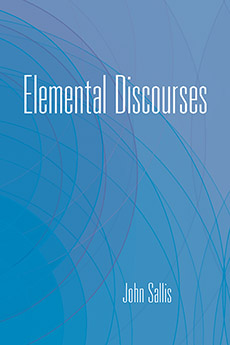 John Sallis, Elemental Discourses, Indiana University Press, 2018 – reviewed by Jeffrey Powell at NDPR
The publication of this book is an event for those familiar with the work of John Sallis, for it is the first volume to be published by Indiana University Press in the forty-three volume series The Collected Writings of John Sallis. It is volume four of Part II of The Collected Writings and contains eight chapters of previously unpublished lectures and talks, as well as two previously published essays. The latter two are chapter 6, “Alterity and the Elemental,” which was originally published as “Levinas and the Elemental” in 1998 in Research in Phenomenology; and chapter 8, “The Scope of Visibility,” originally published as “The Extent of Visibility” in the collection Phenomenology and the Metaphysics of Sight. The Collected Writings will consist of three parts: Part I will be Sallis’s originally published monographs; Part II will be previously published papers, lectures, and talks that will be gathered together according to five different themes; and Part III will be lecture courses delivered over the course of Sallis’s career that are either figure or topic specific.
Details of the series are here – forty-three volumes!
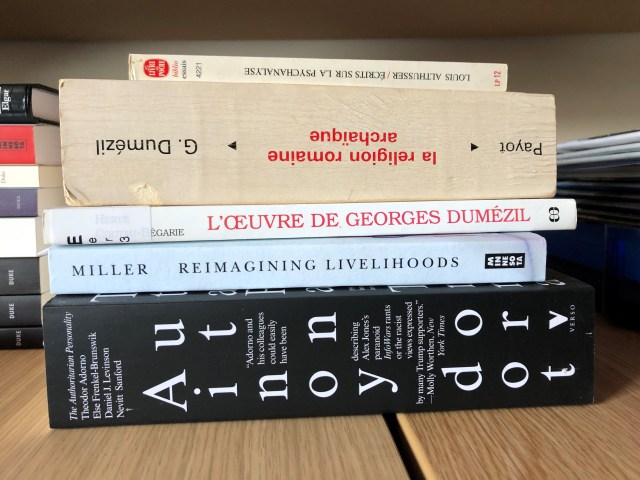
Ethan Miller, Reimagining Livelihoods: Life Beyond Economy, Society and Environment was sent by the press, The Authoritarian Personality has recently been reissued by Verso and is currently on sale, the rest were bought second-hand.


