Emmanuelle Loyer, Lévi-Strauss: A Biography – Polity, 2018 (and review)

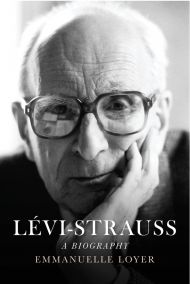
9781509511983.jpgEmmanuelle Loyer, Lévi-Strauss: A Biography – Polity, 2018, translated by Ninon Vinsonneau and Jonathan Magidoff

Academic, writer, figure of melancholy, aesthete – Claude Lévi-Strauss (1908–2009) not only transformed his academic discipline, he also profoundly changed the way that we view ourselves and the world around us. 

In this award-winning biography, historian Emmanuelle Loyer recounts Lévi-Strauss’s childhood in an assimilated Jewish household, his promising student years as well as his first forays into political and intellectual movements. As a young professor, Lévi-Strauss left Paris in 1935 for São Paulo to teach sociology. His rugged expeditions into the Brazilian hinterland, where he discovered the Amerindian Other, made him into an anthropologist. The racial laws of the Vichy regime would force him to leave France yet again, this time for the USA in 1941, where he became Professor Claude L. Strauss – to avoid confusion with the jeans manufacturer.

Lévi-Strauss’s return to France, after the war, ushered in the period during which he produced his greatest works: several decades of intense labour in which he reinvented anthropology, establishing it as a discipline that offered a  offered new view on the world. In 1955,  Tristes Tropiques indisputable proof of this the world over. During those years, Lévi-Strauss became something of a French national monument, as well as a celebrity intellectual of global renown. But he always claimed his perspective was a ‘view from afar’, enabling him to deliver incisive and subversive diagnoses of our waning modernity.

Loyer’s outstanding biography tells the story of a true intellectual adventurer whose unforgettable voice invites us to rethink questions of the human and the meaning of progress. She portrays Lévi-Strauss less as a modern than as our own great and disquieted contemporary.

The book is reviewed in Boston Review (thanks to Peter Gratton for the link)

Posted in Uncategorized | Leave a comment

Stuart Elden, Canguilhem – Polity Key Contemporary Thinkers series, now published

This book should now be available in the US and worldwide.

stuartelden's avatarProgressive Geographies

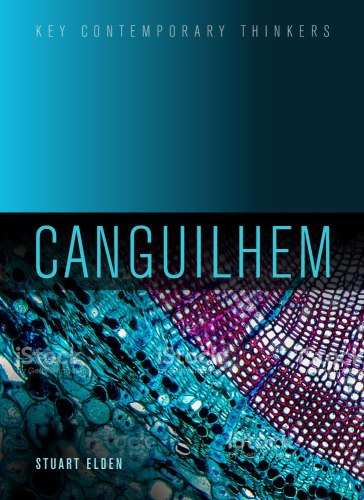
Canguilhem coverMy study of George Canguilhem for Polity’s Key Contemporary Thinkers series is now released in the UK in both hardback and paperback. It should be available in North America and worldwide over the next couple of months. [Update April 23 – now available worldwide]

Although it is coming out very shortly after Shakespearean Territories, the manuscripts were actually submitted about a year apart – Polity are much faster at getting books through production.

Georges Canguilhem (1904-95) was an influential historian and philosopher of science, as renowned for his teaching as for his writings. He is best known for his book The Normal and the Pathological, originally his doctoral thesis inmedicine, but he also wrote a thesis in philosophy on the concept of the reflex, supervised by Gaston Bachelard. He was the sponsor of Michel Foucault’s doctoral thesis on madness. However, his work extends far beyond what is suggested…

View original post 196 more words

Posted in Uncategorized | 1 Comment

Matthew H. Edney, Cartography: The Ideal and its History – U Chicago Press, April 2019

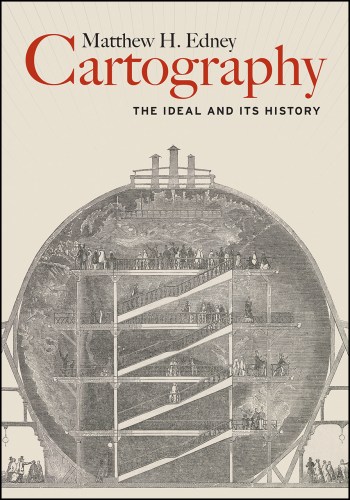
9780226605685.jpgMatthew H. Edney, Cartography: The Ideal and its History – University of Chicago Press, April 2019

Over the past four decades, the volumes published in the landmark History of Cartography series have both chronicled and encouraged scholarship about maps and mapping practices across time and space. As the current director of the project that has produced these volumes, Matthew H. Edney has a unique vantage point for understanding what “cartography” has come to mean and include.

In this book Edney disavows the term cartography, rejecting the notion that maps represent an undifferentiated category of objects for study. Rather than treating maps as a single, unified group, he argues, scholars need to take a processual approach that examines specific types of maps—sea charts versus thematic maps, for example—in the context of the unique circumstances of their production, circulation, and consumption. To illuminate this bold argument, Edney chronicles precisely how the ideal of cartography that has developed in the West since 1800 has gone astray. By exposing the flaws in this ideal, his book challenges everyone who studies maps and mapping practices to reexamine their approach to the topic. The study of cartography will never be the same.


Posted in Uncategorized | 1 Comment

Books received – Story, TCS, Gombrich and Eribon, Crewe, Derrida, Kantorowicz

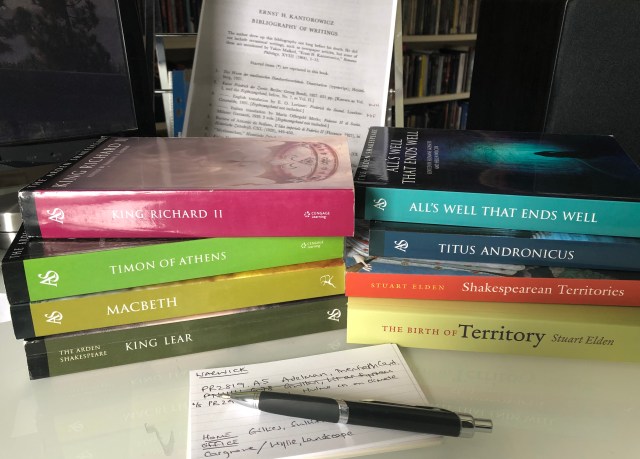
books.jpg Brett Story, Prison Land: Mapping Carceral Power across Neoliberal America; the new issue of Theory, Culture and Society, ‘Thinking with Algorithms‘, edited by Louise Amoore; Ernst Gombrich and Didier Eribon, A Lifelong Interest; Louise Crewe, Lords of Parliament: Manners, Rituals and Politics; Jacques Derrida, La vie la mort: Séminaire (1975-1976); and Ernst Kantorowicz, Selected Studies.

Brett Story’s book was sent by the publisher, and I’m on the board of TCS. The rest were bought new or second-hand.


Posted in Ernst Kantorowicz, Jacques Derrida, Louise Amoore, Politics, Uncategorized | 1 Comment

Christopher P. Heuer, Into the White: The Renaissance Arctic and the End of the Image – Zone, May 2019

Heuer cover_06Christopher P. Heuer, Into the White: The Renaissance Arctic and the End of the Image – Zone, May 2019

European narratives of the Atlantic New World tell stories of people and things: strange flora, wondrous animals, and sun-drenched populations for Europeans to mythologize or exploit. Yet between 1500 and 1700 one region upended all of these conventions in travel writing, science, and, most unexpectedly, art: the Arctic. Icy, unpopulated, visually and temporally “abstract,” the far North – a different kind of terra incognita for the Renaissance imagination – offered more than new stuff to be mapped, plundered, or even seen. Neither a continent, an ocean, nor a meteorological circumstance, the Arctic forced visitors from England, the Netherlands, Germany, and Italy, to grapple with what we would now call a “nonsite,” spurring dozens of previously unknown works, objects, and texts – and this all in an intellectual and political milieu crackling with Reformation debates over art’s very legitimacy.

Into the White uses five case studies to probe how the early modern Arctic (as site, myth, and ecology) affected contemporary debates of perception and matter, of representation, discovery, and the time of the earth – long before the nineteenth century romanticized the polar landscape. In the far North, this book contends, the Renaissance exotic became something far stranger than the marvelous or the curious, something darkly material and unmasterable, something beyond the idea of image itself.

Posted in Uncategorized | Leave a comment

Barnes and Sheppard (eds.), Spatial Histories of Radical Geography: North America and Beyond – Wiley/Antipode June 2019

1119404711.jpgTrevor Barnes and Eric Sheppard (eds.), Spatial Histories of Radical Geography: North America and Beyond – Wiley/Antipode 2019 (two excerpts available)

A wide-ranging and knowledgeable guide to the history of radical geography in North America and beyond.

  • Includes contributions from an international group of scholars
  • Focuses on the centrality of place, spatial circulation and geographical scale in understanding the rise of radical geography and its spread
  • A celebration of radical geography from its early beginnings in the 1950s through to the 1980s, and after
  • Draws on oral histories by leaders in the field and private and public archives
  • Contains a wealth of never-before published historical material
  • Serves as both authoritative introduction and indispensable professional reference
Posted in Uncategorized | 2 Comments

Mark A. Wrathall, The Cambridge Heidegger Lexicon – CUP, December 2019

9781107002746.jpgMark A. Wrathall, The Cambridge Heidegger Lexicon – Cambridge University Press, December 2019

Martin Heidegger (1889–1976) was one of the most original thinkers of the twentieth century. His work has profoundly influenced philosophers including Jean-Paul Sartre, Simone de Beauvoir, Maurice Merleau-Ponty, Michel Foucault, Jacques Derrida, Hannah Arendt, Hans-Georg Gadamer, Jürgen Habermas, Charles Taylor, Richard Rorty, Hubert Dreyfus, Stanley Cavell, Emmanuel Levinas, Alain Badiou, and Gilles Deleuze. His accounts of human existence and being and his critique of technology have inspired theorists in fields as diverse as theology, anthropology, sociology, psychology, political science, and the humanities. This Lexicon provides a comprehensive and accessible guide to Heidegger’s notoriously obscure vocabulary. Each entry clearly and concisely defines a key term and explores in depth the meaning of each concept, explaining how it fits into Heidegger’s broader philosophical project. With over 220 entries written by the world’s leading Heidegger experts, this landmark volume will be indispensable for any student or scholar of Heidegger’s work.

Posted in Martin Heidegger, Uncategorized | Leave a comment

Three upcoming talks on Shakespeare – landscapes, Foucault, Kantorowicz and the oath

Shakespeare.jpgI have three upcoming talks on Shakespeare.
The first is the Fourth Denis Cosgrove lecture in the GeoHumanities, to be given at the British Academy on 23 May 2019, 6.30pm. I was asked to speak about the Shakespearean Territories book, and I will say something about that, but I’m also going to go a bit further with this work on Shakespeare and geography, and think about landscapes figure, or don’t, in some of his plays. I’ll speaking about King Lear, Macbeth and Timon of Athens, with some mention of other plays. The lecture and drinks reception are both free, but registration is required.

I’ll then be giving two papers on the oath in Shakespeare, drawn from what I hope will be a longer manuscript. There will be a bit of overlap between the two, but hopefully not much. The first will a plenary lecture to the Association for Philosophy and Literature conference to be held in Klagenfurt, Austria between 29 May and 2 June 2019. This one will be entitled ‘Foucault, Shakespeare and the Oath’. The second will be at a much smaller workshop on Ernst Kantorowicz and Shakespeare to be held at Garrick’s Temple to Shakespeare, Hampton, on 22 June 2019. I’ll also be speaking about oaths, linking Kantorowicz’s refusal of the University of California loyalty oath to his reading of medieval texts, and examining these themes in Shakespeare.

I imagine many of the speakers at the Kantorowicz event will be speaking about Richard II, which Kantorowicz analysed in The King’s Two Bodies. So for that event, I expect my main focus will be some of the other history plays and All’s Well That Ends Well. But I think in Austria I will discuss Richard II, along with other plays.

Posted in Conferences, Ernst Kantorowicz, Michel Foucault, Shakespearean Territories, Uncategorized, William Shakespeare | 2 Comments

Altering cartographies of climate change, Royal Academy, London, 15 April 2019

Later today in London

stuartelden's avatarProgressive Geographies

Altering cartographies of climate change, Royal Academy, London, 15 April 2019, 6.30-8pm

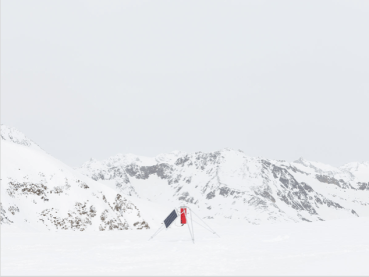
Italian Limes, Glacier 1.png

A panel discussion looking at both material and imagined borders, and the ways in which global warming challenges Western conceptions of territory.

In 2014, Studio Folder initiated the Italian Limes project to survey the fluctuations of the boundary line across the Alps in real time. As a continuation of this project, they have been fascinated by the effects climate change can have on geopolitical understandings of borders and the methods used to represent them.

In this conversation, our panellists will discuss topics of nationalism and cartography using the example of a “moving border” introduced by Italy, Austria, and Switzerland to acknowledge the volatility of the geographical features on Italy’s northern border. The latter is continuously shifting as a result of climate change and often contradicts its representations on official maps. They will both place this case study…

View original post 218 more words

Posted in Uncategorized | 2 Comments

Christopher Watkin, “Nancy is a thinker of Radical Emancipation”, with a response by Jean-Luc Nancy

Christopher Watkin, “Nancy is a thinker of Radical Emancipation”, with a response by Jean-Luc Nancy – plenary talk given at the ‘Thinking with Jean-Luc Nancy’ conference, University of Oxford, 29 March 2019.

Posted in Jean-Luc Nancy, Uncategorized | 1 Comment