
And while we’re on that theme –
David Farrell Krell, “Derrida, Heidegger, and the Magnetism of the Trakl House” (on Derrida’s Geschlecht III – video)
And while we’re on that theme –
David Farrell Krell, “Derrida, Heidegger, and the Magnetism of the Trakl House” (on Derrida’s Geschlecht III – video)
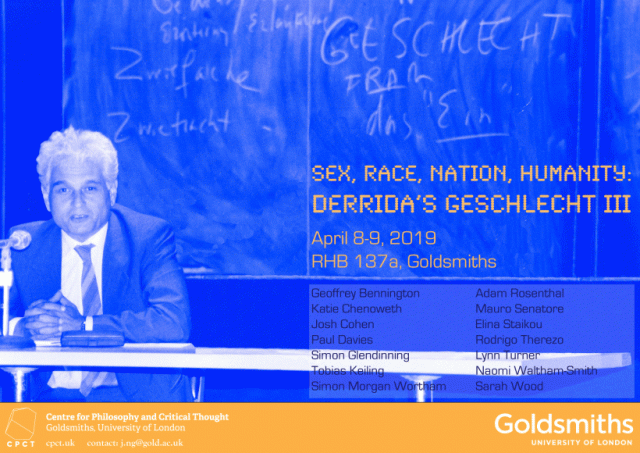
Sex, Race, Nation, Humanity: Derrida’s Geschlecht III (Goldsmiths, April 8-9, 2019)
Sex, Race, Nation, Humanity: Derrida’s Geschlecht III
A Conference on a Newly Re-discovered Text
April 8-9, 2019
Richard Hoggart Building 137a, Goldsmiths, University of London
This two-day conference focuses on a recently discovered text by the late Franco-Algerian philosopher Jacques Derrida. Geschlecht III, rediscovered in the Derrida archive and newly published in French (forthcoming in English), is the “missing” installment in Derrida’s four-part series on Martin Heidegger and the German word Geschlecht (meaning, among other things, “sex,” “race,” and “species”). Geschlecht III presents us with one of Derrida’s most sustained engagements with Heidegger, a meticulous reading of what he will call Heidegger’s “national-humanism”: the nationalistic undercurrent in Heidegger’s thought that posits German and Germany as the privileged media through which to think the essence of the human and its relationship to the fate of the West.
Now published – available to purchase here https://www.arch.columbia.edu/books/catalog/369-a-moving-border-alpine-cartographies-of-climate-change

Andrea Bagnato, Marco Ferrari and Elisa Pasqual, A Moving Border – Alpine Cartographies of Climate Change, Columbia University Press, forthcoming 2019.
[now updated with the final cover]
This is the book developing from the Italian Limes project. I was pleased to welcome Andrea and Marco to Warwick for one of the ICE-LAW project workshops, and to be asked to write an essay for this book. With their permission, you can access my piece, ‘The Instability of Terrain’, here.
There will be a book launch at the Royal Academy on the evening of 15 April 2019 with some of the contributors. More details when advertised.
Italy’s northern border follows the watershed that separates the drainage basins of Northern and Southern Europe. Running mostly at high altitudes, it crosses snowfields and perennial glaciers—all of which are now melting as a result of anthropogenic climate change. As the watershed…
View original post 225 more words
Being in the World – 2010 documentary film directed by Tao Ruspoli
https://www.youtube.com/watch?time_continue=312&v=k5QJ8s3qUyA
Being in the World is a 2010 documentary film directed by Tao Ruspoli. The film is based on Martin Heidegger’s philosophy and is inspired by Hubert Dreyfus. It features a number of prominent philosophers. Philosophers such as Mark Wrathall, Sean Kelly, Taylor Carman, John Haugeland, Iain Thomson, Charles Taylor and Albert Borgmann are also featured in the film.
Synopsis: ‘Being in the World is a celebration of human beings and our ability, through the mastery of physical, intellectual and creative skills, to find meaning in the world around us. Some of our most renowned philosophers, from Harvard to Berkeley, take us on a gripping journey to meet modern day masters-people who not only have learned to respond in a sensitive way to the requirements of their craft, but have also gathered their communities in ways that our technological age threatens to make obsolete.’
Initial release: 2010
Director: Tao…
View original post 4 more words
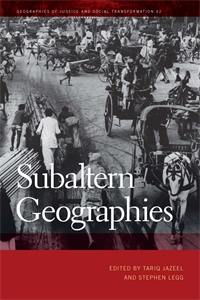 Tariq Jazeel and Stephen Legg (eds.), Subaltern Geographies – University of Georgia Press, 2019
Subaltern Geographies is the first book-length discussion addressing the relationship between the historical innovations of subaltern studies and the critical intellectual practices and methodologies of cultural, urban, historical, and political geography. This edited volume explores this relationship by attempting to think critically about space and spatial categorizations.
Editors Tariq Jazeel and Stephen Legg ask, What methodologicalphilosophical potential does a rigorously geographical engagement with the concept of subalternity pose for geographical thought, whether in historical or contemporary contexts? And what types of craft are necessary for us to seek out subaltern perspectives both from the past and in the present? In so doing, Subaltern Geographies engages with the implications for and impact on disciplinary geographical thought of subaltern studies scholarship, as well as the potential for such thought. In the process, it probes new spatial ideas and forms of learning in an attempt to bypass the spatial categorizations of methodological nationalism and Eurocentrism.
CONTRIBUTORS: David Arnold, Sharad Chari, David Featherstone, Vinay Gidwani, Mukul Kumar, Sunil Kumar, Anna F. Laing, Colin McFarlane, Sarah A. Radcliffe, Ananya Roy, and Jo Sharp
A lot of very good advice here
As I (Rachel Mc Ardle) have recently finished my PhD, I thought it would be a good opportunity to reflect on some tips which helped me survive the last few months and weeks of my PhD:
View original post 799 more words
History of Anthropology theme section – Canguilhem’s Milieu (open access)
Thanks to James Tyner for the link.
Special Focus: Canguilhem’s Milieu Today
 I was very sorry to hear the news of the death of Couze Venn, earlier this week. Couze was a Professor at Goldsmiths University, and managing editor of Theory, Culture & Society. I first met Couze at a Foucault conference at the University of East London, but really got to know him when I joined the editorial board of TCS. I learned a lot from board meetings, and will miss his thoughtful and critical engagement with that process very much.
I also knew his own writing – last year’s After Capital is a good indication of the breadth of his knowledge, and his ability to synthesize and connect issues. Previous books included The Postcolonial Challenge and Occidentalism.
There will be some tributes posted on the TCS website, and the plan is for an e-special issue collecting many of his writings for the journal. I’ll link to these when they are available. Dave Beer has a fuller tribute here, and Gargi Bhattacharyya a review of After Capital here.
Update: Mike Featherstone has a tribute at the TCS website here.
The coda from my 2013 book The Birth of Territory (‘Territory as a Political Technology’) is translated in today’s issue of Iran’s Shargh Daily newspaper (the pdf is here). This translation is made by Sahand Sattari, who has also translated some of my other work on territory, and on Kostas Axelos, for the same paper. Many thanks again Sahand.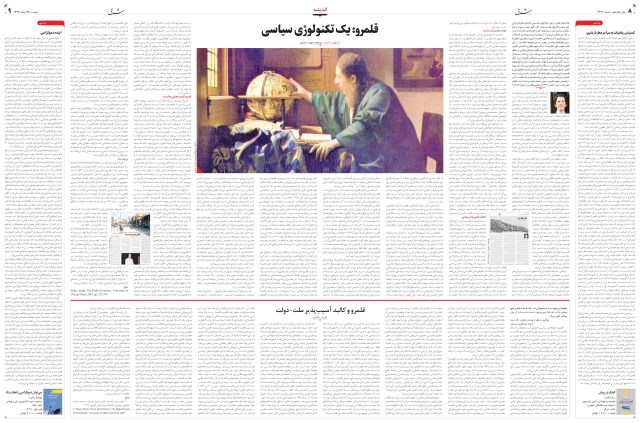
The first of these events is this one on Walter Benjamin and Shakespeare

David Garrick built his Shakespeare Temple beside the Thames at Hampton in 1755 as a place where ‘the thinkers of the world’ would meet to reflect on the plays. He hoped Voltaire would come. Now the Kingston Shakespeare Seminar is realising the great actor’s vision, with a series of symposia on Shakespeare in Philosophy.
The first of the 2019 symposia focuses on the German philosopher and cultural critic Walter Benjamin (1892-1940). Confirmed speakers are Howard Caygill, Hyowon Cho, Julia Ng and Bjorn Quiring.
This event, open to all, will include talks by leading philosophers and Shakespeare scholars, coffee and tea in the riverside garden designed by Capability Brown, and lunch at the historic Bell Inn. Tickets are £20, all profits go to supporting the Temple.


