Tips for finishing a PhD

A lot of very good advice here

nuimgeography's avatarEye on the World

As I (Rachel Mc Ardle) have recently finished my PhD, I thought it would be a good opportunity to reflect on some tips which helped me survive the last few months and weeks of my PhD:

Mental health/ well-being tips:

  1. There is light at the end of the tunnel, even when it often feels like there isn’t.
  2. You will have to ask for help and get comfortable leaning on other people, it is an incredibly stressful time and the people closest to you will become your support network.
  3. As much as you can, take breaks, walks, journal/ brain dump, and look after yourself in terms of time off. If you don’t take breaks your brain simply will not be as productive the next day.
  4. Be kind to yourself, allow yourself to feel free to eat whatever food is handy or you want. Prioritise the PhD over other demands and don’t…

View original post 799 more words

Posted in Uncategorized | Leave a comment

History of Anthropology theme section – Canguilhem’s Milieu (open access)

History of Anthropology theme section – Canguilhem’s Milieu (open access)

Thanks to James Tyner for the link.

Special Focus: Canguilhem’s Milieu Today

Editors’ Introduction: As Adventurous as Life

Gabriel Coren and Cameron Brinitzer

The Life of the Milieu

Kathleen Stewart

A Living Room

Todd Meyers

Canguilhem’s Vital Social Medicine

Carlo Caduff

Le Vivant & Partial Pressure Milieus

Adriana Petryna
Hannah Landecker
Posted in Georges Canguilhem, Uncategorized | Leave a comment

In Memory of Couze Venn

Prof+Couze+Venn.jpgI was very sorry to hear the news of the death of Couze Venn, earlier this week. Couze was a Professor at Goldsmiths University, and managing editor of Theory, Culture & Society. I first met Couze at a Foucault conference at the University of East London, but really got to know him when I joined the editorial board of TCS. I learned a lot from board meetings, and will miss his thoughtful and critical engagement with that process very much.

I also knew his own writing – last year’s After Capital is a good indication of the breadth of his knowledge, and his ability to synthesize and connect issues. Previous books included The Postcolonial Challenge and Occidentalism.

There will be some tributes posted on the TCS website, and the plan is for an e-special issue collecting many of his writings for the journal. I’ll link to these when they are available. Dave Beer has a fuller tribute here, and Gargi Bhattacharyya a review of After Capital here.

Update: Mike Featherstone has a tribute at the TCS website here.

Posted in Couze Venn, Theory, Culture and Society, Uncategorized | 1 Comment

The Birth of Territory coda translated in Iran’s Shargh Daily

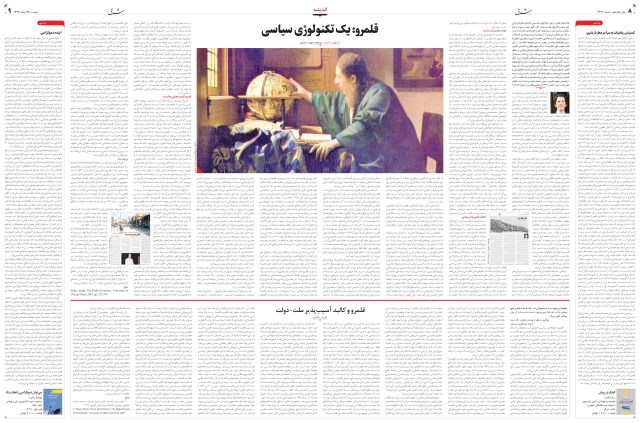
The coda from my 2013 book The Birth of Territory (‘Territory as a Political Technology’) is translated in today’s issue of Iran’s Shargh Daily newspaper (the pdf is here). This translation is made by Sahand Sattari, who has also translated some of my other work on territory, and on Kostas Axelos, for the same paper. Many thanks again Sahand.The Birth of Territory coda.jpg


Posted in Kostas Axelos, Territory, The Birth of Territory, Uncategorized | Leave a comment

Benjamin and Shakespeare symposium, April 6, 2019

The first of these events is this one on Walter Benjamin and Shakespeare

kingstonshakespeareseminar's avatarKingston Shakespeare Seminar

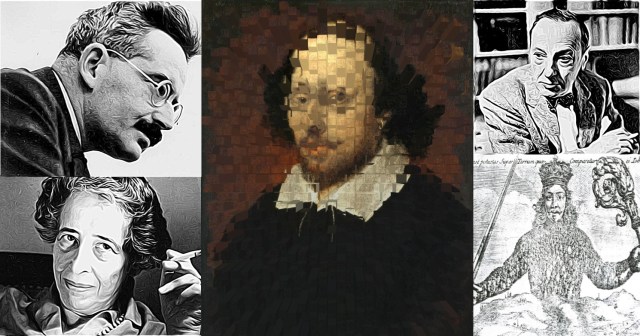
Benjamin Shakespeare Collage

Walter Benjamin and Shakespeare symposium

Saturday April 6, 2019

Garrick’s Temple to Shakespeare, Hampton

David Garrick built his Shakespeare Temple beside the Thames at Hampton in 1755 as a place where ‘the thinkers of the world’ would meet to reflect on the plays. He hoped Voltaire would come. Now the Kingston Shakespeare Seminar is realising the great actor’s vision, with a series of symposia on Shakespeare in Philosophy.

The first of the 2019 symposia focuses on the German philosopher and cultural critic Walter Benjamin (1892-1940). Confirmed speakers are Howard Caygill, Hyowon Cho, Julia Ng and Bjorn Quiring.

This event, open to all, will include talks by leading philosophers and Shakespeare scholars, coffee and tea in the riverside garden designed by Capability Brown, and lunch at the historic Bell Inn. Tickets are £20, all profits go to supporting the Temple.

Book your tickets at: benjaminandshakespeare.eventbrite.co.uk

View original post

Posted in Uncategorized | Leave a comment

Shakespeare in Philosophy symposia at the Temple 2019

The further events in this series of encounters between Shakespeare and philosophy.

kingstonshakespeareseminar's avatarKingston Shakespeare Seminar

Shakespeare in Philosophy collage

After last’s summer’s series of days on French theorists, we turn this year to twentieth-century political theology, and to three thinkers whose work has powerfully shaped recent interpretations of Shakespearean theatre. This is our programme:

Saturday April 6: Walter Benjamin and Shakespeare

Saturday June 22: Ernst Kantorowicz and Shakespeare

Saturday September 7: Hannah Arendt and Shakespeare

On Friday June 21 we are also co-hosting with Historic Royal Palaces what we hope will be the first of an annual series of midsummer conferences at Hampton Court Palace: ‘The Hollow Crown: Shakespeare and Coronation’. With two sections, on ‘Crown’ and ‘Crowd’, this event has been planned to double with the Temple symposium on Kantorowicz the following day, to provide a focus for our discussion of current thinking about Shakespeare and Political Theology.

Mark your diaries and further details to follow!

View original post

Posted in Uncategorized | Leave a comment

CFP: Baudelaire and Philosophy, 5-6 June 2019, Centre for Philosophy and Critical Thought, Goldsmiths, University of London and the Institut Français

Baudelaire and Philosophy: A Conference sponsored by the British Society of Aesthetics

5-6 June 2019, Centre for Philosophy and Critical Thought, Goldsmiths, University of London and the Institut Français

CALL FOR PAPERS
Deadline for submissions: 21 March 2019

INVITED SPEAKERS

Isabelle Alfandary (Paris 3/CIPh)

Jennifer Bajorek (Hampshire)

Patrick ffrench (King’s College London)

Elissa Marder (Emory)

Adrian Rifkin (Goldsmiths)

Richard Rand (Paris)

Charles Baudelaire is a pivotal reference for debates on modernity, criticism and poetics, though in the domains of philosophy and critical theory his work is often approached solely through the prism of contemporary commentary. Baudelaire’s own engagement with the philosophical – for instance in his pairing of Joseph de Maistre and Edgar Allan Poe as critics of the metaphysics of “progress” – has also been insufficiently mined. Yet Baudelaire has been key for thinking about the transformations of the very conditions of aesthetic experience since the 19th century; his writings on the dandy and the poetic significance of intoxication, as well as his work as a critic of fine art and music, have arguably expanded notions of what counts as aesthetic experience, opening it up beyond questions of taste, value, or didactic ends. For Nietzsche, Sartre, Merleau-Ponty, Lukács, Benjamin, Lacan and others, Baudelaire reimagined the poet and the poetic as inseparable from their relations to the social, psychological, material and sexual and, as such, as figures through which such relations may be reevaluated. After Baudelaire, the urban and the technological are no longer mere themes but the very element in which aesthetic experience and poetic production take shape; after Baudelaire, the poem assumes the form of a crucible for new and altered states of “experience.” This had led to Baudelaire often being made synonymous with the notion of modernity, and in particular with the idea that novelty becomes a (or even the) key category for aesthetic experience and artistic production from the mid-nineteenth century onwards. Taking Baudelaire’s own references to philosophy seriously, this conference will also explore the complexity of the relation between the received understanding of Baudelaire as a prophet of modernity and his opposition to any idea of progress that would reduce poetic beauty to a vehicle for social and moral development.

The conference will alternate between delving into specific poetic and critical texts by Baudelaire and tackling some of the key interpretations and uses of his work within philosophy and critical theory, from Georges Bataille to Jacques Derrida, Walter Benjamin to Jacques Rancière. The conference aims to do justice to the richness, complexity and ambiguity of Baudelaire’s critical and poetic writing, to explore his relation to philosophy and the philosophical, and to interrogate his place as a synonym for a certain conception of modernity.

Selected papers will be published as an edited collection or special journal issue.

PAPERS

Proposals for 20 minute papers are invited in all areas pertaining to Baudelaire’s relation to philosophical aesthetics and related areas (e.g. ethics and political philosophy, metaphysics, theology, philosophy of mind, critical theory). Please send abstracts of not more than 250 words together with a brief (50-100 word) biographical statement including affiliation, status (student or not) and contact details to: j.ng [at] gold.ac.uk and a.toscano [at] gold.ac.uk. Please also direct any questions to these addresses.

CONFERENCE ORGANISERS

Julia Ng and Alberto Toscano, CPCT, Goldsmiths, University of London

Posted in Uncategorized | Leave a comment

Books received – Wade, Towarnicki, Althusser, Foucault

books

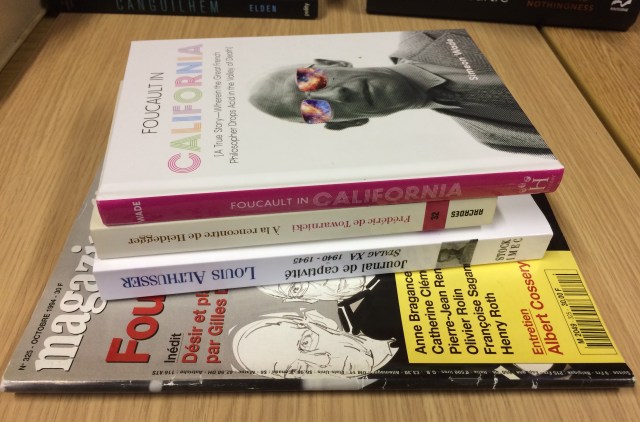
Simeon Wade’s memoir, Foucault in California, Frédéric de Towarnicki, À la rencontre de Heidegger, Louis Althusser, Journal de captivité: Stalag XA 1940-1945, and one of the several issues of Magazine littéraire on Foucault.

Wade’s memoir is the infamous Death Valley acid trip, and is discussed in an interview with Boom California, conducted by Heather Dundas. Dundas writes a foreword to this edition, which also has two of the photos from the trip as endpapers.

Posted in Louis Althusser, Martin Heidegger, Michel Foucault, Uncategorized | Leave a comment

Atsuko Watanabe, Japanese Geopolitics and the Western Imagination – Palgrave 2019

9783030043988Atsuko Watanabe, Japanese Geopolitics and the Western Imagination – Palgrave 2019

This book is the first attempt to comprehensively introduce Japanese geopolitics. Europe’s role in disseminating knowledge globally to shape the world according to its standards is an unchallenged premise in world politics. In this story, Japan is regarded as an enthusiastic importer of the knowledge. The book challenges this ground by examining how European geopolitics, the theory of the modern state, traveled to Japan in the first half of the last century, and demonstrates that the same theory can invoke diverged imaginations of the world by examining a range of historical, political, and literary texts. Focusing on the transformation of power, knowledge, and subjectivity in time and space, Watanabe provides a detailed account to reconsider the formation of contemporary world order of the modern territorial states.

Posted in Uncategorized | 1 Comment

An excellent review of “k-punk: The Collected and Unpublished Writings of Mark Fisher” 

Posted in Uncategorized | Leave a comment