Which edition of Foucault’s Birth of the Clinic did Alan Sheridan actually translate?

Update 4 February 2021: the initial work of a more comprehensive analysis is here.

Foucault’s Naissance de la clinique was published in two editions in his lifetime. The first appeared in 1963 as the first volume in Georges Canguilhem’s ‘Galien’ series with Presses Universitaires de France. The second appeared in the same series in 1972. There are a number of changes between the first and second editions, notably the removal of a lot of the overtly structuralist language, but also some quite large additions.

There have been several reprints of that second edition in the Quadrige series. But unhelpfully, sometime between the 3rd Quadrige edition (1993) and the 9th (2015) the text was reset, and the pagination changed – the preface was incorporated into the main page running order. I’ve made dual references below.

Alan Sheridan’s English translation as The Birth of the Clinic appeared in 1973, shortly after the second edition. But because the structuralist language of the first edition appears in the translation, I’d thought that it was a translation of that edition. But checking some details has made me realise that it is not that simple, and indeed that the changes between the first and second edition are much more significant than I’d previously thought. (I’ve used the Routledge edition for the English references – it’s possible pagination is different in other English editions.)

Here are just a few examples from the preface and first chapter:

Example 1

First edition: p. xiv: On voudrait essayer ici une analyse structurale d’un signifié – l’objet de l’expérience médicale – à une époque où, avant les grandes découvertes du XIXe siècle, il a modifié moins ses matériaux que sa forme systématique. La clinique, c’est une nouvelle découpe du signifié, et le principe de son articulation dans un signifiant où nous avons coutume de reconnaître le langage où nous avons coutume de reconnaître, dans une conscience ensommeillée, le langage d’une « science positive ».

Second edition: pp. xiii-xiv (later reprints p. 16): On voudrait essayer ici l’analyse d’un type de discours – celui de l’expérience médicale – à une époque où, avant les grandes découvertes du XIXe siècle, il a modifié moins ses matériaux que sa forme systématique. La clinique, c’est une nouvelle découpe des choses, et le principe de leur articulation dans un langage où nous avons coutume de reconnaître le langage où nous avons coutume de reconnaître [cut] le langage d’une « science positive ».

Translation: pp. xvii-xviii: I should like to attempt here the analysis of a type of discourse – that of medical experience—at a period when, before the great discoveries of the nineteenth century, it had changed its materials more than its systematic form. The clinic is both a new ‘carving up’ of things and the principle of their verbalization in a form which we have been accustomed to recognizing as the language of a ‘positive science’.

Sheridan translates the second edition.

Example 2

First edition p. xv: Ici, comme ailleurs, il s’agit d’une étude structurale qui essaie de déchiffrer dans l’épaisseur de l’historique les conditions de son histoire elle-même.

Second edition p. xv (later reprints p. 18): Ici, comme ailleurs, il s’agit d’une étude qui essaie de dégager dans l’épaisseur du discours les conditions de son histoire.

Translation: p. xix It is a structural study that set out to disentangle the conditions of its history from the density of discourse, as do others of my works.

Sheridan translates the first edition.

Example 3:

First edition p. xiv: Mais, considerée dans sa structure formelle…

Second edition p. xiv (later reprints p. 17): Mais, considerée dans sa disposition d’ensemble…

Translation p. xviii Nonetheless, considered on an over-all basis…

This is difficult to tell, since the English is not close to either French version but I can see how he got from the second edition to this translation.

Example 4:

First edition p. 2: … c’est-à-dire cette forme de pensée médicale qui, historiquement, a précédé de peu la méthode anatomo-clinique, et l’a rendue, structuralement, possible.

Second edition p. 2 (later reprints p. 20): … c’est-à-dire cette forme de pensée médicale qui, dans la chronologie, a précédé de peu la méthode anatomo-clinique, et l’a rendue, historiquement, possible.

Translation p. 4 … that is to say, in that form of medical thought that, historically, just preceded the anatomo-clinical method, and made it structurally possible.

Sheridan translates the first edition.

Example 5:

First edition p. xiii: N’est-il pas possible de faire une analyse structural du signifié qui échapperait à la fatalité du commentaire en laissent en leur adéquation d’origine signifié et signifiant ?

Second edition p. xiii (later reprints p. 15) : N’est-il pas possible de faire une analyse des discours qui échapperait à la fatalité du commentaire en ne supposant nul reste, nul excès en ce qui a été dit, mais le seul fait de son apparition historique ?

Translation: p. xvii Is it not possible to make a structural analysis of discourses that would evade the fate of commentary by supposing no remainder, nothing in excess of what has been said, but only the fact of its historical appearance?

The first part of this sentence follows the first edition, then it follows the second. “structural analysis of discourses” is a blend of the two editions – not a phrase Foucault wrote for either. The differences between the two French editions continues for the rest of this paragraph, but then Sheridan follows the second.

There are many more examples of Sheridan following either the first or the second edition. There are other places where he seems to switch which edition in a paragraph, or even a sentence.

This issue is not one of how Sheridan translated – perhaps the topic for another time – but what he translated. The English edition is a peculiar hybrid. It doesn’t translate either the first or second edition as an integral whole.

In 1990, James Bernauer, did a comparison between the two French editions in his book Michel Foucault’s Force of Flight. These are in Appendix II, pp. 188–92. What he does is very useful but it’s not comprehensive. (He notes some of my examples, but not others.) Nor does he compare the texts to the English translation. The recent French Oeuvres has endnotes by François Delaporte to Naissance de la clinique that indicate many of the changes, but again not all. Some of his notes require checking the first edition to see what was actually said there, and of course this is just for French variations.

So, before I spend days of work comparing the texts systematically, has anyone ever done this kind of analysis?

How on earth did this happen? The only explanation I can think would explain it is that Sheridan did a translation of the first edition, and then was alerted to the second before publication. He incorporated the major changes where whole paragraphs were replaced, and some of the smaller changes, but didn’t do a comprehensive comparison of the texts which meant he missed several changes.

And why, given that the translation was published 46 years ago, has nobody ever tried to resolve this problem and make a translation of either the entire first or second edition, or better yet, a proper critical edition?

Posted in Michel Foucault, Uncategorized | 6 Comments

1969 : Michel Foucault et la question de l’auteur. Qu’est-ce qu’un auteur ? (2019)

This looks a valuable study. Perhaps it would be a good text to translate, especially if this was an opportunity to do a proper critical edition of the text in English. For the problems with existing English versions, see this post – https://progressivegeographies.com/2017/04/11/the-textual-issues-around-foucaults-what-is-an-author/

Clare O'Farrell's avatarFoucault News

Dinah Ribard, 1969 : Michel Foucault et la question de l’auteur. Qu’est-ce qu’un auteur ?
Texte, présentation, et commentaire

Éditions Honoré Champion, Textes critiques français no 2. 2019. 1 vol., 112 p., broché, 13 × 20 cm. ISBN 978-2-7453-4832-6. 20 €

Qu’est-ce qu’un auteur ? est le texte d’une conférence donnée en 1969 à Paris, puis en 1970 aux États-Unis. Il existe plusieurs manières, fort différentes, de donner un contexte aux propositions avancées par Michel Foucault dans ce texte qui fit événement, de raconter l’histoire de l’impact de sa réflexion sur la théorie, la critique, l’histoire du fait littéraire, d’y réagir enfin. On s’efforce ici d’éclairer ces interprétations, ces récits, leurs évolutions et leurs enjeux, en s’intéressant notamment à leur caractère contradictoire, ainsi qu’à l’importance qu’ont eue, pour l’évolution des études littéraires, des choses que Foucault ne dit pas.

Foucault’s 1969 conference, « What is an author? » has been interpreted in various…

View original post 94 more words

Posted in Uncategorized | Leave a comment

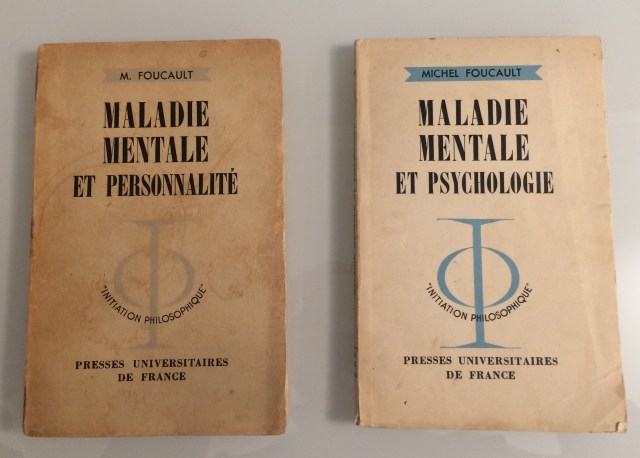
The changes between Foucault’s Maladie mentale et personnalité (1954) and Maladie mentale et psychologie (1962)


MMpe-MMPs.JPG

Maladie mentale et personnalité (1954) and Maladie mentale et psychologie (1962)

As mentioned in the last update on my research for The Early Foucault, I have done a comparison of the 1954 text Maladie mentale et personnalité and the 1962 Maladie mentale et psychologie.

The full analysis can be found here.

Foucault tried to prevent the reissue of the book, following the success of Folie et déraison: Histoire de la folie à l’âge classique (1961), but was unable to do so. Instead, he revised the text and changed its title.

The usual way of describing the changes is that Foucault lightly revises the Introduction and first half (chapters 1-4) and provides a new second half (chapters 5-6) and Conclusion. But the second part does make use of the original: Foucault revises the introduction to the second part, writes a new fifth chapter, uses about half of the original fifth chapter in his new sixth one, with some new material, and drops the original chapter six. He then writes a new conclusion in place of the original. The English translation is of the 1962 edition, which is the only one still in print in France.

The changes are important in tracking how Foucault’s thought developed between 1954 and 1962. A discussion of each book and what the changes mean will be in The Early Foucault. But the raw material for a comparative analysis is here. I’d welcome any corrections or additions to what I’ve done, and I do hope someone finds it useful.

There are lots of other resources on this site relating to Foucault – bibliographies, audio files, some short translations, some more textual comparisons, etc.

Posted in Michel Foucault, The Early Foucault, Uncategorized | Leave a comment

Anthony King, Command: The Twenty-First Century General – CUP, 2019

9781108700276Just published by my Warwick colleague Anthony King, Command: The Twenty-First Century General – Cambridge University Press, 2019

In the wake of the troubled campaigns in Afghanistan and Iraq, military decision-making appears to be in crisis and generals have been subjected to intense and sustained public criticism. Taking these interventions as a starting point, Anthony King examines the transformation of military command in the twenty-first century. Focusing on the army division, King argues that a phenomenon of collective command is developing. In the twentieth century, generals typically directed and led operations personally, monopolising decision-making. They commanded individualistically, even heroically. As operations have expanded in range and scope, decision-making has multiplied and diversified. As a result command is becoming increasingly professionalised and collaborative. Through interviews with many leading generals and vivid ethnographic analysis of divisional headquarters, this book provides a unique insight into the transformation of command in western armies.

  • Includes interviews with some of the most prominent generals of the current era (such as James Mattis, David Petraeus and Nick Carter)
  • Contains a highly original and detailed ethnography of the divisional headquarters, based on extensive fieldwork
  • Includes historical research back to the First World War of both counter-insurgency and conventional operations
  • Presents international comparisons of the major western powers (France, Germany, UK and US)

‘A timely study of the transformation of military command from the realm of individual genius to a more collective and participatory style better suited to today’s multifaceted organizations, global distances, and complex environments. King argues that twenty-first century generalship requires not just heroic leadership and tactical brilliance, but the ability to establish networks and empower subordinates in a more collaborative model tuned to the realities of the information age. A controversial argument that is highly recommended reading for military officers and defense policy makers.’ Peter R. Mansoor, author of Surge: My Journey With General David Petraeus and the Remaking of the Iraq War

‘This book is bound to become a core text on contemporary military command. By focusing on the divisional structure Anthony King is able to chart the move from traditional individualistic and hierarchical approaches to a more professional and collectivist approach. This is done using examples of military success and failure, from Monash to Mattis, and from conventional battles to counterinsurgency.’ Lawrence Freedman, Emeritus Professor of War Studies, King’s College London

‘A fascinating study of the evolution of military command over the past century, explaining how and why many of the challenges of command today are different. Highly recommended – not least for twenty-first-century generals and those who aspire to be.’ John Kiszely, Retired Lieutenant General and author of Anatomy of a Campaign. The British Fiasco in Norway, 1940

‘No one gives a better inside view of what goes on in a combat headquarters than Anthony King. His fieldwork in the Afghanistan War is set against the background of heroic generals in the World Wars, the growth of administrative bureaucracy in WWII, and the shift to counterinsurgency midway through the Iraq War. Throughout, King discerns a growing trend to program combat decisons in a collective of headquarters officers. Apart from the usual studies of generals’ strategies and heroism, King shows how generals have actually commanded their divisions in daily action. On a new level of sociological sophistication, King shows the lifeworld of command – the mesh of individual leaders with the organization that enables and constrains them.’ Randall Collins, author of Civil War Two

Posted in Uncategorized | Leave a comment

Marcus Power, Geopolitics and Development – Routledge, 2019

Now published – Marcus Power, Geopolitics and Development

stuartelden's avatarProgressive Geographies

9780415519571Marcus Power, Geopolitics and Development – Routledge, 2019

Unlike many Routledge titles, pleased to see this will be in paperback immediately.

Geopolitics and Development examines the historical emergence of development as a form of governmentality, from the end of empire to the Cold War and the War on Terror. It illustrates the various ways in which the meanings and relations of development as a discourse, an apparatus and an aspiration, have been geopolitically imagined and enframed.

The book traces some of the multiple historical associations between development and diplomacy and seeks to underline the centrality of questions of territory, security, statehood and sovereignty to the pursuit of development, along with its enrolment in various (b)ordering practices. In making a case for greater attention to the evolving nexus between geopolitics and development and with particular reference to Africa, the book explores the historical and contemporary geopolitics of foreign aid, the interconnections…

View original post 115 more words

Posted in Uncategorized | Leave a comment

Elaine Stratford, Home, Nature, and the Feminine Ideal: Geographies of the Interior and of Empire – Rowman, January 2019

Elaine Stratford, Home, Nature, and the Feminine Ideal: Geographies of the Interior and of Empire, Rowman, January 2019 – now published

stuartelden's avatarProgressive Geographies

5b46ee7ef5ba74183c269bfd.jpgElaine Stratford, Home, Nature, and the Feminine Ideal: Geographies of the Interior and of Empire – Rowman International, January 2019.

Take three things: the home, nature, and the feminine ideal—a notional and perfected femininity. Constitute them as inexorably and universally connected. Enrol them in diverse strategies and tactics that create varied anatomo-politics of the body and biopolitics of the population. Enlist those three things as the “handmaidens” of the government of individuals and groups, places and spaces, and comings and goings. Focus some effort on the periodical press, and on producing and disseminating narratives, discourses, and practices that relate specifically to health and well-being. Deploy those texts and shape those contexts in ways that affect flesh and bone, psychology and social conduct, and the spatial organization and relational dynamics of dwellings and streets, settlements and regions, and states and empires. Stretch these activities over the Anglophone world—from the epicentres of…

View original post 84 more words

Posted in Uncategorized | Leave a comment

Stuart Hall, Essential Essays (Two-volume set): Foundations of Cultural Studies & Identity and Diaspora, edited by David Morley, Duke UP 2019

Hall.jpgStuart Hall, Essential Essays (Two-volume set): Foundations of Cultural Studies & Identity and Diaspora, edited by David Morley, Duke University Press, 2019

Volumes 1 and 2 of Stuart Hall’s Essential Essays are available as a set

From his arrival in Britain in the 1950s and involvement in the New Left, to founding the field of cultural studies and examining race and identity in the 1990s and early 2000s, Stuart Hall has been central to shaping many of the cultural and political debates of our time. Essential Essays—a landmark two volume set—brings together Stuart Hall’s most influential and foundational works. Spanning the whole of his career, these volumes reflect the breadth and depth of his intellectual and political projects while demonstrating their continued vitality and importance.

Volume 1: Foundations of Cultural Studies focuses on the first half of Hall’s career, when he wrestled with questions of culture, class, representation, and politics. This volume’s stand-out essays include his field-defining “Cultural Studies and Its Theoretical Legacies;” the prescient “The Great Moving Right Show,” which first identified the emergent mode of authoritarian populism in British politics; and “Encoding and Decoding in the Television Discourse,” one of his most influential pieces of media criticism. As a whole, Volume 1 provides a panoramic view of Hall’s fundamental contributions to cultural studies.

Volume 2: Identity and Diaspora draws from Hall’s later essays, in which he investigated questions of colonialism, empire, and race. It opens with “Gramsci’s Relevance for the Study of Race and Ethnicity,” which frames the volume and finds Hall rethinking received notions of racial essentialism. In addition to essays on multiculturalism and globalization, black popular culture, and Western modernity’s racial underpinnings, Volume 2 contains three interviews with Hall, in which he reflects on his life to theorize his identity as a colonial and diasporic subject.

Posted in Stuart Hall, Uncategorized | 1 Comment

New Perspectives Vol 26 No 3 out – focus on ‘Post-Truth’ and Politics

New Perspectives Vol 3, 2018 – open access here

Post-Truth-Telling in IR
We break new ground in this issue of New Perspectives with an extensive co-edited special section on ‘Post-Truth’ and its relevance for politics and international relations. As Editor-in-Chief, I have been delighted to share the editing duties – and the authorship of the editorial – with Nick Michelsen of Kings College. It’s been a rich and rewarding collaboration that began in a chance conversation back at ISA 2017 in Baltimore, continued with a high-profile roundtable at ISA 2018 in San Francisco, some low-profile drinks at at the wonderful Gordons Wine Bar in London, and now comes to fruition in this issue of the journal. I’m delighted with how this has turned out and to have such a wonderful array of scholarship – and scholars – in the journal. We present post-truth (and its implications) as seen from the various perspectives of Arendtian ethical politics, critical realism, post-universal international justice, trust and the return of agency as well as the history, and future, of IR as a discipline engaged in or disengaged from the (post-truth) world.

This is one of the first extended, multi-perspectival academic engagements with post-truth and as well as showcasing cutting edge thinking on this hot topic, it will make a wonderful teaching resource in and beyond IR.

It is, therefore, my proud duty as editor of the journal to thank Colin Wight, Kjersti Lohne, Ari-Elmeri Hyvönen, Hannah Marshall and Alena Drieschova, Dagmar Rychnovská and Martin Kohut for their stellar contributions to the special section – and to welcome Nick Michelsen to our Associate Editor team on a permanent basis.

Posted in Uncategorized | Leave a comment

Bruno Latour interviewed in Artnet

Bruno Latour interviewed in Artnet (via Graham Harman)

Posted in Bruno Latour, Graham Harman, Uncategorized | 3 Comments

David Beer, The Data Gaze, reviewed at LSE Review of Books

92857_9781526436924David Beer, The Data Gaze (Sage 2018, Society and Space series) is reviewed at LSE Review of Books by Ignas Kalpokas.

It can by now be taken as a given that ‘data’ or, more precisely, ‘big data’ (often even capitalised to reflect its importance), has come to define today’s society. In fact, as David Beer suggests in this book, we are permanently put under ‘the data gaze’ that extracts, analyses and predicts key variables that are taken to define our world in increasingly granular detail, down to the level of the individual. In this timely and important book, Beer aims to shed light not only on how datafied visibility takes place, but also on how it is seen to act because this imaginary is key to the self-legitimation of the data analytics industry. [continues here]

Posted in Uncategorized | Leave a comment