

Copies of some older Althusser and Koyré books, along with the more recently published Que Faire? and the English translation of Thomas Lemke, Foucault’s Analysis of Modern Governmentality: A Critique of Political Reason.
Copies of some older Althusser and Koyré books, along with the more recently published Que Faire? and the English translation of Thomas Lemke, Foucault’s Analysis of Modern Governmentality: A Critique of Political Reason.
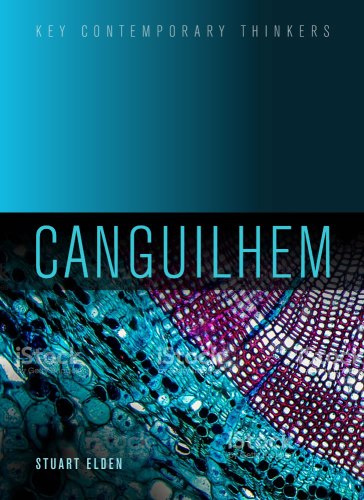 My study of George Canguilhem for Polity’s Key Contemporary Thinkers series is now released in the UK in both hardback and paperback. It should be available in North America and worldwide over the next couple of months. [Update April 23 – now available worldwide]
Although it is coming out very shortly after Shakespearean Territories, the manuscripts were actually submitted about a year apart – Polity are much faster at getting books through production.
Georges Canguilhem (1904-95) was an influential historian and philosopher of science, as renowned for his teaching as for his writings. He is best known for his book The Normal and the Pathological, originally his doctoral thesis inmedicine, but he also wrote a thesis in philosophy on the concept of the reflex, supervised by Gaston Bachelard. He was the sponsor of Michel Foucault’s doctoral thesis on madness. However, his work extends far beyond what is suggested by his association with these thinkers. Canguilhem also produced a series of important works on the natural sciences, including studies of evolution, psychology, vitalism and mechanism, experimentation, monstrosity and disease.
Stuart Elden discusses the whole of this important thinker’s complex work, including recently rediscovered texts and archival materials. Canguilhem always approached questions historically, examining how it was that we came to a significant moment in time, outlining tensions, detours and paths not taken. The first comprehensive study in English, this book is a crucial guide for those coming to terms with Canguilhem’s important contributions, and will appeal to researchers and students from a range of fields.‘The patience, clarity and erudition we expect of Stuart Elden’s books are on full display in this exceptional work. More than a simple introduction, Canguilhem enables readers to see the outlines, stakes and details of the works of an important thinker.’
John Protevi, Louisiana State University‘This impressive and meticulously researched volume which includes a wealth of references to archival material provides the first comprehensive introduction in English to a figure recognized as a seminal influence by postwar French thinkers, including Foucault and Althusser.’
Clare O’Farrell, Queensland University of Technology
One-day Symposium at the Department of Social Sciences, University of Roehampton, London the 1st of July 2019
We invite you to a one-day symposium on Monstrous Ontologies. Politics, Ethics, Materiality at the Department of Social Sciences, University of Roehampton, London, the 1st of July 2019.
The intention is to provoke participants to think and engage with monstrosity as not a mere cultural construct of the ‘other’ (to be deconstructed), but an ontological reality that require to be faced (speculatively, politically, and ethically) in its complex and really-existent materiality.The scope of the symposium is widely trans-disciplinar, welcoming contributions, from sociological, legal, geographical, psychological, philosophical, political and cultural studies, as well as from the arts. The symposium will compile the research papers presented into a book to be published in 2020.
We expect to receive a 250-word abstract by 1 March 2019 (send to Caterina.Nirta@roehampton.ac.uk or andrea.pavoni@iscte-iul.pt).
Monstrous Ontologies. Politics, Ethics, Materiality
Fantastic animals, evil criminals, notorious neighbourhoods, mysterious objects, invisible ideologies, unspoken laws: monstrosity can take different shapes, crossing the boundaries between the visible and the thinkable, reality and imagination, human and nonhuman, as an uncanny atmosphere always on the verge of being materialised and individualised in the monsters that populate collective imagination, biological taxonomies, legal discourses, and moral panics. Contemporary critical thought has done much to frame monstrosity as reflecting the cultural anxieties of the contexts from which it is drawn. Accordingly, much of its wider significance has been located in the affective impact and emotional salience of monsters: the ability to become fearsome, to provoke feelings of disgust, but also to agglomerate desire around a not fully-explored alterity, and create curiosity towards their embodied transgression. Insofar as a purely cultural construction depending on the transgression of given (social, cultural, moral, biological) norms, monstrosity has been critically demystified, by challenging its insidious categorisations of the other (species, body, race, gender) as monstrous. While, as the current climate forcefully shows, it is necessary to challenge these monstrous otherings and their perverse socio-political effects, we do contest the consequent reduction of monstrosity to a mere cultural construction of the other. Against this dialectical definition, we do claim that monstrosity is not a merely epistemological construct, but that it has an ontological reality.
There is a more that the monster embodies and communicates, a monstrous excess that materially resists being ingested within an order (it is this very resistance that is unbearably shown and viscerally exposed by the disgust the monster elicits), and yet cannot be placed in a negative, dialectical opposition to that order either. Reason, Language, Law, Science and other conceptual mechanisms do not simply produce monsters (as their dialectical counter-part), they rather capture, domesticate and naturalise them within their own system, denying their monstrous excess. As George Canguilhem suggests, the sleep of reason does not generate monsters: it liberates them. While monsters may be said to be the end product of discursive rhetorics, normative pressure, and bio-political apparatuses, we suggest monstrosity to be inherently excessive to them. As such, understanding monstrosity means to radically challenge not only the (legal, social, political) categories we use, but also the very mechanisms of categorisation through which reality is framed and acted upon. Here lies the profound ethical and political dimension that monstrosity forces us to acknowledge, one that cannot be unfolded by merely deconstructing monstrosity, and requires facing its uncomfortable, appalling, and revealing materiality. This is the challenge this symposium addresses, encouraging participants to do so by engaging with questions such as (but not limited to):
• What makes a monster a monster?
• What is the material reality of monstrosity?
• What is the advantage of approaching monstrosity ontologically?
• What would a monstrous ethics look like?
• What is the political potential of a monstrous ethics?
• Human, nonhuman, inhuman monsters.
• Monsters, fear and the politics of affect.
• Invisible monsters: atmospheres, ideologies, structures.
• Is gender monstrous?
• Monstrosity, violence, resistanceOrganisers
Caterina Nirta, University of Roehampton
Andrea Pavoni, DINAMIA’CET, ISCTE-IUL, University Institute of Lisbon
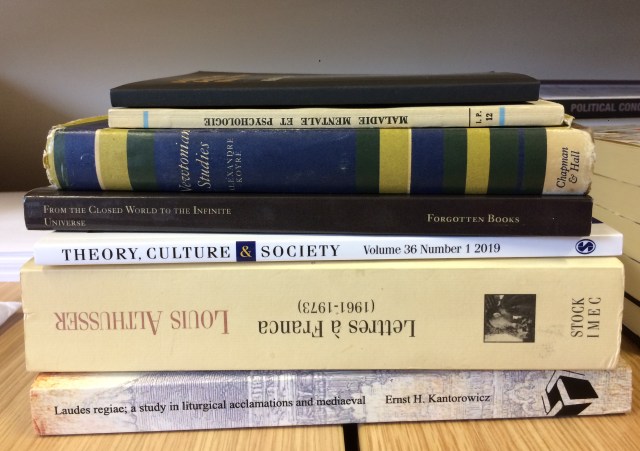
Some books that arrived while I was away – Kathryn Yusoff, A Billion Black Anthropocenes or None; a copy of Foucault’s Maladie mental et psychologie; Alexandre Koyré’s Newtonian Studies and From the Closed World to the Infinite Universe; the latest issue of Theory, Culture and Society; Louis Althusser’s Lettres à Franca; and Ernst Kantorowicz, Laudes Regiae.
Kathryn’s book was sent by University of Minnesota Press. Here’s the description:
Kathryn Yusoff examines how the grammar of geology is foundational to establishing the extractive economies of subjective life and the earth under colonialism and slavery. She initiates a transdisciplinary conversation between black feminist theory, geography, and the earth sciences, addressing the politics of the Anthropocene within the context of race, materiality, deep time, and the afterlives of geology.
I am delighted to have been invited to give the fourth Denis Cosgrove Lecture in the GeoHumanities. The lecture is organised by the Royal Holloway Centre for the GeoHumanities, and will take place at the British Academy in London, on 23 May 2019 at 6pm.
I didn’t know Denis well, but I was a visiting professor at UCLA in 2006, while he was teaching there. The 2018 lecture was given by the art historian Joan Schwartz (Queens, Canada), the 2017 lecture by performance scholar and practitioner Dee Heddon (Glasgow), and the 2016 lecture by Jerry Brotton (QMUL). It’s a real honour to be asked.
As was requested, the topic will related to my work on Shakespeare, but while I will draw on my previous work in Shakespearean Territories I do plan to develop some further ideas. The title I’ve given the organisers is “Shakespearean Landscapes”, which naturally connects to some of Denis’s best-known work.
This lecture explores how Shakespeare’s plays evoke a sense of landscape. Shakespeare’s grasp of specific geographies could be shaky, but his plays are rich with a range of geographical themes, language and detail. Shakespeare lived and wrote at a time of colonial exploration and saw the development of many cartographic, navigational and land-measuring techniques. The lecture builds on the argument of my recent book, Shakespearean Territories, but explores a different yet related geographical theme – that of landscape. This is of course a theme which Denis Cosgrove examined so perceptively. The plays discussed will include some of Shakespeare’s most famous, such as Macbeth and King Lear, and lesser known ones including Timon of Athens.
 Sean Gaston, There are Contexts: Derrida and the Challenge of History – short piece at the Rowman International site, on Derrida, history, politics, text and context. Gaston’s book Jacques Derrida and the Challenge of History appeared late last year.
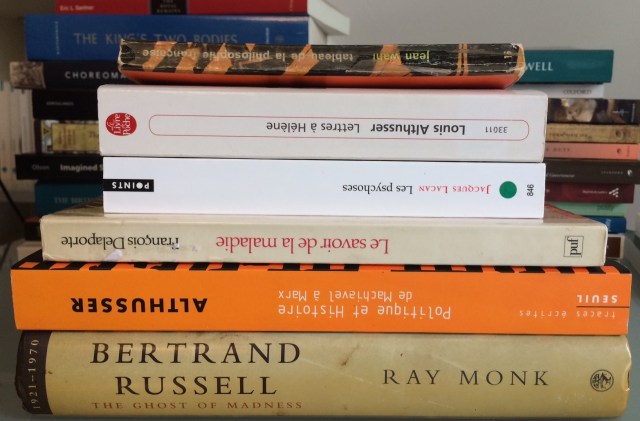
Some second-hand books picked up in Paris – Wahl, Althusser, Lacan, and Delaporte, along with the second volume of Ray Monk’s biography of Bertrand Russell.

The wonderful IMEC – the reading room and library is in the Abbey building itself
Since the last update I have been continuing to work on several different aspects of the work for both The Early Foucault and a planned book on the 1960s.
Initially I finished up the work comparing the 1954 text Maladie mentale et personnalité and the 1962 text Maladie mentale et psychologie. That took a lot of time, but was useful for what I wanted. I’ve shared the raw comparison here. I then began looking at Birth of the Clinicand the two editions of that, and discovered that while Alan Sheridan’s translation is largely of the second edition, strangely there are some parts which clearly follow the first. This alerted me to a much greater degree of revision between the two French editions than I’d previously appreciated. I still need to do a detailed analysis, but my initial thoughts and questions are here.
In my last week in Paris I did have an initial look at some materials at the Bibliothèque nationale relating to Les mots et les choses and L’archéologie du savoir. These comprised reading notes and a course from Brazil in 1965, and a complete and partial draft of L’archéologie du savoir. The reading notes for Les mots et les choses are all scanned and online, so I didn’t anticipate needing to spend much time with that box – it was really just a case of checking all the material was indeed available and that the ordering was the same. However, that box does have a text which is not digitized – the original French text for the 1970 English preface to The Order of Things. The version in Dits et écrits is a translation back into French from the English. When I was writing my PhD I used this text, and was troubled by one particular sentence. I made a comment about how it was frustrating we didn’t have the original French in the thesis and in the book that came from it, Mapping the Present (p. 100).
The English text says:
“In distinguishing between the epistemological level of knowledge (or scientific consciousness) and the archaeological level of knowledge, I am aware that I am advancing in a direction that is fraught with difficulty” (p. xiii).
Now because of Foucault’s important distinction between connaissance and savoir, this seemed like a misleading translation. But the French translation in Dits et écrits didn’t help, rendering the first ‘knowledge’ as savoir, and avoiding the problem with the second:
“En distinguant entre le niveau épistémologique du savoir (ou de la conscience scientifique) et le niveau archéologique, j’ai conscience de m’engager dans une voie très difficile” (Vol II, p. 11).
The original French clarifies things entirely:
“En distinguant le niveau épistémologique de la connaissance (ou de le conscience scientifique) et le niveau archéologique du savoir, je me rends compte que j’avance dans une direction qui n’est pas aisée” (ms. p. 6).
I can see how Sheridan got from the original text to the translation (though he really should have marked the distinction), and then I can see how Fabienne Durand-Bogaert rendered Sheridan’s English into French for Dits et écrits, but it’s an instructive lesson. There are a few other interesting differences between the original French and the derived French, so hopefully this will be published at some point.
The 1965 course is an interesting intermediate stage on the way to Les mots et les choses. A few of the pages have the lecture number, a day and sometimes a day of the month. Checking a 1965 calendar lined things up properly. This course is planned for publication at some point in the sequence of pre-Collège de France courses.
The complete draft of L’archéologie du savoirhas been available at the BnF for 25 years, and it was actually the first box of material I looked at there, but it is certainly an underexplored resource. The partial draft, of a later date to the complete one, is also interesting (it was deposited at the BnF in 2013). Three fragments of these drafts have been published in French in the past several years, but none in English. There is also some valuable discussion in the notes to Oeuvres Vol I.
On my final day in Paris made a trip to the CAPHÉS archive at the École Normale Supérieure, which I used quite a bit for the Canguilhem book, to check over some materials there. And during my time I made several trips to the Mitterand site of the BnF, and a few to the Bibliothèque Saint-Geneviève, to check books and journals which are hard to find in England.
I have also been working a bit on the 1964 shortened text of Histoire de la folie– the abridged version which was the basis for the English translation Madness and Civilization. The abridgment in French was a cheaper edition for a wider audience. Unfortunately, because it was used for the translation, it led to a lot of problems in Foucault debates. Although we now have a translation of the full, unabridged text, and the full text is the only one still in print in France, I think the abridgement is an interesting historical source in itself. It is about a third of the length of the original, and because the abridgment was made by Foucault himself, it gives some sense of how he thought the key lessons of the book might be presented in a more popular way. But I have no time for the claims that the cuts meant anything more significant than that – the full text was also reprinted in 1964, and, except for the original preface, in 1972 and 1976. The only revealing cut is his dropping of the 1961 preface, but that wasn’t removed until 1972. For this purpose I bought another copy of the current Gallimard/Tel edition so I could mark it up with pen and highlighter.
At the end of my trip I also had a few days at IMEC in Normandy. There I looked again at a few files I’d consulted before from the Foucault fonds, but also at some pieces from other collections, notably the Derrida and Althusser ones, which relate to Foucault. Among other things they have Althusser’s personal library, which includes some books given to him by Foucault with dedications. But while the dedications are interesting, it’s what Althusser does to the books that was really revealing. He fills them with underlinings, comments, other markings, links to other pages, and so on. He uses pieces of paper to mark pages, but I also found a clipping of a Foucault newspaper interview in one. The annotations were really interesting. So too were his notes for some of his seminars and those of his students. The Derrida papers were interesting for multiple reasons, including the few texts he wrote on Foucault. The archive has photocopies of some texts where the originals are at Irvine, but also several originals. IMEC is a glorious place to work, but if I come here again it really needs to be in the summer.
I have about 50,000 words of notes that I’ve taken in these past few weeks, and lots of things to follow up. I have a mountain of references to check when I get back to the UK, at home, Warwick, the British Library and a few other places. But I hope that for now I’ve done all I need to do in France. The next time I have a chance to do some archive work it will be elsewhere.
The previous updates on this project are here; and the previous books Foucault’s Last Decade and Foucault: The Birth of Power are both available from Polity. Canguilhem is forthcoming very soon, and is discussed a bit more here. Several Foucault research resources such as bibliographies, short translations, textual comparisons and so on, produced while doing the work for these books, are available here.
Christopher Watkin has shared an update and the Introduction of his major study of Michel Serres.
Michel Serres book project update: Draft Introduction
For the past three and a half years I have been working on a monograph on the thought of Michel Serres. It has been an exhilarating and exhausting project, in the course of which I have largely forgotten what it feels like to be anywhere near an intellectual comfort zone.
During these years I have also been on a journey of learning how to write a book on a single thinker. It has come down, I think, to juggling three related concerns: letting Serres’s thought speak for itself and operate with its own evolving parameters and sensibilities; bringing it into conversation with the positions adopted by other thinkers without taking the focus away from Serres’s own concerns or emphases; and developing an approach to writing on a single thinker per se, seeking to draw my book’s rhythm and approach out of Serres’s own patterns of thought rather than forcing him into an alien set of assumptions and categories, all the while avoiding a hagiographic approach.
This week I finished the first full draft of the book, which spans six chapters and runs to 181 000 words including translated quotations. I have posted the full draft Introduction below, and it is also available as a PDF on academia.edu and researchgate.net. The Introduction gives the reader a sense of my overall approach, some of the main characteristics of Serres’s writing and a potted biography, as well as making the case for the timeliness of Serres’s thought.
 I missed this before, but a previously unpublished lecture from the 1950s, appeared in the journal Zilsel, No 2, in 2017. It was introduced by Jean-François Bert.
Jean-François Bert, “Michel Foucault défenseur de l’ethnologie: « La magie – le fait social total », une leçon inédite des années 1950″
Michel Foucault, “La magie – le fait social total”
Si Michel Foucault n’était pas ethnologue, il a pourtant entretenu une longue familiarité avec les écrits fondateurs de la discipline. C’est ce que nous révèle le manuscrit original d’une leçon que le philosophe a donnée à l’École normale supérieure (ENS) à propos de la magie comme fait social total. Nous le publions dans la rubrique « Classiques » de ce numéro et dans l’article introductif qui suit, Jean-François Bert, qui a trouvé et retranscrit ce document, signale combien la lecture de Marcel Mauss a été cruciale pour le jeune Foucault qui, à la demande de Louis Althusser, enseigna la psychologie rue d’Ulm à partir de 1951. Cette lecture a été essentielle d’abord parce qu’elle l’a confronté à un domaine disciplinaire qui n’était alors pas le sien mais qui fut source d’inspiration. Elle l’est également parce qu’elle lui a fourni les outils d’un décentrement continu des problématiques sur lesquelles il travaillait. Foucault envisageait ici la magie comme fait social et en profitait pour la requalifier en termes philosophiques. Elle s’extrayait alors des formes techniques pour s’inscrire dans une histoire des manières de penser. Dans le prochain numéro 3 de Zilsel, Jean-François Bert poursuivra l’analyse du dialogue que Foucault n’a cessé d’entretenir avec l’ethnologie dans les années 1960 et 1970.

