Reading Derrida’s Geschlecht III: Responses to an Archival Discovery, Princeton, Oct 12-13 2018

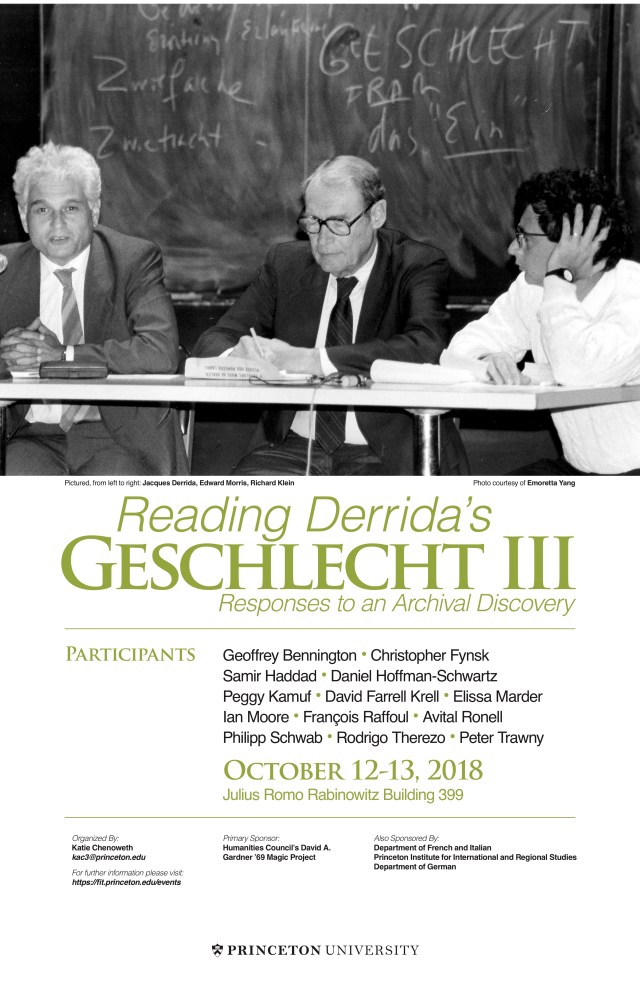
Reading Derrida’s Geschlecht III: Responses to an Archival Discovery, Princeton, Oct 12-13 2018.

Derrida wrote four papers on the theme of ‘Geschlecht’ – race, lineage, sex, and multiple other meanings – in Heidegger, publishing I, II and IV. The third was presented at a conference and a written version circulated to participants but not published. David Farrell Krell, Phantoms of the Other: Four Generations of Derrida’s Geschlecht (Albany: State University of New York, 2015) is an excellent study of this work (my review is here). This conference looks great, with some terrific speakers including Krell.

GELSCHLECHT CONF POSTER V5.jpg

Posted in Jacques Derrida, Martin Heidegger, Uncategorized | Leave a comment

Foucault fever in contemporary China (2017)

Interesting account of Foucault’s status in China – good to know there is this interest when both my recent Foucault books are being translated into Chinese.

Clare O'Farrell's avatarFoucault News

Opinion: Foucault fever in contemporary China – CGTNBy Zhao Hong. CGTN, 2017-02-24
Guest commentary by Zheng Yiran

On September 11, 2016, at the Central Academy of Fine Arts (CAFA) Art Museum, a thousand people squeezed into an auditorium that can accommodate only four hundred audience. It was the Beijing Premiere of Wang Min’an’s documentary, “Michel Foucault”. Hundreds of people were standing on the aisle to watch this 83-minute film, considered to be the epitome of the “Foucault Fever” in contemporary China.
[…]
In Douban, a very popular Chinese SNS website allowing people to share comments related to books, films and other cultural products and activities, the reading group of Foucault has gathered 12,000 people. The number of Foucault fans beats that of Immanuel Kant, Martin Heidegger, G. W. F. Hegel. Interestingly, Foucault’s group is also bigger than other groups tagged “French culture,” “French literature” and “Sophie Marceau,” who is…

View original post 50 more words

Posted in Uncategorized | Leave a comment

Histories of Violence: Nonviolence and the Ghost of Fascism (2018)

Interview with Todd May by Brad Evans in LA Review of Books

Clare O'Farrell's avatarFoucault News


Histories of Violence: Nonviolence and the Ghost of Fascism – Los Angeles Review of Books MAY 21, 2018

This conversation is with Todd May, who is a political philosopher and social activist based at Clemson University. Among his many books are, more recently, A Fragile Life: Accepting Our Vulnerability (2017) and Nonviolent Resistance: A Philosophical Introduction (2015).

In your writings, you continue to highlight the contemporary importance of continental thinkers such as Michel Foucault, Gilles Deleuze, and Jacques Rancière, among others. How do they still help us develop a critique of violence adequate to our times?

Todd May: Let me address this in two parts: the issue of the critique of violence and then the alternative of nonviolence. Regarding violence, we need to ask a bit about what violence is. In my book on nonviolence, I confessed to being unable to come up with an adequate overall definition of violence…

View original post 90 more words

Posted in Uncategorized | Leave a comment

‘Shakespeare, Richard II and the Political Economy of Territory’ – short piece at the Progress in Political Economy blog

I have a short piece at the Progress in Political Economy blog entitled ‘Shakespeare, Richard II and the Political Economy of Territory‘. Thanks to Adam David Morton for the invitation to contribute.

Shakespeare has long been seen as a writer with something to say about the economic. Karl Marx famously uses Timon of Athens to discuss the “power of money” in his 1844 Manuscripts and Capital Volume I. There are crucial economic questions in The Merchant of Venice, not only in the character of the money-lender Shylock, but also the failure of the overseas trading which means that Antonio cannot repay the debt. There are many more readings of Shakespeare’s plays through an economic lens. If the North American school of new historicism owed much to Michel Foucault, the British cultural materialists drew more explicitly on the work of Marx and some of his commentators, notably Raymond Williams. Others have seen the wider shifts of economic systems at work in his history plays – journalist and broadcaster Paul Mason for example wrote a piece in 2014 entitled ‘What Shakespeare taught me about Marxism’.

My forthcoming book, Shakespearean Territories, develops my long-standing interest in the question of territory. [continues here]

Posted in Adam David Morton, Shakespearean Territories, Uncategorized, William Shakespeare | Leave a comment

The Virtual Mappa Project and Digital Mappa – Online editions of Medieval Maps from the British Library and elsewhere

The Virtual Mappa Project and Digita Mappa: Online editions of Medieval Maps from the British Library and elsewhere – full update from Cat Crossley here.

After a long journey and much hard work from a lot of very dedicated people, it is time to get excited about medieval maps again! The Virtual Mappa Project has been officially released as an open access publication, with an incredible collection of digitised medieval world maps from the British Library and beyond, all online, annotated and waiting to be explored.

Back in 2013 I was hard at work in the BL Maps department, tasked with marking up some marvellous medieval mappaemundi. At that time I documented my work and the project’s progress in a few blogs posts, including this overview available here. To recap, the British Library has lent its medieval manuscripts, imaging studios and hive-mind of expertise to the DM project, to help create a corpus of digital editions of medieval world maps in a visually navigable, text-searchable, translated format, that makes their intricacies much more accessible to modern minds. A full history of DM and everyone involved can be found here and it is fair to say there have been some technical hiccups along the way (hence the slight delay in publication), but we are now ready to unveil the finished product and I must admit I’m very excited.

New Addition to Virtual Mappa

DM workspace showing two British Library mappaemundi more recently added to the project, and introductory information for the Virtual Mappa project as a whole.
Posted in Uncategorized | Leave a comment

Laura Vaughan, Mapping Society: The Spatial Dimensions of Social Cartography – UCL Press, September 2018 (open access pdf/paperback)

Mapping_Society.jpgLaura Vaughan, Mapping Society: The Spatial Dimensions of Social Cartography – UCL Press, September 2018 (open access)

From a rare map of yellow fever in eighteenth-century New York, to Charles Booth’s famous maps of poverty in nineteenth-century London, an Italian racial zoning map of early twentieth century Asmara, to a map of wealth disparities in the banlieues of twenty-first-century Paris, Mapping Society traces the evolution of social cartography over the past two centuries. In this richly illustrated book, Laura Vaughan examines maps of ethnic or religious difference, poverty, and health inequalities, demonstrating how they not only serve as historical records of social enquiry, but also constitute inscriptions of social patterns that have been etched deeply on the surface of cities.

The book covers themes such as the use of visual rhetoric to change public opinion, the evolution of sociology as an academic practice, changing attitudes to physical disorder, and the complexity of segregation as an urban phenomenon. While the focus is on historical maps, the narrative carries the discussion of the spatial dimensions of social cartography forward to the present day, showing how disciplines such as public health, crime science, and urban planning chart spatial data in their current practice. Containing examples of space syntax analysis alongside historical maps and photographs, this volume will appeal to all those interested in the long-term forces that shape how people live in cities.

Posted in Uncategorized | 1 Comment

“Much More Than You Think: The Spatialities of Italian Autonomy” – Interview with Neil Gray, author of “Beyond the Right to the City: Territorial Autogestion and the Take over the City Movement in 1970s Italy”

Interesting interview with Neil Grey on the Italian autonomia movement and the right to the city, with some discussion of Lefebvre. The Antipode article it is linked to is unfortunately behind a paywall.

Antipode Editorial Office's avatarAntipodeFoundation.org

Neil Gray and Hamish Kallin, June 2018

Hamish Kallin: What first got you interested in Italian autonomism?

Neil Gray: My personal biography is perhaps not of much interest, but reflecting on this question might help provide a sense of how the relatively obscure theory and praxis associated with Italian autonomy has travelled into my own working class autodidactic milieu in Scotland. First, a step backwards. My initial shift towards the more radical thinking associated with Italian autonomy came through the Situationist International (SI), who helped me grasp a critique of productivism, the refusal of work and an internal critique of the Left. Relatedly, it was through the SI that I encountered Lefebvre, rather than the other way round as with many geographers, and so my perception of him has always been premised on his more insurrectionary side. If anything the reading of Lefebvre I found through SI texts and commentaries…

View original post 6,999 more words

Posted in Uncategorized | Leave a comment

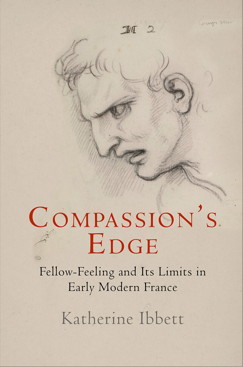
Katherine Ibbett, Compassion’s Edge: Fellow-Feeling and Its Limits in Early Modern France – U Penn Press, 2017

15747.jpgKatherine Ibbett, Compassion’s Edge: Fellow-Feeling and Its Limits in Early Modern France – U Penn Press, 2017. Late coming to this one, which won the 2018 Society for Renaissance Studies Book Prize.

“This is in every respect a brilliant and path-breaking book. Katherine Ibbett is ferociously smart, wonderfully humane, a gloriously playful and lucid writer, and a genuinely gifted close reader. Compassion’s Edge will provoke a great deal of discussion and debate, opening new avenues of reflection and research.”—Christopher Braider, University of Colorado at Boulder

Compassion’s Edge is an intellectually invigorating and original study. Its finely shaded and relentlessly probing investigation never ceases to interest. Katherine Ibbett is astonishing in her ability to synthesize, in a nuanced yet dynamic fashion, a broad spectrum of critical approaches and theoretical angles on the one hand and, on the other, to draw together an impressive range of historical documents and primary literary sources.”—Larry Norman, author of The Shock of the Ancient: Literature and History in Early Modern France

Compassion’s Edge examines the language of fellow-feeling—pity, compassion, and charitable care—that flourished in France in the period from the Edict of Nantes in 1598, which established some degree of religious toleration, to the official breakdown of that toleration with the Revocation of the Edict in 1685. This is not, however, a story about compassion overcoming difference but one of compassion reinforcing division: the seventeenth-century texts of fellow-feeling led not to communal concerns but to paralysis, misreading, and isolation. Early modern fellow-feeling drew distinctions, policed its borders, and far from reaching out to others, kept the other at arm’s length. It became a central feature in the debates about the place of religious minorities after the Wars of Religion, and according to Katherine Ibbett, continues to shape the way we think about difference today.

Compassion’s Edge ranges widely over genres, contexts, and geographies. Ibbett reads epic poetry, novels, moral treatises, dramatic theory, and theological disputes. She takes up major figures such as D’Aubigné, Montaigne, Lafayette, Corneille, and Racine, as well as less familiar Jesuit theologians, Huguenot ministers, and nuns from a Montreal hospital. Although firmly rooted in early modern studies, she reflects on the ways in which the language of compassion figures in contemporary conversations about national and religious communities. Investigating the affective undertow of religious toleration, Compassion’s Edge provides a robust corrective to today’s hope that fellow-feeling draws us inexorably and usefully together.

Posted in Uncategorized | Leave a comment

Mark Polizzotti, Sympathy for the Traitor: A Translation Manifesto – MIT Press, April 2018

Sympathy for the TraitorMark Polizzotti, Sympathy for the Traitor: A Translation Manifesto – MIT Press, April 2018

An engaging and unabashedly opinionated examination of what translation is and isn’t.

For some, translation is the poor cousin of literature, a necessary evil if not an outright travesty—summed up by the old Italian play on words, traduttore, traditore (translator, traitor). For others, translation is the royal road to cross-cultural understanding and literary enrichment. In this nuanced and provocative study, Mark Polizzotti attempts to reframe the debate along more fruitful lines. Eschewing both these easy polarities and the increasingly abstract discourse of translation theory, he brings the main questions into clearer focus: What is the ultimate goal of a translation? What does it mean to label a rendering “faithful”? (Faithful to what?) Is something inevitably lost in translation, and can something also be gained? Doestranslation matter, and if so, why? Unashamedly opinionated, both a manual and a manifesto, his book invites usto sympathize with the translator not as a “traitor” but as the author’s creative partner.

Polizzotti, himself a translator of authors from Patrick Modiano to Gustave Flaubert, explores what translation is and what it isn’t, and how it does or doesn’t work. Translation, he writes, “skirts the boundaries between art and craft, originality and replication, altruism and commerce, genius and hack work.” In Sympathy for the Traitor, he shows us how to read not only translations but also the act of translation itself, treating it not as a problem to be solved but as an achievement to be celebrated—something, as Goethe put it, “impossible, necessary, and important.”

Posted in Uncategorized | Leave a comment

Kingston Shakespeare Series Conference: Shakespeare and Derrida, 1 September 2018

Featured Image -- 34432Kingston Shakespeare Series Conference: Shakespeare and Derrida, 1 September 2018, Garrick’s Temple, Hampton – initial details here.

This follows various other conferences on Shakespeare and theorists – I spoke at the one on Shakespeare and Foucault last month – and is part of the Kingston Shakespeare Seminar – follow the blog here.

Posted in Jacques Derrida, Michel Foucault, Uncategorized, William Shakespeare | Leave a comment