Verena Erlenbusch-Anderson, Genealogies of Terrorism: Revolution, State Violence, Empire – Columbia University Press, July 2018

9780231547178Verena Erlenbusch-Anderson, Genealogies of Terrorism: Revolution, State Violence, Empire, Columbia University Press, July 2018.

What is terrorism? What ought we to do about it? And why is it wrong? We think we have clear answers to these questions. But acts of violence, like U.S. drone strikes that indiscriminately kill civilians, and mass shootings that become terrorist attacks when suspects are identified as Muslim, suggest that definitions of terrorism are always contested. In Genealogies of Terrorism, Verena Erlenbusch rejects attempts to define what terrorism is in favor of a historico-philosophical investigation into the conditions under which uses of this contested term become meaningful. The result is a powerful critique of the power relations that shape how we understand and theorize political violence.

Tracing discourses and practices of terrorism from the French Revolution to late imperial Russia, colonized Algeria, and the post-9/11 United States, Erlenbusch examines what we do when we name something terrorism. She offers an important corrective to attempts to develop universal definitions that assure semantic consistency and provide normative certainty, showing that terrorism means many different things and serves a wide range of political purposes. In the tradition of Michel Foucault’s genealogies, Erlenbusch excavates the history of conceptual and practical uses of terrorism and maps the historically contingent political and material conditions that shape their emergence. She analyzes the power relations that make different modes of understanding terrorism possible and reveals their complicity in justifying the exercise of sovereign power in the name of defending the nation, class, or humanity against the terrorist enemy. Offering an engaged critique of terrorism and the mechanisms of social and political exclusion that it enables, Genealogies of Terrorism is an empirically grounded and philosophically rigorous critical history with important political implications.

1. The Trouble with Terrorism
2. The Emergence of Terrorism
3. State Terrorism Revisited
4. Terrorism and Colonialism
5. Reimagining Terrorism at the End of History
6. Towards a Critical Theory of Terrorism: Genealogy and Normativity

Inspired by Wittgenstein and Foucault, and contemporary debates about concepts, in this remarkable book Verena Erlenbusch-Anderson undertakes a significant examination of terrorism. Rather than assuming its meaning and looking for that in her sources, she instead allows a multifaceted understanding to emerge from a historical study of texts and practices. A powerful and urgent intervention for our troubled times. Stuart Elden, University of Warwick

This book is political philosophy at its best. It offers an instructive model of mobilizing philosophical genealogy for a critique of a highly-charged idea. It complicates the seeming obviousness with which the concept of ‘terrorism’ is today purveyed. Through meticulous historical and philosophical analysis, this book shows how the concept of terrorism came to be an explosive, dangerous, and contested political idea. Colin Koopman, University of Oregon

Verena Erlenbusch-Anderson’s careful genealogy of ‘terrorism’—tracking the term’s multiple and overdetermined meanings since its first appearance as a political concept in the late eighteenth century—powerfully shows us how we all too frequently ask the wrong questions about terrorism. This critical book offers a necessary corrective to how we think about terrorism, and it reshapes the grounds upon which we should have any meaningful debate about terrorism in the present moment. Andrew Dilts, Loyola Marymount University

Posted in Uncategorized | Leave a comment

Stuart Elden, ‘Why should people interested in territory read Shakespeare?’ – Territory, Politics, Governance, open access until end of September 2018

Publication CoverStuart Elden, ‘Why should people interested in territory read Shakespeare?‘ – Territory, Politics, Governance – open access until end of September 2018.

I shared this before, but the article is now open access. It’s a short piece which acts as a kind of preview of the forthcoming book Shakespearean Territories.

This paper argues that territory is more than a simple concept, and that William Shakespeare is a valuable guide to understanding its complexities. Shakespeare’s plays explore many aspects of geography, politics and territory. They include ideas about the division of kingdoms in King Lear, the struggle over its control in Macbeth and many of the English history plays, to the vulnerability of small territories with powerful neighbours in Hamlet. However, the plays also help us to understand the legal and economic issues around territory, of the importance of technical innovations around surveying and cartography, and the importance of landscapes and bodies. Shakespeare is especially interesting because debates in political theory at this time concerned a recognizably modern understanding, and European states were consolidating their own rule, marking boundaries and seizing colonial possessions. Shakespeare dramatizes many of these themes, from The Tempest to plays set in the Eastern Mediterranean such as Othello. Territory is a word, concept and practice, and their interrelation is explored with Shakespeare as a guide. This builds on the author’s previous work on territory, but also develops the understanding further, especially around the colonial, corporeal and geophysical. Historical work on our contemporary concepts can also be revealing of our present.


Posted in Shakespearean Territories, Territory, Uncategorized, William Shakespeare | Leave a comment

Thoughts on the History of Telos, 1968–2018

Some interesting reflections on the history of the Telos journal from Tim Luke.

Clare O'Farrell's avatarFoucault News

Thoughts on the History of Telos, 1968–2018
By Timothy W. Luke, Telos Wednesday, July 11, 2018

On June 8, 2018, Telos celebrated its fiftieth anniversary at a special event held in New York City. Speakers included Telos Press publisher Maria Piccone, Telos editors Russell Berman, Tim Luke, David Pan, and Adrian Pabst, as well as Jacob Siegel, who delivered a talk on “Telos, Post-liberal Politics, and a Veteran’s Reading of Ernst Jünger.” Videos of the event are available at the Telos-Paul Piccone Institute websiteTelos 183 (Summer 2018), our fiftieth anniversary issue, is available for purchase in our store. Presented below is a revised transcript of Tim Luke’s remarks at the anniversary event.

View original post

Posted in Uncategorized | Leave a comment

Cycling across borders – Slovenia, Austria, Italy

Just back from a week on holiday in Kranjska Gora, Slovenia. A little hiking but mainly cycling. Kranjska Gora is in the north-west of the country, close to the borders with Italy and Austria. I’ve crossed borders within the Schengen area before, of course, but never with the frequency I did on this trip – a couple of routes went through all three countries. There was a lot of climbing in the Julian Alps, including the Vršič Pass (also known as the Russian road), with 50 hairpins up and down, and the highest at 1611 metres, and the Wurzen Pass between Slovenia and Austria both ways. The Wurzen Pass from Austria to Slovenia was the hardest climb, with some long stretches of tough gradient, though doing that in a thunderstorm didn’t help.

KG.jpeg

With the Canguilhem book wrapped up just before I left, I’m now dealing with some small things and then, finally, back to the work on The Early Foucault.


Posted in Boundaries, Canguilhem (book), Cycling, Georges Canguilhem, Michel Foucault, The Early Foucault, Travel, Uncategorized | Leave a comment

Canguilhem – book for Polity’s Key Contemporary Thinkers series, forthcoming 2019

My study of Georges Canguilhem was resubmitted earlier this month. It’s now been accepted in final form and will appear in Polity’s Key Contemporary Thinkers series in early 2019.

As I’ve mentioned before, the book developed out of the work I’ve been doing on the very early Foucault. Here’s the book description:

Georges Canguilhem (1904-1995) was an influential historian and philosopher of science, as renowned for his teaching as for his writings. He is best known for his book The Normal and the Pathological, originally his doctoral thesis in medicine, but he also wrote a thesis in philosophy on the concept of the reflex, supervised by Gaston Bachelard. He was the sponsor of Michel Foucault’s doctoral thesis on madness. However, his work extends far beyond what is suggested by his association with these thinkers. Canguilhem also produced a series of important works on the natural sciences, including studies of evolution, psychology, vitalism and mechanism, experimentation, monstrosity and disease.

Stuart Elden discusses the whole of this important thinker’s complex work, including recently rediscovered texts and archival materials. Canguilhem always approached questions historically, examining how it was that we came to a significant moment in time, outlining tensions, detours and paths not taken. The first comprehensive study in English, this book is a crucial guide for those coming to terms with Canguilhem’s important contributions, and will appeal to researchers and students from a range of fields.

Here’s the table of contents:

Abbreviations

1. Foundations

2. The Normal and the Pathological

3. Philosophy of Biology

4. Physiology and the Reflex

5. Regulation and Psychology

6. Evolution and Monstrosity

7. Philosophy of History

8. Writings on Medicine

9. Legacies

Timeline

Foucault and Canguilhem

Jean Hyppolite, Michel Foucault, Georges Canguilhem, Dina Dreyfus, 1965 (source: Institut national de l’audiovisuel, via Foucault Blog)

Posted in Canguilhem (book), Gaston Bachelard, Georges Canguilhem, Jean Hyppolite, Michel Foucault, The Early Foucault, Uncategorized | 1 Comment

Stuart Elden, ‘Why should people interested in territory read Shakespeare?’ – Territory, Politics, Governance

Publication CoverStuart Elden, ‘Why should people interested in territory read Shakespeare?‘ – Territory, Politics, Governance (requires subscription or contact me). Update: open access until end of September 2018.

A new short article from me, which acts as a kind of preview of the forthcoming book Shakespearean Territories. My thanks to Martin Jones, John Agnew and the others at the journal for asking me to write this.

This paper argues that territory is more than a simple concept, and that William Shakespeare is a valuable guide to understanding its complexities. Shakespeare’s plays explore many aspects of geography, politics and territory. They include ideas about the division of kingdoms in King Lear, the struggle over its control in Macbeth and many of the English history plays, to the vulnerability of small territories with powerful neighbours in Hamlet. However, the plays also help us to understand the legal and economic issues around territory, of the importance of technical innovations around surveying and cartography, and the importance of landscapes and bodies. Shakespeare is especially interesting because debates in political theory at this time concerned a recognizably modern understanding, and European states were consolidating their own rule, marking boundaries and seizing colonial possessions. Shakespeare dramatizes many of these themes, from The Tempest to plays set in the Eastern Mediterranean such as Othello. Territory is a word, concept and practice, and their interrelation is explored with Shakespeare as a guide. This builds on the author’s previous work on territory, but also develops the understanding further, especially around the colonial, corporeal and geophysical. Historical work on our contemporary concepts can also be revealing of our present.

Posted in My Publications, Shakespearean Territories, Territory, Uncategorized, William Shakespeare | Leave a comment

E-IR interview with Lisa Tilley

E-IR interview with Lisa Tilley

Lisa Tilley is Lecturer in Politics and Leverhulme Early Career Fellow at Birkbeck, University of London. She is also co-convenor of the Colonial, Postcolonial, Decolonial Working Group of the British International Studies Association (CPD-BISA); co-founder of the collaborative research project Raced Markets; and Associate Editor of the pedagogical resource. Her work draws on various theoretical approaches to ‘the colonial question’ in analyses of Global Social Theoryprocesses of accumulation and expropriation, especially along urban and rural extractive frontiers in Indonesia.

Where do you see the most exciting debates happening in your field?

Race has really been the neglected, or deliberately proscribed, category in political economy, the field I am trained in. In fact, the exclusion/displacement of race from analyses of power and the economy is not separable from broader projects of exclusion/displacement of racialised persons in real life spheres. As such, a great deal of work needs to be done to rewrite global political economic histories, revise the core concepts we work with, and redesign curricula to properly account for the complex legacies, and elaborate renewals, of colonial racial ordering. There is, of course, extensive work on race already in existence which continues to be marginalised from most teaching and from disciplinary canon formation. The most vibrant scholarship on political economy is undoubtedly crafted (as it always has been) by Indigenous and otherwise racialised intellectuals and, at its best, this work attends to racial ordering in relation to class, gender, and sexuality too. [continues]

Posted in Uncategorized | Leave a comment

Judith Wambacq, Thinking Between Deleuze and Merleau-Ponty – reviewed at NDPR

OUP56Q220A944Judith Wambacq, Thinking Between Deleuze and Merleau-Ponty – reviewed at NDPR by Laura McMahon.

Thinking between Deleuze and Merleau-Ponty is the first book-length examination of the relation between these two major thinkers of the twentieth century. Questioning the dominant view that the two have little of substance in common, Judith Wambacq brings them into a compelling dialogue to reveal a shared, historically grounded concern with the transcendental conditions of thought. Both Merleau-Ponty and Deleuze propose an immanent ontology, differing more in style than in substance. Wambacq’s synthetic treatment is nevertheless critical; she identifies the limitations of each thinker’s approach to immanent transcendental philosophy and traces its implications—through their respective relationships with Bergson, Proust, Cézanne, and Saussure—for ontology, language, artistic expression, and the thinking of difference. Drawing on primary texts alongside current scholarship in both French and English, Thinking between Deleuze and Merleau-Ponty is comprehensive and rigorous while remaining clear, accessible, and lively. It is certain to become the standard text for future scholarly discussion of these two major influences on contemporary thought.

Posted in Uncategorized | Leave a comment

Sara Custer, ‘Social media: the good, the bad and the ugly’, Times Higher Education

Sara Custer, ‘Social media: the good, the bad and the ugly‘, Times Higher Education – may require registration, but should be free to read.

With about one-third of Earth’s 7 billion inhabitants on a social network, it is an inevitable part of scholars’ lives. While many academics find Twitter and Facebook useful means of disseminating their research, Sara Custer finds that the addictive seeking of ‘likes’ has its perils.

I was one of the academics interviewed, and while my comments quoted are all about avoiding social media and blocking sites, I do of course think there are positives too!


Posted in Uncategorized | Leave a comment

Books received – Fordham University Press and Steven Seegel, Map Men

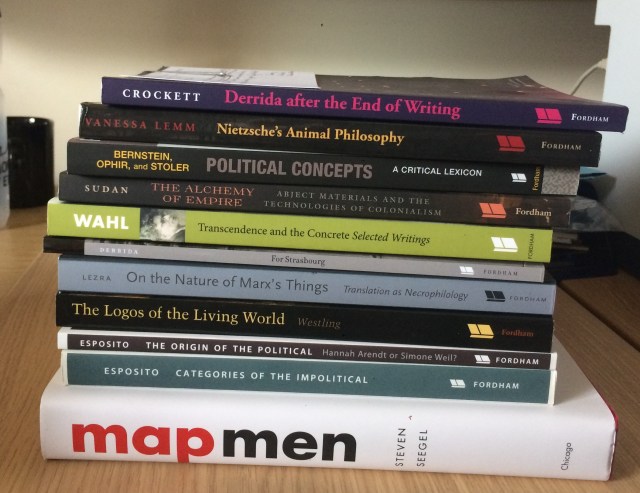
IMG_3453.JPG

A pile of books from Fordham University Press in recompense for review work, and Steven Seegel, Map Men: Transnational Lives and Deaths of Geographers in the Making of East Central Europe, sent by University of Chicago Press. The Fordham books are a number of books by or on Esposito, Derrida, Wahl, etc. but also Louise Westling, The Logos of the Living World: Merleau-Ponty, Animals, and Language, Jacques Lezra, On the Nature of Marx’s Things: Translation as Necrophilology, the collection Political Concepts: A Critical Lexicon, Rajani Sudan, The Alchemy of Empire and Vanessa Lemm, Nietzsche’s Animal Philosophy.

Posted in Friedrich Nietzsche, Jacques Derrida, Karl Marx, Maurice Merleau-Ponty, Roberto Esposito, Uncategorized | Leave a comment