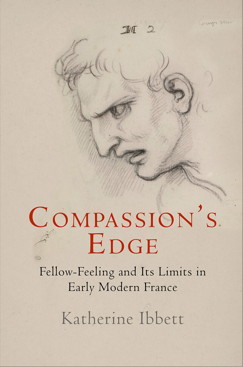
Katherine Ibbett, Compassion’s Edge: Fellow-Feeling and Its Limits in Early Modern France – U Penn Press, 2017

15747.jpgKatherine Ibbett, Compassion’s Edge: Fellow-Feeling and Its Limits in Early Modern France – U Penn Press, 2017. Late coming to this one, which won the 2018 Society for Renaissance Studies Book Prize.

“This is in every respect a brilliant and path-breaking book. Katherine Ibbett is ferociously smart, wonderfully humane, a gloriously playful and lucid writer, and a genuinely gifted close reader. Compassion’s Edge will provoke a great deal of discussion and debate, opening new avenues of reflection and research.”—Christopher Braider, University of Colorado at Boulder

Compassion’s Edge is an intellectually invigorating and original study. Its finely shaded and relentlessly probing investigation never ceases to interest. Katherine Ibbett is astonishing in her ability to synthesize, in a nuanced yet dynamic fashion, a broad spectrum of critical approaches and theoretical angles on the one hand and, on the other, to draw together an impressive range of historical documents and primary literary sources.”—Larry Norman, author of The Shock of the Ancient: Literature and History in Early Modern France

Compassion’s Edge examines the language of fellow-feeling—pity, compassion, and charitable care—that flourished in France in the period from the Edict of Nantes in 1598, which established some degree of religious toleration, to the official breakdown of that toleration with the Revocation of the Edict in 1685. This is not, however, a story about compassion overcoming difference but one of compassion reinforcing division: the seventeenth-century texts of fellow-feeling led not to communal concerns but to paralysis, misreading, and isolation. Early modern fellow-feeling drew distinctions, policed its borders, and far from reaching out to others, kept the other at arm’s length. It became a central feature in the debates about the place of religious minorities after the Wars of Religion, and according to Katherine Ibbett, continues to shape the way we think about difference today.

Compassion’s Edge ranges widely over genres, contexts, and geographies. Ibbett reads epic poetry, novels, moral treatises, dramatic theory, and theological disputes. She takes up major figures such as D’Aubigné, Montaigne, Lafayette, Corneille, and Racine, as well as less familiar Jesuit theologians, Huguenot ministers, and nuns from a Montreal hospital. Although firmly rooted in early modern studies, she reflects on the ways in which the language of compassion figures in contemporary conversations about national and religious communities. Investigating the affective undertow of religious toleration, Compassion’s Edge provides a robust corrective to today’s hope that fellow-feeling draws us inexorably and usefully together.

Posted in Uncategorized | Leave a comment

Mark Polizzotti, Sympathy for the Traitor: A Translation Manifesto – MIT Press, April 2018

Sympathy for the TraitorMark Polizzotti, Sympathy for the Traitor: A Translation Manifesto – MIT Press, April 2018

An engaging and unabashedly opinionated examination of what translation is and isn’t.

For some, translation is the poor cousin of literature, a necessary evil if not an outright travesty—summed up by the old Italian play on words, traduttore, traditore (translator, traitor). For others, translation is the royal road to cross-cultural understanding and literary enrichment. In this nuanced and provocative study, Mark Polizzotti attempts to reframe the debate along more fruitful lines. Eschewing both these easy polarities and the increasingly abstract discourse of translation theory, he brings the main questions into clearer focus: What is the ultimate goal of a translation? What does it mean to label a rendering “faithful”? (Faithful to what?) Is something inevitably lost in translation, and can something also be gained? Doestranslation matter, and if so, why? Unashamedly opinionated, both a manual and a manifesto, his book invites usto sympathize with the translator not as a “traitor” but as the author’s creative partner.

Polizzotti, himself a translator of authors from Patrick Modiano to Gustave Flaubert, explores what translation is and what it isn’t, and how it does or doesn’t work. Translation, he writes, “skirts the boundaries between art and craft, originality and replication, altruism and commerce, genius and hack work.” In Sympathy for the Traitor, he shows us how to read not only translations but also the act of translation itself, treating it not as a problem to be solved but as an achievement to be celebrated—something, as Goethe put it, “impossible, necessary, and important.”

Posted in Uncategorized | Leave a comment

Kingston Shakespeare Series Conference: Shakespeare and Derrida, 1 September 2018

Featured Image -- 34432Kingston Shakespeare Series Conference: Shakespeare and Derrida, 1 September 2018, Garrick’s Temple, Hampton – initial details here.

This follows various other conferences on Shakespeare and theorists – I spoke at the one on Shakespeare and Foucault last month – and is part of the Kingston Shakespeare Seminar – follow the blog here.

Posted in Jacques Derrida, Michel Foucault, Uncategorized, William Shakespeare | Leave a comment

Handbook on the Geographies of Power, edited by John Agnew and Mat Coleman – Edward Elgar, July 2018

9781785365638Handbook on the Geographies of Power – edited by John Agnew and Mat Coleman, Edward Elgar, 2018. A very expensive but interesting looking collection.

The so-called spatial turn in the social sciences means that many researchers have become much more interested in what can be called the spatialities of power, or the ways in which power as a medium for achieving goals is related to where it takes place. Most famous authors on the subject, such as Machiavelli and Hobbes, saw power as entirely equivalent to domination exercised by some over others. Though this meaning is hardly redundant, understandings of power have become more multidimensional and nuanced as a result of the spatial turn. Much recent writing in human geography, for example, has rigorously extended use of the term power beyond its typical understanding as a resource that pools up in some hands and some places to a medium of agency that has different effects depending on how it is deployed across space and how actors cooperate, or not, to give it effect. To address this objective, the book is organized thematically into four sections that cover the main areas in which much of the contemporary work on geographies of power is concentrated: bodies, economy, environment and energy, and war.

Contents:
Part I Introduction

1. Introduction to the Handbook on the Geographies of Power
Mat Coleman and John Agnew

Part II Bodies
Mat Coleman

2. When Ethnography Meets Space
Ishan Ashutosh

3. Sex and Sexuality: Exploring the Geographies of Prostitution
Phil Hubbard

4. Spatial Technologies of Racialized Knowing: On Visuality, Measurement, and the Law
Robin Wright, Eric Goldfischer, Aaron Mallory and Kate Derickson

5. “This Wack(Yhut) Idea!!!”: The Plantation Bloc and Political Economy of Prison Expansion in Louisiana
Jenna M. Loyd

6. Human, All too Human, Geographies
Claire Rasmussen and Michael Brown

Part III Economy
John Agnew

7. Reflections on the Power in and the Power of Financial Markets
Adam D. Dixon

8. Corporate–state relations in the age of Trumpism: analytical problems with the neoliberal synthesis and some potential ways forward
Joshua Barkan

9. Reproduction, Justice and Spatialities of Power
Kendra Strauss

10. Abstract and Concrete Labor in the Age of Informality
Vinay Gidwani

11. The Circulation of Financial Elites
John Allen

Part IV Energy And Environment
Mat Coleman

12. The Anthropocene and Geographies of Geopower
Kathryn Yusoff

13. The Power of Water
Philip Steinberg

14. Animated Place: Invisible Industrial Technologies and the Shaping of Eating Bodies
Nicholas Bauch

15. Microontologies and the Politics of Emergent Life
Nigel Clark and Myra Hird

16. Destituent Power and Common Use: Reading Agamben in the Anthropocene
Bruce Braun and Stephanie Wakefield

Part V Warfare
John Agnew

17. Human Shields and the Political Geography of International Humanitarian Law
Neve Gordon and Nicola Perugini

18. Matrix Governance and Imperialism
Pádraig Carmody

19. Governing Banishment: Settler Colonialism, Territory, and Life in an Economy of Death
Lisa Bhungalia

20. Military Contracting and the Labor of Force Projection
Adam Moore

21. Autonomy, Human Vulnerability and the Volumetric Composition of US Border Policing
Geoff Boyce

22. Maps, Complexity, and the Uncertainty of Power
Luca Muscarà

23. To Help or Not to Help? Humanitarian Spaces, Power, and Government
Jennifer Hyndman

24. Power’s Outsides
Mat Coleman and John Agnew

Index

Posted in Uncategorized | 1 Comment

Global Politics: A New Introduction, 3rd edition, edited by Jenny Edkins and Maja Zehfuss – Routledge, December 2018

9781138060296Global Politics: A New Introduction, 3rd edition, edited by Jenny Edkins and Maja Zehfuss – forthcoming in December 2018.

The 3rd edition of Global Politics: A New Introduction continues to provide a completely original way of teaching and learning about world politics. The book engages directly with the issues in global politics that students are most interested in, helping them to understand the key questions and theories and also to develop a critical and inquiring perspective.

Completely revised and updated throughout, the 3rd edition includes a host of new illustrative examples which focus on the most pressing issues in in global politics, offering new material on topics such as Migration, Brexit, the rise and impact of ISIS, Race and Racism and Drone warfare.

Global Politics:

  • Examines the most significant issues in global politics – from war, peacebuilding, terrorism, security, violence, nationalism, political violence, human rights and authority to poverty, development, postcolonialism, gender, inequality, ethnicity, environmental politics, nationalism, the internet, democratization, colonialism and the financial crisis.
  • Offers chapters written to a common structure which is ideal for teaching and learning and features a key question, an illustrative example, general responses and broader issues
  • Integrates theory and practice throughout the text, by presenting theoretical ideas and concepts in conjunction with a global range of historical and contemporary case studies

Drawing on theoretical perspectives from a broad range of disciplines including international relations, political theory, postcolonial studies, sociology, geography, peace studies and development this innovative textbook is essential reading for all students of global politics and international relations.

Like the previous editions, I have a  chapter in this, entitled ‘Why is the world divided territorially?’


Posted in Uncategorized | Leave a comment

Elaine Stratford, Home, Nature, and the Feminine Ideal: Geographies of the Interior and of Empire – Rowman, January 2019

5b46ee7ef5ba74183c269bfd.jpgElaine Stratford, Home, Nature, and the Feminine Ideal: Geographies of the Interior and of Empire – Rowman International, January 2019.

Take three things: the home, nature, and the feminine ideal—a notional and perfected femininity. Constitute them as inexorably and universally connected. Enrol them in diverse strategies and tactics that create varied anatomo-politics of the body and biopolitics of the population. Enlist those three things as the “handmaidens” of the government of individuals and groups, places and spaces, and comings and goings. Focus some effort on the periodical press, and on producing and disseminating narratives, discourses, and practices that relate specifically to health and well-being. Deploy those texts and shape those contexts in ways that affect flesh and bone, psychology and social conduct, and the spatial organization and relational dynamics of dwellings and streets, settlements and regions, and states and empires. Stretch these activities over the Anglophone world—from the epicentres of the United Kingdom and the United States to Australia or Canada, New Zealand or India—and extend their reach over the whole of the long nineteenth century. Such are the subjects of this work, in which Elaine Stratford draws from governmentality, the geohumanities, and geocriticism to converse with an extensive archive that profoundly shaped our engagements with home, nature, and the feminine ideal, deeply influenced our collective capacity to flourish, and powerfully constituted diverse geographies of the interior and of empire that still affect us.

Posted in Uncategorized | 1 Comment

Ian Klinke, Cryptic Concrete: : A Subterranean Journey Into Cold War Germany – RGS-IBG book series, April 2018

1119261031Ian Klinke, Cryptic Concrete: : A Subterranean Journey Into Cold War GermanyRGS-IBG book series, April 2018

Cryptic Concrete explores bunkered sites in Cold War Germany in order to understand the inner workings of the Cold War state.

  • A scholarly work that suggests a reassessment of the history of geo- and bio-politics
  • Attempts to understand the material architecture that was designed to protect and take life in nuclear war
  • Zooms in on two types of structures – the nuclear bunker and the atomic missile silo
  • Analyzes a broad range of sources through the lens of critical theory and argues for an appreciation of the two subterranean structures’ complementary nature

Chapter 1 available to download from the publisher; a bit more information on the RGS website.


Posted in Uncategorized | Leave a comment

James A. Tyner, The Politics of Lists: Bureaucracy and Genocide under the Khmer Rouge – West Virginia University Press, September 2018

tyner_politics_des_cov_sm_rgbJames A. Tyner, The Politics of Lists: Bureaucracy and Genocide under the Khmer Rouge – West Virginia University Press, September 2018

Scholars from a number of disciplines have, especially since the advent of the war on terror, developed critical perspectives on a cluster of related topics in contemporary life: militarization, surveillance, policing, biopolitics (the relation between state power and physical bodies), and the like. James A. Tyner, a geographer who has contributed to this literature with several highly regarded books, here turns to the bureaucratic roots of genocide, building on insight from Hannah Arendt, Zygmunt Bauman, and others to better understand the Khmer Rouge and its implications for the broader study of life, death, and power.

The Politics of Lists analyzes thousands of newly available Cambodian documents both as sources of information and as objects worthy of study in and of themselves. How, Tyner asks, is recordkeeping implicated in the creation of political authority? What is the relationship between violence and bureaucracy? How can documents, as an anonymous technology capable of conveying great force, be understood in relation to newer technologies like drones? What does data create, and what does it destroy? Through a theoretically informed, empirically grounded study of the Khmer Rouge security apparatus, Tyner shows that lists and telegrams have often proved as deadly as bullet and bombs.

Posted in Uncategorized | Leave a comment

The Doreen Massey Reader and Doreen Massey: Critical Dialogues – Agenda, 2018

97819111168379781911116868

The Doreen Massey Reader, edited by Brett Christophers, Rebecca Lave, Jamie Peck, Marion Werner and Doreen Massey: Critical Dialogues, edited by Marion Werner, Jamie Peck, Rebecca Lave, and Brett Christophers, Agenda, 2018

Here’s the description of the Reader:

Doreen Massey (1944–2016) changed geography. Her ideas on space, region, labour, identity, ethics and capital transformed the field itself, while also attracting a wide audience in sociology, planning, political economy, cultural studies, gender studies and beyond. The significance of her contributions is difficult to overstate. Far from a dry defence of disciplinary turf, her claim that “geography matters” possessed both scholarly substance and political salience.

Through her most influential concepts – such as power-geometries and a “global sense of place” – she insisted on the active role of regions and places not simply in bearing the brunt of political-economic restructuring, but in reshaping the uneven geographies of global capitalism and the horizons of politics. In capturing how global forces articulated with the particularities of place, Massey’s work, right up until her death, was an inspiration for critical social sciences and political activists alike. It integrated theory and politics in the service of challenging and transforming both.

This collection of Massey’s writings brings together for the first time the full span of her formative contributions, showcasing the continuing relevance of her ideas to current debates on globalization, immigration, nationalism and neoliberalism, among other topics. With introductions from the editors, the collection represents an unrivalled distillation of the range and depth of Massey’s thinking. It is sure to remain an essential touchstone for social theory and critical geography for generations to come.

And of Critical Dialogues:

These specially commissioned essays, many from some of Doreen Massey’s long-time interlocutors and collaborators, interrogate both the generative sources and the potential of Massey’s remarkably wide-ranging and influential oeuvre. They provide readers with an unparalleled assessment of the political and social context that gave rise to many of Massey’s key ideas and contributions – such as spatial divisions of labour, power-geometries, and a “global sense of place” – and how they subsequently travelled, and were translated and transformed, both within and outside of academia.

Looking forward, rather than merely backward, the collection also highlights some of the diverse ways in which Massey’s formulations and frameworks provide a basis for new interventions in contemporary debates over immigration, financialization, macroeconomic crises, political engagement beyond academia, North-South development cooperation, and more. The collection stands as a testament to the continuing relevance of Massey’s work across a wide range of fields and serves as an excellent companion to the volume of Massey’s own writings, The Doreen Massey Reader, published simultaneously and also compiled by the editors.

Posted in Doreen Massey, Uncategorized | Leave a comment

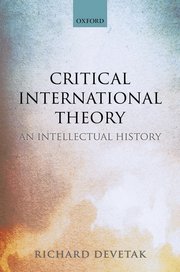
Richard Devetak, Critical International Theory: An Intellectual History – OUP, August 2018

9780198823568Richard Devetak, Critical International Theory: An Intellectual History – OUP, August 2018

Whether inspired by the Frankfurt School or Antonio Gramsci, the impact of critical theory on the study of international relations has grown considerably since its advent in the early 1980s. This book offers the first intellectual history of critical international theory.

Richard Devetak approaches this history by locating its emergence in the rising prestige of theory and the theoretical persona. As theory’s prestige rose in the discipline of international relations it opened the way for normative and metatheoretical reconsiderations of the discipline and the world. The book traces the lines of intellectual inheritance through the Frankfurt School to the Enlightenment, German idealism, and historical materialism, to reveal the construction of a particular kind of intellectual persona: the critical international theorist who has mastered reflexive, dialectical forms of social philosophy. . In addition to the extensive treatment of critical theory’s reception and development in international relations, the book recovers a rival form of theory that originates outside the usual inheritance of critical international theory in Renaissance humanism and the civil Enlightenment. This historical mode of theorising was intended to combat metaphysical encroachments on politics and international relations and to prioritise the mundane demands of civil government over the self-reflective demands of dialectical social philosophies. By proposing contextualist intellectual history as a form of critical theory, Critical International Theory defends a mode of historical critique that refuses the normative temptations to project present conceptions onto an alien past, and to abstract from the offices of civil government.

Posted in Uncategorized | Leave a comment